
API Versioning and Breaking Changes: The Dubai 2026 Playbook
60% of teams version their APIs but only 26% use semantic versioning. Here is how Dubai platforms ship breaking changes without breaking integrators: RFC 9745 headers, sunset windows and real AED costs.
- PUBLISHED
- 19 NOV 2026
- READ TIME
- 12 MIN
- AUTHOR
- AQUARIUS · DUBAI
- UNIT
- REV 2026.09
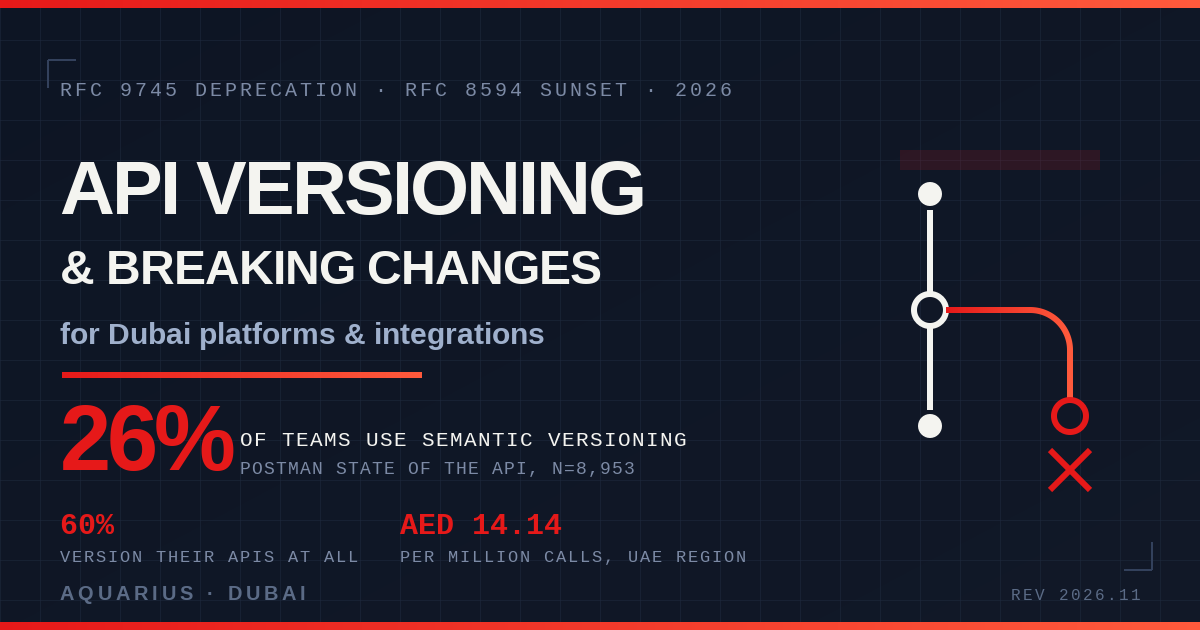
Version your API the day you publish it, give every retired version a machine-readable deprecation and sunset date, and never delete a field without one. That is the entire discipline. Postman’s State of the API research found that 60% of teams version their APIs but only 26% use semantic versioning — so most teams track changes without ever communicating the impact of those changes to the people downstream.
Why 2026 is the year versioning stopped being optional in Dubai
Three numbers set the stakes. First, the versioning gap above: 60% version, 26% use semantic versioning, and 57% keep their API definitions in Git repositories — which means the change history exists but the contract signal does not. Second, API consumers are no longer only humans. In Postman’s 2026 survey of 8,953 practitioners, 25% already run AI agents against their APIs in production, yet just 13.2% describe their APIs as fully agent-ready and 75.2% have no dedicated security controls for agent traffic at all. An agent re-reads your schema on every run; a silently renamed field becomes a silently wrong answer.
Third, the UAE is adding hard regulatory deadlines to the same calendar. Mandatory e-invoicing goes live on 1 January 2027 for businesses with annual revenue of AED 50 million or more, using the PINT AE schema built on UBL 2.1, with the pilot running since 1 July 2026. Every Dubai ERP, POS, billing engine and accounting integration touching that flow is scheduled to change its payload shape inside a fixed window — whether or not its API has a versioning policy.
The downside is quantifiable. ITIC research puts the cost of a single hour of downtime above USD 300,000 (roughly AED 1.1 million) for 91% of mid-sized and large enterprises. And because SMEs make up 94% of UAE companies and 63% of the non-oil economy, your typical integrator is a five-person team with no spare sprint to absorb an unannounced breaking change. They will not refactor. They will churn.
What actually counts as a breaking change
Most arguments about versioning are really arguments about this definition. Write it down once, put it in your developer docs, and the rest of the policy follows.
Breaking (needs a new version): removing or renaming a field, endpoint or enum value; narrowing a type or making it nullable-to-non-nullable; adding a required request parameter; tightening validation; changing a status code, error code or pagination default; changing the meaning of an existing field while keeping its name. That last one is the silent killer — it passes every schema diff and breaks every consumer.
Non-breaking (ship it today): adding an optional request parameter; adding a new response field; adding a new endpoint; adding a new enum value if you documented from day one that clients must tolerate unknown values; relaxing validation. Tolerant readers on the client side and additive-only changes on the server side between major versions is the cheapest combination that exists.
Myth: “We put
/v1/in the URL, so we version our API.” A version number with no deprecation policy, no sunset date and no consumer inventory is a label, not a contract. The 26% figure above is the gap between the two.
Four versioning strategies, and which one fits a Dubai platform
There is no neutral choice here — each strategy moves cost between you and your integrators.
| Strategy | How consumers pin | Cost of a breaking change | Best fit in the UAE |
|---|---|---|---|
URI path (/v1/, /v2/) | Hard-coded in the base URL | High for you: two full stacks, two sets of tests, duplicated routes | Public platforms with many unknown integrators and long migrations |
Header / media type (Accept: application/vnd.co.v2+json) | Request header | Medium: one route tree, version-aware serialisers | Internal and partner APIs where you control the client list |
| Dated versions + release trains | A date string header, pinned per account | Low per change, high to build: needs a request/response transformation layer | Fintech and SaaS platforms with paying API customers |
| Additive-only (no versions) | Nothing — contract never breaks | Zero, until you need to remove something, then it is enormous | Small products, early-stage ERPs, government read-only feeds |
Stripe is the clearest public example of the third model, and worth copying deliberately: monthly API releases that contain no breaking changes, plus two major releases a year that do. The current version is 2026-10-28.endive, pinned per account and overridable per request with a Stripe-Version header — and crucially, webhook endpoints carry their own pinned version, so an inbound event never changes shape under a consumer who has not opted in. If you are building an API product rather than an integration, read our guide to monetising your own API from Dubai alongside this one.
The deprecation contract: RFC 9745 and RFC 8594
Since March 2025 there is an IETF Standards Track answer to “how do I tell clients this is going away?”. RFC 9745 defines the Deprecation HTTP response header field, carrying a structured-header date, and it pairs with RFC 8594’s Sunset header for the removal date. The spec is explicit: the timestamp in Sunset MUST NOT be earlier than the one in Deprecation.
A retiring endpoint should answer with all three signals at once:
Deprecation: @1767225599— the moment the version became deprecated.Sunset: Thu, 31 Dec 2026 23:59:59 GMT— the moment it stops answering.Link: <https://api.example.ae/docs/deprecation>; rel="deprecation"; type="text/html"— the migration guide.
Three operational rules make those headers worth something. Log every deprecated call with its API key, so you know exactly which integrators are still on the old version instead of guessing. Set the sunset window by audience: 6 months minimum for partner APIs, 12 months for anything a bank, insurer or government system consumes, 30 days is fine for an internal service. And run consumer-driven contract tests in CI so a breaking change fails your build before it fails someone else’s production — the schema in a registry is the test fixture, not a document.
This matters most where the schema is someone else’s to change. Regulated UAE integrations — CBUAE Open Finance, e-invoicing via an accredited service provider, Ejari and DLD property data — all publish versioned standards that move on their own schedule. We cover two of those specifically: Open Finance API integration in Dubai and Ejari and DLD APIs for property software.
What a second live version actually costs
Running two versions in parallel is the real price of a clean migration, and in the UAE it is cheap enough that there is no excuse. These are current AWS list rates for the Middle East (UAE) me-central-1 region, converted at the pegged AED 3.6725 per USD.
| Line item | Unit | USD | AED | Cost of a parallel v1 + v2 |
|---|---|---|---|---|
| API Gateway REST API | per million requests (first 333M/mo) | $3.85 | AED 14.14 | AED 707/mo extra at 50M calls |
| API Gateway HTTP API | per million requests (first 300M/mo) | $1.22 | AED 4.48 | AED 224/mo extra at 50M calls |
| WebSocket messages | per million messages | $1.25 | AED 4.59 | Plus AED 1.15 per million connection-minutes |
| Dedicated cache, 1.55 GB | per month (730 hrs) | $30.51 | AED 112 | AED 112/mo per extra version cached |
| Managed developer portal | per month | $137.50 | AED 505 | Plus AED 50.50 per published API product |
So a Dubai platform serving 50 million REST calls a month pays roughly AED 707 per month to keep the old version answering during a six-month migration — about AED 4,250 total. Add two hours a week of engineering maintenance at a Dubai senior-developer rate of around AED 152 per hour and you reach roughly AED 7,900 in labour. Call it AED 12,000 for a six-month, zero-surprise migration, against AED 1.1 million for one hour of downtime at the ITIC figure. The parallel version is not the expensive option.
How Aquarius ships breaking changes
When we build or inherit a Dubai platform API, the versioning policy is written before the second endpoint exists, because retrofitting one costs more than every other item on this list combined. In practice that means five artefacts: a published breaking-change definition in the developer docs; an OpenAPI or schema-registry entry under version control as the single source of truth; consumer-driven contract tests wired into CI so a breaking diff fails the pipeline; Deprecation, Sunset and Link headers emitted automatically from the version registry rather than hand-added; and per-key usage logging on deprecated routes so the sunset decision is based on who is actually still calling.
Risk reversal: we do not sunset anything until the deprecated-usage log shows zero calls from unidentified keys for 30 consecutive days, and migration guides ship with the deprecation header on day one, never after. If a version has to be revived, it is a configuration change, not a redeploy. You can see scope and rates on our pricing page, or browse the full services list.
The conversion argument is simple. Fully API-first organisations are far more likely to earn real money from their interfaces — 55% of them generate more than a quarter of their revenue from APIs, against 16% of non-API-first organisations. Versioning discipline is the cheapest part of being in that first group, and the part most Dubai teams skip.
FAQ
Should I put the version in the URL or in a header?
URL for a public platform with unknown integrators — it is visible, cacheable and impossible to get wrong by accident. Header or media type for partner and internal APIs where you know every client and want one route tree. Pick one and never mix both in the same product.
How long should a deprecated API version stay alive in the UAE?
Six months minimum for partner APIs, twelve for anything consumed by a bank, insurer or government system, and 30 days is acceptable for a purely internal service. Set the date in a Sunset header on day one of deprecation, and remember RFC 8594 requires the sunset date to be no earlier than the deprecation date.
Does semantic versioning work for REST APIs?
Partially. The major number is the only part consumers can act on, which is why dated versions with release trains have become the dominant model for commercial APIs. Use semantic versioning for your SDKs and client libraries, dated versions or a major-only path segment for the HTTP surface.
How does AI agent traffic change versioning?
Agents read your schema and your docs at request time, so an undocumented field rename produces a confidently wrong result instead of a loud 500. With 25% of teams already serving agents in production and only 13.2% describing their APIs as fully agent-ready, machine-readable deprecation headers and a published schema are now the difference between an agent that degrades gracefully and one that hallucinates your data model.
What is the single cheapest improvement if I only have a day?
Add per-API-key logging to every endpoint you intend to retire. You cannot plan a sunset window, price a migration or negotiate with an integrator until you know who is calling. Everything else on this page is easier once that log exists.
Breaking changes are not the problem — unannounced breaking changes are. If you are planning a v2, a regulatory schema migration, or an e-invoicing integration ahead of the January 2027 deadline, talk to Aquarius and we will map the versioning and deprecation plan with you, or check our pricing first.