
Ejari and DLD API Integration in Dubai (2026): AED 30,000 Per API, Real Build Costs and the Rental Index Rules
What Ejari and DLD API integration really costs in Dubai: AED 30,000 + VAT per API per year, who is eligible, free Dubai Pulse open data, AED build tiers and the Smart Rental Index caps.
- PUBLISHED
- 02 OCT 2026
- READ TIME
- 12 MIN
- AUTHOR
- AQUARIUS · DUBAI
- UNIT
- REV 2026.09
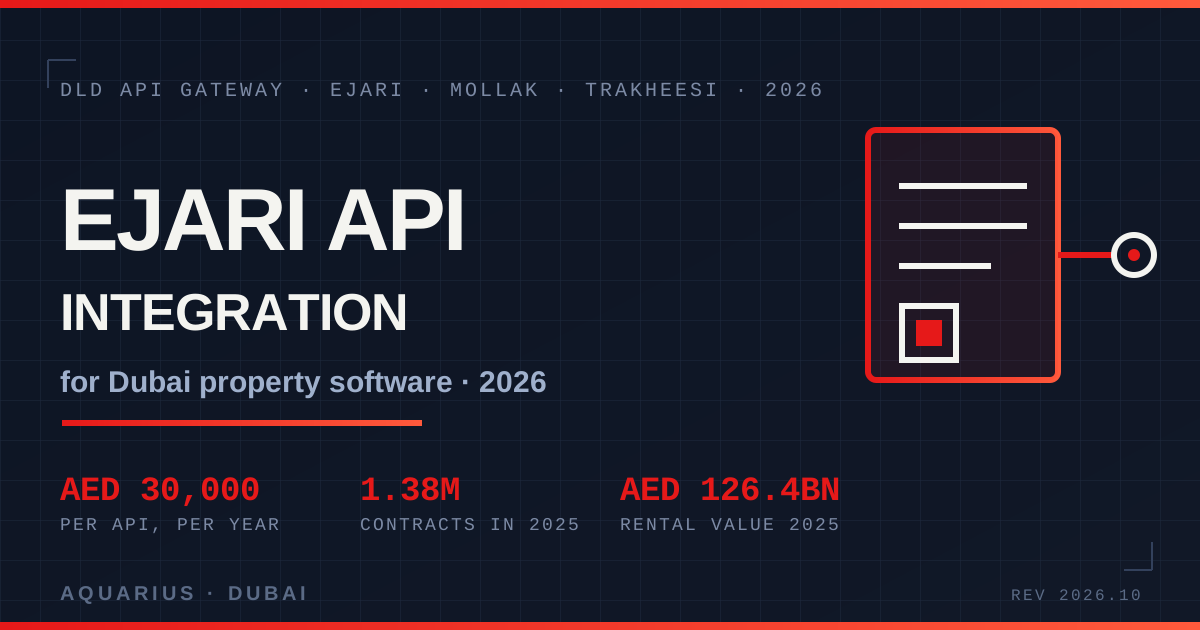
Short answer: There are only three legitimate ways to get Ejari into your own software in Dubai. You subscribe to the DLD API Gateway, which costs AED 30,000 + 5% VAT per API, per year and requires you to be a registered, active real estate management company; you integrate through an approved Ejari service provider; or you stay manual and keep re-typing contracts into Dubai REST. Wiring the gateway into a property management platform is typically a AED 45,000–95,000 build for tenancy lifecycle only, and AED 140,000–320,000 when Mollak, Trakheesi and the Rental Index come with it.
Most Dubai property companies discover this pricing late — after a developer has quoted a “simple Ejari integration” against an API they were never eligible to call. The gateway is real, documented and open to third parties, but it is a procurement decision with an annual licence attached, not a weekend sprint.
Why 2026 is the year leasing software stops being a spreadsheet
The volume is the argument. Dubai registered 1.38 million tenancy contracts in 2025 — a 6% rise in volume and a 17% rise in value year on year — worth AED 126.4 billion, according to Dubai Land Department figures. That split into more than 513,000 new contracts (up 10%) and more than 514,000 renewals (up 3%).
The pace carried into this year. In Q1 2026 alone, contracts registered through Ejari represented AED 32.2 billion of activity, with 118,385 new contracts and 135,607 renewals processed in a single quarter. Meanwhile DLD issued 14,364 real estate licences in 2025, of which 3,513 were for leasing brokerage and 6,009 for sales and purchase brokerage — which is to say the number of companies competing to administer those contracts grew alongside the contracts themselves.
Most Dubai property managers get this wrong by budgeting for software and forgetting the licence. A PMS that cannot write to Ejari is a nicer spreadsheet; the API subscription is what turns it into a system of record.
At those volumes, the cost of manual registration is not the AED 177.75 fee. It is a leasing admin re-keying tenant, landlord, Emirates ID, DEWA premise and contract-value data that already exists in your CRM, then reconciling certificate numbers by hand at renewal season.
What the DLD API Gateway actually exposes
DLD publishes a subscription API gateway for third-party developers, PropTech firms, enterprise software vendors, property management companies and government partners. The catalogue currently runs to thirteen interfaces, and the ones that matter to most builds are:
- Ejari — the full tenancy contract lifecycle: issuance, renewal, termination, plus supporting lookup endpoints. Eligibility: a registered and active real estate management company.
- Mollak — jointly owned property and service charge data. Eligibility is tied to being an approved JOP management company with a valid Dubai trade licence; banks need RERA approval. Additional Mollak variants cover budgets, virtual accounts, supplier verification and authorised signatories, each licensed separately.
- Trakheesi — licensing and advertising permits, which is what legitimises a listing before it goes live.
- Oqood — off-plan registration and Trust Account System integration, including bank escrow connectivity and developer bulk inflow submission.
- Dubai Brokers — broker card and brokerage office verification.
- Rental Index — market rental price data, the machine-readable face of the Smart Rental Index.
- Token Sale — bulk property token sales, reflecting Dubai's move into tokenised title.
Every one of them is priced the same: AED 30,000 plus 5% VAT per year, including one year of support. Subscribe to Ejari, Mollak and Trakheesi and your licence line alone is AED 94,500 a year before a single hour of development. That is the number to put in front of your finance director in week one, not week ten.
The free alternative, and its hard limit
If you only need to read market data — rents by area, transaction history, building and project registries, broker lists — you do not need the paid gateway. DLD publishes that as open data on Dubai Pulse, including a queryable rent-contracts endpoint at api.dubaipulse.gov.ae/open/dld/dld_rent_contracts-open-api and bulk CSV downloads, free of charge. It is genuinely good data: analytics dashboards, rental yield tools and valuation models are routinely built on it.
The limit is absolute, and it decides your architecture: open data is read-only and historical. You cannot register a contract, renew one, or pull a specific certificate for a specific tenant through Dubai Pulse. The moment your product needs to transact, you are in gateway territory. Build analytics on open data, transactions on the licensed API, and do not let a vendor blur the two in a proposal.
Indicative AED costs in Dubai
| Scope | What you get | Build (AED) | Annual licences & run |
|---|---|---|---|
| Read-only market data layer | Dubai Pulse ingestion, rent and transaction analytics, area benchmarks, dashboards | 28,000–60,000 | Nil in DLD fees; 6,000–18,000 hosting |
| Ejari lifecycle integration | Issue, renew, terminate, lookups, certificate storage, audit trail inside your PMS | 45,000–95,000 | 31,500 Ejari API incl. support |
| Leasing platform with Rental Index | Above plus index-aware renewal pricing, cap calculation, notice workflow, tenant portal | 95,000–190,000 | 63,000 for two APIs |
| Full property operations suite | Ejari, Mollak service charges, Trakheesi permits, Brokers verification, accounting hooks | 140,000–320,000 | 94,500–126,000 in API fees |
| Off-plan / developer stack | Oqood registration, escrow and Trust Account flows, bank integration | 180,000–400,000 | 31,500 per API subscribed |
Two local line items imported quotes almost always omit. First, onboarding time: eligibility documents, trade licence verification and RERA checks sit outside your sprint plan, so assume weeks, not days, between signing and first successful call in production. Second, the per-contract government fee still applies — integration removes the typing, not the charge. Registering through Dubai REST costs AED 177.75 (AED 100 registration, AED 10 knowledge fee, AED 10 innovation fee, AED 55 service-partner fee, AED 2.75 VAT), rising to AED 220 at a Real Estate Services Trustee Centre, while property management companies commonly bill tenants AED 400–500 for handling it.
The Rental Index logic your renewal screen must encode
Since January 2025 the old RERA rental increase calculator has been superseded by the Smart Rental Index, which adds AI-assisted valuation and a building-level classification based on location and accessibility, structural and technical features, maintenance and finishing quality, and available amenities. Two identical-size flats in the same community can now carry different index values because the buildings are rated differently.
The permitted-increase brackets are the part to hard-code, because getting them wrong in software is how a landlord ends up at the Rental Dispute Centre:
- Rent within 10% of index value — no increase permitted.
- 11–20% below index — maximum 5%.
- 21–30% below — maximum 10%.
- 31–40% below — maximum 15%.
- More than 40% below — maximum 20%.
Build this as a calculation your renewal workflow performs and logs, with the index value, bracket and resulting cap stored against the contract. When a tenant disputes a renewal notice, that record is your defence. Our guide to property management software in Dubai covers the surrounding workflow; for service-charge collection on jointly owned property, see owners association and Mollak software.
Four compliance details that break Ejari integrations
1. Ejari is the gate to utilities, so timing is a product requirement
A valid Ejari certificate is a prerequisite for activating DEWA services — no Ejari, no electricity and water. DEWA's One Step Move-in service goes further, transferring tenant data straight from Ejari to create and activate the utility account. If your handover flow registers Ejari late, you have not caused a paperwork delay; you have left a tenant without power. Sequence registration before key handover in the workflow itself.
2. Co-occupant declaration
Registrations now require declaring every co-occupant who will live in the property for one month or more. If your tenancy data model has one tenant field and a notes box, it will fail validation. Model occupants as a collection from day one.
3. No Ejari, no dispute remedy
Without a registered contract, neither landlord nor tenant can file at the Rental Dispute Centre, and a lapsed registration complicates renewals and rent-increase negotiations. DLD enforcement in 2026 runs through digital monitoring rather than inspectors knocking, which means gaps in your portfolio are visible to the regulator before they are visible to you.
4. Advertising permits are enforced separately and expensively
Trakheesi non-compliance carries fines of up to AED 50,000, alongside listing removal and possible suspension of a brokerage licence — and DLD has publicly fined ten real estate companies while warning another thirty over advertising requirements. If your software publishes listings, the permit number belongs in the publishing validation, not in a colleague's inbox. Our RERA and Trakheesi guide for Dubai property websites has the detail.
How Aquarius builds this
We start with an eligibility and scope session before any code: which of the thirteen APIs your licence and business model actually entitle you to, what the annual fee total looks like, and which parts of your roadmap can run on free Dubai Pulse open data instead. Moving analytics off the paid gateway is the single easiest way to cut a first-year licence bill.
Then we build in the order that de-risks spend: open-data layer first, so you have something working while DLD onboarding proceeds; Ejari transaction flows next, behind a sandbox-then-production switch with full request and response logging for audit; Rental Index logic encoded as a tested calculation rather than guidance in a PDF; and finally the adjacent systems — Mollak, Trakheesi, accounting — only once the core is live. If you also need a tenant-facing front end, our real estate CRM guide covers how that connects.
The conversion-side number worth holding on to: a leasing team handling 1,200 contracts a year at roughly 25 minutes of manual registration and reconciliation each burns about 500 hours annually — two and a half months of one salary — on data entry the API does for free. At Dubai's 2025 volume of 1.38 million registered contracts, that workload is growing, not shrinking.
Tiers and phasing are on our pricing page. If you manage a portfolio, the useful first step is small: tell us your contract volume and current system, and we will come back with the API combination you qualify for, the real annual licence cost, and a phased build that does not pay for a gateway subscription you cannot yet use.
Frequently asked questions
How much does DLD API access cost in Dubai?
Each API on the DLD API Gateway costs AED 30,000 plus 5% VAT per year, including one year of support — so AED 31,500 per API. Ejari, Mollak and Trakheesi together come to AED 94,500 annually. That is the licence only; software development to integrate it is separate, typically AED 45,000–320,000 depending on how many systems are in scope.
Can any software company integrate with Ejari?
No. Eligibility is tied to the business, not the developer: the Ejari API requires the subscriber to be a registered and active real estate management company, and Mollak requires association with an approved jointly owned property management company holding a valid Dubai trade licence, with banks needing RERA approval. Your development partner builds against the API; your company holds the subscription.
Is there a free Dubai real estate API?
Yes, for reading. DLD publishes rent contracts, sales transactions, projects, buildings and broker registries as open data on Dubai Pulse, with both a queryable API and bulk CSV downloads, free to access. It is read-only and historical — fine for analytics, valuation and market dashboards, but it cannot register or renew a tenancy contract.
How much does Ejari registration itself cost in 2026?
AED 177.75 through the Dubai REST app or DLD portal, broken down as AED 100 registration, AED 10 knowledge fee, AED 10 innovation fee, AED 55 service-partner fee and AED 2.75 VAT. At a Real Estate Services Trustee Centre it is AED 220, and property management companies typically charge tenants AED 400–500 to handle it. API integration removes the manual work, not the fee.
What happens if a tenancy contract is not registered with Ejari?
The contract is not recognised by the Dubai Land Department, neither party can file a case at the Rental Dispute Centre, and DEWA will not activate electricity and water for the property. Renewals and rent-increase notices also become difficult to enforce, and DLD's digital monitoring makes unregistered contracts visible to the regulator.
How long does an Ejari integration take?
Plan for two tracks running in parallel. Commercially, DLD onboarding involves eligibility checks against your trade licence and RERA status and is measured in weeks. Technically, a tenancy lifecycle integration into an existing platform is usually 4–8 weeks of build and testing; a full suite spanning Mollak, Trakheesi and accounting runs 3–5 months. Starting the subscription application before development, not after, is what compresses the calendar.