
Arabic LLMs for Dubai Businesses 2026: Jais vs Falcon vs GPT vs Claude
Arabic is 0.6% of the web but 400M+ speakers. Jais 3 vs Falcon H1 vs GPT vs Claude — real 2026 benchmarks, dialect coverage, the Arabic token tax and AED budgets.
- PUBLISHED
- 19 OCT 2026
- READ TIME
- 11 MIN
- AUTHOR
- AQUARIUS · DUBAI
- UNIT
- REV 2026.09
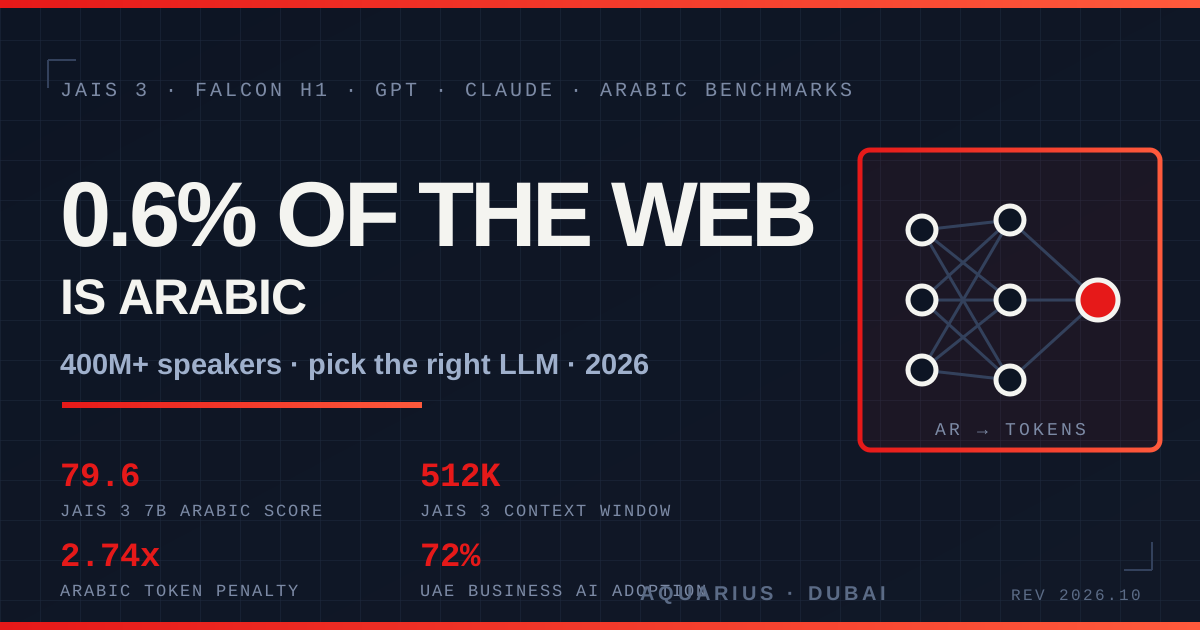
Short answer: if your Dubai business serves Arabic-speaking customers, the best model in 2026 is rarely the biggest one — it is the one with the best Arabic-per-dirham. Jais 3 (launched 15 October 2026) now leads Arabic-native understanding and speech, Falcon H1 Arabic leads open-weight Arabic reasoning you can self-host, and Claude or GPT still win on multilingual agentic work and ecosystem maturity. Most UAE companies pick a frontier model by brand, then quietly pay a 30–170% Arabic token tax on every single message.
The Arabic AI gap is the opportunity
Three numbers frame the whole decision:
- 72% of UAE businesses now use AI, up from 53% a year earlier — 36% year-on-year growth, per the Unlocking the UAE's AI Potential 2026 report from AWS and the UAE Artificial Intelligence Office (September 2026).
- The UAE AI market is worth roughly USD 4.6 billion in 2026, and the national target is an AED 335 billion AI contribution to GDP by 2031.
- Yet Arabic is only 0.6% of all websites (W3Techs, October 2026) — serving 400 million+ speakers across 22 countries, and the fourth most-used language on the internet.
That mismatch is the shareable part: your competitors' AI is fluent in the half of the web that is English and thin on the language many of your Dubai customers actually prefer. Arabic-first AI is still an unclaimed advantage in the UAE market, not a commodity.
There is also a compliance floor most teams miss. Under Federal Law No. 15 of 2020 on Consumer Protection and Federal Decree-Law No. 14 of 2023 on Trading through Modern Technology, e-commerce product data, advertising, contracts, website information and invoices in the UAE must be available in Arabic — other languages are optional additions, not substitutes. A dedicated UAE Arabic Language Law went before the Federal National Council in 2026 and is expected to take full effect in 2027. If your chatbot, product descriptions or auto-generated invoices are English-only, that is a legal exposure, not a roadmap item.
Jais vs Falcon vs GPT vs Claude: what actually changed in 2026
Jais 3 — the Arabic-native leader
Released 15 October 2026 by the Institute of Foundation Models (MBZUAI) with Inception42, Jais 3 is a six-model family from 900M to 375B parameters (including 3.7B, 7B and 32B). On an audited suite of 24 Arabic benchmarks, the 7B model moves its base average from 56.4 to 79.6 — and the 3.7B model beats every open model under 5B parameters on both Arabic and agentic tasks. The 375B model matches the best open models in the world on Arabic understanding.
Two details matter commercially. First, a 512,000-token context window — the longest of any Arabic-native model — which is what makes "read this entire Arabic tender document and answer questions about it" realistic. Second, Jais Speech covers Modern Standard Arabic plus dialects from 19 Arab countries, records the lowest average word and character error rates across six public test sets, handles Arabic–English and Arabic–French code-switching, adds vowel marks, and identifies which dialect it heard. For a Dubai call centre fielding Emirati, Egyptian and Levantine callers in one queue, that is the differentiator. Weights ship openly on Hugging Face with vLLM and SGLang support.
Falcon H1 Arabic — the self-hosting choice
TII Abu Dhabi launched the hybrid Mamba-Transformer Falcon H1 base family on 21 May 2025 (500M–34B), then added Falcon H1 Arabic in 3B, 7B and 34B plus the Falcon H1R 7B reasoning model in January 2026, with a 256k context. On the Open Arabic LLM Leaderboard the three Arabic sizes average 61.87%, 71.47% and 75.36%; the 34B beats both Qwen2.5 72B and Llama-3.3 70B on Arabic, and H1R 7B out-reasons models roughly seven times its size. Permissive open licensing means you can run it on your own UAE infrastructure with no per-token bill.
Claude and GPT — still the agentic default
Frontier closed models remain the pragmatic pick when Arabic is one requirement among many: tool use, long multi-step agents, code generation, document extraction, mature SDKs and enterprise controls. Published Claude API pricing (per million tokens, input/output) is USD 1 / 5 for Haiku 4.5, USD 2 / 10 for Sonnet 5 and USD 5 / 25 for Opus 5 — roughly AED 3.67 / 18.36, AED 7.35 / 36.73 and AED 18.36 / 91.81 at the pegged rate. The trade-off is that Arabic is a cost line rather than a native strength.
| Model family | Arabic strength | Context | Hosting | Best fit for Dubai |
|---|---|---|---|---|
| Jais 3 (3.7B–375B) | Highest — 79.6 average on 24 audited Arabic benchmarks at 7B; dialects from 19 countries | 512K | Open weights — self-host or partner API | Arabic support, voice, dialect-heavy customer bases |
| Falcon H1 Arabic / H1R (3B–34B) | Strong — 61.9%–75.4% OALL; 34B beats 70B-class rivals | 256K | Open weights — self-host | Data-residency builds, fixed-cost high volume |
| Claude (Haiku 4.5 → Opus 5) | Good multilingual, not Arabic-native | 200K–1M | API only | Agents, tool use, document workflows |
| GPT-class frontier | Good multilingual, not Arabic-native | Large | API only | Broad ecosystem, fastest prototyping |
The hidden cost nobody prices: the Arabic token tax
This is where most UAE AI budgets go wrong. The same meaning costs more tokens in Arabic than in English — measured at 68% to 340% more depending on tokenizer, or about 2.4 tokens per word in Arabic versus 1.5–1.6 in English. Older tokenizers are brutal: Arabic ran roughly 2.74× English on cl100k_base, improving to about 1.28× on o200k_base. Same answer, more tokens, higher latency, bigger invoice.
Translate that into a monthly bill. Worked example — a model, not a benchmark: 50,000 Arabic support conversations a month at roughly 600 input and 250 output tokens each is 30M input and 12.5M output tokens. On Sonnet 5 that is about USD 185, or AED 680 per month. Run the identical conversations through an older tokenizer and the same answers can cost two to three times more. Token efficiency is a procurement criterion in the UAE in a way it simply is not in an English-only deployment.
Budgets, residency and how Aquarius builds it
Three deployment shapes, with the real cost drivers:
- API-first (fastest). A closed frontier model behind your own routing layer. Lowest build cost, pay-per-token forever, and your Arabic token tax scales with traffic. Right for pilots and sub-10,000-conversation months.
- Hybrid routing (usually the winner). Send Arabic-heavy and dialect traffic to an Arabic-native model, keep tool-use and agentic work on Claude or GPT. You buy Arabic quality where it matters and keep the agent ecosystem where that matters.
- Self-hosted open weights (highest control). Falcon H1 Arabic or Jais 3 on UAE infrastructure — a fixed GPU cost instead of per-token, and the cleanest answer to data-residency questions. See our breakdown of private LLM options and AED costs for keeping AI data in the UAE.
UAE AI investment across 2024–25 exceeded AED 543 billion, and 85% of UAE AI adopters report a faster pace of digital change. The cost of inaction is not a missing feature — it is that your Arabic-speaking customers get measurably worse service than they would from the competitor who routed them to an Arabic-native model.
How we approach it at Aquarius: we start with your actual message logs, not a vendor demo. We measure Arabic token counts and dialect mix on your real traffic, benchmark two or three candidate models on your own questions, then pick the cheapest model that clears your quality bar — frequently a 7B Arabic-native model rather than a frontier one. Arabic output also needs a front end that does not break, which is a separate discipline: see Arabic website localisation and RTL in Dubai. Transparent scopes sit on our pricing page, and every engagement starts with a fixed-fee evaluation you own outright — if the numbers say "keep what you have", we will tell you that.
FAQ
Is Jais better than GPT or Claude for a Dubai business?
For Arabic understanding, dialect handling and Arabic speech, Jais 3 is ahead — its 7B model averages 79.6 across 24 audited Arabic benchmarks, and its speech model covers dialects from 19 Arab countries. For multi-step agents, tool use and ecosystem maturity, Claude and GPT remain stronger. Most production systems in the UAE should use both.
Can I run an Arabic LLM entirely inside the UAE?
Yes. Both Jais 3 and Falcon H1 Arabic ship open weights with vLLM and SGLang support, so you can host them on UAE infrastructure and keep prompts and outputs in-country. That is the standard answer to PDPL and DIFC data-residency questions from regulated clients.
Does Arabic really cost more per API call?
Yes. Arabic text consumes roughly 68%–340% more tokens than equivalent English depending on the tokenizer — about 2.4 tokens per word versus 1.5–1.6 for English. At scale that changes which model is actually cheapest, which is why we benchmark on your traffic instead of trusting published price lists alone.
Do we legally need Arabic in our app or online store?
For UAE e-commerce, yes. Federal Law No. 15 of 2020 and Federal Decree-Law No. 14 of 2023 require product data, advertising, contracts, website information and invoices to be available in Arabic, with other languages as optional additions. A dedicated UAE Arabic Language Law is expected to take full effect in 2027.
What size model do we actually need?
Smaller than you think. Jais 3's 3.7B model beats every open model under 5B on Arabic and agentic tasks, and Falcon H1R 7B out-reasons models around seven times its size. Start at 7B, measure on your own evaluation set, and only scale up if the numbers demand it.
Weighing Arabic AI for your UAE business? Tell us what your customers are asking and we will benchmark the realistic options on your own data — in AED, with the token maths shown.