
Arabic Website Localization in Dubai (2026): The Coming Language Law, RTL Costs and the SEO Gap Nobody Is Filling
Between 40% and 50% of UAE searches happen in Arabic, yet Arabic is under 1% of the web. With a federal Arabic Language Law in drafting, here is what RTL localization really costs in AED.
- PUBLISHED
- 14 SEPT 2026
- READ TIME
- 10 MIN
- AUTHOR
- AQUARIUS · DUBAI
- UNIT
- REV 2026.09
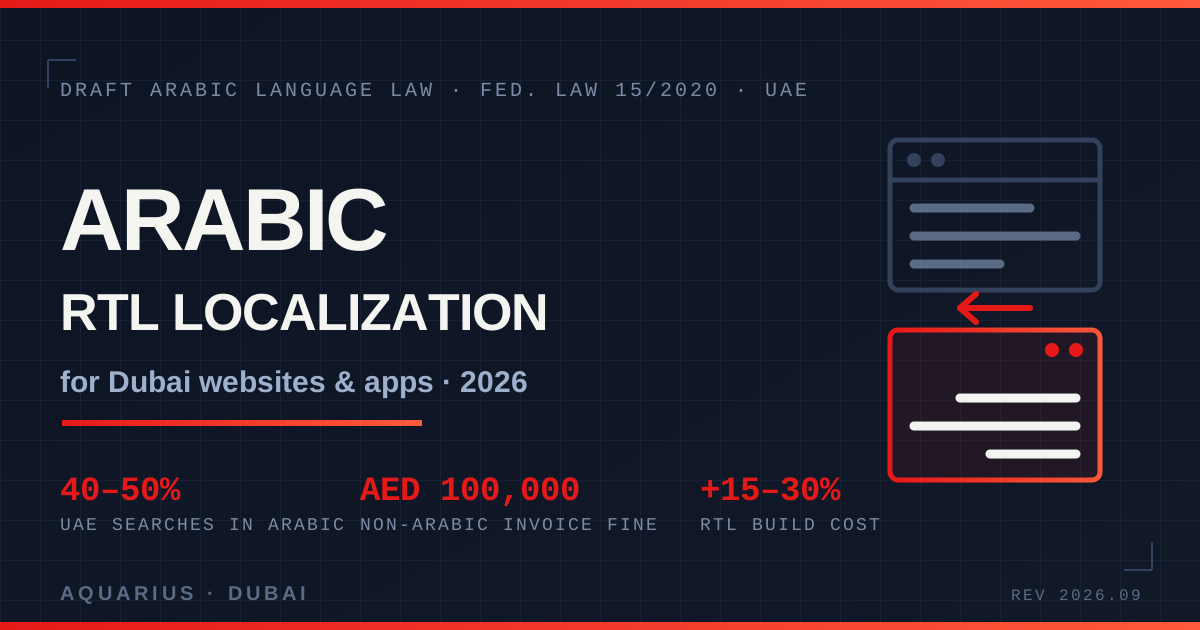
Short answer: Arabic localization is no longer a nice-to-have for a Dubai business website — it is a compliance requirement under Federal Law No. 15 of 2020 for consumer-facing content, and it is about to get stricter under the UAE's first dedicated Arabic Language Law, which the Ministry of Culture was cleared to draft in 2026 and which is expected to land by 2027. Doing it properly — real Arabic copy plus a true right-to-left (RTL) interface — adds roughly 15% to 30% to a build: about AED 3,000 to AED 8,000 on a small business site and AED 9,000 to AED 15,000 on an AED 60,000 project. The payback is an Arabic search market where keyword difficulty runs 40% to 60% lower than the English equivalent. Updated September 2026.
Key takeaways
- Half your search market is invisible to you. Industry measurement puts 40% to 50% of UAE searches in Arabic, with regional estimates running higher — yet Arabic makes up under 1% of all web pages globally, against roughly 348 million Arab internet users in 2025.
- Arabic is already law for consumer content. Under Federal Law No. 15 of 2020, data, advertisements and consumer contracts must be in Arabic; other languages may only be added. E-commerce suppliers must publish adequate product, specification and contract-terms information in Arabic.
- The fines are specific, not theoretical. Cabinet Decision No. 66 of 2023 sets out 46 penalties ranging from AED 100,000 to AED 1,000,000, including AED 100,000 for failing to issue an invoice in Arabic, with a ceiling of AED 2,000,000 and/or two years' imprisonment for the worst breaches.
- A tougher law is coming. The draft Arabic Language Law covers 10 sectors — including economy and business, technology and digitisation, media and customer service — and would require Arabic in all visual, audio and written advertising directed at the public, backed by penalties and incentives.
- The commercial case stands alone. Roughly 75% of consumers prefer to buy in their native language and 92.2% prefer prices shown in local currency, in a GCC digital-commerce market expected to clear USD 50 billion in 2026.
TOFU: 11.57 million people, 200+ nationalities, and one official language
The UAE's population reached about 11.57 million by May 2026, of which roughly 10.24 million are expatriates and 1.33 million are Emirati citizens — around 11% of the total, spread across more than 200 nationalities. That demographic is exactly why so many Dubai businesses default to an English-only site, and exactly why that default is a mistake.
Two numbers break the assumption. First, 40% to 50% of UAE searches are performed in Arabic — not only by Emiratis, but by the large Egyptian, Levantine, Sudanese and Gulf-national communities living and spending here. Second, Arabic accounts for under 1% of the world's web pages while serving roughly 348 million Arab internet users, about 70.2% penetration across a 496-million population as of 2025. Demand is enormous; supply is almost absent.
Here is the part most Dubai businesses get wrong: they treat Arabic as a translation task for the "local market" and English as the real website. The regulator sees it the other way around. Under Federal Law No. 15 of 2020 on Consumer Protection, data, advertisements and contracts directed at consumers must be in Arabic, and any other language is an addition on top. For online sellers the law is explicit: suppliers operating in e-commerce must give consumers and the authorities their name, legal status, address and licensing body, plus adequate information in Arabic about the product or service, its specifications, and the terms of contract, payment and warranty.
The enforcement layer arrived with Cabinet Decision No. 66 of 2023, the executive regulation, which lists 46 financial penalties from AED 100,000 to AED 1,000,000. Failure to issue an invoice in Arabic alone carries AED 100,000. Beyond fines, the sanctions menu includes doubled penalties for repeat violations, administrative closure of 24 hours to 90 days, suspension of activity, and licence revocation.
And the direction of travel is one way. In 2026 the Ministry of Culture received approval to draft the UAE's first Arabic Language Law, presented to the Federal National Council with a target of 2027. It spans 10 sectors, including economy and business, technology and digitisation, media, and customer service and internal work policies. Its advertising clause is the one that should move budgets: Arabic must appear in all visual, audio or written advertisements and promotional campaigns directed to the public. Officials framed it as a response to a "noticeable decline" in Arabic use across institutions.
MOFU: translation is not localization — five things that actually break
Running your English site through machine translation and flipping a CSS switch produces a page that is technically Arabic and commercially dead. Arabic web content already has a quality reputation problem precisely because so much of it is user-generated or machine-translated. Here is what a real build has to handle.
1. True RTL layout, not a mirrored stylesheet
Arabic runs right to left, so navigation, logo placement, form labels, breadcrumbs, progress steppers, sliders, icon direction and table column order all invert. Modern CSS logical properties (margin-inline-start rather than margin-left) do most of the work, but only if the site was built that way. Retrofitting RTL onto a stylesheet full of hard-coded left and right values is where budgets quietly double. RTL CSS work typically adds 20% to 30% to development time.
2. Bidirectional text (the "05:30 م" problem)
Arabic pages are bidirectional: Arabic text flows RTL while numbers, AED figures, phone numbers, email addresses, VAT numbers and Latin brand names flow LTR inside the same sentence. Without correct direction handling, an AED price or a TRN renders with the digits in the wrong order — on an invoice or a checkout page, that is not a cosmetic bug.
3. Typography and expansion
Arabic needs a proper Arabic typeface with real weights, connected letterforms and correct diacritic spacing — not a Latin font with an Arabic fallback. Arabic text also changes length relative to English and sits on a different baseline, so line-height, button widths and card heights that were tuned for English break silently.
4. Arabic copy written by a human, with local dialect judgement
Product descriptions, SEO metadata, checkout microcopy and legal terms need native Arabic writing. Dubai translation rates give a realistic budget line: commercial translation typically runs AED 0.37 to AED 0.59 per word, with legal and specialist work from AED 0.25 to AED 1.25 per word depending on complexity. Legal translation is often priced per page at roughly AED 49 to AED 52 plus VAT per 100 to 250 words. A 6,000-word site is therefore an Arabic copy line of roughly AED 2,200 to AED 3,500 for commercial content — small against the cost of getting it wrong.
5. Arabic SEO as a separate site, technically
The Arabic version needs its own indexable URLs (a /ar/ path or subdomain), hreflang tags pairing ar-AE with en-AE, Arabic title tags and meta descriptions, an Arabic XML sitemap, and Arabic keyword research — not translated English keywords. Arabic search queries use different phrasing, and rendering-dependent language switching that hides Arabic behind JavaScript keeps it out of the index entirely.
BOFU: what Arabic localization costs in Dubai, and what it returns
Base website pricing in Dubai in 2026 runs from about AED 3,000 for a landing page to AED 8,000 to AED 25,000 for a 5 to 10 page business site, AED 20,000 to AED 80,000 for e-commerce, and AED 200,000+ for a custom web platform. Arabic localization sits on top of that as a percentage, not a flat fee.
| Project | Base build (AED) | Arabic + RTL add-on (AED) | What the add-on covers |
|---|---|---|---|
| Landing page / small brochure site | 3,000 – 8,000 | 1,500 – 3,000 | RTL stylesheet, Arabic font, human copy for 5–8 sections, hreflang |
| Business site (5–15 pages) | 8,000 – 25,000 | 3,000 – 8,000 | Full RTL UI, Arabic navigation and forms, Arabic metadata, Arabic sitemap |
| E-commerce store | 20,000 – 80,000 | 15% – 25% of build (approx. 9,000 – 15,000 on a 60,000 build) | RTL checkout, bidirectional AED pricing, Arabic product catalogue, Arabic invoices |
| Custom platform / web app | 200,000+ | 15% – 30% of build | Logical-property design system, RTL component library, Arabic content model, QA in both directions |
Now the return. Arabic paid and organic search is the most under-contested inventory in Dubai. English commercial auctions have run to AED 45 to AED 65 per click on terms such as "Dubai real estate agent," while equivalent Arabic queries show 40% to 60% lower keyword difficulty at comparable commercial intent — and Arabic campaigns remain systematically underused by UAE advertisers. Reporting from agencies working both languages puts Arabic page-one rankings at roughly two to three times faster than the English equivalent in the same sector. Set against a GCC digital-commerce market heading past USD 50 billion in 2026 and consumers who prefer to buy in their own language 75% of the time, an AED 8,000 add-on is one of the cheapest sources of qualified traffic available in this market.
The cost of inaction is asymmetric. The upside is discounted traffic; the downside is an AED 100,000 line item for a non-Arabic invoice, plus whatever the Arabic Language Law brings when it lands. Fixing it after the fact costs more than building it in — the same retrofit tax we describe in our guides to UAE PDPL compliance and web accessibility compliance.
How Aquarius does it
We build bilingual from the first commit, not as a phase two. The design system uses CSS logical properties so English and Arabic share one codebase; the content model is language-aware, so an Arabic page is a first-class document with its own slug, metadata and schema rather than a translation overlay; AED figures, TRNs and phone numbers get explicit bidirectional handling; and every Arabic page ships with human-written copy and Arabic keyword targeting. We QA both directions on real devices before launch, and we make the English and Arabic versions reachable at clean, indexable URLs with correct hreflang. See pricing or our services for scope, and read our Dubai SEO cost breakdown if search is the reason you are localizing.
FAQ
Is an Arabic version of my website legally required in the UAE?
For consumer-facing content, effectively yes. Federal Law No. 15 of 2020 requires that data, advertisements and consumer contracts be in Arabic, with other languages permitted in addition. E-commerce suppliers must also provide adequate Arabic information on products, specifications and contract, payment and warranty terms. A pure B2B site has more latitude, but the draft Arabic Language Law expected by 2027 would extend Arabic requirements across advertising and digital platforms generally.
How much does it cost to add Arabic to a website in Dubai?
Budget 15% to 30% of the build cost. In practice that is roughly AED 3,000 to AED 8,000 for a standard business site and AED 9,000 to AED 15,000 on an AED 60,000 e-commerce project, covering RTL layout, Arabic typography, human copy and Arabic SEO setup.
Can I just use Google Translate or an auto-translate plugin?
Not for anything the Consumer Protection Law touches, and not if you want rankings. Auto-translated Arabic is a known quality problem across the Arabic web, it frequently mangles bidirectional AED and TRN formatting, and plugin-injected translations are often invisible to search engines because they are not served at indexable URLs.
What is the fine for not having Arabic content or invoices?
Cabinet Decision No. 66 of 2023 sets 46 penalties between AED 100,000 and AED 1,000,000, including AED 100,000 for failing to issue an invoice in Arabic. Serious breaches under the law can reach AED 2,000,000 and/or two years' imprisonment, and authorities can order closure of 24 hours to 90 days or revoke a licence.
Will an Arabic version actually bring traffic, or just tick a box?
It brings traffic. With 40% to 50% of UAE searches in Arabic, Arabic keyword difficulty 40% to 60% below the English equivalents, and Arabic representing under 1% of global web content, Arabic pages in most Dubai sectors face far weaker competition than their English twins.
How long does Arabic localization take to build?
On a new build it adds roughly 20% to 30% to the development schedule, typically one to three extra weeks on an SME project. Retrofitting RTL into an existing site that hard-codes left and right spacing usually takes longer than adding it to a fresh build, because the stylesheet has to be rewritten rather than extended.
If you are planning a Dubai website or store in 2026, build it bilingual from day one. Tell us your sector and page count and we will send a fixed AED scope for the English and Arabic versions together — talk to Aquarius.