
We scanned 578 .ae homepages: 52.6% have no working Arabic version
We pulled every .ae domain in the Tranco top 1M, fetched 578 homepages on 24 November 2026 and opened each claimed Arabic version. Only 47.4% had one that worked. Method, faults and AED fix costs.
- PUBLISHED
- 24 NOV 2026
- READ TIME
- 12 MIN
- AUTHOR
- AQUARIUS · DUBAI
- UNIT
- REV 2026.09
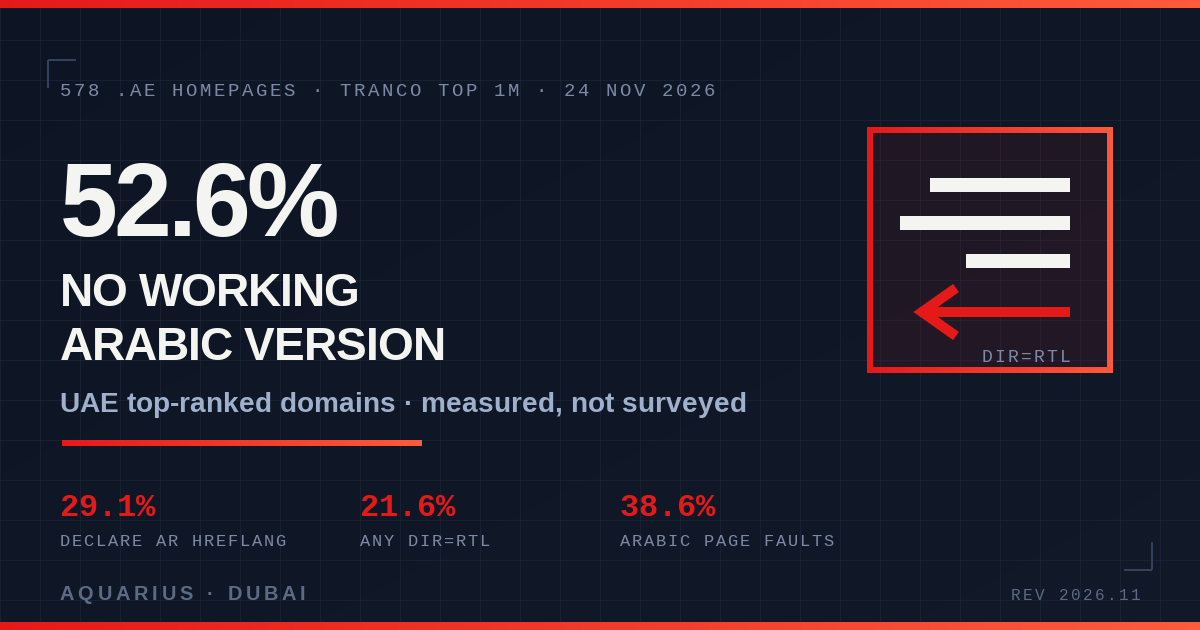
Short answer: we pulled every .ae domain in the Tranco top 1 million, fetched the homepages on 24 November 2026 and then tried to actually open each site’s Arabic version. Of 578 live .ae homepages, only 274 (47.4%) had an Arabic experience we could verify — 52.6% did not. Among the ones that did, 38.6% still shipped at least one basic RTL or language-signal fault, including Arabic pages with no dir="rtl" anywhere in the markup.
That is the opposite of what the market looks like from the inside. Arabic is the official language of the UAE, Arabic content is legally required on consumer-facing material, and nearly every Dubai agency deck promises “bilingual EN/AR”. On the public web, slightly more than half of the country’s most-visited domains serve English only.
The three numbers that set the stakes
1. Arabic is structurally under-supplied online. W3Techs puts Arabic at 0.6% of all websites whose content language is known, and 1.0% of the top 1 million — against a global Arabic-speaking population in the hundreds of millions. The UAE itself runs on roughly 1.33 million Emiratis inside a population of about 11.6 million, with Arabic as the official language and English as the default business language. The commercial consequence: Arabic search results in the Gulf are thin, so the cost per visitor of ranking an Arabic page is usually far lower than the English equivalent.
2. Arabic is not optional for consumer-facing content. Cabinet Decision No. 66 of 2023, the executive regulation of Federal Decree-Law No. 15 of 2020 on Consumer Protection, came into effect on 14 October 2023. It requires most information given to consumers — invoices, product information, advertising, and contract and warranty terms — to be provided in Arabic, with other languages permitted in addition. Its penalty table runs 46 financial penalties from AED 100,000 to AED 1,000,000, and Article 8(4) alone sets a fine of AED 100,000 if the supplier fails to issue the invoice in the Arabic language. E-commerce platforms are explicitly in scope for the information they display.
3. The rules are about to get wider. In 2026 the Ministry of Culture received approval to draft a federal Arabic Language Law covering 10 areas — among them government transactions, economy and business, customer service and internal work policies, and technology and digitisation — with incentives and phased penalties for non-compliance. Anyone planning a 2027 web build in Dubai is choosing now whether Arabic is a line item or a retrofit.
How we measured it
The method is deliberately boring and repeatable:
- Extracted every
.aehost from the Tranco top 1 million list — 781 domains. - Fetched each homepage over HTTPS with a desktop Chrome user agent and
Accept-Language: en-US, following redirects. 588 returned HTTP 200; 110 did not respond, 62 returned 403 and the rest were various errors. 578 homepages had parseable HTML. - Parsed the served HTML for
<html lang>,dir,hreflangalternates,Content-Language,og:locale, Arabic webfont declarations, language-switcher links, Arabic anchor text, and the ratio of Arabic Unicode characters (U+0600–U+06FF) in visible text. - Then the part most audits skip: for every domain that claimed an Arabic version, we fetched the claimed Arabic URL and measured whether Arabic text actually arrived. 326 candidate Arabic URLs were probed.
One honest limitation, stated up front: this is a static-HTML scan, so Arabic that is injected later by JavaScript is invisible to it. Where we report a low Arabic ratio, the accurate reading is “no Arabic in the served HTML” — which is exactly what a non-rendering crawler, an AI answer engine or a slow phone on first paint sees. Every figure below is a floor, not a ceiling.
What the 578 homepages actually declared
| Signal in the served homepage HTML | Domains | Share of 578 |
|---|---|---|
| Any verified Arabic experience | 274 | 47.4% |
| No Arabic signal anywhere (no hreflang, no switcher, no Arabic text) | 243 | 42.0% |
| Zero Arabic characters on the homepage | 292 | 50.5% |
| Arabic-first homepage (majority Arabic text) | 71 | 12.3% |
Declares an hreflang alternate for Arabic | 168 | 29.1% |
Declares x-default | 145 | 25.1% |
dir="rtl" present anywhere in the markup | 125 | 21.6% |
<html lang> missing entirely | 43 | 7.4% |
| Declares an Arabic webfont (Dubai, Tajawal, Cairo, Almarai, Noto Kufi…) | 79 | 13.7% |
Sends a Content-Language header | 60 | 10.4% |
Three of those rows deserve a second look. Only 29.1% declare an Arabic hreflang, which is the one machine-readable way to tell a search engine an Arabic version exists. Only 13.7% load an Arabic typeface at all — and among the Arabic-capable sites it is still just 18.2%, which means most Arabic pages in the UAE top ranks render in whatever fallback the device happens to have. And 43 domains ship no lang attribute whatsoever; three more declare invalid underscore values like ar_ar.
Declaring Arabic and delivering Arabic are different things
This is the finding we did not expect. We took the 187 domains that advertised an Arabic version on their own domain and opened it:
- 160 (85.6%) resolved and served real Arabic. Fine.
- 21 (11.2%) returned HTTP 200 but under 30% Arabic text in the served HTML — a shell that fills in later, or an Arabic route that renders the English page.
- 6 (3.2%) were dead links — the Arabic button on a well-known homepage leading to a 404.
Two we re-checked by hand on 24 November 2026: alhilalbank.ae/ar/islamic/personal returned 404, and starbucks.ae/ar/home-anonymous returned 404. A third, centralbank.ae/ar, returned 200 with just 1.07% Arabic characters in the served HTML — a client-rendered page that a human sees correctly and a non-rendering crawler does not.
The cohort split is the practical lesson. Of the 168 domains declaring hreflang="ar", 158 (94.0%) delivered verifiable Arabic. Of the 158 that only had a language-switcher link and no hreflang, only 106 (67.1%) did — roughly one in three was unverifiable. A switcher in the header is a UI decision; hreflang is a contract, and the teams that write the contract are the teams whose Arabic actually works.
The quality faults inside the 264 working Arabic pages
| Fault on a page serving real Arabic | Pages | Share of 264 |
|---|---|---|
No dir="rtl" anywhere in the document | 33 | 12.5% |
lang attribute not set to Arabic on the Arabic page | 25 | 9.5% |
No reciprocal English hreflang pointing back | 78 | 29.5% |
| At least one of the three | 102 | 38.6% |
The missing return link is the expensive one, because Google is explicit about it: “If two pages don’t both point to each other, the tags will be ignored,” and if reciprocation is missing across pages using hreflang, “those annotations may be ignored or not interpreted correctly.” Nearly a third of the working Arabic pages in the UAE’s top ranks are running annotations Google is entitled to discard. Worth remembering too that Google “doesn’t use hreflang or the HTML lang attribute to detect the language of a page” — those attributes govern targeting and rendering, so a page that is visually Arabic but declared lang="en" with no dir is still a broken page for screen readers, browser translation and RTL layout, even if it ranks.
Government domains do better on substance and worse on signalling. Across 55 .gov.ae domains, 70.9% were Arabic-capable versus 44.9% of the 523 non-government domains — but only 18.2% of them declared an Arabic hreflang, below the 30.2% non-government rate. The public sector writes the Arabic; the private sector, occasionally, remembers to tell the crawler.
What it costs to fix in Dubai (AED)
These are our planning bands for UAE work, not vendor list prices. The audit is the only line you should ever buy first.
| Scope | What it covers | Typical timeline | Aquarius price |
|---|---|---|---|
| Arabic & RTL readiness audit | The 14 checks above run against your live site, crawler-view proof for every Arabic URL, reciprocal hreflang map, written remediation plan | 3–5 days | from AED 500 |
| RTL retrofit of an existing site | Logical CSS properties, mirrored navigation and icons, Arabic webfont with correct numerals, lang/dir per route, switcher that preserves the current page | 1–3 weeks | 8,000 – 26,000 |
| Bilingual EN/AR site build | Up to 8 pages, CMS with paired Arabic fields, Arabic-first typography, hreflang and sitemaps generated, Arabic-side analytics | ~2 weeks | from AED 2,500 |
| Bilingual web app or store | Arabic checkout and account flows, Arabic-language VAT invoices, transactional email and SMS in both languages, RTL in every component state | 4–8 weeks | from AED 10,000 |
| Arabic content operations | Native Arabic copy for the pages that convert, plus ongoing parity checks so the Arabic side stops drifting behind the English one | monthly | 3,500 – 9,000 / month |
Ranges are planning estimates for scoping conversations, not quotes. Current figures are on our pricing page.
Now the cost of inaction, measured rather than asserted. In this scan, 14.4% of the domains that advertised Arabic on their own site sent users to a dead page or a page with almost no Arabic in it. Those companies already paid for Arabic. They are carrying the build cost, the translation cost and the maintenance cost, and getting none of the traffic, none of the trust and none of the consumer-protection comfort — because nobody ever fetched the Arabic URL and checked. The equivalent English failure would be escalated within an hour.
How Aquarius does it
We start from the crawler’s view, not the browser’s. Every Arabic route gets fetched without JavaScript, and we show you the Arabic character ratio that arrived — so “our Arabic site works” becomes a number rather than an opinion. Then we fix structure before copy: lang and dir per route, reciprocal hreflang with x-default, logical CSS so a single stylesheet serves both directions, and an Arabic typeface actually loaded rather than inherited. Translation comes last, because translating into a layout that mirrors badly only produces a prettier failure. Our standing recommendations are in Arabic RTL website design best practices for UAE sites, and the content-side process in Arabic website localization for Dubai.
Risk reversal is simple: if the audit finds your Arabic side is already clean, we tell you that and stop. You keep the report and the crawler-view evidence, and you have one fewer thing to worry about when the Arabic Language Law lands. If it finds faults, the retrofit is quoted fixed-price against that inventory. Send us your domain and we will tell you what a crawler sees on your Arabic URL before you commit to anything.
FAQ
Is an Arabic version of my website legally required in the UAE?
A full Arabic website is not itself mandated, but most consumer-facing information is. Cabinet Decision No. 66 of 2023, in force since 14 October 2023, requires invoices, product information, advertising, and contract and warranty terms to be in Arabic, with other languages allowed alongside, and e-commerce platforms are covered for the information they display. The penalty table runs from AED 100,000 to AED 1,000,000, including AED 100,000 for failing to issue an invoice in Arabic. In practice, if your site advertises, prices and invoices, the Arabic obligation already reaches your product pages and checkout.
Is Google Translate or an auto-translate widget enough?
No, for two separate reasons. A client-side widget usually produces no separate indexable Arabic URL, so there is nothing for an Arabic search result to point at — and our scan shows why that matters: Arabic content is scarce enough that a genuine Arabic page faces far less competition than its English twin. Machine output also tends to leave the layout untouched, which is where the visible damage is — 12.5% of the working Arabic pages we measured had no dir="rtl" at all.
What is the single highest-value fix if I only do one thing?
Publish your Arabic version on its own URL and wire reciprocal hreflang between the two, plus x-default. In our data, declaring hreflang="ar" correlated with Arabic that actually worked 94.0% of the time, versus 67.1% for a switcher link alone — and 29.5% of working Arabic pages are currently missing the return link that Google requires before it will honour the annotation.
Our Arabic page is React-rendered. Does your 52.6% include us as a failure?
Possibly, and that is the point. A static fetch is what a non-rendering crawler and most AI answer engines get. If your Arabic arrives only after hydration, you are visible to shoppers who already found you and invisible to the systems that would have sent new ones. Server-render the Arabic route, or accept that the Arabic market sees you only through paid channels.
Can I reuse my English design for Arabic?
The structure, yes; the stylesheet, only if it was written with logical properties. Replace margin-left with margin-inline-start, mirror directional icons but never mirror logos, phone numbers or Latin brand names, and load an Arabic typeface deliberately — just 18.2% of Arabic-capable UAE sites in this scan declared one, which is why so many Arabic pages in the Gulf look thinner than their English equivalents.
Methodology note: 781 .ae domains from the Tranco top 1 million, 578 homepages parsed, 326 claimed Arabic URLs re-fetched, all on 24 November 2026, static HTML only. Numbers are a floor. If you want your own domain measured the same way, see what we build or send it over — the audit takes a few days and tells you something your analytics cannot.