
Web Accessibility Compliance for Dubai Websites (2026): WCAG 2.2, the Universal Design Code & the AED 200,000 Risk
What web accessibility really requires in Dubai in 2026 — the Universal Design Code WCAG 2.1/2.2 AA mandate, the AED 200,000 penalty, why overlay widgets fail, and real AED audit and remediation ranges.
- PUBLISHED
- 12 SEPT 2026
- READ TIME
- 09 MIN
- AUTHOR
- AQUARIUS · DUBAI
- UNIT
- REV 2026.09
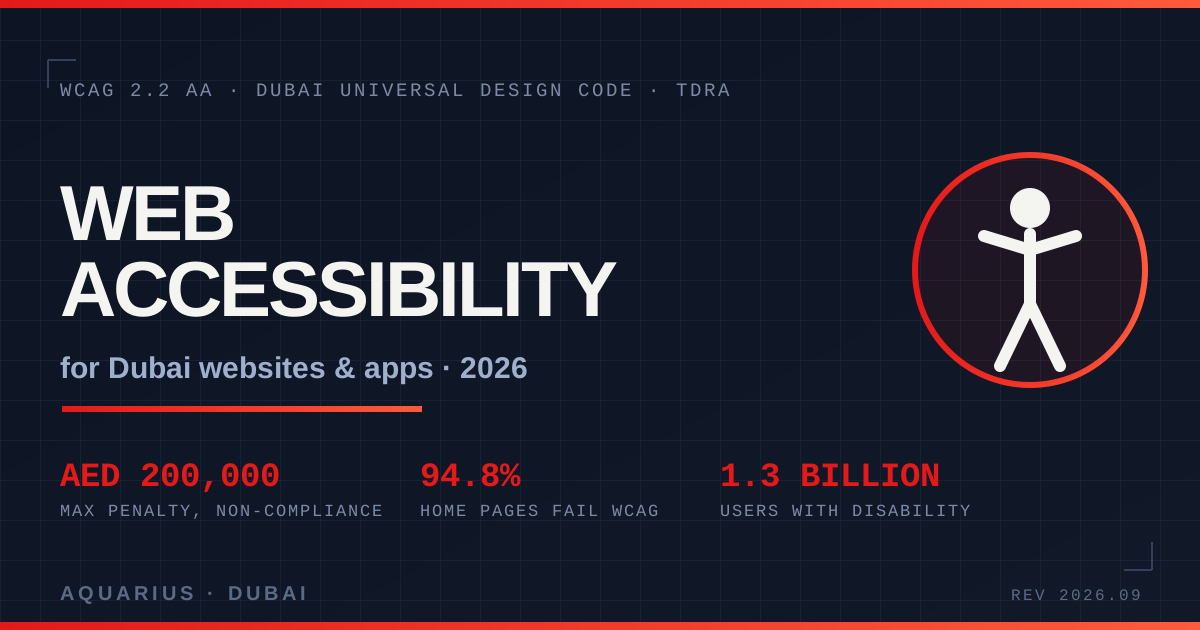
Short answer: In 2026, a Dubai business website should meet WCAG 2.2 Level AA — the standard the Dubai Universal Design Code already anchors to (WCAG 2.1 AA) and the level the TDRA's updated Web Accessibility Policy is moving toward. It is not optional goodwill: under the UAE's disability legislation and the Design Code, non-compliance can draw penalties of up to AED 200,000, with higher fines for repeat offences. Yet 94.8% of the world's home pages still fail WCAG. The fix is a real audit and remediation — not an "accessibility widget," which does not make a site compliant and has itself been named in lawsuits.
Why this matters in Dubai right now — three numbers
Accessibility stopped being a "nice to have" the moment it became a legal standard tied to fines and government-contract eligibility. Three figures set the stakes for 2026:
- 94.8% of the top one million home pages had detectable WCAG failures in 2025, averaging ~51 errors per page — a figure that has improved just 3.1% in six years (WebAIM Million 2025). Odds are your site is in that 94.8%.
- Up to AED 200,000 in penalties for violations under the UAE Disability Act and the Dubai Universal Design Code, with higher amounts for repeat offences — plus exclusion from government tenders, which in Dubai increasingly require accessible digital services.
- ~1.3 billion people worldwide — about 16% of the population — live with a significant disability (World Health Organization). In a market as international as Dubai, that is customers, tourists, and residents your site may be quietly turning away.
Most Dubai businesses get this wrong: they bolt on a floating "accessibility" button, assume the box is ticked, and move on. Overlay widgets do not deliver WCAG conformance — and in markets with active enforcement, sites running these overlays have themselves been sued. A widget is not a wheelchair ramp; it is a sticker of one.
What "accessible" actually means: WCAG 2.2 and POUR
WCAG 2.2 (a W3C Recommendation since October 2023) is the global yardstick, built on four principles — content must be Perceivable, Operable, Understandable, and Robust (POUR). Level AA, the compliance target for business sites, means in practice:
- Perceivable — text alternatives for images, captions for video, and a colour contrast ratio of at least 4.5:1 for normal text. Your hazard-red-on-dark hero has to be readable, not just on-brand.
- Operable — every function works by keyboard alone, focus is always visible, and nothing flashes in a way that triggers seizures. WCAG 2.2 added criteria like larger touch targets and accessible drag alternatives.
- Understandable — predictable navigation, clear labels, and error messages that tell users how to fix the problem. This matters doubly on bilingual Arabic/English sites, where language must be correctly declared for screen readers.
- Robust — clean, semantic HTML that assistive technology (screen readers like VoiceOver, NVDA, or the built-in Arabic TTS on UAE devices) can parse reliably.
Accessibility and speed pull in the same direction: semantic markup, proper headings, and lean code also lift your Core Web Vitals and SEO. If you are already fixing performance, see our guide on Core Web Vitals for Dubai sites — the two projects share most of the work.
The UAE legal stack you are actually answering to
There is no single "UAE web accessibility law" — there is a layered framework, and a Dubai business sits inside all of it:
- Federal Law No. 29 of 2006 (Rights of People of Determination, amended by Law No. 14 of 2009) — the foundation guaranteeing equal access to services, public and private.
- The Dubai Universal Design Code — mandates WCAG 2.1 Level AA for digital platforms, with a 2026–27 review expected to extend scope into smart-city and AI-driven public services.
- The TDRA Web Accessibility Policy — WCAG 2.1 AA aligned today, with an updated WCAG 2.2 policy in stakeholder consultation through 2026. Building to 2.2 AA now future-proofs you.
- The National Digital Accessibility Policy — commits the UAE to digital inclusivity for People of Determination and senior citizens across websites, apps, and software.
Two more reasons to act above the minimum: if you sell into the EU, the European Accessibility Act became enforceable on 28 June 2025, so ecommerce and digital services aimed at European customers now need EN 301 549 / WCAG conformance regardless of where you are based. And accessible data handling overlaps with privacy duties — pair this work with our UAE PDPL compliance checklist.
Overlay widget vs real remediation vs accessible-by-design
This is the consideration stage, and it is where money is wasted. Here is the honest comparison, with indicative 2026 AED ranges from UAE studios:
| Approach | What you get | WCAG 2.2 AA conformance? | Indicative cost (AED) |
|---|---|---|---|
| Overlay / "accessibility widget" | A floating toolbar; superficial tweaks | No — and a litigation risk | 1,500 – 7,000 / year |
| Audit + remediation (existing site) | Manual + automated audit, then code fixes and a conformance report | Yes, when done properly | Audit 8,000 – 35,000; remediation 15,000 – 90,000+ |
| Accessible-by-design (new build) | WCAG 2.2 AA baked into design, code & QA from day one | Yes, and cheapest long-term | ~5–10% of build cost |
The economics are unforgiving in one direction: designing for accessibility from the start adds roughly 5–10% to a build, while retrofitting a large, non-semantic site after launch routinely costs multiples of that. And the checkout is where inaccessibility bites hardest — only 11% of cart and checkout pages meet minimum accessibility standards, and 71% of users with disabilities abandon an inaccessible site immediately. For a UAE store, that is revenue walking out the door before the payment gateway ever loads.
Getting Arabic and RTL right — the part overlays can never fix
A Dubai site is usually bilingual, and accessibility in Arabic is more than a translation layer. Screen readers need the correct lang and dir="rtl" attributes to pronounce Arabic properly; focus order must mirror correctly in RTL; and numerals, dates, and form labels have to localise. This is precisely where widget overlays collapse — they cannot restructure your markup. It is also where a proper build wins trust with UAE audiences. Our Arabic & RTL design best-practices guide goes deep on doing this correctly.
How Aquarius builds accessibility that holds up
We treat accessibility as engineering, not decoration. On a new build we bake WCAG 2.2 AA into the design system, component library, and QA — so it costs a few percent, not a retrofit. On an existing site we run a combined automated and manual audit (automated tools catch only a fraction of real barriers), fix the code, and hand you a documented conformance report you can attach to government tenders. The BOFU math is straightforward: businesses lose an estimated US$2.3 billion a year to inaccessible checkouts alone, 62% of business leaders believe customers have abandoned transactions over accessibility issues, and the global disability community commands roughly US$13 trillion in disposable income. Accessibility is not a cost centre — it is a market you are currently locked out of. See our web services and transparent AED pricing, or book a free accessibility scoping call and we will run a first-pass audit of your homepage on the spot.
Frequently asked questions
Is web accessibility legally required in Dubai in 2026?
Effectively yes. The Dubai Universal Design Code mandates WCAG 2.1 Level AA for digital platforms, Federal Law No. 29 of 2006 guarantees equal access for People of Determination, and the TDRA policy is moving to WCAG 2.2. Violations can draw penalties of up to AED 200,000, plus exclusion from government contracts. Building to WCAG 2.2 AA now covers you against the pending updates.
What WCAG level should my Dubai website target?
Level AA — of WCAG 2.2, the current W3C Recommendation. Level A is the bare minimum and Level AAA is rarely required in full, but AA is the accepted global and UAE benchmark for business sites and the level the Dubai Universal Design Code and TDRA policies align to.
Do accessibility overlay widgets make my site compliant?
No. Overlay widgets and "accessibility buttons" do not deliver WCAG conformance — they cannot fix the underlying HTML that screen readers rely on — and in markets with active enforcement, sites running these overlays have themselves been named in accessibility lawsuits. Real compliance requires an audit and code-level remediation.
How much does a web accessibility audit and remediation cost in Dubai?
As indicative 2026 ranges: a professional audit runs roughly AED 8,000–35,000 depending on site size, and remediation AED 15,000–90,000+ for an existing site. Building accessibility in from the start on a new project adds only about 5–10% to the build cost, which is why retrofitting is always the expensive path.
Does accessibility help my SEO and conversions?
Yes. The semantic HTML, alt text, clear headings, and fast, keyboard-friendly pages that WCAG requires also improve Core Web Vitals and how search engines and AI Overviews parse your content. On conversions, only 11% of checkouts meet minimum standards and 71% of users with disabilities abandon inaccessible sites — fixing that recovers revenue you are currently losing.