
AWS Multi-Account Setup for Dubai Companies (2026): Landing Zone Costs in AED and the Guardrails That Pay for Themselves
A full AWS governance baseline across five accounts in me-central-1 costs about AED 731 a month. Real account structure, SCP guardrails and the AED maths.
- PUBLISHED
- 18 NOV 2026
- READ TIME
- 12 MIN
- AUTHOR
- AQUARIUS · DUBAI
- UNIT
- REV 2026.09
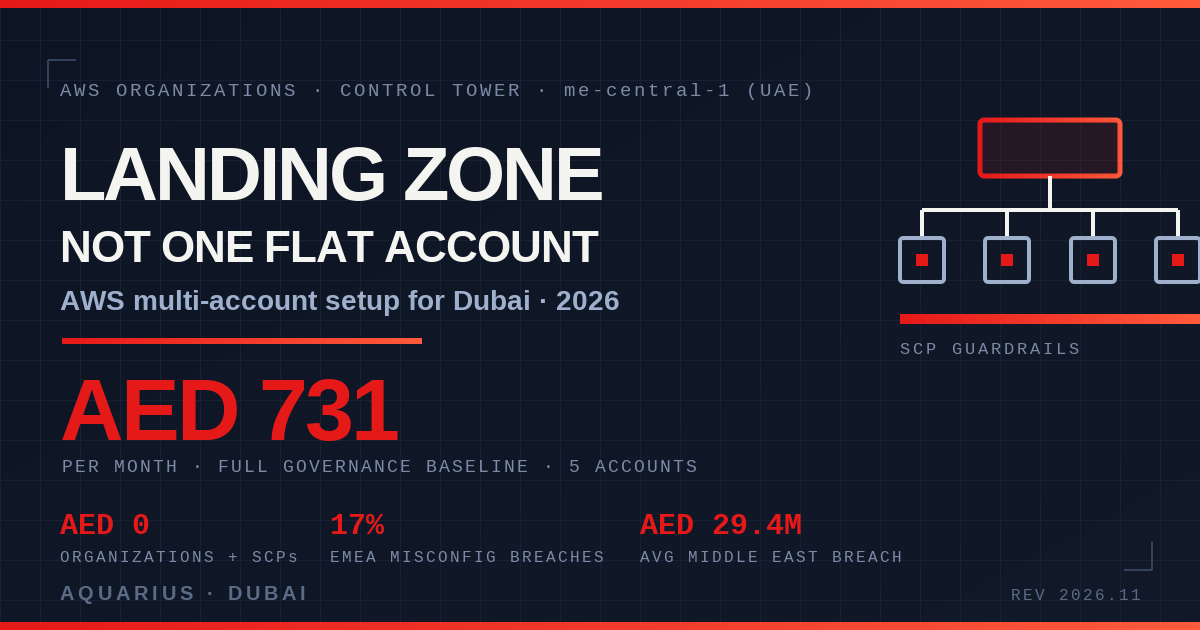
Short answer: A production-grade AWS multi-account setup for a Dubai company — an organisation, a Control Tower landing zone, separate production and development accounts, centralised logging and detective controls — costs roughly AED 731 a month in me-central-1 at the volumes a typical UAE SME generates. AWS Organizations, service control policies (SCPs) and IAM Identity Center are free; Control Tower itself adds no charge. You pay only for the services it switches on: AWS Config, CloudTrail, GuardDuty, Security Hub and S3.
Set that against the number that matters. IBM’s 2026 Cost of a Data Breach study puts the average breach in the Middle East at USD 8 million — about AED 29.4 million. The governance layer most Dubai teams keep postponing costs about AED 8,778 a year, or 0.03% of a single average regional breach. Below are the real me-central-1 prices from the AWS public price list, the account split that actually works for a UAE business, and the guardrails worth writing on day one. Updated November 2026.
Why Dubai teams are suddenly re-opening the account question
Almost every Dubai company we inherit runs on one AWS account. One root login, one VPC, production and staging in the same blast radius, and a bill nobody can split by project. That worked when the company was four people. Three things changed the stakes:
- Regional breach costs are climbing fast. IBM’s 2026 report puts the Middle East average at USD 8 million (AED 29.4 million), up from USD 7.29 million (AED 26.8 million) in 2025 and far above the global average of USD 4.99 million (AED 18.3 million). Lost business alone averages USD 3.57 million (AED 13.1 million) per breach, and technology and financial-sector breaches in the region average USD 10.67 million each. Among malicious breaches, 26% were AI-enabled.
- Misconfiguration is worse in this region than globally. Verizon’s 2026 Data Breach Investigations Report puts misconfiguration-related breaches at 17% in EMEA against 13% overall. The same report found that for weak passwords and permission misconfigurations in cloud environments, the time to resolve half of all findings approached eight months, with a full remediation rate of only 31%.
- Your buyers and your auditors now ask. DBIR 2026 recorded third-party involvement in 48% of breaches, up 60% year on year, and found that only 23% of third parties fully remediated missing or improperly secured MFA on their cloud accounts. If you sell to a bank, a government entity or a listed group in the UAE, that questionnaire is coming — and “we have one AWS account and the CTO has the root password” is not an answer that survives it.
The pattern we see across Dubai and Abu Dhabi is not negligence. It is a founder-era account that nobody ever restructured, carrying a company that has since grown into real compliance exposure.
What a landing zone actually is
Strip the marketing away and a landing zone is four things: multiple AWS accounts, grouped into organisational units, constrained by policies you cannot accidentally delete, with one sign-in surface for humans. AWS Control Tower orchestrates it and adds no cost of its own. When you set it up, it creates a Security OU containing two shared accounts — Log Archive and Audit — alongside your management account.
The account split that works for a UAE SME
You do not need twenty accounts. Five is the honest starting point for a Dubai company running one product:
| Account | What lives there | Who gets access |
|---|---|---|
| Management | Organisations, SCPs, consolidated billing. No workloads at all. | Two named break-glass identities |
| Log Archive | Centralised CloudTrail and Config logs in an S3 bucket nobody else can delete from | Nobody, day to day |
| Audit | Security Hub, GuardDuty findings, cross-account read roles | Security lead, external auditor |
| Production | Live workloads and customer data, me-central-1 | Deploy pipeline; humans via time-boxed roles |
| Development | Staging, experiments, the AI proof-of-concept someone will forget to delete | Engineering team |
The point of the split is not tidiness. It is that a leaked developer credential, a runaway script or a misconfigured bucket in Development cannot reach production data, and that your monthly bill arrives already divided along lines that mean something.
The SCP guardrails worth writing on day one
Service control policies are the only control in AWS that a local administrator genuinely cannot override. They cost nothing. Four of them do most of the work for a UAE business:
- Region deny. Deny every action outside me-central-1 (plus the global endpoints you need). This is the single most useful control a Dubai company can apply, because it turns data residency from a policy document into something the platform enforces. If you have told a client or a regulator that UAE personal data stays in the UAE, this is how you make that true even when an engineer picks the wrong region in a dropdown. It pairs directly with your obligations under the UAE PDPL.
- Protect the audit trail. Deny deletion or disabling of CloudTrail trails, Config recorders and the log-archive bucket from inside member accounts. An attacker’s first move is to stop the recording.
- No root usage. Deny all actions by the root principal in member accounts. Humans sign in through IAM Identity Center with MFA instead.
- Block public exposure by default. Deny disabling S3 Block Public Access and deny creating internet gateways in accounts that should never have one.
Most Dubai businesses get this backwards: they buy a security tool before they have an account boundary. A tool reports a misconfiguration. An SCP makes it impossible.
What governance actually costs in me-central-1
Here is the part nobody publishes with real UAE prices. All figures are on-demand rates from the AWS public price list for the Middle East (UAE) region, converted at the pegged USD 1 = AED 3.6725. Volumes assume five accounts, home region me-central-1 only, and a moderate workload.
| Line item | me-central-1 rate | Assumed volume | AED / month |
|---|---|---|---|
| Organizations + SCPs + IAM Identity Center + Control Tower | No additional charge | — | 0 |
| AWS Config — configuration items | AED 0.011 per item | 6,000 / month | 66 |
| AWS Config — rule evaluations | AED 0.0037 per evaluation (first 100k) | 25,000 / month | 92 |
| CloudTrail — management events, first copy | Free | All accounts | 0 |
| CloudTrail — data events (S3 / Lambda) | AED 3.67 per million events | 30 million / month | 110 |
| S3 — log archive storage | AED 0.092 per GB-month | 40 GB | 4 |
| GuardDuty — CloudTrail events analysed | AED 0.018 per 1,000 events | 2 million / month | 37 |
| GuardDuty — VPC flow and DNS logs | AED 4.59 per GB (first 500 GB) | 60 GB / month | 275 |
| Security Hub — security checks | AED 0.0037 per check (first 100k) | 40,000 / month | 147 |
| Security Hub — findings ingestion | First 10,000 free, then AED 0.127 per 1,000 | 15,000 / month | 1 |
| Total | 731 |
Three things to notice. First, the orchestration is free — what you pay for is evidence: recorded configuration, analysed logs, retained trails. Second, GuardDuty traffic analysis is the single largest line at AED 275, because VPC flow and DNS data is billed at AED 4.59 per GB for the first 500 GB a month and falls to AED 2.30, then AED 1.15, then AED 0.69 per GB as volume grows. Third, the cheap-looking items scale with carelessness: Config bills per configuration item, so a chatty auto-scaling group or an untagged sandbox in Development will quietly multiply that AED 66.
Two optional lines are worth budgeting if you need longer retention or deeper forensics: CloudTrail Lake ingestion is AED 9.18 per GB for the first 5 TB a month, extended retention storage is AED 0.084 per GB-month, and queries scan at AED 0.018 per GB. GuardDuty malware scanning of EBS volumes adds AED 0.147 per GB scanned.
The three things one flat account quietly costs you
1. You cannot attribute cost to a legal entity. This is the UAE-specific trap. Under Ministerial Decision 97 of 2023, a taxable person must maintain a Master File and a Local File where its own revenue reaches AED 200 million in the tax period, or where it belongs to a multinational group with consolidated revenue of AED 3.15 billion or more — and must produce them within 30 days of an FTA request. If one Dubai entity pays the AWS bill for three group companies, you are running an unpriced intra-group service with no cost basis to defend. An account-per-entity structure gives you a defensible allocation from the billing console. Our guide to UAE transfer pricing data covers the documentation side.
2. You cannot contain a mistake. One account means one IAM boundary. The intern’s credential, the CI token in a public repo and the production database live inside the same trust domain. The DBIR’s eight-month median for fixing cloud permission findings is what happens when there is no boundary to fix things behind.
3. You pay more, not less. Teams keep one account because they think consolidation saves money. It does not. Consolidated billing across an organisation gives you a single invoice and shares Reserved Instance and Savings Plans discounts across member accounts — open sharing is the default, applying each plan first to the account that owns it and then to any other sharing-activated account. You get the volume discount and the cost visibility. One flat account gives you the discount and a bill you cannot read. If your bill is already unreadable, start with cloud cost optimisation.
Migrating when you are already flat
You do not need a big-bang migration, and you should not move production first. The order that works:
- Week 1. Create the organisation from your existing account, enable Control Tower, let it create Log Archive and Audit. Nothing in your workload changes.
- Week 2. Turn on IAM Identity Center with MFA, move every human off IAM users, and lock the root credentials into a physical safe with a named owner.
- Week 3. Apply the region-deny and audit-protection SCPs to a new Development OU first. Verify nothing breaks, then extend to the whole organisation except the management account.
- Weeks 4–8. Stand up a clean Production account and cut over service by service — stateless workloads first, then data, with a tested rollback. Decommission the old account last, after one full billing cycle of overlap.
- Ongoing. Enforce a tagging policy at creation time. Tags applied later never backfill, and untagged spend is the reason cost reports stay useless.
How Aquarius does it, and what it costs
We build landing zones as infrastructure-as-code, not console clicks, so the whole structure is reviewable and reproducible. A standard five-account me-central-1 landing zone with the four guardrail SCPs, IAM Identity Center, centralised logging and a tagging policy runs AED 18,000 to AED 35,000 as a one-off build for a Dubai SME, typically delivered in two to three weeks. A migration of an existing production workload out of a flat account into it runs AED 30,000 to AED 85,000 depending on how much state moves and how much downtime you can tolerate. The AWS bill on top is the AED 731 a month modelled above, give or take your log volume.
That build cost is 0.1% of the AED 29.4 million average Middle East breach, and it is the same artefact your ISO 27001 or SOC 2 auditor will ask to see — so it does double duty against the certification costs you are probably already facing. If you want the compute layer costed too, we published the real me-central-1 Kubernetes and serverless prices separately. Our pricing page sets out how we scope engagements.
FAQ
Is AWS Control Tower free in the UAE region?
Control Tower adds no charge of its own, and AWS Organizations and IAM Identity Center are also free. You pay for the services it enables — AWS Config, CloudTrail, S3, SNS, Service Catalog and CloudWatch — based on your usage. In me-central-1 that lands around AED 731 a month for a five-account setup at moderate volume.
How many AWS accounts does a Dubai SME need?
Five: management, log archive, audit, production and development. Add one per additional legal entity if you need per-entity cost attribution for UAE corporate tax or transfer pricing, and one per additional production environment only when you genuinely have separate release trains.
Can an SCP keep my data inside the UAE?
A region-deny SCP prevents resources being created in any region you have not allowed, which is the enforceable half of a data-residency commitment. It does not stop data leaving through an application — an API call to a service outside the UAE is still an export. You need both the SCP and a reviewed data-flow map.
Why is AWS Config the line item that surprises people?
Because it bills per configuration item recorded, at AED 0.011 each in me-central-1, and infrastructure that changes often generates items constantly. A landing zone at version 3.0 or later limits recording of global resources such as IAM roles to your home region, which helps, but a noisy development account can still outspend production on Config alone.
We are a startup with one product. Is this premature?
The free half is never premature: an organisation, a region-deny SCP, IAM Identity Center and root locked away take an afternoon and cost nothing. Defer GuardDuty and Security Hub until you have customer data or a buyer asking. What is genuinely expensive is restructuring after you have three years of production state in one account.
Where to start
If you run on AWS from Dubai and you can answer “how much did project X cost last month” only by guessing, or if nobody can say with certainty that no resource exists outside me-central-1, the account structure is your problem — not your tooling. Send us your current AWS bill and account list and we will map the landing zone your setup should become, with the AED numbers attached. No obligation, and you keep the map either way.