
Kubernetes vs Serverless in the UAE (2026): Real me-central-1 Costs in AED and the Break-Even
EKS plus two nodes costs AED 804/month in me-central-1 before you deploy anything. Real AWS UAE prices for EKS, ECS, Fargate and Lambda, and the exact request volume where serverless stops being cheaper.
- PUBLISHED
- 18 NOV 2026
- READ TIME
- 13 MIN
- AUTHOR
- AQUARIUS · DUBAI
- UNIT
- REV 2026.09
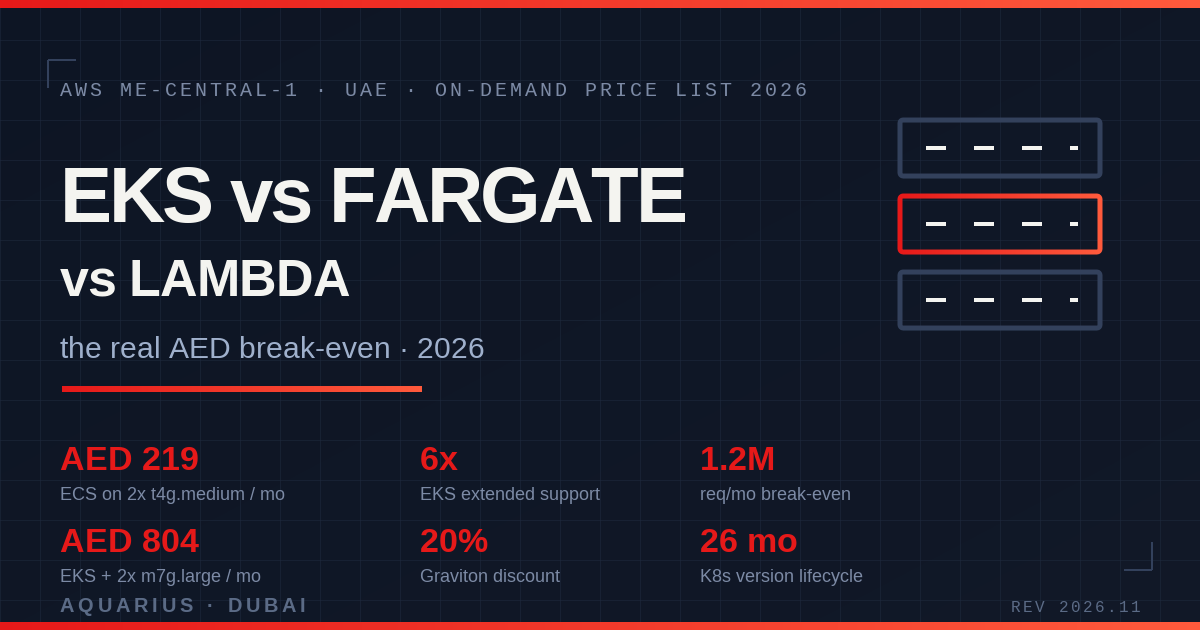
Short answer: In AWS me-central-1 (UAE), the cheapest way to run a small production service is ECS on two t4g.medium instances at roughly AED 219 a month of compute; two Fargate ARM tasks cost about AED 551; and an EKS cluster with two m7g.large nodes costs about AED 804 before you deploy a single container. Lambda beats all three until you cross the break-even, and that break-even is not a fixed number — it moves from 31.7 million requests a month down to 1.2 million purely by changing your function’s memory and duration.
That last sentence is the whole decision. Almost every “Kubernetes vs serverless” argument we walk into in Dubai is really an argument about a break-even nobody has calculated. Below are the actual me-central-1 on-demand prices from the AWS public price list, converted at the pegged rate of USD 1 = AED 3.6725 over a 730-hour month, plus the break-even maths for your own workload. Updated November 2026.
Why UAE teams are suddenly re-running this numbers exercise
Three things changed the stakes for container platform decisions made inside the country:
- The region is now a default, not an experiment. AWS me-central-1 launched on 29 August 2022 with three Availability Zones, backed by a planned USD 5 billion (AED 20.1 billion) investment through 2036 and an expected USD 11 billion (AED 41 billion) contribution to UAE GDP over 15 years. Workloads that used to sit in Frankfurt or Mumbai for cost reasons now have a local option, and local means a different price sheet.
- Sovereign cloud demand in this region is growing faster than anywhere on earth. Gartner forecast worldwide sovereign cloud IaaS spending at USD 80 billion in 2026, up 35.6%, with Middle East and Africa posting the highest growth rate at 89% — ahead of Europe at 83% — and roughly 20% of current workloads shifting from global to local providers. Separately, Gartner put MENA IT spending at USD 169 billion in 2026 (+8.9%), with software at USD 20.4 billion (+13.9%).
- Kubernetes became the default answer before most teams needed it. The CNCF 2025 Annual Cloud Native Survey found 82% of container users now run Kubernetes in production, up from 66% in 2023, and 66% of organisations hosting generative-AI models use Kubernetes for inference. It also found the top adoption challenge is cultural change (47%), with complexity at 34%.
Put those together and you get the pattern we see across Dubai and Abu Dhabi: a five-service product running on a managed Kubernetes cluster that costs more in platform overhead than in application compute, chosen because Kubernetes is what everyone else said they were using.
What each option actually costs in me-central-1
These are on-demand list prices pulled from the AWS price list API for me-central-1, Linux, shared tenancy. A “minimum HA stack” means two Availability Zones’ worth of compute — the smallest thing you can honestly call production — and counts compute only. Load balancers, NAT gateways, data transfer, storage and observability sit on top of every row equally.
| Option | Unit price (me-central-1) | Minimum HA stack / month | AED / month |
|---|---|---|---|
| ECS on EC2 (2x t4g.medium) | Orchestration USD 0.00 + USD 0.0408/hr per node | USD 59.57 | AED 219 |
| Fargate ARM (2x 2 vCPU / 4 GB) | USD 0.04208 per vCPU-hr + USD 0.00464 per GB-hr | USD 149.97 | AED 551 |
| Fargate x86 (2x 2 vCPU / 4 GB) | USD 0.0526 per vCPU-hr + USD 0.0058 per GB-hr | USD 187.46 | AED 688 |
| EKS + 2x m7g.large nodes | USD 0.10/hr control plane + USD 0.10/hr per node | USD 219.00 | AED 804 |
| EKS control plane alone | USD 0.10/hr | USD 73.00 | AED 268 |
| EKS on extended support | USD 0.60/hr (USD 0.50 surcharge) | USD 438.00 | AED 1,609 |
| Lambda ARM, 512 MB / 200 ms | USD 0.25 per million requests + USD 0.0000165334 per GB-s | USD 1.94 per million req | AED 7.14 |
| Lambda ARM, 1 GB / 1 s | same rates, 10x the GB-s | USD 16.78 per million req | AED 61.64 |
Four things in that table are worth more than the rest of this article:
1. ECS orchestration is free; EKS orchestration is AED 268 a month
ECS on EC2 charges nothing for the control plane — you pay for instances and nothing else. EKS charges USD 0.10 per hour per cluster, which is AED 268 a month per cluster, every month, whether the cluster runs one pod or two hundred. If your team runs separate dev, staging and production clusters, that is AED 804 a month (AED 9,648 a year) in control planes alone before a single workload.
2. Graviton is exactly 20% cheaper, and almost nobody switches
In me-central-1, Fargate ARM is priced at exactly 20% below x86 on both vCPU and memory, and Lambda ARM is 20% below x86 at every GB-s tier. On EC2 the gap is similar: t4g.medium at USD 0.0408/hr is 18.7% cheaper than t3.medium at USD 0.0502/hr, and m7g.large at USD 0.1000/hr is 19.1% cheaper than m7i.large at USD 0.12359/hr. For most Node, Python, Go, Java and .NET 8 workloads the migration is a base-image change and a rebuild. It is the single highest-return afternoon of work available to a UAE cloud bill.
3. Windows containers on Fargate cost 1.87x Linux
A 2 vCPU / 4 GB Windows Fargate task in me-central-1 runs USD 0.23966 per hour — USD 0.06049 per vCPU-hr plus a USD 0.046 per vCPU-hr OS licence charge plus USD 0.00667 per GB-hr — or AED 643 a month per task against AED 344 for the same Linux x86 task. If you are containerising a legacy .NET Framework app in Dubai, that licence line is the number to put in the business case for porting to .NET 8 on Linux.
4. The EKS version clock is the expensive one
Each Kubernetes minor version gets 14 months of standard support, then 12 months of extended support — a 26-month total lifecycle — while upstream ships a new minor roughly every four months. Extended support is enabled by default, and it costs USD 0.50 per hour on top of the USD 0.10 base: six times the standard control-plane price. One cluster left to drift onto extended support costs an extra USD 4,380 a year, or AED 16,086 a year, for exactly the same cluster. At the end of extended support AWS auto-upgrades the control plane with no notification — and it does not upgrade your node groups, so your data plane is the thing that breaks. As of now, standard support covers 1.37, 1.36, 1.35 and 1.34; 1.33, 1.32 and 1.31 are already in extended support, with 1.32 leaving standard support on 23 March 2026 and 1.31 leaving extended support on 26 November 2026.
The break-even: when Lambda stops being cheaper
Here is the myth-bust. “Serverless gets expensive at scale” is treated as a law, but the crossover point depends almost entirely on memory multiplied by duration, not on your traffic. Against one Fargate ARM 2 vCPU / 4 GB task at USD 74.99 a month:
- 512 MB, 200 ms: Lambda stays cheaper until 31.69 million requests a month (~12 requests per second, sustained, around the clock).
- 1 GB, 1 second: break-even at 3.58 million requests a month.
- 1 GB, 3 seconds: break-even at 1.20 million requests a month — about 27 requests a minute.
Against the EKS two-node stack at USD 219 a month, the same three profiles break even at 92.55 million, 10.47 million and 3.52 million requests a month. The span between the cheapest and most expensive profile is roughly 26x, driven by nothing but how much memory you provisioned and how long your handler blocks. A Dubai e-commerce API doing 2 million lean 512 MB calls a month is firmly in Lambda territory. The same traffic on a 2 GB, 5-second PDF or image pipeline costs USD 206.92 per million invocations on x86 (AED 760) and belongs in a container.
Two corollaries worth internalising. First, provisioned concurrency erases the serverless cost argument: 10 instances of a 2 GB function held warm for a month costs USD 268.62, or AED 987 — more than the EKS stack, for one function. If you need warm capacity around the clock, you need a container. Second, the Lambda free tier of 1 million requests and 400,000 GB-s a month means a genuinely small UAE service — an internal tool, a webhook receiver, a booking form backend — frequently runs at AED 0 of compute. We have moved several Dubai clients’ low-traffic internal services off AED 300-a-month instances onto functions that cost nothing.
How Aquarius picks, and what it costs in AED
Our default order is deliberately boring, because boring is what you can hand to a two-person team in Business Bay without a platform engineer on payroll:
- Lambda first for event-driven, spiky and low-volume work: webhooks, scheduled jobs, image and document processing, notifications, integrations with UAE payment and government APIs. Always ARM. Always with a memory and duration budget written down.
- ECS on Fargate ARM for anything long-running, latency-sensitive or stateful-ish — APIs, web apps, queue workers. One task per service, autoscaled. No cluster to patch.
- ECS on EC2 Graviton when the bill matters more than the operational convenience and utilisation is steady — that AED 219 versus AED 551 gap is real, and it is the same ECS API.
- EKS only when a real requirement demands it: an existing Helm estate to migrate, a multi-tenant platform, GPU scheduling for AI inference, a service mesh, or a team that already runs Kubernetes competently. If none of those is true, EKS is AED 268 a month plus a 26-month upgrade treadmill bought for nothing.
Typical engagement ranges, fixed-scope: a me-central-1 compute review with a costed migration plan sits in the AED 7,500–15,000 band; moving an existing service to Fargate ARM with CI/CD and autoscaling runs AED 18,000–45,000 depending on service count; a Graviton migration across an existing estate is usually AED 12,000–30,000 and frequently pays for itself inside the first year on the 20% delta alone. Current figures are on our pricing page, and the delivery scope is on services.
The risk reversal is simple: we do the costed comparison for your actual workload before you commit to a platform. If the numbers say your current setup is already right, we tell you that and you have spent four figures to avoid a five-figure mistake. The CNCF’s 2024 FinOps microsurvey found 49% of organisations saw cloud spend rise after migrating to Kubernetes, with 70% of those citing overprovisioning, and 88% reported year-on-year Kubernetes cost increases. Picking the platform before pricing the platform is how that happens.
FAQ
Is Kubernetes cheaper than serverless in the UAE?
Only above your break-even. In me-central-1, an EKS control plane plus two m7g.large nodes is about AED 804 a month of compute before any application traffic. A 512 MB, 200 ms Lambda function stays cheaper than that stack until roughly 92.5 million requests a month. Flip to a 1 GB, 3-second function and the crossover drops to about 3.5 million.
How much does EKS cost in AWS me-central-1?
USD 0.10 per hour per cluster for the control plane — USD 73 a month, about AED 268 — plus whatever your nodes cost. On extended support the control plane rises to USD 0.60 per hour, about AED 1,609 a month, which is six times the standard rate.
Does ECS cost extra compared with EKS?
No. ECS orchestration is free on both EC2 and Fargate; you only pay for the compute underneath. That makes ECS on EC2 the cheapest managed-container option in me-central-1, and it is the reason most small UAE product teams should start there rather than on Kubernetes.
Is Graviton worth migrating to for a Dubai workload?
Usually yes. In me-central-1 the ARM discount is exactly 20% on Fargate and Lambda and roughly 19% on comparable EC2 instances. For interpreted and modern compiled runtimes the change is typically a base image and a rebuild, which makes it the highest-return cost action available on most UAE AWS accounts.
Can we keep all of this inside the UAE?
Yes — me-central-1 has three Availability Zones in the UAE, so EKS, ECS, Fargate and Lambda all run in-country, which matters when data residency is a contractual or regulatory requirement. We cover the residency side in website hosting and data residency in Dubai, and the ongoing spend side in our Dubai cloud cost optimisation guide.
If you want the break-even run against your own request volumes, memory settings and p95 durations rather than the illustrative profiles above, send us the numbers and we will come back with the costed comparison in AED.