
Bakery & Sweets Production Software in Dubai (2026): Recipe Costing, Wastage Control & Food Watch Traceability
Dubai wastes 38% of prepared food daily. Real 2026 AED costs for bakery POS and production software, recipe costing, wastage control and Food Watch batch traceability.
- PUBLISHED
- 24 OCT 2026
- READ TIME
- 10 MIN
- AUTHOR
- AQUARIUS · DUBAI
- UNIT
- REV 2026.09
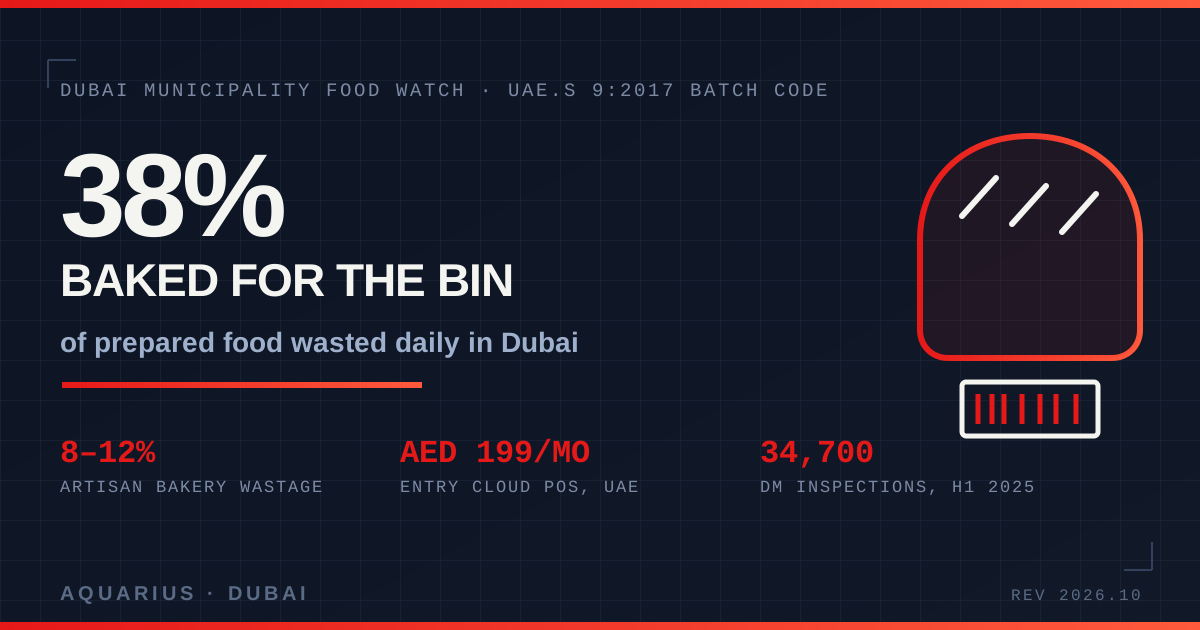
Short answer: a Dubai bakery does not lose money on the shop floor — it loses it in the production sheet. Bakery software earns its keep by costing every recipe to the gram, planning each day’s bake against real sales history, and printing a batch and expiry code that satisfies Dubai Municipality. Off-the-shelf cloud POS starts around AED 199 per month; a custom production and multi-outlet platform runs AED 45,000 to AED 320,000 to build.
Here is the number most Dubai bakery owners have never been shown: in Dubai, 38% of prepared food is wasted every day — rising to 60% during Ramadan. A bakery is the one food business that manufactures its own stock every morning and watches it expire by evening. That makes wastage a production-planning problem, and production planning is software.
Three UAE numbers that set the stakes
- The UAE bakery and cereals market was worth about AED 5.4 billion (USD 1.5 billion) in 2023 and is growing at more than 6% a year to 2028 (GlobalData), with bread and rolls the single highest per-capita category in the country. Demand for bread in the Emirates has climbed roughly 2.1% every year since 2012. On the frozen and retail side, the UAE market was valued at USD 9.71 billion in 2024 and is forecast to reach USD 16.64 billion by 2032 at a 6.69% CAGR (Verified Market Research).
- Dubai Municipality carried out 34,700 food inspections in the first half of 2025 alone, cleared 940,000 food items, registered 77,700 new food products — and watched 2,336 new food establishments open in six months. Industry trackers put Dubai at roughly 1,400–1,800 licensed bakery operations in 2026, from artisan counters to production-only wholesale plants.
- The UAE wastes an estimated 3.27 million tonnes of food a year, worth about USD 3.5 billion (Ministry of Climate Change and Environment, 2024). Organic material is roughly 40% of Dubai’s municipal solid waste, and the national target is to halve food waste by 2030.
Most Dubai bakeries get this wrong: they buy a till, not a production system. The till tells you what sold. It cannot tell you what you should have baked.
Where the margin actually leaks
A 120 sqm neighbourhood bakery in Dubai running 200 transactions a day at an AED 65 average ticket turns over roughly AED 390,000 a month. Against that, the published operating model for the format is cost of goods at 22–28%, labour at 25–30%, and rent plus utilities at 8–14%. Gross margin lands at 35–55% for a retail counter, 28–45% for a bakery café, and only 22–35% for production-only wholesale.
Now layer wastage on top. Independent studies put artisan bakery waste at 8–12% of production, with unsold returns from trade customers running 8–10% on average and, for large wholesale bakeries supplying supermarkets, anywhere from 3% to 20% of loaves shipped. Operators who combine FEFO stock rotation, data-driven production planning and per-item waste logging report cutting that waste by 30–40%.
Model it on the bakery above. If 10% of production goes unsold at an average 25% ingredient cost, that is roughly AED 9,750 of flour, butter and labour burned every month — AED 117,000 a year. Taking a third out of it returns around AED 35,000–47,000 a year. Entry-level cloud POS in the UAE lists at AED 199 per month. The arithmetic is not close.
The features that pay for themselves
1. Recipe and sub-recipe costing (BOM to the gram)
A croissant is a recipe inside a recipe: détrempe inside laminated dough inside a finished item. Without multi-level bills of material, your cost per unit is a guess. Proper costing updates every finished-good price the moment a supplier invoice changes — which matters in the UAE more than most markets, because bread and wheat are two of the nine essential goods whose prices cannot be raised without prior approval from the Ministry of Economy, a policy in force since 2 January 2025 and reinforced with a Ramadan 2026 cap. Fines for unapproved increases start at AED 500 and reach AED 100,000, with temporary closure for serious cases. If your input cost rises and your shelf price is frozen, the only lever left is yield — and you can only manage yield you measure.
2. Production planning against real demand
Dubai demand is violently seasonal. During Ramadan, Spinneys Dubai lifted honey-cake output by almost 250%, selling 3,000 cakes a day; baklava, maamoul and premium gift boxes spike through Ramadan and Eid, then collapse. A planning engine that reads two years of item-level sales, day-of-week patterns, weather and the Hijri calendar produces a bake sheet per shift per outlet. A spreadsheet produces last Tuesday’s bake sheet.
3. Batch, expiry and traceability — the compliance core
This is where Dubai is stricter than most operators realise. Food Watch registration with Dubai Municipality is mandatory for every food business in the emirate and free — it carries your supplier records, temperature logs, hygiene compliance and inspection history. Packaged products additionally need registration through the municipality’s food product registration route, with a bilingual Arabic and English label, ingredient list, certificate of analysis, nutritional data and halal documentation where it applies.
On the label itself, UAE standard UAE.S 9:2017 requires a batch or lot number alongside production and expiry dates for traceability and recall, and those dates must be printed by the manufacturer — date stickers are not permitted. Allergen disclosure carries increasing weight under the Dubai Food Code. Serious violations of Federal Law No. 10 of 2015 on Food Safety are reported to carry penalties into the millions of dirhams, and a recall you cannot trace to a batch becomes a recall of everything you made that week. Our guide to HACCP and food-safety compliance software in Dubai covers the inspection side in depth.
4. Multi-outlet, central kitchen and wholesale flows
The moment a second counter opens, you are running a central kitchen: internal transfer notes, per-outlet par levels, van loading and returns, and a wholesale price list separate from retail. Bakeries supplying hotels and cafes need order capture, delivery notes, VAT-compliant invoicing and a returns policy that tracks unsold stock back to a batch. That is the same machinery as van sales and route distribution, and it is the single most common reason a bakery outgrows a plain till.
Build, buy, or both: real 2026 AED costs
Three honest routes. Published UAE pricing for a mainstream cloud restaurant POS puts bundles at AED 199, AED 375 and AED 556 per month when billed annually, with inventory, loyalty and delivery integrations as paid add-ons at the entry tier. Odoo’s Community edition is free and its Enterprise edition starts near USD 24 per user per month, with manufacturing and POS modules that fit a bakery after configuration. Custom development is the third route, and the ranges below are ours.
| Route | Typical 2026 cost | Best fit | The catch |
|---|---|---|---|
| Off-the-shelf cloud POS | AED 199–556 / month + hardware | 1–3 outlets, retail-only, fast start | Recipe BOM and batch-code printing are shallow or absent |
| ERP suite (Odoo / similar), configured | AED 35,000–120,000 setup, then licences | Bakery with production + accounting + stock in one place | Implementation quality decides everything; Arabic labels need work |
| Custom production module on existing POS | AED 45,000–120,000 | You like your till, you need real costing and bake sheets | Depends on the POS exposing a usable API |
| Custom multi-outlet bakery platform | AED 120,000–320,000 | Central kitchen + retail + wholesale + delivery | 8–16 weeks; needs your recipes documented first |
| Add-on: demand forecasting engine | AED 30,000–75,000 | Bakeries above ~AED 300k monthly revenue | Needs 12–24 months of item-level sales history |
For context on the licence side, government fees for a Dubai bakery in 2026 total roughly AED 24,795–39,895 — a DET commercial licence at AED 16,000–22,000, a municipality food permit at AED 2,500–6,500, Civil Defence approval at AED 1,500–4,000, health cards at AED 320 per food handler and HACCP or person-in-charge certification at AED 800–2,000 per supervisor. Equipment runs AED 180,000–580,000. Against a build-out of AED 350,000–900,000, a software budget of AED 45,000–120,000 is 5–15% of capex for the system that decides whether the other 90% is profitable.
What we would build first — and how Aquarius does it
Never start with the full platform. Start with the module that stops the bleeding, because the payback is measurable inside one quarter. In order: recipe costing, then the daily bake sheet with waste logging, then batch and expiry printing, then multi-outlet transfers, then wholesale ordering, then forecasting. Each one ships in two to four weeks and each one has a number attached to it.
The conversion case for a Dubai bakery is simple. With COGS at 22–28% of an AED 390,000 month and documented wastage of 8–12% of production, a disciplined production system that recovers a third of waste pays back a AED 45,000 module in roughly 12–15 months on waste alone — before counting the labour hours your head baker currently spends rebuilding a bake sheet in Excel at 4am, or the cost of a recall you cannot narrow to a single batch. With bread prices under Ministry of Economy control, yield is the only margin lever you still fully own.
How we run it at Aquarius: a one-week discovery that documents your recipes and sub-recipes properly, a fixed-price first module, your data and your code yours outright, and Arabic and English labels designed against the standard rather than retrofitted. If you are running several brands or a cloud-kitchen setup alongside the bakery, our notes on cloud kitchen management software and on POS and inventory development in Dubai are the companion reads. Ranges live on our pricing page, and the build side is on services.
FAQ
How much does bakery software cost in Dubai in 2026?
Off-the-shelf cloud POS bundles in the UAE list from AED 199 to AED 556 per month billed annually, plus hardware. A configured ERP implementation runs AED 35,000–120,000 up front. A custom production module costs AED 45,000–120,000, and a full multi-outlet bakery platform with central kitchen and wholesale flows AED 120,000–320,000.
Is Food Watch registration mandatory for a Dubai bakery?
Yes. Food Watch registration with Dubai Municipality is mandatory for all food businesses operating in Dubai and is free to register. It holds supplier records, temperature logs, hygiene compliance and your inspection history, and it should be completed as one of the first operational steps after the premises is ready.
Do I need batch and expiry codes on bakery labels in the UAE?
For packaged product, yes. UAE standard UAE.S 9:2017 requires a batch or lot number along with production and expiry dates so a product can be traced and recalled, and those dates must be printed by the manufacturer rather than applied as stickers. Labels also need Arabic and English text, a full ingredient list and allergen disclosure.
Can a normal restaurant POS run a bakery?
It can take the money, but it usually cannot run the production side. Bakeries need multi-level recipe costing, a daily bake sheet driven by sales history, per-item waste capture, and batch and expiry traceability. Most restaurant POS products treat stock as items you buy and sell, not items you manufacture every morning and write off every night.
How much wastage is normal in a bakery?
Studies of artisan bakeries put waste at 8–12% of production, with trade returns averaging 8–10% and large wholesale bakeries seeing 3–20% of loaves returned unsold. Operators who pair FEFO rotation with data-driven production planning and waste logging report reducing waste by 30–40%.
Can software help with the UAE price cap on bread?
Not by raising your prices — bread and wheat sit among the nine essential goods that require prior Ministry of Economy approval for any increase, with fines from AED 500 up to AED 100,000. What software does is protect the margin on the other side of the equation: accurate cost per unit, tighter yield, less waste, and documented input-cost movements if you do apply for an adjustment.
If you run a bakery, patisserie or sweets kitchen in Dubai and your bake sheet still lives in a spreadsheet, that is the cheapest fix available to you this quarter. Send us one week of your sales and waste data and we will tell you, free, which module to build first and what it should return.