
Van Sales Software in Dubai (2026): Route Accounting, FTA Rules and Real AED Costs
Van sales software for Dubai distributors: AED 140-550 per user monthly or AED 15,000-120,000 to build. FTA invoice timing, the 1 Jan 2027 e-invoicing deadline and buy-vs-build.
- PUBLISHED
- 27 SEPT 2026
- READ TIME
- 10 MIN
- AUTHOR
- AQUARIUS · DUBAI
- UNIT
- REV 2026.09
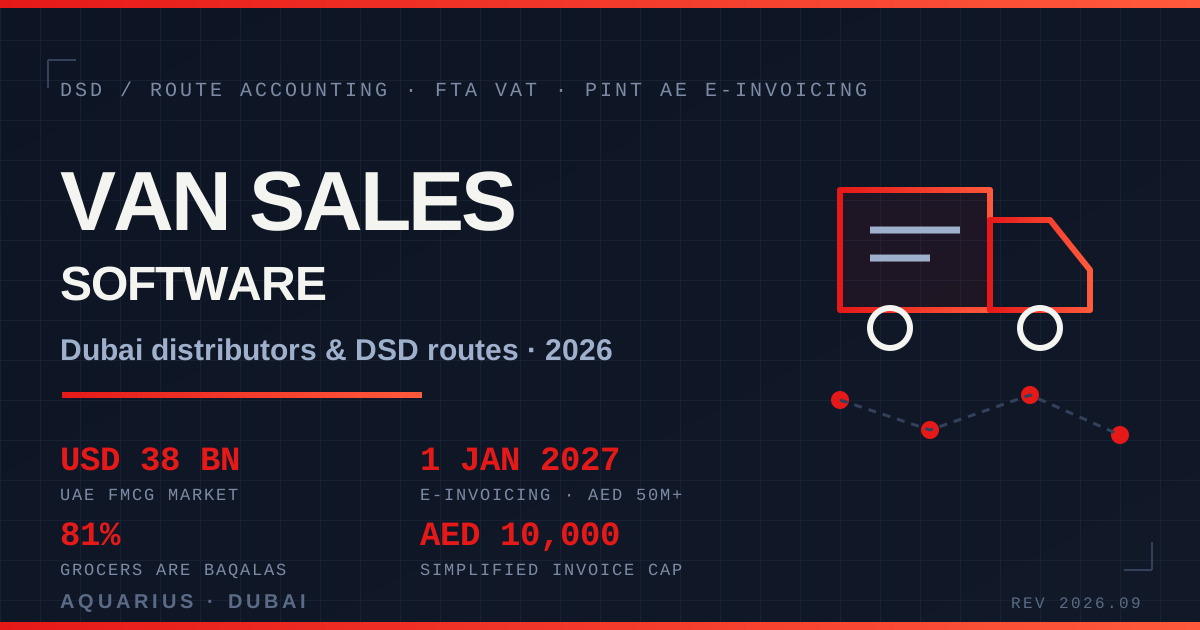
Short answer: van sales software (also called route accounting or DSD software) puts a Dubai distributor's whole route on one offline-first app — load the van, sell or deliver at the shop, print an FTA-compliant tax invoice at the door, take cash or credit, then reconcile stock and money in one end-of-day report. Off-the-shelf subscriptions run roughly AED 140–550 per user per month, and a custom or ERP-integrated build lands between AED 15,000 and AED 120,000+ depending on integrations. The deadline that should be driving your decision is 1 January 2027, when Peppol e-invoicing becomes mandatory for UAE businesses above AED 50 million.
Key takeaways
- The market is van-shaped: the UAE FMCG market is worth about USD 38 billion growing at roughly 5% CAGR, and 81% of UAE grocery retailers are baqalas under 50 square metres — thousands of tiny drops no hypermarket EDI feed will ever serve.
- Paper invoicing has an expiry date: the FTA e-invoicing pilot opens 1 July 2026, ASP appointment for large businesses is due by 30 October 2026, and PINT AE via Peppol is mandatory from 1 January 2027 (AED 50M+), 1 July 2027 (smaller businesses) and 1 October 2027 (government entities).
- Most Dubai distributors get this wrong: they buy a van sales app that syncs orders but cannot legally close a sale at the door. A simplified tax invoice must be issued on the date of supply — not within 14 days like a standard tax invoice.
- Real money: per-user SaaS from about AED 140–290 per user per month at the low end, AED 150–550 for ERP-class seats, plus SME implementation commonly quoted at AED 15,000–80,000.
Why Dubai distribution still runs on vans
Every few years someone declares that traditional trade is dying in the UAE. The numbers say otherwise. The UAE FMCG market sits at around USD 38 billion with roughly 5% annual growth forecast over the next five years, and off-trade outlets — supermarkets, hypermarkets and grocery stores — accounted for 71.98% of UAE food sales in 2025.
The critical detail for a distributor is the shape of that demand. 81% of grocery retailers in the UAE are small shops known as baqalas, measuring no more than 50 square metres, and 60% of UAE consumers visit a small grocery store at least once a week. That is a long tail of outlets ordering two cases at a time, paying part cash and part credit, and expecting a printed invoice before the salesman leaves. Serving them profitably is not really a logistics problem. It is a data-capture problem, and it happens in a moving vehicle with patchy signal in an industrial block in Al Quoz or Ras Al Khor.
That is the gap van sales software fills: it turns every drop into a clean, tax-compliant, same-second transaction instead of a carbon-copy book someone keys in at 9pm.
What van sales software actually does
The category name changes by vendor — van sales, route accounting, DSD (direct store delivery), mobile selling — but a serious system for the UAE covers eight jobs. If a demo skips any of them, you will be paying a human to patch the gap later.
| Module | What happens on the route | Why it matters in the UAE |
|---|---|---|
| Van loading / stock issue | Warehouse issues stock to a van as a controlled transfer | Every van becomes its own stock location; variance is attributable |
| Route & journey plan | Day-wise visit lists with GPS-stamped visit compliance | Proves coverage and exposes the phantom-visit problem |
| Invoice at the door | 5% VAT tax invoice or simplified invoice printed on a Bluetooth thermal printer | FTA timing rules make same-visit issuance non-negotiable |
| Cash & credit control | Collections plus outstanding balance visible before the sale | Stops a rep selling more credit to an outlet already 90 days overdue |
| Returns, damages, expiry | Captured as typed transactions, not scribbles | Expiry and recall traceability for food and pharma lines |
| Offline-first sync | Full functionality with no signal; auto-sync on reconnect | Basements, cold stores and free-zone dead spots |
| End-of-day reconciliation | One report matching stock out, sales, returns and cash in | Turns hours of manual matching into a single confident close |
| ERP / accounting sync | Posts to the ledger, inventory and customer accounts | Prevents the second set of books that wrecks audits |
The one feature buyers consistently underrate is offline-first. An app that needs connectivity to price a line or generate an invoice number will fail at exactly the moment a customer is standing there with cash. Ask the vendor to put the demo device in airplane mode and complete a full sale, printing included. Many cannot.
The FTA rules that decide your build
This is where most Dubai van sales projects quietly go wrong, so it is worth being precise.
A simplified tax invoice may be issued where the recipient is not VAT-registered, or where the recipient is VAT-registered and the consideration does not exceed AED 10,000. Above AED 10,000 including VAT you need a full tax invoice — and only a full tax invoice supports the customer's input tax recovery. A standard tax invoice must be issued within 14 days of the date of supply, but a simplified invoice must be issued on the date of supply itself. In plain terms: your van cannot promise to email it tomorrow.
Then comes e-invoicing. The UAE's phased mandate now has firm dates:
| Milestone | Date | Who it hits |
|---|---|---|
| Voluntary pilot opens | 1 July 2026 | Any business ready to test |
| Appoint an accredited service provider (ASP) | 30 October 2026 | Revenue of AED 50,000,000 or more |
| ASP appointment deadline | 31 March 2027 | Smaller businesses and government entities |
| Mandatory PINT AE via Peppol | 1 January 2027 | Revenue of AED 50,000,000 or more |
| Mandatory | 1 July 2027 | Smaller businesses |
| Mandatory | 1 October 2027 | Government entities |
Two practical consequences. First, the mandate applies to persons conducting business regardless of VAT registration, with limited exclusions — so being under the VAT threshold is not a strategy. Second, the accreditation rules for service providers now include an experience requirement: the proposed e-invoicing solution must have been in operation for at least two years, and the applicant must already be a Peppol-certified service provider. That has a direct effect on your architecture. Do not plan to become your own Peppol access point. Build the van sales layer so it hands a clean, structured document to an accredited ASP, and keep that integration behind an interface you can swap. We go deeper on the plumbing in our UAE e-invoicing ERP integration guide.
What it costs in Dubai in 2026
Pricing splits into three honest buckets, and vendors rarely present them together.
| Option | Typical cost (AED) | Best for |
|---|---|---|
| Per-user SaaS van sales app (entry to premium tiers) | About 140–290 per user / month | 3–15 vans, standard FMCG flows |
| ERP or CRM-class seat licence | 150–550 per user / month | Distributors already standardised on a large suite |
| One-time quick-start setup and configuration | From about 3,700 | Small teams plugging into existing accounting |
| SME implementation (config, migration, training) | 15,000–80,000 | Most Dubai distributors, one-off |
| Mid-size year-one programme | About 120,000 one-off, plus about 25,000 a year support | Multi-branch, multi-warehouse, multi-emirate |
Do the arithmetic before you sign. A 20-user team at AED 300 per user per month is over AED 72,000 a year in subscription alone; 15 users at AED 450 is AED 81,000 a year. Across five years that is AED 360,000–405,000 of rent on software you never own. All figures exclude 5% VAT, and none include hardware: budget separately for rugged or mid-range Android handhelds plus a Bluetooth thermal printer per van.
There is a second cost nobody quotes: the per-seat tax on growth. If every new salesman adds a monthly fee, you will ration the app — and an app used by half the fleet gives you half a data set. Distributors who scale routes aggressively (one documented UAE case went from 7 vans to 15) tend to prefer models where adding a device does not add a licence. Our Dubai ERP implementation cost guide breaks the same maths down for the wider system.
Buy, configure or build?
Three routes, and the right answer depends on how unusual your business really is.
- Buy off-the-shelf if you sell cases of standard SKUs on fixed routes with simple pricing. Fast, proven, FTA formats already handled. You accept the per-user cost.
- Configure an open ERP such as Odoo or ERPNext if you want ledger, warehouse and van app in one system without per-seat fees. Expect real implementation effort, not a weekend.
- Build custom when your margin lives in rules no product supports: tiered trade promotions per outlet class, free-goods schemes, consignment stock, cold-chain temperature logs tied to the invoice, an Arabic-first rep interface, or an existing warehouse system you will not replace. See our warehouse management system guide for how the two layers meet.
A note specific to Dubai: if you distribute chilled or frozen goods, the vehicle itself is regulated. Commercial vehicles carrying food that needs refrigeration or temperature control must meet Dubai Municipality hygiene and safety criteria, verified through authorised testing centres. Your software should hold that evidence — vehicle permit expiry, temperature logs, food-handler status — because on the day an inspector asks, a photo in a WhatsApp group is not a record. The same discipline applies to PDPL: GPS-tracking your reps is lawful, but it is personal data, so state the purpose, the retention period and who can see it, in writing.
How Aquarius builds it
We build van sales and route accounting systems as an offline-first React Native app plus a Node backend that owns pricing, invoice numbering and reconciliation, with a thin adapter for your accounting system and a separate adapter for the e-invoicing ASP. Invoice numbers are server-authoritative with an offline-safe reserved range per device, so two vans can never mint the same number — the single most common defect we find in systems already running in production here.
We start with a paid discovery and a two-van pilot on one real route, because the process described in a meeting is never the process running in the vehicle. Route-by-route rollout follows. You own the code and the database, the invoice format is validated against FTA field requirements before launch, and the reconciliation report is signed off by your accountant rather than by us. Indicative ranges are on our pricing page, and for an ordering layer the outlets themselves can use, see our B2B wholesale portal guide.
The cost-of-inaction number is the one to weigh at decision time. A distributor running 10 vans at AED 8,000 of daily sales per van moves roughly AED 24 million a year through those vehicles. A 1% leak in unrecorded returns, pricing errors and unreconciled cash is AED 240,000 — more than the entire cost of a custom system, every single year.
FAQ
Do I need van sales software if I only run three vans?
Yes, though probably an off-the-shelf subscription rather than a custom build. Three vans still produce a daily reconciliation problem and carry the same FTA invoice timing obligations as thirty. The threshold for software is not fleet size; it is whether stock and cash leave your sight.
Will my van sales app be compliant with UAE e-invoicing?
Only if it can emit a structured document in PINT AE format and pass it to an accredited service provider on the Peppol network. Ask the vendor two questions: which ASP do they integrate with, and can they show a test transmission. Large businesses must have an ASP appointed by 30 October 2026 and be live by 1 January 2027.
Can the app work without internet in Dubai industrial areas?
A properly built one can. Insist on a live airplane-mode test covering pricing, VAT calculation, invoice numbering and printing. Sync-only apps that merely queue orders are order-taking tools, not route accounting systems.
How long does implementation take?
A configured off-the-shelf rollout typically reaches a stable evening close within a few weeks if you pilot one or two vans first and expand route by route. A custom build with ERP and ASP integration is a longer programme — plan in months, and never migrate every route on the same Monday.
Should the warehouse run the same system?
Ideally the van app and the warehouse share one stock ledger, so a van load is a transfer rather than a paper note. If you already run a separate warehouse system, integrate rather than duplicate, and make the warehouse the single source of truth for quantity on hand.
If you are weighing buy against build for your routes in Dubai or across the Northern Emirates, send us your current route sheet and your evening close report. We will tell you plainly which of the three options fits — including when the answer is to buy something off the shelf and spend nothing with us.