
Baseline 2026 for Dubai Websites: We Checked 598 .ae Sites and 53% Use Zero Modern Web Features
Container queries reach 96% of browsers. Only 17.4% of top .ae sites use them. 70.1% still ship jQuery. Here is what Baseline 2026 is worth to a Dubai business, and what a retrofit costs in AED.
- PUBLISHED
- 23 NOV 2026
- READ TIME
- 12 MIN
- AUTHOR
- AQUARIUS · DUBAI
- UNIT
- REV 2026.09
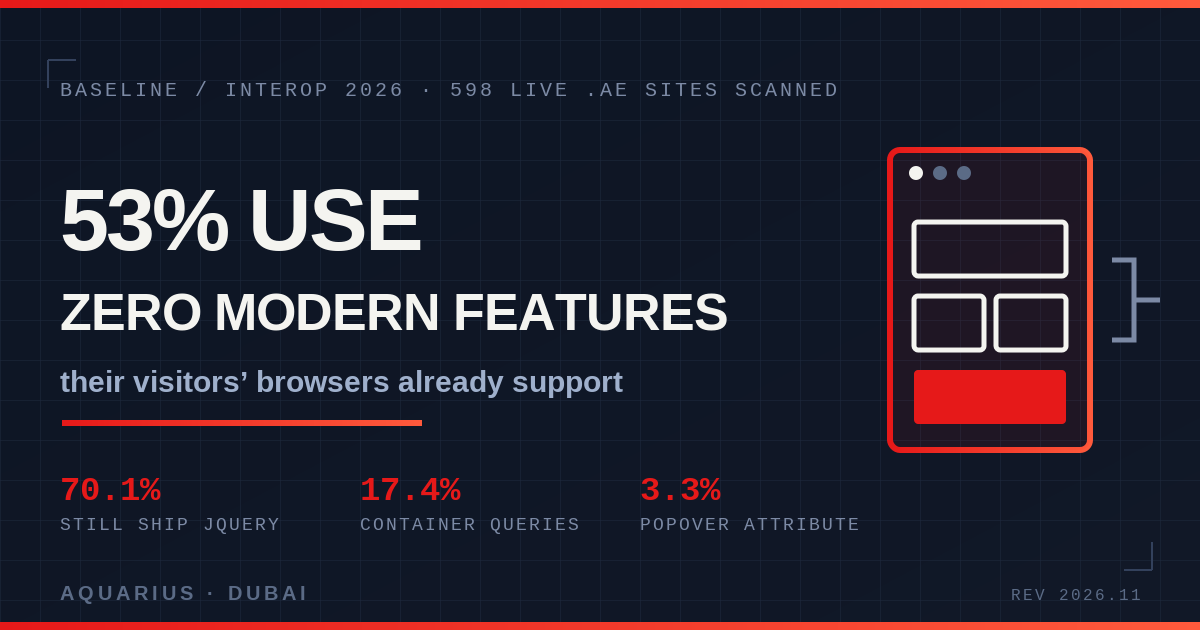
Short answer: Baseline is the industry label that tells you when a web feature is safe to use in every major browser — "Newly available" when all core browsers ship it, "Widely available" 30 months later. In November 2026 we scanned 598 live .ae websites to see how many actually use the features that already cleared that bar. 53.3% use none of them. Meanwhile 70.1% still ship jQuery, a library that exists mostly to work around browser gaps that closed years ago.
This is the cheapest performance and UX win available to a Dubai business in 2027, and almost nobody in the market is taking it. Not because the features are risky — they are not — but because the agencies building UAE websites are still writing 2017 CSS.
What Baseline actually means (and why 2026 is the year it matters)
Baseline is maintained by the W3C WebDX Community Group and surfaced on MDN, caniuse and web.dev. Its core browser set is Chrome (desktop and Android), Edge, Firefox (desktop and Android) and Safari (macOS and iOS). A feature is Newly available once all of those ship it. It becomes Widely available exactly 30 months after the newly-interoperable date, at which point web.dev's own guidance is that it "can be used by most sites without worrying about support."
For the UAE specifically, that browser set is close to the whole market. On StatCounter's October 2026 figures, Chrome holds 76.98% of UAE traffic, Safari 12.05% and Edge 2.7% — so roughly 92% of UAE sessions run on a Baseline core browser, before you count Samsung Internet and Opera, which are Chromium underneath and inherit the same features.
And on 12 February 2026, Apple, Google, Igalia, Microsoft and Mozilla published Interop 2026: 19 focus areas, 3 cleanup areas and 4 investigation areas that all five vendors committed to making work identically. The list reads like a direct answer to what Dubai sites are not using: dialogs and popovers, container style queries, anchor positioning, view transitions, scroll-driven animations, scroll snap, contrast-color(), and unprefixing -webkit-user-select.
So the platform is converging. The question is whether your site is on the right side of the convergence.
What we measured
We took every .ae host in the Tranco top-one-million ranking — 785 of them — requested each homepage over HTTPS with a desktop Chrome user agent, and for every host that answered we downloaded up to six first-party stylesheets and three first-party scripts, plus the contents of every inline <style> block. That gave us 598 live sites with parseable front-end code. We then searched that code for 32 feature fingerprints. Every detector was validated against a known-positive control first, so a low number here is a low number, not a broken regex.
Browser-support percentages below are caniuse global usage as of November 2026. Adoption is our own scan.
| Feature | Baseline / browser support | .ae sites using it |
|---|---|---|
aspect-ratio | Widely available | 51.0% (305) |
dvh / svh viewport units | Widely available | 27.1% (162) |
color-mix() | Widely available | 19.4% (116) |
| Container queries | Widely available, ~96% | 17.4% (104) |
text-wrap: balance | Newly available | 16.6% (99) |
:has() selector | Widely available, ~96% | 37.0% (221) |
@layer cascade layers | Widely available | 6.0% (36) |
oklch() colour | Widely available | 4.3% (26) |
| Native CSS nesting | Newly available | 3.8% (23) |
popover attribute | Widely available since Apr 2024, ~94% | 3.3% (20) |
| Subgrid | Widely available | 2.2% (13) |
| View transitions (CSS) | Interop 2026 focus area | 1.2% (7) |
| Anchor positioning | Interop 2026 focus area | 0.5% (3) |
@scope | Newly available | 0.2% (1) |
light-dark() | Newly available | 0.0% (0) |
| — legacy comparison — | ||
| jQuery | — | 70.1% (419) |
Vendor prefixes (-webkit-, -moz-) | — | 65.1% (389) |
float: left layout | — | 64.4% (385) |
Two numbers are worth sitting with. 68.2% of these sites use CSS Grid — and 52.7% use CSS Grid and float: left on the same page. That is the signature of a theme bought in 2018, patched in 2021, and never rebuilt. And not one site in 598 used light-dark(), the one-line way to support dark mode without duplicating your entire colour system.
The composite: how modern is the UAE web, really?
We scored every site on seven features that genuinely change how you build — container queries, :has(), @layer, view transitions, subgrid, anchor positioning and @scope. The distribution is brutal:
- 319 sites (53.3%) use none of the seven.
- 203 sites (33.9%) use exactly one — almost always
:has(), and usually because a framework shipped it, not because anyone chose it. - Only 26 sites (4.3%) use three or more.
- Zero sites use six or seven. The highest score in the entire UAE top-1M was five.
The .gov.ae subset — 59 live sites — is worse than the commercial average on every count: 78.0% ship jQuery, 67.8% still use float: left, 1.7% use container queries, and 0% use popover.
The tell: features only arrive when a platform gives them to you
Here is the finding that explains everything else. Two features bucked the trend, and both for the same reason.
Speculation Rules — the prerender API that makes next-page navigation instant — showed up on 100 of 598 sites (16.7%), which looks like healthy adoption until you check who. 91 of those 100 are WordPress sites. WordPress 6.8 turned speculative loading on by default in core. Nobody in that group decided anything; they ran an update. (If you want to switch it on deliberately, we wrote up the mechanics in instant page loads with Speculation Rules.)
The popover attribute — Baseline Widely available since April 2024, roughly 94% browser support, and it replaces an entire modal/dropdown JavaScript library with one HTML attribute — appeared on exactly 20 sites. We read all 20. Every single one is an international retail brand's UAE storefront: nike.ae, decathlon.ae, bloomingdales.ae, gap.ae, underarmour.ae, yslbeauty.ae, armanibeauty.ae, giordano.ae, faces.ae, chemistwarehouse.ae and similar. Not one is a locally built website.
The pattern is clear and it is the most useful thing in this dataset: in the UAE, modern web features arrive with a global platform, never with a local build. That is a gap you can price. If your competitors' sites only improve when WordPress or Shopify pushes an update, deliberate engineering is a durable advantage, not a nice-to-have.
Which of these actually move a number
Not all 32 features are worth your money. These five are, in order:
1. Container queries (17.4% adoption)
A card component that lays itself out based on its own width, not the viewport's. This is the single biggest maintenance saver on any UAE site with Arabic and English layouts, because the same component stops needing separate breakpoint rules per placement. Container style queries are an Interop 2026 focus area, so the remaining rough edges are being actively fixed.
2. popover + <dialog> (3.3% and 11.0%)
Native modals, dropdowns, tooltips and menus with correct focus trapping, Escape handling and top-layer stacking — for free, in HTML. This typically deletes 20–60 KB of JavaScript from a site and fixes accessibility defects at the same time. "Dialogs and popovers" is the sole HTML focus area in Interop 2026.
3. :has() (37.0%)
The parent selector. Removes most of the small "add a class with JavaScript so CSS can react" glue code that accumulates in every long-lived theme.
4. View transitions (1.2%)
Smooth animated navigation between pages with no single-page-app framework. With cross-document view transitions now in Safari as well, this reaches roughly 92% of UAE sessions. At 1.2% adoption it is effectively an unclaimed differentiator in this market.
5. light-dark() (0.0%)
Dark mode in one function instead of a parallel stylesheet. Zero of 598. There is no competitive reason this is at zero — it is simply that nobody looked.
Note what is not on this list: oklch(), @scope, scroll-driven animations. They are real and they are Baseline, but they do not pay for themselves on a typical Dubai business site yet. Modernising is not the goal. Removing jQuery-era weight and fixing broken interaction patterns is.
What a Baseline retrofit costs in Dubai
You do not rebuild. You retrofit, in order of payback. Realistic AED ranges for a typical UAE business site or storefront:
| Scope | What changes | Typical AED | Timeline |
|---|---|---|---|
| Baseline audit | Feature + weight report on your live site, prioritised fix list, before/after Core Web Vitals targets | AED 2,500 – 5,000 | 3 – 5 days |
| jQuery & legacy removal | Replace jQuery plugins with native equivalents, drop dead polyfills and vendor prefixes | AED 6,000 – 15,000 | 1 – 3 weeks |
| Native UI migration | Modals, dropdowns, menus and tooltips moved to popover / <dialog> with keyboard and screen-reader testing | AED 5,000 – 12,000 | 1 – 2 weeks |
| Layout modernisation | Container queries + :has() refactor, float removal, Arabic/RTL parity | AED 8,000 – 20,000 | 2 – 4 weeks |
| Full front-end rebuild | New Baseline-first front end on your existing CMS or commerce back end | AED 25,000 – 60,000 | 5 – 9 weeks |
The audit is the only step you should ever buy first. On more than half the sites in our scan, the single highest-ROI change was deleting code, not writing it — and you cannot price that until someone has actually measured your bundle.
Why this is a revenue question, not a tidiness question
The UAE e-commerce market is tracked at USD 12.30 billion in 2026, heading to USD 21.01 billion by 2031 at an 11.29% CAGR (Mordor Intelligence). Smartphones processed 78.67% of UAE orders, and the Central Bank's March 2026 retirement of SMS-based one-time passwords is cutting mobile checkout times by a further 30–40%. Every one of those orders passes through the front end you are deciding whether to fix.
That is the cost-of-inaction number. A mobile-first market growing at 11% a year, running on sites where 70% still load jQuery before they load content. Google and Deloitte's Milliseconds Make Millions study measured an 8.4% lift in retail conversions from a 0.1-second mobile load-time improvement — and deleting a jQuery-plus-plugins stack is usually worth considerably more than 0.1 seconds on a mid-range Android phone over UAE mobile data.
How Aquarius does it
We build Baseline-first by default and we measure rather than assume. Every front end we ship gets a feature-support budget tied to the actual StatCounter UAE browser mix, native HTML for anything that has a native element, and a documented fallback for anything that is only Newly available. We test RTL Arabic and LTR English on the same components, on real mid-range Android devices on a UAE network — not on a MacBook on fibre.
Risk reversal: the Baseline audit is a fixed-fee, fixed-scope deliverable with no obligation to buy the retrofit. You get the report, the prioritised list and the measured before/after targets, and you are free to hand it to whoever currently maintains your site. Our published pricing starts at AED 2,500 for a Business Site and AED 10,000 for custom app work — AED-first quotes, fixed scope, and you own the code and the accounts at handover. If you want the other half of the "free capability nobody switched on" story, read our scan of WebGPU across 586 .ae sites, where the adoption number was zero.
Most Dubai businesses get this wrong in the same way: they budget for a redesign when what they need is a measurement. Start with the audit.
FAQ
Is it safe to use Baseline "Widely available" features on a UAE website in 2027?
Yes. Widely available means 30 months have passed since every core browser shipped the feature. With Chrome at 76.98%, Safari at 12.05% and Edge at 2.7% of UAE traffic, you are covering roughly 92% of local sessions directly, and the Chromium-based remainder inherits the same support. For "Newly available" features, add a fallback.
Do I need to remove jQuery?
Not on day one, and not for its own sake. Remove it when you remove what depends on it — the modal plugin, the carousel, the form validator. Replacing those with popover, <dialog> and native constraint validation is what deletes the weight; pulling jQuery out while leaving 12 plugins behind just breaks the site.
Will modern CSS break Arabic or RTL layouts?
The opposite. Logical properties, container queries and :has() were designed partly to make bidirectional layouts stop needing a separate stylesheet. Most RTL bugs we see in UAE sites come from hard-coded left/right values in float-era CSS — the exact code a Baseline retrofit removes.
How do I check my own site?
Open your stylesheet bundle and search it for @container, :has(, light-dark( and popover. If all four return nothing, you are in the 53.3%. Chrome DevTools' Lighthouse and the web-features explorer on web.dev will tell you the Baseline status of anything you are unsure about.
Is this the same thing as Core Web Vitals?
Related, not identical. Core Web Vitals measure outcomes — load, responsiveness, stability. Baseline features are one of the cheapest levers for improving those outcomes, because the native version of a component is almost always smaller and faster than the JavaScript one it replaces. Fixing Baseline adoption tends to fix INP in particular.
Method: 785 .ae hosts from the Tranco top-one-million list, scanned November 2026; 598 returned parseable front-end code. Sources: web.dev Baseline documentation; W3C WebDX web-features explorer; Igalia and web-platform-tests Interop 2026 announcement (12 February 2026); caniuse global usage data, November 2026; StatCounter GlobalStats UAE browser share, October 2026; Mordor Intelligence UAE E-commerce Market report; Deloitte Digital and Google, Milliseconds Make Millions.