
We Scanned 586 Live .ae Websites for WebGPU: Zero Use It (Dubai On-Device AI Guide 2027)
We scanned 2,773 JavaScript bundles across 586 live .ae websites. Not one calls navigator.gpu. Yet 8% already ship WebAssembly. Here is what on-device AI is worth to a Dubai business in 2027.
- PUBLISHED
- 23 NOV 2026
- READ TIME
- 12 MIN
- AUTHOR
- AQUARIUS · DUBAI
- UNIT
- REV 2026.09
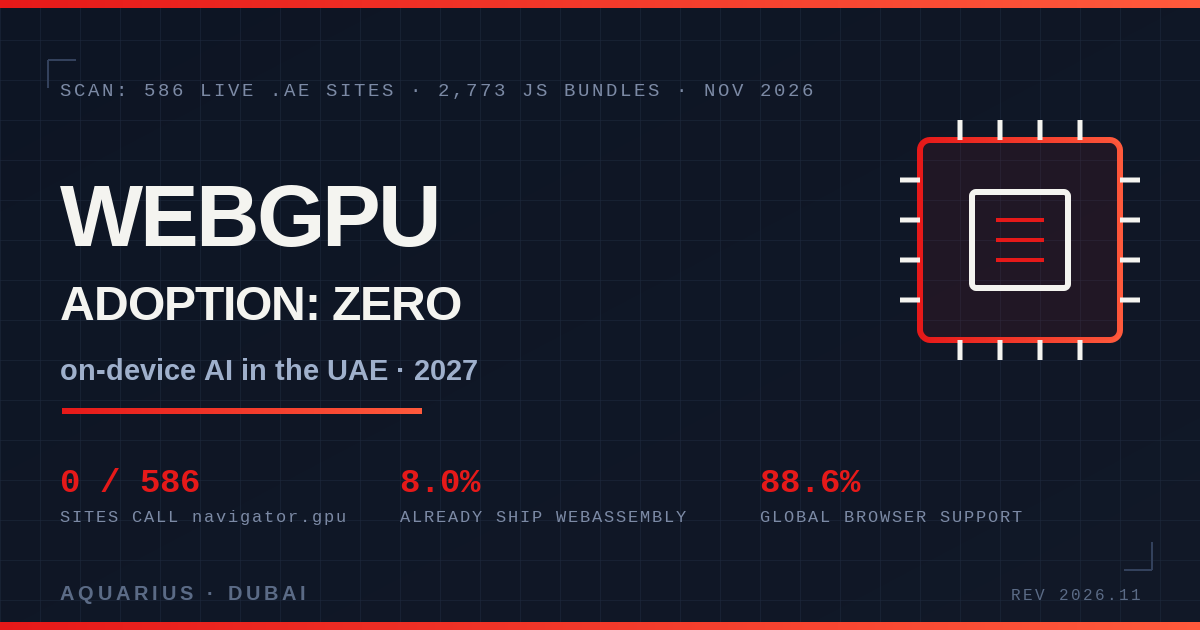
Short answer: WebGPU is the browser API that hands JavaScript direct access to the visitor's graphics chip, which makes it practical to run real AI models — translation, semantic search, image cleanup, live vision — on the customer's own device instead of through a paid cloud API. It is now available to roughly 88.6% of global web traffic. In November 2026 we scanned 586 live .ae websites and found exactly zero of them using it.
That is not a typo and it is not a rounding artefact. We pulled every .ae host in the Tranco top one million, fetched the homepage of each one that answered, downloaded 2,773 of their first-party JavaScript bundles, and searched 287 MB of shipped code for a single call to navigator.gpu. Nothing. Meanwhile 8.0% of those same sites already ship WebAssembly and 5.1% already ship TensorFlow.js — so UAE sites are running compute in the browser today. None of it is on the GPU.
Why this matters right now in the UAE
The gap is strange because the demand is not theoretical. The UAE artificial intelligence market was valued at USD 4.60 billion in 2025 and is tracked at roughly USD 9.80 billion for 2026. Adoption among UAE businesses jumped to 72% in 2026, up from 53% the year before, according to research published with the UAE AI Office. On the consumer side, 73.3% of the UAE's working-age population now uses generative AI — the highest penetration rate measured anywhere in the world.
Spending is following. UAE AI software spend grew roughly five-fold year on year and now accounts for about a quarter of all software spend, and PwC's 29th Annual CEO Survey found 72% of UAE employees already using AI at work, 24% of them daily, with 83% reporting productivity gains. So the market is buying AI aggressively. It is buying all of it by the token, from servers outside the country.
Here is the part most Dubai businesses get wrong: they treat "AI feature" and "API call to a foreign model" as the same decision. They are not. Every inference that leaves the device is a recurring bill, a latency penalty, and — if it carries personal data — a cross-border transfer under the UAE Personal Data Protection Law. WebGPU is the option where none of those three things happen.
What we actually measured
The scan ran in November 2026. Method: take the Tranco top-one-million ranking, filter to .ae hosts, request each homepage over HTTPS with a desktop browser user agent, then extract and download up to six first-party script URLs per host and regex the contents for runtime fingerprints. The detectors were validated against a known-positive control bundle first, so a zero here means zero, not a broken pattern.
| Signal | Sites | Share of live sites |
|---|---|---|
.ae hosts in Tranco top 1M | 780 | — |
| Homepages answering with HTTP 200 | 586 | 100% (the base) |
| First-party JS bundles scanned | 2,773 files / 287 MB | — |
WebGPU (navigator.gpu, requestAdapter) | 0 | 0.0% |
| ONNX Runtime Web, transformers.js or WebLLM | 0 | 0.0% |
| WebAssembly | 47 | 8.0% |
| TensorFlow.js | 30 | 5.1% |
| WebGL | 26 | 4.4% |
| three.js | 22 | 3.8% |
| MediaPipe | 2 | 0.3% |
.gov.ae hosts live, using WebGPU | 61 live / 0 using | 0.0% |
Two honest caveats. We looked at homepages, not entire sites, and we capped script downloads per host — a WebGPU feature buried on an authenticated dashboard would not show up. And a site can of course feature-detect WebGPU without shipping the string we searched for, though in practice the API surface is hard to use without naming it. Treat 0.0% as "no meaningful public adoption", which is the conclusion either way.
WebGPU is not the same thing as Chrome's built-in AI
This confusion costs Dubai teams real money, so it is worth separating cleanly.
Chrome's built-in AI ships a specific small model (Gemini Nano) inside the browser and exposes it through fixed JavaScript APIs for translation, summarisation and prompting. You get it free, you get it instantly, and you get whatever Google decided the model should do — which, as we covered in our guide to Chrome's built-in AI and the Arabic catch, still has real gaps for Arabic reasoning.
WebGPU ships nothing. It is a compute pipe to the GPU. You choose the model, you choose the quantisation, you choose whether it is a 1B-parameter chat model, a 90 MB multilingual embedding model, a background-removal network or a custom ranking model trained on your own catalogue. The ceiling is much higher and the control is total; the cost is that you own the download, the memory budget and the fallback path. It also works beyond Chrome: WebGPU is supported in Chrome and Edge from version 113, Safari from version 26 across macOS, iOS and iPadOS, Samsung Internet from 24, and Firefox on Windows since version 141.
The UAE browser reality check
Global support numbers are useless if your traffic is Dubai traffic, so check it against the local mix. StatCounter's October 2026 UAE mobile figures put Chrome for Android at 72.1% and Safari on iPhone at 14.99% — both WebGPU-capable on current versions, with the iPhone share gated on iOS 26 or newer. Below that, Chrome for iPhone sits at 3.8% (it uses WebKit, so it inherits Safari's support), and the two UC Browser builds together hold about 3.3% with no WebGPU at all. In other words: the large majority of UAE mobile sessions can do this today, and a stubborn few per cent never will. That is a fallback requirement, not a blocker.
Four workloads worth moving to the device
Do not start with a chatbot. Start where on-device wins on cost, latency and compliance simultaneously.
- Semantic site and catalogue search. A small multilingual embedding model runs locally, so Arabic and English queries match the same products without a round trip. Every keystroke of a type-ahead becomes free instead of billable.
- Image preparation before upload. Background removal, document edge detection, Emirates ID or trade licence cropping, compression. The file is cleaned on the device, so you upload less and store less.
- Classification and routing. Sentiment on a review, language detection on a support message, "is this a complaint or an order", spam screening on a form. Small models, enormous call volume, zero marginal cost.
- Live camera vision. Fit and pose for retail, barcode and label reading in a warehouse app, liveness hints in onboarding. Streaming frames to a server is both slow and a privacy problem; on the GPU it is neither.
The architecture that actually survives production is a three-step ladder, not a bet: WebGPU where available, WebAssembly as the slower local fallback, cloud API only as the last resort. Published browser benchmarks put WebGPU in the region of 5–20x faster than WebAssembly for neural network inference, with 1B-class quantised models reaching roughly 30–60 tokens per second on current consumer hardware. WebAssembly keeps the feature alive on the 3.3% that cannot do GPU; the cloud call keeps it alive on an ancient device.
What the cost difference looks like in AED
Take a mid-sized Dubai e-commerce or portal workload: 50,000 assisted searches or classifications a month, roughly 700 input tokens and 150 output tokens each. Priced against a mid-tier hosted model at USD 2 per million input tokens and USD 10 per million output tokens, converted at AED 3.6725 to the dollar:
| Approach | Monthly inference cost | Annual | What you pay instead |
|---|---|---|---|
| Cloud API, every query | about AED 530 | about AED 6,400 | Tokens, forever, scaling with traffic |
| Cloud API at 10x this traffic | about AED 5,300 | about AED 64,000 | Tokens, forever, scaling with traffic |
| WebGPU on-device | AED 0 | AED 0 | One cached model download (90 MB to 1.1 GB) and CDN egress |
| On-device plus cloud fallback | about AED 50 to AED 150 | about AED 600 to AED 1,800 | Tokens only for the unsupported tail |
The headline is not the AED 530. It is the slope. On-device inference cost does not move when your traffic triples, which is the single most useful property a Dubai growth-stage business can buy. If you are weighing the server-side version of this same question, our breakdown of self-hosted LLM versus managed inference costs works through the hosted side of the ladder.
The compliance argument nobody is making yet
This is the reason a Dubai CFO should care, not just a Dubai CTO. The UAE Personal Data Protection Law (Federal Decree-Law No. 45 of 2021) has been in force since 2 January 2022, and its cross-border transfer provisions restrict moving personal data outside the UAE without a lawful basis. When your website sends a customer's Arabic support message, uploaded ID photo or purchase history to a model hosted abroad, that is a cross-border transfer of personal data — it does not stop being one because it happened inside an API call.
Inference that never leaves the browser removes the transfer entirely. There is no DPA to negotiate for that feature, no sub-processor to disclose, no residency question to answer in a procurement questionnaire. With the Executive Regulations still unpublished and a single Artificial Intelligence and Data Authority now owning the file — the full timeline is in our UAE AI and Data Authority compliance clock — the cheapest compliance posture available in 2027 is the architecture where the obligation never attaches.
What a WebGPU build costs in Dubai, and how we scope it
Our ranges for this work, all fixed-scope:
| Engagement | AED range | Timeline | What you get |
|---|---|---|---|
| Feasibility spike on your own data | AED 9,000 – 18,000 | 1 to 2 weeks | Device-support report from your real analytics, one model benchmarked in-browser, go or no-go with numbers |
| One production on-device feature | AED 38,000 – 85,000 | 4 to 7 weeks | WebGPU path, WASM fallback, cloud fallback, model hosting and cache strategy, telemetry |
| Bilingual on-device search or vision pipeline | AED 95,000 – 180,000 | 8 to 14 weeks | Arabic and English embeddings, catalogue indexing, camera pipeline, full fallback matrix, load testing |
How we de-risk it: the feasibility spike is deliberately separable and its fee is credited against the build if you proceed, so the expensive decision is made with your own measured numbers rather than a vendor's benchmark. Every build ships the WASM and cloud fallbacks in the same release as the GPU path — we do not hand over a feature that breaks on 3.3% of UAE sessions. And we instrument adapter-acquisition success in production from day one, so you know the real support rate for your audience rather than the global one. See transparent pricing for how our fixed-scope engagements are structured.
The conversion maths is simple. A single cloud-inference feature at meaningful scale will cost AED 64,000 a year in tokens and never stop; one build at AED 85,000 removes that line item permanently and takes the cross-border transfer risk with it. The companies that move first also get something the budget does not capture: in a market where 72% of businesses have adopted AI and zero of the top 586 websites have touched the GPU in the browser, this is still an empty lane.
FAQ
Does WebGPU work on iPhones in the UAE?
Yes, on iOS 26 and later, which shipped with Safari 26 in September 2025 across macOS, iOS, iPadOS and visionOS. Safari on iPhone holds 14.99% of UAE mobile browsing as of October 2026, and Chrome for iPhone's 3.8% uses the same WebKit engine, so it inherits the same support. Always feature-detect rather than sniff the user agent.
Will a model download ruin my page speed?
Only if you load it on first paint, which you should not. Models range from roughly 90 MB for a small multilingual embedding model to about 1.1 GB for a 1B-parameter chat model, and they are cached after the first fetch. The pattern that works is lazy: render the page, then fetch the model on explicit intent (the user opens search, taps the camera, starts a chat), with a visible progress state and the cloud fallback already wired for anyone who will not wait.
Is this cheaper than Chrome's built-in AI?
No — built-in AI is free and needs no download, so use it where it fits. The honest split is that Chrome's built-in APIs win for translation and summarisation on Chrome desktop, and WebGPU wins everywhere you need your own model, cross-browser reach including Safari, Arabic-capable reasoning, or anything trained on your own catalogue.
Does on-device inference actually satisfy UAE PDPL?
It removes the cross-border transfer question for that specific processing, because the personal data never leaves the device. It does not exempt you from the rest of the law — consent, purpose limitation, data-subject rights and breach obligations all still apply to whatever you do store. Treat it as eliminating one of the hardest obligations, not all of them.
How do I know whether my own visitors support it?
Measure it, do not model it. Add a tiny analytics event that attempts navigator.gpu.requestAdapter() and records success, failure or absence, then let it run for a fortnight. You will have a real support percentage for your audience, which is the only number worth building a budget on. That measurement is the first thing in our feasibility spike.
The short version
Dubai businesses are buying AI faster than almost anywhere on earth, and paying for every single inference by the token while a free compute resource sits idle in their customers' pockets. Browser support reached 88.6% of global traffic; local adoption is zero. That combination does not last long.
If you want to know whether your traffic and your use case clear the bar, the two-week feasibility spike answers it with your numbers, not ours. Talk to Aquarius and bring your analytics.