
We Read Cache Headers on 536 UAE Websites: 1 in 6 Static Files Ships No Cache-Control at All (2027)
First-hand audit of 1,562 static files on 536 .ae domains: 17.9% send no Cache-Control, 39.7% of .gov.ae assets are uncacheable, and the p90 site re-serves 810 KB per repeat visit. Plus the AED fix.
- PUBLISHED
- 24 NOV 2026
- READ TIME
- 11 MIN
- AUTHOR
- AQUARIUS · DUBAI
- UNIT
- REV 2026.09
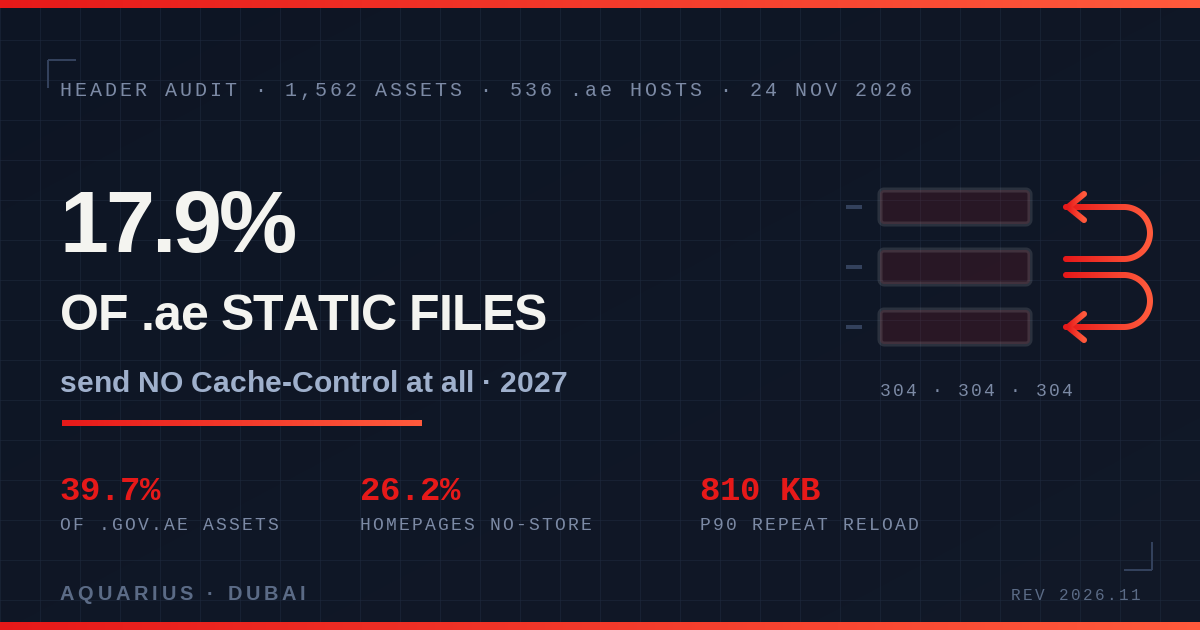
Short answer: on 24 November 2026 we read the HTTP cache headers on 1,562 static files served by 536 of the most-visited .ae websites. 17.9% of those files ship no Cache-Control header at all, 34.1% are either uncacheable or expire in under a day, and 77 hosts (14.4%) send no caching instruction on a single asset we sampled. The result is a UAE web where returning visitors re-download megabytes they already have on disk.
This is first-hand measurement, not a survey. We pulled the Tranco top-1M list, filtered it to .ae domains, fetched 781 homepages, parsed the HTML of the 584 that answered, then requested up to four first-party CSS, JS, image and font files per host and recorded every caching header on the response. Every number below comes from that dataset.
The state of HTTP caching on UAE websites (TOFU)
Three figures set the stakes:
- 280 of 1,562 static assets (17.9%) have no
Cache-Controlheader. Notno-store, notmax-age=0— nothing. The browser is left to guess. - 532 assets (34.1%) are missing a cache policy or expire in under 24 hours, and 48.1% of hosts (258 of 536) have at least one asset in that state.
- 26.2% of UAE homepages (153 of 584) send
Cache-Control: no-storeon the HTML document itself — a directive that forbids writing the response to disk at all.
For context, the Web Almanac's 2021 caching chapter — the last edition to measure this — found 25.1% of mobile resources worldwide with no Cache-Control and 10.3% using no-store. UAE sites are modestly better than that global baseline on static assets, and markedly worse on HTML documents.
It matters more here than almost anywhere. The UAE topped the Ookla Speedtest Global Index for mobile in September 2026 at 681.14 Mbps, so bandwidth is not the constraint — round-trips are. Every file without a cache policy costs a conditional request, and a conditional request costs a full network round-trip no matter how fast the pipe is.
Why "no Cache-Control" is not the same as "no caching"
This is the part most Dubai development teams get wrong. A missing Cache-Control header does not disable caching — it hands the decision to the browser's heuristic. RFC 9111 §4.2.2 permits a cache to invent a freshness lifetime from the Last-Modified date, and notes that "a typical setting of this fraction might be 10%" of the time since the file was last changed.
Our data shows exactly that fallback being leaned on: of the 280 assets with no Cache-Control, 267 still send Last-Modified and 231 send an ETag. Not one of them was missing both. So the files are usually reused — but only after a 304 round-trip, and with a lifetime nobody on the team chose. Chrome, which holds 76.98% of UAE browser share (StatCounter, October 2026), is the one making that call for you.
The sites that did choose a number mostly chose sensibly. Across the 1,237 assets carrying a max-age, the median is 30 days (2,592,000 seconds), the 25th percentile is 7 days and the 75th percentile is a full year. 527 assets (33.7%) are set to a year or more, and 175 (11.2%) add immutable — the RFC 8246 directive that tells clients not to revalidate at all during the freshness window.
What to set, and on what (MOFU)
There is no single correct Cache-Control value. There are four, and which one you need depends on whether the URL changes when the content changes.
| Resource type | Recommended header | Why | Share of our .ae sample getting it right |
|---|---|---|---|
Fingerprinted asset (app.4f2a1b.js) | public, max-age=31536000, immutable | URL changes on every deploy, so the file can never go stale | 66.9% of 611 fingerprinted URLs |
Un-fingerprinted asset (style.css) | public, max-age=3600 plus ETag | Short window, cheap revalidation, no risk of serving last month's CSS | 70.3% of 951 such URLs |
| HTML document | no-cache (or max-age=0, must-revalidate) | Always revalidate, but keep the copy for back/forward navigation | 25.0% of 584 homepages |
| Logged-in or personalised response | private, no-store | Keeps account data out of shared and disk caches | n/a — reserve for pages that genuinely need it |
Cross-tabulating fingerprinting against policy is where the real waste shows up. 202 of the 611 fingerprinted URLs we found (33.1%) are cached for less than 30 days or not at all — files that are safe to cache for a year, being re-fetched for no reason. And in the opposite direction, 282 of the 951 un-fingerprinted URLs (29.7%) are set to a year or marked immutable, which means a CSS fix will not reach returning visitors until they hard-refresh.
Google's Lighthouse flags the first case under its Serve static assets with an efficient cache policy audit, which looks for max-age=31536000 on scripts, stylesheets, fonts, images and media. If your Dubai site has ever scored badly on that audit, this is the reason.
The .gov.ae gap
Government sites are the weakest segment by a wide margin. Across 131 assets on 47 .gov.ae hosts:
- 39.7% have no
Cache-Control, versus 15.9% on non-government.aesites. - 58.8% are uncacheable or expire inside a day.
- Only 18.3% reach a one-year policy, and exactly one asset out of 131 uses
immutable. - Median
max-agewhere one exists: 7 days, versus 30 days elsewhere. - 13 of the 47 hosts (27.7%) send no caching header on any asset we sampled.
The consequences are measurable. For the 393 hosts where we could read content lengths on repeat-visit candidates, the median wasted re-download is 93.4 KB per return visit, the 75th percentile is 281.2 KB and the 90th percentile is 810.4 KB. The worst host in the sample re-serves 3.7 MB. Here are the named offenders, all captured on 24 November 2026:
| Host | File | Size | Cache-Control sent |
|---|---|---|---|
| dubaiculture.gov.ae | app.min.js | 2,320 KB | absent |
| dubaiculture.gov.ae | style.css | 1,386 KB | absent |
| added.gov.ae | style.css | 1,276 KB | absent |
| admobility.gov.ae | style.css?v=1.1 | 1,073 KB | absent |
| propertyfinder.ae | pf-icons-sprite.svg | 931 KB | public, max-age=0 |
| tamm.abudhabi | vendors chunk (hashed) | 637 KB | public, max-age=0 |
| dha.gov.ae | bundle.js | 580 KB | public, max-age=0 |
| moe.gov.ae | corev15.css | 243 KB | private,max-age=0 |
Note the pattern in rows 4 to 7. admobility.gov.ae version-stamps its CSS with ?v=1.1 and then caches it for zero seconds. Dubai Health Authority and TAMM both ship content-hashed bundles — the exact case immutable was designed for — behind public, max-age=0. PropertyFinder sets a one-year immutable policy on its web font and max-age=0 on a 931 KB icon sprite in the same page load. These are not architectural problems. They are one line of server config each.
Myth-bust: "we're behind Cloudflare, caching is handled"
We heard this from enough UAE teams to test it. Cloudflare fronted 775 of the asset responses we measured — the single largest server population in the sample, ahead of 155 nginx, 84 Apache, 48 LiteSpeed and 47 Microsoft-IIS. Of the 754 Cloudflare responses carrying a cache status, 459 (60.9%) were a HIT at the edge.
That is a good origin-offload number and it says nothing about your visitor's second page view. A CDN HIT means Cloudflare answered instead of your server; the request still left the device, still crossed the network, still cost a round-trip. Browser caching is the only layer that removes the request entirely — and it is driven by the Cache-Control header your origin sets, which Cloudflare forwards unchanged by default. An edge cache in front of a site with no Cache-Control protects your bandwidth bill, not your user's experience. We covered the edge side of this in our Dubai CDN and edge delivery cost breakdown.
The second myth is that no-store on HTML is a security best practice. Since Chrome rolled the change out to 100% of users in March 2025, pages served with no-store are eligible for the back/forward cache — but with a 3-minute timeout instead of 10, and they are evicted the moment a cookie changes. For the 26.2% of UAE homepages using no-store, that means instant back-button navigation silently degrades to a full reload. Unless the page contains personal data, no-cache gives you the same freshness guarantee without that penalty.
What it costs, and what fixing it is worth (BOFU)
Start with bandwidth, because it is the smaller number and being honest about it builds the case for the bigger one. CloudFront's pay-as-you-go rate for the Middle East is USD 0.110 per GB — about AED 0.404/GB at 3.6725 — versus USD 0.085 in the US and Europe, a 29% regional premium. At the 75th-percentile waste of 281 KB, 100,000 repeat sessions a month burns 28 GB, or roughly AED 11 per month. At the dubaiculture.gov.ae level of 3.7 MB, the same traffic costs about AED 146 per month.
So the bandwidth saving rarely pays for the work. The conversion effect does. Deloitte and Google's mobile-speed study measured a 0.1-second improvement in load time driving an 8.4% lift in retail conversion and a 9.2% rise in average order value. Eliminating eight to twelve conditional requests on a repeat visit is worth far more than 0.1 seconds on a mobile connection — and with UAE e-commerce heading from USD 12.30bn in 2026 to USD 21.01bn by 2031 (11.29% CAGR, Mordor Intelligence) and smartphones taking 78.67% of 2025 orders, repeat mobile visits are the traffic that matters most.
How Aquarius fixes this
We treat cache headers as a deploy-time contract, not a tuning exercise. Every build fingerprints its assets, every fingerprinted file goes out with public, max-age=31536000, immutable, HTML gets no-cache, and un-fingerprinted legacy files get a one-hour window plus a strong ETag. Then we re-run the same curl audit used for this article against staging, so a regression shows up before release rather than in a Lighthouse report three months later.
For most Dubai sites this is a half-day to two-day change depending on stack, and it pairs naturally with the compression work in our audit of text compression across 784 .ae domains — compression shrinks the first visit, caching removes the second one entirely. See our pricing for where a performance sprint sits, and if you just want to know how bad your own headers are, we will run the audit on your domain and send you the table.
FAQ
What is the best Cache-Control value for a website in Dubai?
There is no single value. Use public, max-age=31536000, immutable for files whose filename contains a content hash, public, max-age=3600 with an ETag for un-hashed assets, no-cache for HTML, and private, no-store only for authenticated responses. Geography does not change the directives — it changes the cost of getting them wrong, because a round-trip to a distant origin hurts more.
Does a missing Cache-Control header break caching?
No, but it removes your control. Browsers fall back to heuristic freshness based on Last-Modified — commonly around 10% of the file's age per RFC 9111 — and still issue a conditional request. In our sample, 267 of the 280 assets with no Cache-Control did send Last-Modified, so they are reused after a 304 rather than re-downloaded in full. You still pay the round-trip.
Is Cache-Control: no-store bad for SEO?
Not directly — Googlebot does not rank on your cache headers. It is bad for the user metrics that do feed into ranking. no-store shortens Chrome's back/forward cache window to three minutes and makes cookie changes evict the entry, which turns instant back-button navigation into a full page load. Use no-cache unless the response contains personal data.
How do I check my own site's cache headers?
Run curl -sI https://yourdomain.ae/path/to/app.js and read the cache-control, etag and last-modified lines. Do it for one CSS file, one JS bundle, one image, one font and the HTML document. If any fingerprinted file comes back without a long max-age, or any file comes back with no cache-control at all, you are in the 34.1%.
Will long cache lifetimes stop users seeing my updates?
Only if the URL stays the same. That is the whole point of fingerprinting: change the content, change the filename, and the year-long cache entry for the old file becomes irrelevant. The dangerous combination is the one on 282 of the un-fingerprinted URLs in our sample — a stable filename with a one-year policy. That genuinely does strand visitors on old code.
Cache headers are the cheapest performance win available to a UAE business: no redesign, no framework migration, no new vendor. Our scan says roughly a third of the country's most-visited sites are leaving it on the table. Send us your domain and we will tell you which third you are in.