
Brotli, zstd or gzip? We Scanned 784 UAE Websites and Half of .gov.ae Ships Zero Compression (2027)
First-hand scan of 784 .ae domains: 11.2% ship zero text compression, 51% of .gov.ae sites send uncompressed HTML, and u.ae wastes 881 KB per visit. Plus br vs zstd vs gzip, and AED fix costs.
- PUBLISHED
- 24 NOV 2026
- READ TIME
- 11 MIN
- AUTHOR
- AQUARIUS · DUBAI
- UNIT
- REV 2026.09
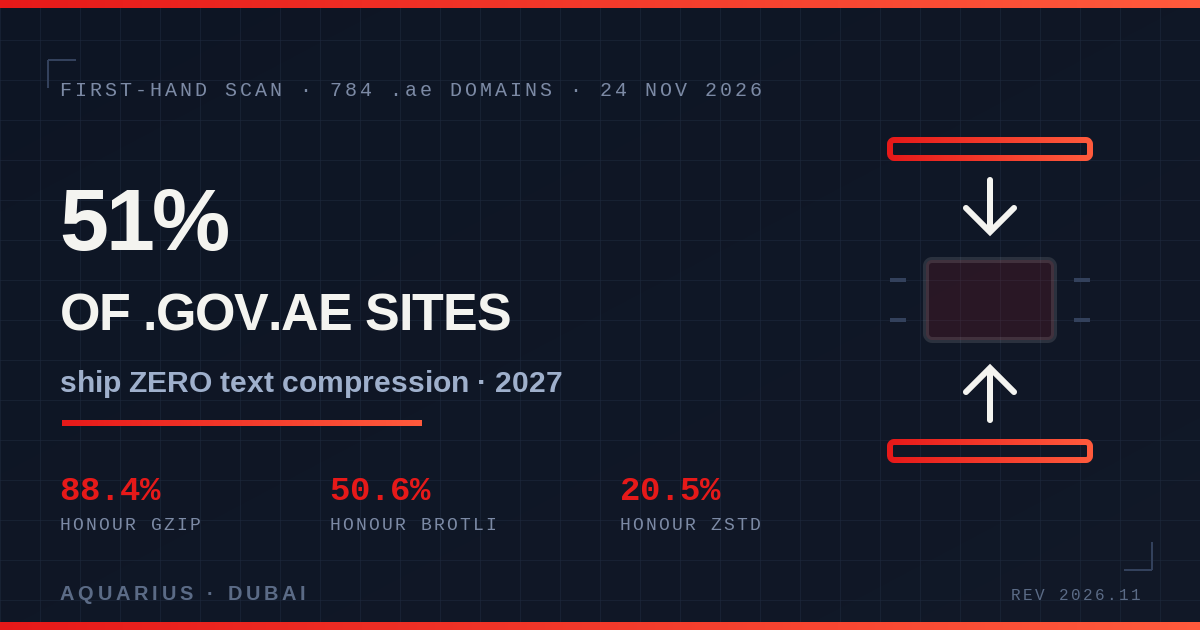
Short answer: on 24 November 2026 we asked 784 of the most-visited .ae domains for their homepage four times — once each with identity, gzip, br and zstd in the Accept-Encoding header — and measured what came back. Of the 561 that returned a real page, 88.4% honour gzip, 50.6% honour Brotli, 20.5% honour Zstandard, and 11.2% compress nothing at all. Across .gov.ae the picture collapses: 51.0% of UAE government homepages ship completely uncompressed HTML, including the national portal u.ae, which sends 947.7 KB of markup that gzip alone would reduce to 66.3 KB.
Text compression is the cheapest performance win in the UAE, and half the country skips it
This is one server setting. Not a rebuild, not a framework migration, not a CDN contract — one directive that every web server written in the last fifteen years supports. And it is still missing from one in nine of the busiest websites in the Emirates.
The context makes it worse, not better. The UAE has the fastest median mobile internet on earth at 681.14 Mbps (Ookla, October 2026), so the local excuse of "our users have good connections" is actually true — which means every uncompressed byte is a self-inflicted wound rather than a network problem. Meanwhile UAE e-commerce is heading from USD 12.30 billion in 2026 to USD 21.01 billion by 2031 at an 11.29% CAGR (Mordor Intelligence), with smartphones taking 78.67% of 2025 revenue share. The traffic is mobile, the money is growing, and the payload is unsqueezed.
There is also a scoring consequence most Dubai teams never connect. Lighthouse's "Enable text compression" audit only accepts br, gzip or deflate as valid encodings, and only fires when the response is over 1.4 KiB and the estimated saving exceeds 10%. Anything outside that list reads as uncompressed — which, as we show below, has a very specific consequence for anyone on a Cloudflare free plan in 2026.
What 784 UAE domains actually send
We probed every .ae host in the Tranco top-1M list. 114 refused to connect, 63 returned 403, and 561 returned a usable HTML page. Here is the encoding support, measured rather than assumed:
Encoding offered in Accept-Encoding | UAE sites that honoured it | Share of 561 |
|---|---|---|
gzip, deflate | 496 | 88.4% |
br (Brotli) | 284 | 50.6% |
zstd (Zstandard) | 115 | 20.5% |
| Nothing — uncompressed under every header | 63 | 11.2% |
| gzip only (no Brotli, no zstd) | 212 | 37.8% |
| Brotli but no zstd | 170 | 30.3% |
The payload numbers tell you what that costs. The median UAE homepage ships 211.0 KB of raw HTML; gzip takes the median down to 34.7 KB, an 81.4% saving. Four fifths of the document, gone, for a configuration line. That is a bigger single-step improvement than almost anything else on the Core Web Vitals checklist for Dubai websites, and it costs nothing per month.
One more structural finding: only 76.6% of these responses send Vary: Accept-Encoding. Compressing correctly but omitting Vary is how a shared cache ends up serving a Brotli body to a client that never asked for one. If you fix compression this week, fix the Vary header in the same commit.
The shareable number: UAE government sites are the worst offenders
51 .gov.ae domains returned a usable page. 26 of them — 51.0% — sent uncompressed HTML under every header we tried. Only 3 of 51 (5.9%) support Brotli. Not one supports zstd. Against a private-sector baseline of 11.2% uncompressed, that is a four-fold gap in the direction nobody expects.
We re-fetched the biggest offenders by hand with a desktop Chrome user-agent and a full Accept-Encoding: zstd, br, gzip, deflate header, confirmed each returned 200 with text/html and an empty Content-Encoding, then recompressed the saved body locally at gzip level 9:
| Domain | HTML sent today | Same HTML, gzip-9 | Saving | Wasted per visit |
|---|---|---|---|---|
u.ae (UAE Government Portal) | 947.7 KB | 66.3 KB | 93.0% | 881 KB |
tdra.gov.ae / tra.gov.ae | 1,139.1 KB | 413.5 KB | 63.7% | 726 KB |
mof.gov.ae (Ministry of Finance) | 581.3 KB | 83.6 KB | 85.6% | 498 KB |
scad.gov.ae (Abu Dhabi Statistics) | 514.9 KB | 84.4 KB | 83.6% | 431 KB |
tax.gov.ae (Federal Tax Authority) | 467.3 KB | 107.5 KB | 77.0% | 360 KB |
moiat.gov.ae (Industry & Advanced Technology) | 446.6 KB | 55.3 KB | 87.6% | 391 KB |
mmihomedelivery.ae (private, Vercel) | 1,299.2 KB | 99.0 KB | 92.4% | 1,200 KB |
Read the top row again. The UAE's national services portal transfers nearly a megabyte of HTML on every cold visit, and 93% of it is air. The tax authority sends 467 KB where 107 KB would do. These are not startups cutting corners; they are the highest-traffic public services in the country, and the fix is a server flag.
If your homepage is over 100 KB of HTML and your Content-Encoding response header is empty, you are shipping four to nine times more bytes than you need to. Check that one header before you spend a dirham on performance consulting.
Brotli, zstd or gzip: what the UAE data says to pick
Here is where the received wisdom breaks. Brotli is supposed to be the default and zstd the exciting newcomer. In the field, at the compression levels real edges actually choose, the margins are small and the ordering is not what the benchmark blogs promise.
Across the 283 UAE sites that served both, Brotli saved a median of 6.1% more than gzip — a median of just 1.0 KB per page. The mean was 6.8%, and the 90th percentile saving was 28.3 KB, so the win is real but heavily concentrated in large documents. And across the 114 sites serving both Brotli and zstd, zstd responses were a median of 6.2% larger than Brotli. Zstandard is not a ratio upgrade at edge defaults; it trades a little size for much faster decompression, which matters on cheap phones and high-throughput APIs rather than on your marketing homepage.
Browser support no longer decides this either. Brotli sits at 97.37% global support; Zstandard reached 86.45% (Chrome and Edge 123+, Firefox 126+, Opera 109+, Safari on iOS 26.3+), with no support in UC Browser, Samsung Internet or Opera Mini. That matters in the UAE specifically, because UC Browser still holds 2.49% of UAE browser share (StatCounter, September 2026) — a rounding error globally, a real segment locally. Globally the Web Almanac 2025 CDN chapter found CDN-served responses at 46% Brotli, 42% gzip, 12% Zstandard, with zstd quadrupling from 3% in 2024; at origin it is still 61% gzip to 39% Brotli.
| gzip | Brotli (br) | Zstandard (zstd) | |
|---|---|---|---|
| Browser support | Universal | 97.37% | 86.45% |
| Honoured by UAE sites (our scan) | 88.4% | 50.6% | 20.5% |
| Size vs gzip (UAE median) | baseline | 6.1% smaller | ~Brotli +6.2% |
| Counted by Lighthouse | Yes | Yes | No |
| Decompression speed | Fast | Moderate | Fastest |
| Best used for | Universal fallback | Static HTML, CSS, JS | Large dynamic responses, APIs |
The practical answer for a UAE business site: serve Brotli with a gzip fallback, and leave zstd off unless you have measured a decode-time problem. Order matters in your server config, because most clients send all three tokens and let you choose.
The Cloudflare free-plan trap
If you are on Cloudflare — and 278 of the sites in our scan are — your plan silently picks your encoding. Cloudflare's documented defaults are Zstandard on Free, Brotli on Pro and Business, and Gzip on Enterprise. That default is why our Cloudflare subset honours zstd at 40.3% while non-Cloudflare UAE sites manage 7.6%.
It also means a free-plan site can be serving a perfectly compressed response that Lighthouse reports as uncompressed, because the audit only recognises br, gzip and deflate. If you are chasing a green performance score on a Free zone, add a Compression Rule to force Brotli rather than arguing with the audit. Cloudflare compresses from 48 bytes for gzip and 50 bytes for br/zstd, and only on 200, 403 and 404 responses.
The Cloudflare effect is the single strongest predictor in our whole dataset. Sites behind Cloudflare: 86.7% Brotli, 51.5% zstd, 0.4% uncompressed. Everyone else: 35.6% Brotli, 7.6% zstd. Among sites that sent no Server header at all, 30.5% shipped nothing compressed.
What your server stack predicts
Breaking the 561 sites down by Server header shows exactly where UAE compression goes to die:
| Server | Sites | Brotli | zstd | No compression |
|---|---|---|---|---|
| Cloudflare | 278 | 80.6% | 40.3% | 0.4% |
No Server header | 95 | 8.4% | 0.0% | 30.5% |
| nginx | 52 | 9.6% | 0.0% | 7.7% |
| Apache | 28 | 7.1% | 0.0% | 25.0% |
| LiteSpeed | 18 | 88.9% | 0.0% | 0.0% |
| Microsoft-IIS | 18 | 11.1% | 5.6% | 50.0% |
| Vercel | 9 | 88.9% | 0.0% | 11.1% |
Plain nginx honours Brotli only 9.6% of the time — because Brotli is not built in. On Ubuntu 24.04 you install libnginx-mod-http-brotli from universe, which gives you the filter and static modules, then enable brotli on with brotli_types. Microsoft-IIS is the worst stack in the sample at 50% fully uncompressed, and it is heavily represented in UAE government hosting. LiteSpeed, by contrast, just works.
What it costs to fix in Dubai (2026 AED)
Compression is the rare performance item where the work is measured in hours and the saving is permanent. Our indicative ranges for UAE clients:
| Work | Sites in our scan needing it | Effort | Indicative cost (AED) |
|---|---|---|---|
| Turn on gzip where nothing is compressed | 11.2% | Under an hour | Included in any engagement |
Add Brotli with gzip fallback + Vary fix | 49.4% | Half a day | 900 – 2,500 |
| Cloudflare Compression Rule + plan-default review | 49.5% of CF sites | 1 – 2 hours | 600 – 1,500 |
| Full transfer-size audit (HTML, CSS, JS, JSON, fonts, SVG) | — | 2 – 4 days | 4,000 – 12,000 |
| Payload reduction on a 500 KB+ homepage | Top decile | 1 – 3 weeks | 9,000 – 35,000 |
| Compression + caching + HTTP/3 delivery rebuild | — | 3 – 6 weeks | 18,000 – 60,000 |
The conversion case is simple arithmetic rather than a promise. A site in the 500 KB-plus uncompressed group that enables Brotli typically drops 80–90% of its HTML transfer weight. On a UAE e-commerce business doing even modest volume inside a market growing 11.29% a year, shaving the better part of a megabyte off every cold session is a one-day change that keeps paying every month — and it compounds with the connection-level wins from HTTP/3 and QUIC adoption on UAE websites and the routing wins from CDN edge delivery for Dubai sites. Our pricing page shows where this sits inside a full build.
And because we will not publish a benchmark we fail ourselves: this site currently serves gzip only. Our own homepage goes from 99,303 bytes uncompressed to 22,947 bytes with gzip (76.9%), and asking for br still returns gzip — nginx/1.18.0 on Ubuntu without the Brotli module. We are in the 37.8% gzip-only bucket. The module is going on this month, and you can re-run the check on us yourself.
What is coming next: shared dictionaries
Compression Dictionary Transport finished standardisation as RFC 9842 after the IETF draft was finalised in December 2024, and Chrome has shipped it since version 130. It lets a browser reuse a previously downloaded file as a compression dictionary for the next version, sending an Available-Dictionary header with a SHA-256 hash and receiving a dcb (delta Brotli) or dcz (delta Zstandard) response. Cloudflare has it in beta on all plans. For a versioned JavaScript bundle that changes slightly every deploy, the delta can be a fraction of the full file. It is worth knowing about; it is not worth touching until your Content-Encoding header says something.
How we measured this, and what it cannot see
We took every .ae host in the Tranco top-1M list (784 unique domains), and on 24 November 2026 requested each homepage over HTTPS four times with a desktop Chrome user-agent, following up to five redirects: once with Accept-Encoding: identity, once with gzip, deflate, once with br, gzip, deflate, and once with zstd, br, gzip, deflate. We recorded the response code, transferred size, Content-Encoding, Server and Vary headers for each. 561 domains returned a page large enough to analyse honestly.
Four limits worth stating. We tested the homepage document only, not CSS, JS, JSON or font responses — a site can compress HTML and leave its bundles raw. The 63 hosts that returned 403 are bot-gated, and some of them may compress for real browsers, so our uncompressed rate is a floor rather than a ceiling. The Brotli and zstd deltas reflect whatever compression level each edge chose, not tuned maxima, so treat them as field behaviour rather than a lab benchmark. And a handful of sites vary their behaviour between requests; moce.gov.ae was uncompressed in the scan and gzipped on recheck, so we excluded it from the offender table.
FAQ
Should I use Brotli or Zstandard on a UAE website in 2027?
Brotli, with a gzip fallback. Brotli has 97.37% browser support against 86.45% for zstd, it produced a median 6.1% smaller response than gzip in our UAE scan, and zstd responses in the same scan were a median 6.2% larger than Brotli at edge defaults. Zstandard also is not recognised by Lighthouse's text-compression audit. Reach for zstd when decompression CPU on low-end devices or very large dynamic API payloads is the measured bottleneck.
How do I check whether my site compresses text?
Run curl -sI -H 'Accept-Encoding: br, gzip' https://yourdomain.ae/ and look at Content-Encoding. If it is empty, you are shipping raw HTML. Repeat with zstd, br, gzip to see what your edge prefers, and confirm Vary: Accept-Encoding is present — 23.4% of UAE sites that compress are missing it.
Why does Lighthouse say my site has no text compression when Cloudflare is compressing it?
Because you are probably on a Cloudflare Free zone, where the documented default encoding is Zstandard, and Lighthouse only accepts br, gzip and deflate. The response is compressed; the audit cannot see it. Add a Compression Rule forcing Brotli, or move to a plan whose default is Brotli.
How much does enabling compression actually save?
In our scan the median UAE homepage went from 211.0 KB raw to 34.7 KB with gzip — an 81.4% reduction. On the worst offenders it is far larger: u.ae would drop from 947.7 KB to 66.3 KB, a 93.0% saving, and mmihomedelivery.ae from 1,299.2 KB to 99.0 KB. Those are gzip-9 figures computed on the exact bytes those sites served us.
Does compression help SEO in the UAE?
Indirectly but reliably. Smaller HTML means a faster first byte of content and a better Largest Contentful Paint, which feeds the Core Web Vitals signals Google uses, and it reduces crawl cost on every page a bot fetches. It is not a ranking factor by itself — it is the cheapest input to the ones that are.
Check your own header today
Eleven percent of the busiest websites in the UAE, and half of all government homepages, are paying for bandwidth they do not need to send. The test takes one command and the fix usually takes one line. We tune delivery for UAE businesses — compression, caching, HTTP/3, payload weight — and we will run the same four-header probe on your domain and tell you what we find before you commit to anything. Send us your URL.