
Cash Flow Statement Automation in Dubai 2026: Rebuilding IAS 7 Before IFRS 18 Lands
IFRS 18 rewrites the statement of cash flows from 1 January 2027 and FY2026 is the comparative year. What changes under IAS 7, and the real AED cost of building the ledger data to produce it.
- PUBLISHED
- 13 NOV 2026
- READ TIME
- 13 MIN
- AUTHOR
- AQUARIUS · DUBAI
- UNIT
- REV 2026.09
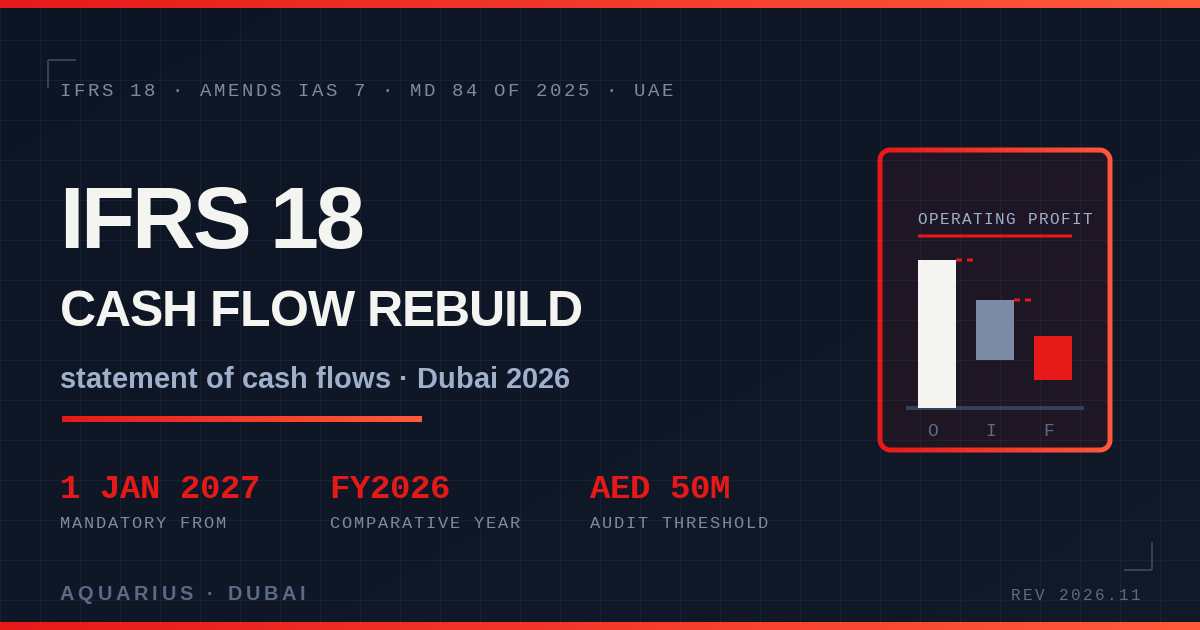
Short answer: IFRS 18 replaces IAS 1 for annual periods beginning on or after 1 January 2027, and on the way through it amends IAS 7: when you use the indirect method, the statement of cash flows must now start from operating profit or loss instead of profit after tax, and the free choice over where interest and dividends sit is removed. Adoption is retrospective, so for a December year-end the comparative year is FY2026 — the one closing in a few weeks. If your cash flow statement is rebuilt by hand in a spreadsheet every quarter, you have one close left to fix the data underneath it.
Here is what most Dubai finance teams are getting wrong: they have filed IFRS 18 under “income statement presentation project, deal with it next year.” But the cash flow statement is the piece that actually breaks, because its new starting point is a subtotal your chart of accounts does not currently produce. You cannot present operating profit or loss in the cash flow statement until every line in your general ledger has been classified into one of IFRS 18’s categories. That is a data-model change, not a formatting change — and it has to be live for the comparative period, not the adoption period.
Three numbers that set the stakes
The first number is why anyone outside your finance team reads this statement at all. Gross credit in the UAE banking system reached AED 2.908 trillion by September 2026, up 17.3% year on year, with lending to the corporate sector the single largest contributor to September’s growth at AED 10.8 billion in one month. Total banking assets hit AED 5.815 trillion in Q3 2026 and deposits AED 3.568 trillion. When credit grows at roughly three times the pace of the wider Gulf, the number a UAE credit committee leans on hardest is operating cash flow — not revenue, and not EBITDA that nobody can tie back to a bank statement. Your statement of cash flows is the covenant document.
The second number is the audit perimeter. More than 651,000 businesses have registered for UAE corporate tax. Under Ministerial Decision No. 84 of 2025, applying to tax periods starting on or after 1 January 2025, audited financial statements are mandatory for any taxable person with revenue above AED 50 million, for every Qualifying Free Zone Person regardless of size, and for all tax groups — the old rule that a tax group only needed audited statements above AED 50 million of consolidated revenue is gone. Those statements must be prepared under IFRS; only businesses at or below AED 50 million of revenue may fall back to IFRS for SMEs. An auditor signing an ISA opinion on your FY2027 accounts will test the FY2026 comparative as presented, which means they will test whether your categories were derivable from the 2026 ledger.
The third number is the deadline, and it is earlier than the standard’s own effective date suggests. IFRS 18 applies to annual and interim periods beginning on or after 1 January 2027, with retrospective application. For a calendar year-end UAE entity, that means the Q1 2027 interim statement already needs a restated Q1 2026 comparative, and the FY2027 accounts need a full restated FY2026. The year you have to be able to reproduce is the year ending 31 December 2026. Early application is permitted, which in practice is the cheaper route for anyone whose data is already clean.
What actually changes in the statement of cash flows
The indirect method now starts at operating profit
Almost every UAE set of accounts you will open today starts the operating section at profit for the year and then unwinds tax, finance costs, impairments and fair value movements line by line. From 2027 that reconciliation starts at operating profit or loss — one of two subtotals IFRS 18 makes mandatory on the face of the income statement, alongside profit or loss before financing and income taxes. Because the new starting point already excludes investing and financing items, a large block of the add-backs you currently present simply disappears. The statement gets shorter. Producing it gets harder, because the starting figure now depends on classification decisions made upstream, in the P&L.
Interest and dividends lose their classification choice
IAS 7 historically let you park interest paid in either operating or financing, and interest received in either operating or investing, as an accounting policy. IFRS 18 removes that optionality for entities without specified main business activities — which covers the large majority of Dubai trading, contracting, logistics, retail, real estate services and professional services companies.
| Cash flow | Classification under old IAS 7 | From 1 January 2027 (no specified main business activity) | Data you now need |
|---|---|---|---|
| Interest paid | Operating or financing (policy choice) | Financing | Cash interest split from accrued interest and from amortised fees |
| Interest received | Operating or investing (policy choice) | Investing | Bank and deposit interest separated from trade-related finance income |
| Dividends paid | Operating or financing (policy choice) | Financing | Declaration versus settlement dates; dividends to non-controlling interests |
| Dividends received | Operating or investing (policy choice) | Investing | Associate and JV distributions tagged by investee |
| Lease payments | Split by IFRS 16 policy | Principal in financing; interest follows the interest-paid rule | Principal/interest split per lease, per payment |
Banks, insurers and other entities with specified main business activities keep a narrower policy choice: classification mirrors where the related income or expense sits in their income statement, and dividends paid always go to financing. If you are a DIFC-regulated financial entity, that exception is doing real work for you; if you are a Business Bay trading company, it is not.
What does not change
The three-section architecture of the cash flow statement — operating, investing, financing — survives. The definition of cash and cash equivalents survives. The direct method is still permitted and still encouraged. Non-cash transactions still get disclosed outside the statement. If someone is selling you a rebuild of your entire treasury and reporting stack on the strength of IFRS 18, that is scope creep, not compliance.
Why this is a data problem, not a disclosure problem
IFRS 18 classifies every item of income and expense into one of five categories: operating, investing, financing, income taxes, and discontinued operations. Investing and financing are defined; operating is the residual — everything that is not one of the other four. That sounds forgiving until you try to compute it from an actual UAE general ledger, because the residual is only correct if the four defined categories are complete and consistent. Three gaps show up in almost every ledger we open in Dubai.
1. Your chart of accounts has no category tag
Most UAE charts of accounts are organised by nature (salaries, rent, bank charges, depreciation) and by cost centre. Nothing in that structure tells you whether an item belongs to the investing category. A single account called “Other income” routinely holds interest on a fixed deposit, a supplier rebate, a gain on disposal of a vehicle, and an insurance claim recovery — which in IFRS 18 terms land in three different categories. Until that account is split or tagged at transaction level, the operating subtotal is a guess, and so is the cash flow statement built on top of it.
2. Interest paid is held net, in one account, on an accrual basis
The new rules need cash interest paid, classified as financing, separated from accrued interest, arrangement fee amortisation and the lease-interest element. In most Dubai ledgers all of that lives inside one finance cost account, reconciled once a year by whoever has the bank facility letters. Groups running supplier finance or invoice discounting have a further problem: the cash movement and the interest element arrive in the same bank line.
3. Nobody owns the comparative
In the adoption year IFRS 18 also requires a reconciliation between the prior-period income statement as presented under IAS 1 and the same period as presented under IFRS 18. That reconciliation is only cheap if the 2026 trial balance can be re-categorised by rule. If it has to be re-derived by judgement, line by line, a year later, by someone who was not there, you are paying for FY2026 twice — once in the 2026 audit and again in the 2027 one. This is the same failure mode we described for group eliminations in UAE tax group close and consolidation: the number is not wrong, it is simply unreproducible.
The five layers of a cash flow engine
A cash flow statement you can produce in an afternoon instead of a fortnight is five layers of plumbing, not one report. Build them in this order — each one is useful on its own, which matters when the budget arrives in stages.
| Layer | What it does | Source data | Breaks if missing |
|---|---|---|---|
| 1. Category mapping | Tags every GL account, and the exceptions within accounts, to one of the five IFRS 18 categories | Chart of accounts, posting rules, prior-year audit file | Operating subtotal is unauditable |
| 2. Cash versus accrual split | Separates cash movements from accruals for interest, tax and dividends | Bank statements, facility schedules, dividend resolutions | Interest paid lands in the wrong section |
| 3. Movement engine | Derives working capital, non-cash and FX movements from opening and closing balances, excluding acquisitions and translation | Trial balances by period, FX rates, acquisition schedules | Operating cash flow silently absorbs non-cash noise |
| 4. Statement builder | Produces the indirect reconciliation from operating profit, with drill-down to the journal | Layers 1–3 | Every quarter is a manual rebuild |
| 5. Evidence and comparative store | Freezes each period’s mapping and output so FY2026 can be reproduced under both IAS 1 and IFRS 18 | Layer 4 snapshots, immutable archive | You restate the comparative by hand in 2027 |
Layer 5 is the one that gets cut from scope and the one that pays for itself. UAE corporate tax record-keeping rules require supporting records to be retained for seven years, and an audited comparative you cannot regenerate on demand is a finding waiting to happen.
Direct or indirect: which to build in 2026
IAS 7 still prefers the direct method, and IFRS 18 did not change that. The direct method is also genuinely easier to build if you already have clean, categorised bank transaction data — which is exactly what a multi-bank cash visibility layer gives you. With 63 licensed banks in the UAE and most mid-market groups holding accounts at three or more, that feed is the hard part; we covered it in building a treasury management system in Dubai. Our practical advice for 2026: build the indirect method first because it is what your auditor and your lender expect, then add the direct presentation once bank feeds are automated. Do not attempt both in one quarter while also closing the year.
One more dependency worth sequencing properly: the tax line in the cash flow statement is only as good as your tax provision. If your deferred tax is still a year-end spreadsheet, the income taxes category will fight you — see building an IAS 12 deferred tax provision.
What this costs in Dubai
Real AED ranges for building the layers above on top of an existing ERP — one-off engineering, no annual licence:
| Scope | What you get | Typical AED (one-off) | Timeline |
|---|---|---|---|
| Category mapping sprint | Full chart-of-accounts classification to the five IFRS 18 categories, exception rules, sign-off pack for your auditor | 22,000 – 45,000 | 2 – 3 weeks |
| Cash/accrual split and interest module | Interest, dividend and lease payment decomposition wired to bank and facility data | 40,000 – 80,000 | 3 – 5 weeks |
| Movement and statement engine | Automated indirect statement from operating profit, drill-down to journal, period lock | 65,000 – 135,000 | 5 – 8 weeks |
| Comparative and evidence store | Dual IAS 1 / IFRS 18 presentation of FY2026, immutable snapshots, seven-year archive | 35,000 – 70,000 | 3 – 4 weeks |
| Full programme | All layers, one ERP, multi-entity, with handover documentation and auditor walkthrough | 160,000 – 310,000 | 10 – 14 weeks |
| Run and support | Hosting, monitoring, mapping changes, year-end audit support | 3,500 – 9,000 / month | ongoing |
Set that against the cost of doing nothing. Administrative penalties under Cabinet Decision No. 75 of 2023 run at AED 10,000 for failing to keep the required records, rising to AED 20,000 for a repeat within 24 months, plus AED 500 per month for a late corporate tax return in the first twelve months and AED 1,000 per month thereafter. Those are the visible costs. The expensive one is invisible: an audit that slips past the nine-month filing window because the comparative had to be rebuilt, in a market where AED 2.9 trillion of credit is priced partly off the statement you could not produce on time. Compare the ranges above with our standard engagement pricing before you assume this is a six-figure problem — for most single-entity Dubai companies, layers 1 and 2 are the whole job.
How we build it
We start with the mapping sprint as a standalone, fixed-price piece of work, because it is the layer that tells you how big the rest actually is. You get the classification workbook and the auditor sign-off pack whether or not you continue — no retainer, no lock-in, and nothing to unpick if you decide your existing ERP module can take it from there. Everything we build sits on your infrastructure, with handover documentation, so there is no annual licence attached to your own cash flow statement.
FAQ
Does IFRS 18 apply to my Dubai company?
If you prepare financial statements under IFRS Accounting Standards, yes — from annual and interim periods beginning on or after 1 January 2027. That includes mainland companies above the AED 50 million audit threshold, every Qualifying Free Zone Person, all UAE tax groups, DIFC and ADGM entities, and any company whose lender or investor requires IFRS statements. Businesses at or below AED 50 million of revenue that apply IFRS for SMEs are outside IFRS 18’s scope, but lose that option the moment they cross the threshold or elect into a tax group.
Can I keep starting the indirect method at profit after tax?
No. From the effective date the reconciliation begins at operating profit or loss. Keeping the old starting point is a departure from IAS 7 as amended, and it is visible on the face of the statement — it is the first thing a reviewer looks at.
Do I really have to restate FY2026?
Application is retrospective, so yes: the comparative period presented in your first IFRS 18 accounts must be presented under IFRS 18, and the adoption year requires a reconciliation back to how that period was originally presented under IAS 1. For a 31 December year-end, FY2026 is that period.
Does the FTA care about the statement of cash flows?
Indirectly, and that is the trap. Corporate tax starts from accounting income determined under IFRS, and Ministerial Decision No. 84 of 2025 requires audited IFRS financial statements for the populations above. A cash flow statement that cannot be tied back to the ledger undermines the credibility of the whole file during a review, even though no tax line is computed from it directly.
Is IFRS 19 a way out of this?
Not of the cash flow statement. IFRS 19, also effective 1 January 2027, lets an eligible subsidiary — one without public accountability whose parent publishes IFRS consolidated financial statements — apply reduced disclosures. It does not change recognition, measurement or presentation, so the amended IAS 7 requirements still apply in full.
How long does this take if we start now?
Layers 1 and 2 fit inside the remainder of a calendar FY2026 if you start in November or December, which is enough to make the comparative reproducible by rule rather than by memory. Waiting until the 2026 audit is signed means re-deriving a closed year, and that is where the cost doubles.
The reporting change nobody is budgeting for
IFRS 18 has been discussed in Dubai boardrooms for two years as an income statement story. It is a cash flow story with an income statement dependency, and its real deadline is 31 December 2026, not 1 January 2027. If you are not sure whether your ledger could produce an operating profit subtotal today, that is the question worth answering this month — ask us for the mapping review and we will tell you which of your accounts are ambiguous before you commit to anything.
This article is general information on building financial reporting and tax data systems, not accounting or tax advice. Confirm positions under IFRS 18, IAS 7 as amended, Federal Decree-Law No. 47 of 2022, Ministerial Decision No. 84 of 2025 and Cabinet Decision No. 75 of 2023 with your auditor and a registered UAE tax adviser.