
Group Financial Close & Consolidation Software for UAE Tax Groups (2026): The 9-Month Clock, the 95% Test, and Real AED Costs
A UAE Tax Group files one return and must submit ISA-audited aggregated financial statements within nine months, with no revenue threshold. Real AED costs for the close and elimination data layer.
- PUBLISHED
- 10 NOV 2026
- READ TIME
- 13 MIN
- AUTHOR
- AQUARIUS · DUBAI
- UNIT
- REV 2026.09
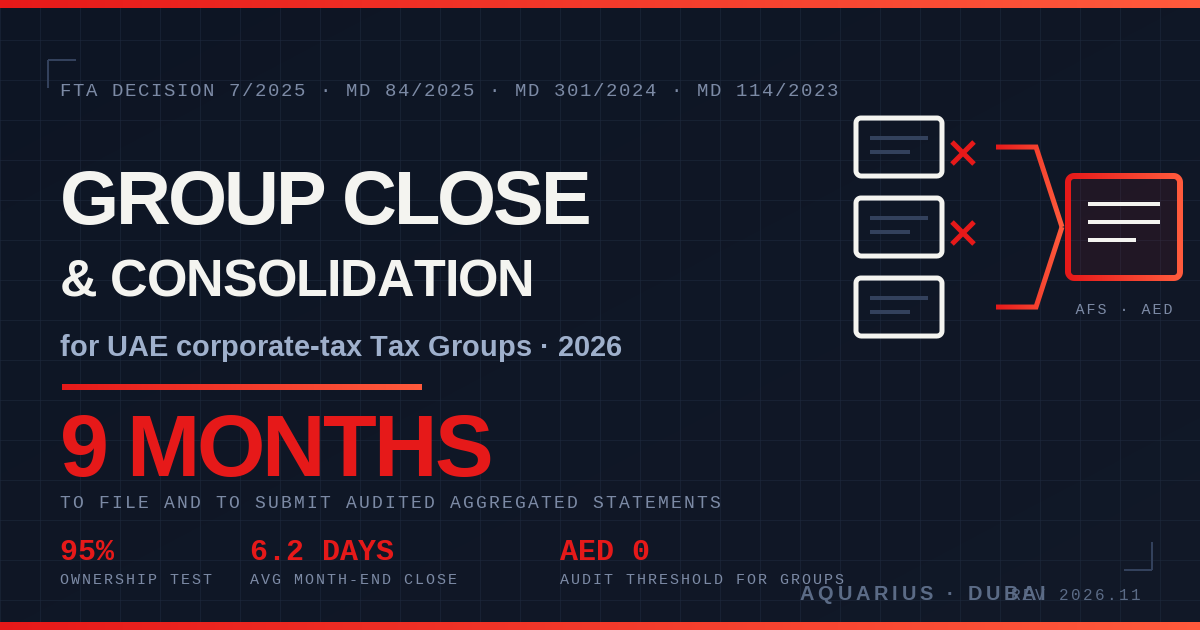
Short answer: A UAE Corporate Tax Tax Group is one Taxable Person filing one return — and for tax periods starting on or after 1 January 2025 it must also prepare audited special-purpose Aggregated Financial Statements and submit them within nine months of period end, with no revenue threshold at all. That is not a tax-return problem; it is a group close, elimination and data-lineage problem. If your eliminations live in a spreadsheet that one person rebuilds every quarter, the nine-month clock is already working against you.
Three numbers that set the stakes
The UAE now has 743,000 corporate tax registrants alongside 587,000 VAT registrants, reported at the Federal Tax Authority board meeting of 30 April 2026. Dubai Chamber of Commerce active membership hit 292,486 companies at the end of 2025, up 13.2% on 258,318 a year earlier — and a large share of that growth is multi-entity: a mainland LLC, a free-zone trading arm, a property-holding SPV, a management company.
Against that, the close itself has not improved. The 2026 Vena Solutions month-end close survey (fieldwork 20–24 August 2026, n=624 finance and accounting professionals, ±3.9% at 95% confidence) found the average month-end close runs 6.2 business days, and that 78% of teams had to restate or correct numbers after declaring the close complete in the previous twelve months. ISG Research’s Office of Finance benchmark found 40% of midsize and larger organisations still use standalone spreadsheets exclusively for consolidation, and that 88% of enterprises automating most of the close finish a quarter in six business days or fewer, versus 40% of those with little or no automation.
Here is the myth-bust most Dubai groups get wrong: they assume the audit requirement follows revenue. It does not. A Tax Group with AED 12 million of combined revenue has exactly the same ISA-audited aggregated-statement obligation as one with AED 2 billion.
What “consolidation” legally means here — and it is not IFRS 10
Article 42(11) of Federal Decree-Law No. 47 of 2022 says a Tax Group must prepare consolidated financial statements. Then Ministerial Decision No. 114 of 2023, Article 3, redefines that phrase: consolidated statements mean standalone statements prepared on the basis of aggregation of each member’s standalone statements, eliminating transactions between them. That is not a transition concession with a sunset date — it has been the permanent prescribed method since 9 May 2023.
FTA Decision No. 7 of 2025 (issued 16 July 2025) then specifies the form, and this is where off-the-shelf group-reporting modules quietly produce the wrong answer. The Aggregated Financial Statements must use line-by-line aggregation with:
- No IFRS 3 or IFRS 10 business-combination accounting — no goodwill, no bargain-purchase gain, no fair-value step-up in the AFS.
- Investments in group members are NOT eliminated against the corresponding subsidiary equity. They are aggregated line by line, both sides. Impairment recorded on an intra-group investment is also not eliminated.
- Pre-tax aggregation: UAE corporate tax balances are excluded, while other taxes continue to be aggregated.
- AED presentation, converted at the Central Bank of the UAE rate (Article 43 of the law).
- Four statements only — financial position, profit or loss, other comprehensive income, changes in equity. No cash flow statement is required.
Any standard consolidation engine configured for statutory IFRS 10 reporting will eliminate the investment-versus-equity pair by default, because that is what it is built to do. For CT purposes that is a defect, not a feature. You need two outputs from one set of books: the statutory consolidation your auditor and bank want, and the CT aggregation the FTA wants. Same source data, different elimination rule set.
The eight conditions, and the two that break ERP projects
Article 40(1) sets eight cumulative conditions: resident juridical persons, 95% of share capital, 95% of voting rights and 95% entitlement to profits and net assets (directly or indirectly), neither party an Exempt Person, neither party a Qualifying Free Zone Person, the same financial year, and the same accounting standards. Ministerial Decision No. 301 of 2024, Article 2, adds that these must be met continuously throughout the tax period.
The last two conditions are systems conditions, not legal ones. Groups routinely discover one subsidiary on a 31 March year-end, or one on IFRS for SMEs (permitted only where revenue does not exceed AED 50 million) while the parent is on full IFRS. And a free-zone entity cannot be a group member while it is a QFZP — joining means giving up the 0% regime, which is a separate modelling exercise entirely. We cover the tagging side of that in QFZP qualifying-income tagging in your ERP.
The elimination rules are narrower and stranger than your group accountant expects
MD 301 of 2024 pushes eliminations past the obvious parent-to-subsidiary pairs. Article 6 extends them to subsidiary-to-subsidiary transactions and to valuation adjustments and provisions arising from transactions between members, including any resulting change in the carrying value of the affected asset or liability. Article 4 then cuts the other way: a transaction must not be eliminated to the extent a member recognised a deductible loss on it before joining the group, until that loss fully reverses.
So a single intercompany balance can be in-scope, out-of-scope, or partially in-scope depending on when the counterparty joined and whether a provision was booked. That is a per-transaction, per-period attribute. It cannot be reconstructed from a trial balance at quarter end — it has to be tagged at the point of posting. Three more operational tripwires:
- 20 business days to notify the FTA when a subsidiary leaves or the group ceases to meet conditions (MD 301, Article 12).
- Pre-grouping losses are capped at the lower of income attributable to that subsidiary and the 75% Article 37(2) cap, and are used first (Article 7).
- Forfeiture risk: where pre-grouping losses or carried-forward net interest expenditure are used, Article 8 requires an arm’s-length attribution and FTA disclosure. Fail to perform the attribution and the losses are forfeited to the extent they were under-utilised. That makes your transfer-pricing data and your close data the same dataset — see related-party data in your ERP.
Spreadsheet, ERP module, EPM platform, or a thin layer on what you have
Published pricing is thinner than vendors imply, so these are list prices from primary sources, converted at the AED peg of 3.6725. Oracle’s own Fusion Cloud global price list of 5 November 2026 no longer carries a separate FCCS line — consolidation is licensed inside EPM Standard and Enterprise.
| Approach | Published cost | Where it breaks for a Tax Group |
|---|---|---|
| Spreadsheet-only consolidation | AED 0 licence | Peer-reviewed audits of 50 live operational spreadsheets (270,722 formula cells) found errors in 94% of them. No audit trail an ISA special-purpose audit can test. |
| ERP group-reporting module | Usually bundled; configuration-led | Defaults to IFRS 10 logic — eliminates investment against equity, which the AFS rules forbid. Needs a second rule set. |
| EPM / CPM platform | Oracle EPM Standard: USD 250/user/month, minimum 10 users = USD 30,000/yr (~AED 110,000). EPM Enterprise: USD 500/user/month, minimum 25 = USD 150,000/yr (~AED 551,000). Jedox Essential (AWS Marketplace, 3 users): USD 12,000/yr (~AED 44,000) | Licence is the small number. Implementation and the annual re-mapping are the real cost, and nothing ships with UAE CT elimination logic out of the box. |
| Aggregation and elimination layer on your existing ERP | AED 45,000–130,000 build | Requires disciplined intercompany tagging at source. Weakest option if your chart of accounts differs materially between members. |
Note the gap: no verifiable UAE or GCC benchmark for EPM implementation cost exists publicly. Anyone quoting one is quoting a blog. What is verifiable is the direction of travel — AFP’s 2025 FP&A technology survey (n=362) found 96% of finance teams still use spreadsheets as a planning tool weekly or more often, while only 71% touch an EPM tool even quarterly. The tool is rarely the constraint. The data is.
What this costs in AED
Our bands for the data layer itself, not the tax advice. These assume a group of three to eight members on one or two ERPs.
| Scope | AED band | Timeline |
|---|---|---|
| Tax Group close readiness diagnostic — condition tests, standards and year-end gaps, elimination scope map | 18,000–45,000 | 2–3 weeks |
| Aggregation and elimination layer on an existing ERP — intercompany tagging, dual rule sets, AFS output pack | 45,000–130,000 | 4–8 weeks |
| Multi-ERP group data platform — uniform policy mapping, member standalone packs, audit-ready lineage | 180,000–420,000 | 10–16 weeks |
| Close-cycle care — monthly run support, new-member onboarding, rule changes | 3,500–14,000 / month | Ongoing |
Compare that against the downside. Cabinet Decision No. 75 of 2023 charges AED 500 per month for the first twelve months of a late return, then AED 1,000 per month, plus 14% per annum on unsettled payable tax. Fail to file a voluntary disclosure before you are notified of an audit and the penalty is a fixed 15% of the tax difference plus 1% per month. Record-keeping failures run AED 10,000, doubling to AED 20,000 on repeat within 24 months. None of that counts the forfeited pre-grouping losses under MD 301 Article 8, which is usually the largest number on the page.
How Aquarius builds it
We treat the Aggregated Financial Statements as a reporting product with a fixed specification, then work backwards to the posting layer. Intercompany counterparty, member-join date and provision linkage get tagged at transaction level, so eliminations are a query rather than a quarterly reconstruction. The statutory IFRS 10 consolidation and the CT aggregation become two views over the same tagged ledger — different rule sets, one source of truth, both reproducible for an auditor on demand. Member standalone packs come out of the same pipeline, on uniform accounting policies, because the group cannot aggregate what the members have not produced consistently.
We build it on the ERP you already own. If you are also facing the e-invoicing cohorts — accredited service provider appointed by 30 October 2026 and go-live 1 January 2027 for businesses above AED 50 million of revenue — the same integration work carries both, and we sequence them together rather than twice. See UAE e-invoicing ERP integration for that timeline.
The upside is measurable. The Hackett Group’s 2025 Digital World Class Finance research found top-quartile finance functions operate at 45% lower cost as a percentage of revenue, with up to 42% fewer FTEs, 35–57% shorter close cycles, and 99% of journal entries automated versus 85% for their peers. On a 6.2-day close, a third off the cycle is two business days a month handed back to the people who should be forecasting instead of reconciling.
FAQ
Does a Tax Group under AED 50 million of revenue need audited statements?
Yes. Ministerial Decision No. 84 of 2025, Article 2(2), requires every Tax Group to prepare and maintain audited special-purpose financial statements in the form the FTA specifies, with no revenue threshold. The AED 50 million threshold in Article 2(1) applies only to Taxable Persons that are not a Tax Group. Qualifying Free Zone Persons have no threshold either.
Do the individual members need audited standalone accounts?
No. The CT Law does not require separate audited statements for the parent or subsidiary members, even where a member’s own revenue exceeds AED 50 million. But each member does need standalone statements prepared under IFRS or IFRS for SMEs on uniform accounting policies, because the aggregation is built from them.
Can a free-zone company be in our Tax Group?
Only if it is not a Qualifying Free Zone Person. Article 40(1)(f) excludes QFZPs outright, so joining means forgoing the 0% regime. EY has noted that where QFZP relief is not claimed in an initial return, it may not be claimed in the following four tax periods — so model it before you elect.
Do we eliminate our investment in a subsidiary against its equity?
No. FTA Decision No. 7 of 2025, Article 3(3)(d), requires line-by-line aggregation of investment captions recorded by the parent and the corresponding equity recorded by the subsidiaries without any eliminations between those captions. Impairment on intra-group investments is likewise not eliminated. This is the single most common configuration error we see.
When exactly is everything due?
The return is due nine months from the end of the tax period (Article 53(1)), and the audited Aggregated Financial Statements are due on the same nine-month clock under FTA Decision 7/2025, Article 2(3). The FTA confirmed 30 September 2026 as the deadline for periods ending 31 December 2025. A 31 March year-end therefore runs to the end of December 2026 on the same rule.
Start with one aggregation run
The cheapest way to find out whether your group close is actually audit-ready is to produce one Aggregated Financial Statement pack under the FTA Decision 7/2025 rules for a period you have already closed, and see what does not tie. Everything that fails is a specification for the build. Our pricing page lists the diagnostic band, and if you would rather just talk it through, get in touch — we will tell you honestly whether this is a four-week tagging job or a platform rebuild before anyone signs anything.