
CBUAE Insurance Reporting Software in Dubai (2026): The New Central Bank Law and the Data Layer Your Policy System Cannot Produce
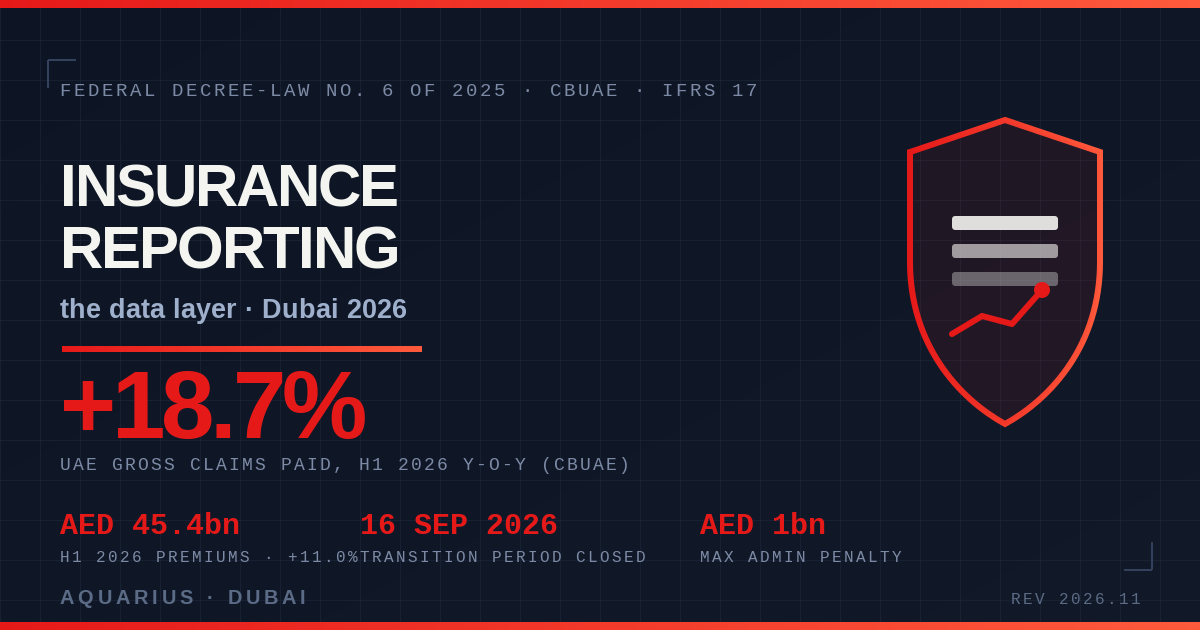
UAE claims paid rose 18.7% in H1 2026 while premiums rose 11.0%, and the new Central Bank Law transition closed on 16 September. Real AED costs for an insurance reporting data layer.
- PUBLISHED
- 10 NOV 2026
- READ TIME
- 13 MIN
- AUTHOR
- AQUARIUS · DUBAI
- UNIT
- REV 2026.09
Short answer: Insurance regulatory reporting software is the data layer that sits between your policy, claims and general ledger systems and the Central Bank of the UAE — producing quarterly solvency returns, the annual ORSA pack, IFRS 17 groups-of-contracts measurement and an audit trail that reconciles back to a named policy. It matters more in 2026 because Federal Decree-Law No. 6 of 2025 put insurance under the consolidated Central Bank framework and its one-year transition period closed on 16 September 2026, with administrative penalties reaching AED 1,000,000,000. Budget AED 35,000–480,000 to build the reporting layer on the core system you already own.
Most UAE insurers do not fail a CBUAE return because the actuary got the maths wrong. They fail it because nobody can trace the number back to the policies that produced it. The spreadsheet balances, the auditor asks which contracts sit inside that cohort, and the room goes quiet.
The 2026 numbers: premiums are growing, claims are growing faster
Start with the regulator's own figures, because they frame the whole problem. In its Quarterly Economic Review for September 2026, the CBUAE reported that UAE gross written premiums reached AED 45.4 billion in H1 2026, up 11.0% year on year, against AED 74.8 billion for the full year 2025.
Now the line that should change your 2027 budget. Gross claims paid rose 18.7% year on year to AED 25.5 billion in H1 2026 — claims growing roughly 1.7 times faster than premiums. Underneath that:
- Health insurance: premiums AED 23.0 billion (+11.4%), claims AED 13.2 billion.
- Property and liability: premiums AED 17.2 billion (+6.0%), claims AED 9.3 billion.
- Insurance of persons and fund accumulation: premiums AED 5.2 billion (+28.8%), claims AED 2.9 billion.
The sector is not fragile — it is simply being watched more closely as it gets bigger. Total technical provisions hit AED 106.9 billion (+6.8%), invested assets rose to AED 99.2 billion (55.8% of total assets, down from 57.2% a year earlier), total assets reached AED 177.8 billion and equity AED 36.3 billion (+15.6%). Capital is comfortable: own funds to Minimum Capital Requirement climbed to 560.4% in Q2 2026 from 516.1% in Q1, with the Solvency Capital Requirement ratio at 198.2% and the Minimum Guarantee Fund ratio at 290.9%. Retention improved to 56.2% from 52.5% a year before.
And this is now a systemically important industry, not a niche. In Q1 2026 UAE real GDP grew 3.0% and non-oil GDP 4.8%, with financial and insurance activities surging 17.3% and contributing 2.4 percentage points of that non-oil growth — lifting the sector's share of non-oil GDP from 14.1% to 15.8%. There are 59 licensed insurance companies in the market (23 traditional national, 10 national takaful operators and 26 branches of foreign insurers) plus 528 registered insurance-related professions.
Read those two facts together: a sector compounding at double digits, with claims outrunning premiums, supervised by a central bank that can levy up to AED 1 billion. Reporting quality stopped being a back-office matter.
The law changed underneath you, and the grace period is over
Federal Decree-Law No. 6 of 2025 was issued on 8 September 2025 and published in the Official Gazette on 15 September 2025. It repealed both Federal Law No. 14 of 2018 (the old Central Bank law) and Federal Decree-Law No. 48 of 2023, the insurance law that had only been in force for about two years, folding banking, insurance, payments and financial market infrastructures into one consolidated supervisory framework.
Applicable entities were given a one-year transition period, ending 16 September 2026 (extendable at CBUAE discretion). As of today that window has closed. Three features of the new law matter directly to the systems you run:
- Technology-neutral licensing. Article 62 catches any entity carrying on, offering, issuing or facilitating a licensed financial activity — in the law's words, regardless of the medium, technology or form employed. A white-labelled embedded-insurance widget inside a retailer's checkout is not outside the perimeter because it is a widget.
- Hard penalty ceilings. Administrative penalties run up to AED 1,000,000,000 for licensed institutions, AED 20,000,000 for financial market infrastructures and AED 5,000,000 for authorised individuals. Unlicensed activity is a criminal offence carrying imprisonment and/or a fine from AED 50,000 to AED 500,000,000, with a AED 1,000,000 floor.
- Confidentiality and data safeguards. Customer information is confidential with narrow statutory exceptions, and data exchange runs through CBUAE protocols. Fraud prevention and customer notification duties are explicit. That pushes access control, logging and consent out of policy documents and into your architecture — the same shift we covered in CBUAE operational resilience for software vendors.
Enforcement is not theoretical. In March 2025 the CBUAE imposed AED 2,621,000 in sanctions on five banks and two insurance companies for failures in CRS and FATCA reporting procedures. In May 2025 it sanctioned five insurance brokers over anti-money-laundering and counter-terrorist-financing failures — two fined, three formally warned. In June 2026 it fined a foreign bank branch AED 20 million after supervisory examinations found significant and repeated compliance framework failures. Note what the 2025 insurance penalties were actually about: reporting procedures.
What you actually have to file, and how often
The filing calendar is the build specification. Crowe's UAE summary of CBUAE filings for insurance companies and brokers sets out the cadence below — confirm your own dates against the CBUAE portal, because the new law gives the regulator room to amend them.
| Submission | Frequency | Deadline | What the data layer must hold |
|---|---|---|---|
| Audited annual financial statements | Annual | Within 3 months of financial year end | GL tie-out, actuarial report inputs, IFRS 17 disclosures |
| Governance, risk and compliance reports | Annual | Within 90 days of year end | Control evidence with owners and dates |
| Own Risk and Solvency Assessment (ORSA) | Annual | Within 4 months of year end, and no later than 30 days before the General Assembly | Stress and scenario runs, reproducible assumptions |
| Quarterly financial statements and solvency reports | Quarterly | 45 days after quarter end | MCR, SCR and MGF components, admissible assets |
| Quarterly interim reports (financial, risk, compliance) | Quarterly | 30 days after quarter end | Same figures, 15 days earlier — so no manual rebuild |
| AML/CFT self-assessment | Twice yearly | 15 February and 15 August | Customer risk scores, screening hits, case outcomes |
| Annual compliance report | Annual | 15 February | Breach register, remediation status |
Count the cycles: a December year-end insurer has a filing obligation in roughly nine months out of twelve, and two of those quarterly obligations fall 15 days apart on overlapping data. Any process that depends on a quarter-end spreadsheet marathon will break on the 30-day deadline, not the 45-day one.
Why your policy system cannot produce it
Core insurance platforms are built to issue policies and settle claims. CBUAE returns and IFRS 17 want something different: a measurement view of the same business, sliced in ways the operational system never stored.
IFRS 17 has applied in the UAE since 1 January 2023, with no phasing. Its unit of account is not the policy — it is the group of contracts: same portfolio, similar risks managed together, split by profitability at inception, and critically no group may contain contracts issued more than one year apart. That single annual-cohort rule is where most core systems fail, because they were never asked to stamp a contract with the cohort it belongs to. Then the measurement model asks for more:
- A contractual service margin per group, rolled forward every period, with new business, interest accretion, experience adjustments and release recognised separately — not derivable from a closing balance.
- Coverage units to drive that release, which means a quantity-of-benefit measure per group per period.
- A risk adjustment for non-financial risk, with a disclosed confidence level, reproducible on demand.
- A documented premium allocation approach eligibility test for every group you measure under PAA — the simplification most UAE general and medical insurers rely on, and the one auditors challenge hardest.
- Separate presentation of insurance finance income and expense, which requires discount curves stored as of each measurement date, not just the latest one.
Takaful operators carry all of that plus a structural mismatch: the standard was not written around a participants' fund, a wakala or mudarabah fee, qard hasan support from the shareholders' fund, or surplus distribution to participants. Those are presentation and allocation decisions your system has to hold as data, with the Shariah board's rationale attached, because an auditor will ask you to show the same treatment applied consistently across every group.
There are two more quietly expensive gaps. Distribution data: commission, override and incentive structures usually live in broker agreements and spreadsheets rather than in the ledger, yet acquisition cash flows are part of IFRS 17 measurement — the same data problem we unpacked in insurance broker management software for Dubai. And claims granularity: a health claim repriced after adjudication, or a motor claim reopened in a later period, has to land in the right cohort and the right development triangle, not in the period the cash moved.
Build, buy or extend — the honest comparison
The reflex is to replace the core system. That is almost always the wrong first move. Roland Berger puts core replacements at large insurers in the range of EUR 20 million to more than EUR 100 million — a European benchmark, but the order of magnitude travels. Enterprise IFRS 17 engines from the specialist vendors (Aptitude, Legerity, Moody's, RNA Analytics, SAS, OneSumX and peers) are quoted per insurer rather than published, and sit in enterprise annual-licence territory before implementation.
For most UAE insurers, brokers and TPAs the reporting problem is narrower than the vendor conversation suggests. You do not need a new core. You need a measurement layer beside it:
- A cohort and group assignment service that stamps every contract with portfolio, profitability bucket and annual cohort at inception, and never silently restates history.
- A reporting data mart holding policy, claims, reinsurance, commission and GL facts at the grain the returns need, with the discount curve and assumption set used for each run.
- A returns engine that produces the quarterly solvency and interim packs from that mart on a button, with a reconciliation to the trial balance printed alongside.
- An evidence trail: who ran it, with which assumptions, what changed since last quarter, and why.
Scope matters more than tooling. In H1 2026 the 27 UAE-listed insurers reported insurance revenue of AED 28 billion, up 14%, with a weighted-average combined ratio of 86% — and the growth was not where you would guess. Per BADRI's 17 August 2026 analysis, the top five insurers grew 12% to AED 18.8 billion while everyone else grew 19% to AED 9.2 billion. Smaller insurers' underwriting result jumped 45% to AED 470 million, against 9% growth to AED 1.37 billion at the top five. Industry net profit reached AED 2.2 billion (+12%), with investment income at AED 1.4 billion (+13%) — up 26% for the top five but down 5% for smaller companies. Four of the 27 ran combined ratios above 100%.
That is the shareable point. The fastest-growing cohort of UAE insurers is the one least likely to own an enterprise reporting stack, and the one most exposed to a volume spike landing on a manual close.
What this costs in Dubai, in real AED
Indicative Aquarius ranges for the reporting layer, assuming your policy and claims systems stay where they are:
| Scope | AED range | Typical timeline |
|---|---|---|
| Data assessment and gap report (cohort, CSM and returns readiness) | 18,000–45,000 | 2–3 weeks |
| Broker, agent and commission data clean-up and model | 35,000–85,000 | 3–6 weeks |
| Policy and claims data migration plus quality remediation | 40,000–120,000 | 4–8 weeks |
| Regulatory reporting data mart and returns engine on existing core | 60,000–150,000 | 6–10 weeks |
| IFRS 17 subledger feed with CSM roll-forward and coverage units | 90,000–240,000 | 8–14 weeks |
| Full supervisory reporting portal (returns, ORSA pack, evidence trail, role-based access) | 220,000–480,000 | 14–22 weeks |
| Care, assumption updates and regulatory change watch | 4,000–16,000 / month | ongoing |
Put that against the alternative. A single AED 20 million enforcement action — the amount the CBUAE actually levied in June 2026 — is more than forty times the top of that build range. A qualified audit opinion on an IFRS 17 cohort you cannot evidence costs you capital-markets credibility you cannot buy back. And an insurer growing 19% a year on a manual close is accumulating the problem quarterly, not annually. See our pricing for how these engagements are structured.
How Aquarius does it
We start with a two-week data assessment, not a platform pitch: we trace one real quarter end from the filed return back to the policies that produced it, and show you exactly where the chain breaks. Then we build the narrowest thing that fixes it. Fixed scope, fixed price, your data stays in your UAE-hosted environment, and you own the code and the models at handover. If the assessment concludes your existing stack already produces defensible returns, we will tell you that and bill you for the assessment only.
FAQ
Does Federal Decree-Law No. 6 of 2025 replace the 2023 insurance law completely?
Yes. FDL 6/2025 repealed Federal Decree-Law No. 48 of 2023 along with the 2018 Central Bank law, consolidating banking, insurance, payments and financial market infrastructure supervision under the CBUAE. Entities had a one-year transition period ending 16 September 2026, extendable at the regulator's discretion.
Do we need a new core insurance system to comply?
Usually not. The compliance failures we see are measurement and traceability failures, not transaction-processing failures. A reporting data mart plus a cohort assignment service beside your existing core typically closes the gap at AED 60,000–240,000, against core replacement programmes that run in the tens of millions internationally.
What makes IFRS 17 harder for takaful operators in the UAE?
The standard assumes a conventional insurer. Takaful adds the participants' fund, the operator's wakala or mudarabah fee, qard hasan from the shareholders' fund and surplus distribution to participants. None of those map cleanly onto IFRS 17 categories, so the treatment is a documented judgement that your system must apply identically across every group of contracts, every period, with the Shariah rationale attached.
How much data history do we need to rebuild?
Enough to reconstruct every group of contracts still being measured — which, because groups cannot span contracts issued more than a year apart, means at least one full annual cohort per portfolio plus the claims development that sits behind it. In practice UAE insurers rebuild three to five years, and the cost is driven by how many systems that history is scattered across, not by its volume.
Are brokers and TPAs in scope for this?
Brokers file their own CBUAE submissions and were the subject of the May 2025 AML sanctions, so yes — different returns, same traceability requirement. TPAs are usually the data source rather than the filer, but an insurer cannot evidence health claims measurement without clean TPA feeds, which is why TPA integration appears in most of these projects.
Where to start
Pick your most recent filed quarterly return and try to trace one line — gross written premium for a single group of contracts — back to the policies behind it, with the assumptions used on the day. If that takes more than an afternoon, you have found your project, and you have found it before an examiner does.
Aquarius builds the measurement and reporting layer for UAE insurers, takaful operators, brokers and TPAs — on the core systems you already run. Tell us about your close process and we will come back with a scoped assessment and a fixed price.