
CBUAE Operational Resilience Rules (C 1/2026): The Build Checklist for Dubai Software Teams
Regulation C 1/2026 took effect on 14 September 2026: a four-hour incident clock, 30-day notice before changing critical systems, and UAE-resident systems of record.
- PUBLISHED
- 05 NOV 2026
- READ TIME
- 12 MIN
- AUTHOR
- AQUARIUS · DUBAI
- UNIT
- REV 2026.09
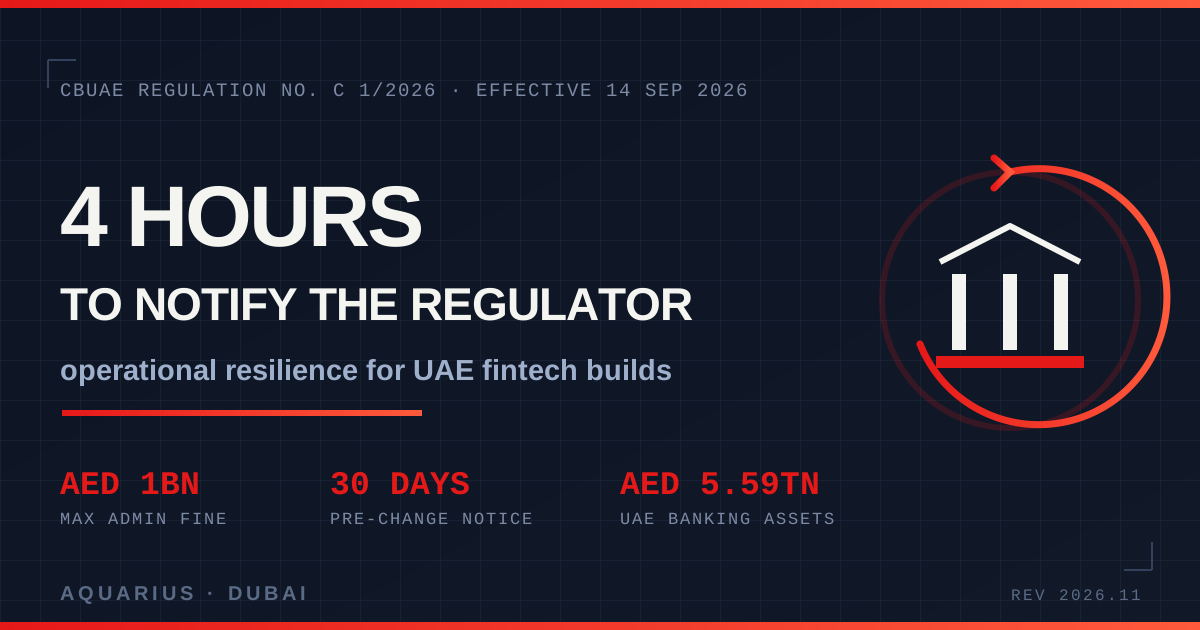
Short answer: CBUAE Regulation No. C 1/2026 on operational risk management took effect on 14 September 2026 and replaced the 2018 regime. Every licensed financial institution in the UAE must now map its critical operations, set a board-approved impact tolerance, notify the Central Bank within four hours of a material disruption, and obtain written no-objection at least 30 days before any material change to those operations. If you build software for a UAE bank, insurer or payment firm, those clauses land in your contract and in your release process — your deployment pipeline is now part of a regulated control environment.
Why this is suddenly a Dubai engineering problem
The stakes are the size of the banking system. CBUAE’s Quarterly Economic Review for September 2026 puts total UAE banking assets at AED 5,594 billion at the end of Q2 2026, up 12.5% year on year, across 62 banks — 24 UAE national banks and 38 foreign branches. Gross credit grew 18.1% and the loan-to-deposit ratio moved to 79.4% from 76.6% a year earlier. Capital adequacy sits at 17.0%. This is a system lending and digitising fast, and the regulator has responded by hardening the operational side rather than the capital side: CBUAE announced a Financial Institution Resilience Package in March 2026, and Regulation C 1/2026 is the part that reaches your codebase.
The threat volume justifies it. The UAE Cyber Security Council reported in July 2026 that the country faces more than 800,000 cyberattack attempts every day, and confirmed it had foiled sophisticated attacks on financial-sector entities — phishing, vulnerability exploitation, malware and AI-enhanced methods — while keeping financial services running. Spending has followed: Gartner puts MENA end-user information security spending at USD 4 billion in 2026, up 10.1%, inside a regional IT market of USD 169 billion where software is the fastest-growing segment at +13.9%.
Most vendors selling into this market have read none of it. They find out when a bank’s procurement team sends a 40-page operational resilience annexe and asks for an architecture diagram naming every fourth party.
What Regulation C 1/2026 actually requires
Circular No. 1/2026 was issued on 3 February 2026 and brought Regulation No. C 1/2026 into force on 14 September 2026, repealing Circular No. 163/2018. It applies to all licensed financial institutions with legal personality under Federal Decree-Law No. 6 of 2025 — banks, insurers and reinsurers, whether UAE-incorporated or operating as branches and subsidiaries.
1. Critical operations and impact tolerance
Institutions must identify their Critical Operations and define a maximum acceptable level of disruption for each. The regulation names the obvious ones: payments and transfers, salary processing, card services, time-critical customer services, maintenance of financial records, and solvency and liquidity management. Each has to be mapped to the people, systems, data, facilities and third parties that support it — and the tolerance has to be approved by the board, not delegated to a committee.
2. Three notification clocks
This is where most integrations fail. A material event affecting a Critical Operation must reach CBUAE within four hours. A brief report follows within 24 hours covering the nature of the incident, measures taken, potential impact and expected restoration timeframe. High-severity incidents, as classified under the institution’s own board-approved scheme, carry a 72-hour obligation. Four hours is not a human process. It is an alerting pipeline with pre-approved severity thresholds and a template that fills itself.
3. Independent penetration testing, reported to the board
Beyond periodic operational risk stress tests and control-environment testing, the regulation requires penetration testing of critical functions by an independent external party, with results presented to the board. Internal scans and a dependency-bot badge do not satisfy this.
4. Outsourcing you cannot outsource
Institutions must retain in-house expertise and cannot rely excessively on outsourcing. CBUAE may require termination of a problematic arrangement. A bank remains responsible for continuity even when the failure sits with its cloud host or payment processor — which is precisely why your contract will now carry step-in rights, substitutability assessments and a named subcontractor register.
5. Master systems of record must stay in the UAE
Master Systems of Record have to be maintained inside the UAE, including for outsourced functions. Foreign branches may hold compliant domestic copies with CBUAE approval. In practice that means AWS Middle East (UAE) or Azure UAE North and UAE Central for anything authoritative, with written attestation of where the data physically lives. An EU or Singapore primary region with a UAE read replica is the wrong way round.
Your release calendar is now a regulatory filing
The clause that reshapes delivery schedules is the one on material changes. Before implementing a material change to a Critical Operation, the institution must test thoroughly, keep a rollback plan, run old and new systems in parallel for a defined period, appoint an external expert for independent assurance, notify CBUAE at least 30 days in advance, and obtain written no-objection before proceeding.
Read that as an engineer: a core banking migration, a payment-rail switch or a new authentication flow is a quarter-long regulatory process, not a sprint. Teams that ship these as a big-bang cutover miss the parallel-run requirement entirely. The pattern that works is dual-write with shadow traffic, feature flags per customer segment, and a documented rollback that someone has actually executed in a rehearsal.
The warning from mature markets is blunt. The UK Treasury Committee found that nine major banks accumulated more than 803 hours of unplanned IT outages across 158 separate incidents between January 2023 and February 2025 — after years under a developed resilience framework. Frameworks do not create uptime; architecture does.
| Regulation C 1/2026 requirement | What you actually build |
|---|---|
| Critical operations mapped to dependencies | Service catalogue with tiering, dependency graph including fourth parties, exportable as evidence |
| Board-approved impact tolerance | Per-service SLO and RTO/RPO wired to live alerting, not a spreadsheet |
| Four-hour notification | Severity classifier at incident creation, auto-drafted regulator notice, named on-call authoriser |
| 24-hour and 72-hour reporting | Immutable incident timeline, blast-radius query, restoration-estimate field |
| Parallel run and rollback for material change | Dual-write, shadow traffic, per-segment flags, rehearsed rollback script |
| Independent penetration test to the board | Scoped external test per release train, board-format summary |
| Master system of record in the UAE | UAE-region primary, documented residency attestation, keys held locally |
| Third-party register and substitutability | Machine-readable vendor register, exit plan per critical dependency |
What resilience work costs in Dubai
Indicative ranges from our UAE financial-sector engagements. These are build-and-evidence costs, not licence fees or legal opinions.
| Workstream | Indicative AED | Timeline |
|---|---|---|
| Critical-operations mapping and dependency graph | 28,000 – 52,000 | 2 – 3 weeks |
| Four-hour notification pipeline (alerting, classifier, templates) | 35,000 – 68,000 | 3 – 5 weeks |
| Impact-tolerance instrumentation (SLO, RTO/RPO, dashboards) | 42,000 – 90,000 | 4 – 6 weeks |
| UAE data-residency migration for a system of record | 85,000 – 240,000 | 8 – 16 weeks |
| Parallel-run and rollback harness for one material change | 60,000 – 150,000 | 6 – 12 weeks |
| Vendor register, exit plans and evidence pack | 22,000 – 48,000 | 2 – 4 weeks |
| Full readiness programme, phased | 240,000 – 520,000 | 4 – 7 months |
Set that against the cost of inaction. Under Federal Decree-Law No. 6 of 2025, CBUAE can impose administrative fines on an institution of up to AED 1 billion, and up to ten times the value of the violation or the unjust enrichment it produced. Gulf News reported the supervisory toolkit alongside it: removing or restricting senior management and board powers, temporarily taking over management of the institution, and prohibiting an entity from operating in the UAE financial sector. A vendor whose architecture causes a reportable breach is not fined directly — it is removed from the register, which is commercially worse.
How Aquarius builds this
We treat resilience as deliverables, not a policy document. First we map your critical operations and produce the dependency graph the bank’s risk team will actually be asked for, including fourth parties. Then we instrument tolerance: every critical service gets an SLO, an RTO and an RPO wired to live alerting, so impact tolerance is a measured number rather than an assertion. Then we build the four-hour pipeline — severity classification at incident creation, an auto-drafted CBUAE notice with the 24-hour fields pre-populated, and a named authoriser on call. For material changes we ship the parallel-run harness and rehearse the rollback with your team before go-live, because an untested rollback plan is the single most common audit finding.
You own the code and the evidence pack at handover — no lock-in, no retained dependency on us to pass your next inspection. If the mapping phase shows your architecture already meets the regulation, we say so and stop; we would rather lose the build than sell a programme you do not need. Indicative ranges live on our pricing page, and the wider build stack is on our services page.
If your product also sells into Europe, read this alongside our breakdown of DORA compliance for Dubai software vendors selling to EU banks — the mechanics are close enough that one evidence pack can serve both regimes. If you are building the regulated product itself, our e-wallet and CBUAE SVF licence guide covers the licensing route.
FAQ
Does Regulation C 1/2026 apply to my software company?
Not directly. It binds licensed financial institutions with legal personality under Federal Decree-Law No. 6 of 2025 — banks, insurers, reinsurers. It reaches software vendors through contract: your client has to evidence continuity of its critical operations, so the obligations flow to you as clauses, notification SLAs, register entries and audit rights.
When did the four-hour notification requirement start?
Circular No. 1/2026 was issued on 3 February 2026 and the regulation took effect on 14 September 2026. The clock is live now, with no further transition window for the notification timeframes.
Can we host a UAE bank’s data in Europe or Singapore?
Not as the master system of record — those must be maintained within the UAE, including where the function is outsourced. Analytics copies, backups and DR topology outside the UAE need careful structuring, and material cloud arrangements need prior engagement with CBUAE. Foreign branches may keep compliant domestic copies with approval.
What counts as a material change needing 30-day notice?
A change that materially affects a Critical Operation: core banking replacement, payment-rail migration, authentication overhaul, moving a system of record between providers. Routine feature releases that do not alter the critical path are out of scope — which is exactly why a defensible service tiering document is worth building first.
How long does readiness take for a mid-sized UAE institution?
Four to seven months for a phased programme covering mapping, tolerance instrumentation, the notification pipeline and an evidence pack. Mapping alone can be delivered in two to three weeks, and it is the right first step because it tells you how much of the rest you actually need.
Not sure whether your pipeline survives a four-hour clock? Send us your service list and your current incident runbook, and we will tell you where the gaps are before an auditor does. Talk to Aquarius →