
Change Data Capture in Dubai: Real-Time Data Sync Architecture and AED Costs (2026)
Real-time CDC for Dubai ERP, POS and app databases: AWS DMS vs Debezium on MSK vs EventBridge Pipes, with verified me-central-1 AED rates and why serverless CDC costs 4x a t3.micro instance.
- PUBLISHED
- 19 NOV 2026
- READ TIME
- 12 MIN
- AUTHOR
- AQUARIUS · DUBAI
- UNIT
- REV 2026.09
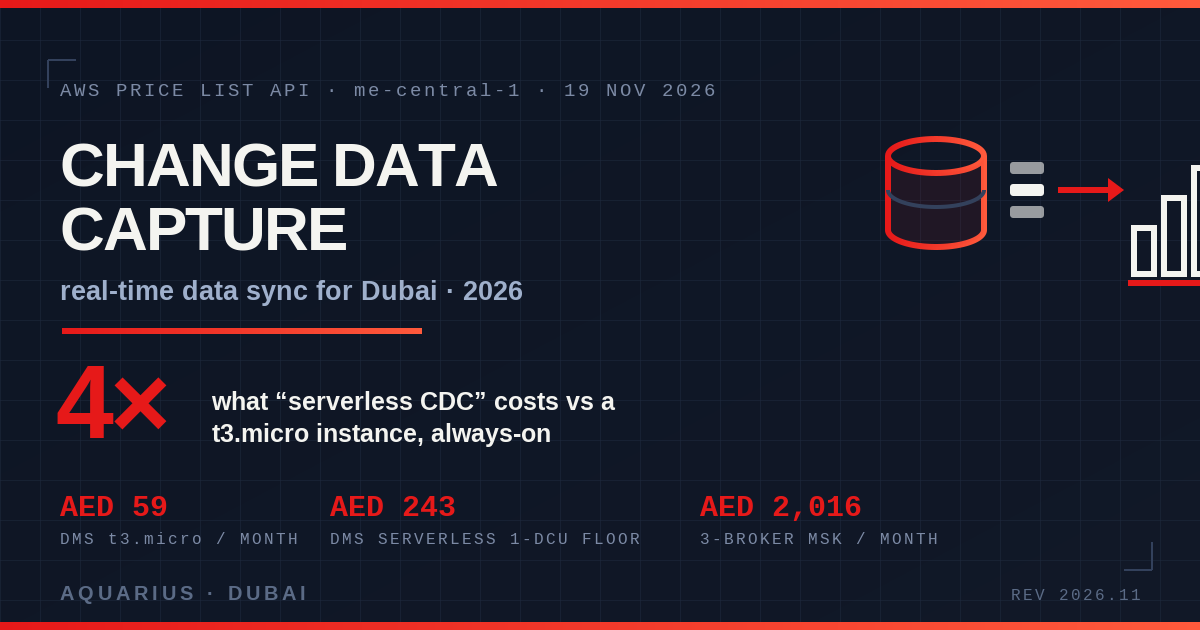
Change data capture (CDC) reads your database's own transaction log and streams every insert, update and delete to a second system within seconds — no nightly export, no polling, no reconciliation spreadsheet. For a Dubai business running always-on sync in the AWS Middle East (UAE) region, the cheapest working capture layer is a single dms.t3.micro replication instance at AED 59 per month. The "serverless" option most people reach for first costs AED 243 for the same always-on job — roughly 4× more — because AWS DMS Serverless never bills below one capacity unit.
Why real-time data stopped being optional in the UAE
The UAE's payment rails already run in real time. Al Etihad Payments, the Central Bank subsidiary that operates the national instant-payments platform Aani, reported the service passing 500,000 transactions a day with 27% month-on-month growth in transaction volume and integration across 57 licensed financial institutions. Money settles in seconds. If your sales dashboard still refreshes at 2am, your finance team is reconciling yesterday against a rail that moved on hours ago.
Regulation is pushing the same direction. Under the UAE e-invoicing programme, Phase 1 applies to businesses with revenue of AED 50 million or more: the deadline to appoint an Accredited Service Provider was extended to 30 October 2026, the pilot has been open since 1 July 2026, and the go-live date is 1 January 2027 — confirmed as final, with no further extensions. Phase 1 means structured invoice data leaving your system continuously, not in a month-end batch. A business whose invoice data only becomes queryable overnight has nothing to report from during the day.
And the batch files themselves are a liability. IBM's Cost of a Data Breach research puts the average breach cost in the Middle East at roughly USD 8 million — about AED 29.4 million, the second-highest of any region studied. The nightly CSV dropped onto a shared drive so that "ops can have a look" is exactly the artefact that shows up in breach post-mortems. Log-based CDC removes the file entirely.
If your payments clear in seconds and your reporting clears in hours, the gap is not a technology problem. It is a decision you are making every day.
The thing most Dubai businesses get wrong about "serverless" CDC
Serverless is usually the frugal choice. For change data capture it is the opposite, and the reason is a single line in the AWS documentation: a DMS capacity unit (DCU) is 2 GB of RAM, the default minimum is 1 DCU, and AWS bills every DCU the replication is currently using. Ongoing CDC runs 24/7 by definition, so a serverless replication sits on its floor forever and never gets to scale to zero.
Here are the real numbers from the AWS public price list for me-central-1 (Middle East, UAE), converted at USD 1 = AED 3.6725 and 730 hours per month:
| Capture option (me-central-1) | Published rate | Always-on cost / month |
|---|---|---|
DMS dms.t3.micro, single-AZ | USD 0.022 / hr | AED 59 |
DMS dms.t3.micro, Multi-AZ | USD 0.044 / hr | AED 118 |
| DMS Serverless, 1 DCU floor, single-AZ | USD 0.0907 / DCU-hr | AED 243 |
| DMS Serverless, 1 DCU floor, Multi-AZ | USD 0.1815 / DCU-hr | AED 487 |
DMS dms.c5.large, single-AZ | USD 0.193 / hr | AED 517 |
DMS dms.c5.large, Multi-AZ | USD 0.385 / hr | AED 1,032 |
Amazon MSK, 3 × kafka.m7g.large | USD 0.2506 / broker-hr | AED 2,016 |
Amazon MSK Express, 3 × m7g.large | USD 0.5013 / broker-hr | AED 4,032 |
| MSK Connect worker | USD 0.135 / MCU-hr | AED 362 per MCU |
| Kinesis Data Streams, provisioned shard | USD 0.0187 / shard-hr | AED 50 per shard |
| EventBridge Pipes | USD 0.52 / million requests | AED 1.91 per million |
Two further UAE-specific facts that change architecture decisions and that generic international guides will not tell you:
- MSK Serverless is not available in me-central-1. AWS lists it in fourteen regions — three in the US, Canada Central, five in Asia Pacific and five in Europe. The UAE region is not among them. If you want Kafka in Dubai you are provisioning brokers, and the realistic floor is a three-broker cluster at AED 2,016 a month before storage, connectors or data transfer.
- MSK tiered storage is 46% cheaper than GP2 broker storage in me-central-1: USD 0.0652 versus USD 0.121 per GB-month. For CDC topics with a long retention window, that single setting is the largest easy saving on the cluster bill.
Four ways to get changes out of a Dubai ERP, POS or app database
1. Nightly batch export — and how it fails quietly
A scheduled job selects rows where updated_at is newer than last night, writes a file, and something downstream loads it. It works until a row is hard-deleted (no row, no export, the target keeps a ghost record forever), until a trigger updates updated_at without a real change, or until the job overruns and two copies run at once. The failure mode is not an alert — it is a number that is quietly wrong for three weeks. At Dubai's median engineer compensation, an hour spent proving the warehouse disagrees with the ERP costs about AED 152, and these investigations are never one hour.
2. Log-based CDC with AWS DMS
DMS tails the source's own write-ahead log — MySQL binlog, PostgreSQL replication slot, Oracle redo, SQL Server transaction log — so deletes and out-of-band updates are captured correctly and the source carries almost no query load. DMS Serverless supports MongoDB, DocumentDB, SQL Server, PostgreSQL, MySQL, MariaDB, Oracle, Db2 and S3 as sources, and writes to Redshift, DynamoDB, Kinesis, MSK, OpenSearch, Neptune, S3 and the usual relational targets. It is the right default for the overwhelming majority of UAE SME and mid-market workloads.
Two operational details worth knowing before you commit. AWS explicitly recommends enabling Multi-AZ when you intend to run ongoing CDC — which is why the AED 118 line, not the AED 59 line, is the honest production number for a critical pipeline. And a serverless replication that has not been started within 48 hours is deprovisioned, so a staging pipeline you only touch weekly will need recreating.
3. Debezium on Amazon MSK
Debezium running as a Kafka Connect source on MSK gives you a durable, replayable change log that many consumers can read independently. That is genuinely valuable — and genuinely expensive in Dubai. Three m7g.large brokers, 300 GB of broker storage and one 1-MCU connector come to roughly AED 2,511 a month before a single row reaches a warehouse. Choose this when three or more separate systems need the same change stream, or when replaying six months of history is a real requirement. Do not choose it to feed one dashboard.
One cost trap if you do: Amazon Data Firehose charges USD 0.065 per GB when MSK is the source versus USD 0.0341 per GB for direct-PUT or a Kinesis stream — a 91% premium on the same bytes, purely because of where they came from.
4. EventBridge Pipes and the transactional outbox
If you own the application code, you can write change events into an outbox table in the same transaction as the business write, then have EventBridge Pipes move them onward at AED 1.91 per million requests. There is no cluster, no replication instance and no hourly floor at all. The cost is discipline: every write path in the application has to populate the outbox, and the one that does not becomes an invisible gap. This is the cheapest option by a wide margin and the easiest to get wrong.
Worked example: a 12-branch Dubai retail chain
Point-of-sale writes to MySQL. Finance wants branch-level sales in Amazon Redshift within a minute, not the next morning. Call it 350,000 row changes a day at about 0.9 KB each — roughly 9.5 GB a month of change data. All rates me-central-1, Glue on the Gen2 tier (Glue 6.0 and later), Redshift Serverless at the 8-RPU base running about two hours a day:
| Component | Basis | AED / month |
|---|---|---|
DMS dms.t3.micro, Multi-AZ | 730 hrs | 118 |
| Firehose ingest, direct-PUT tier | 9.5 GB @ USD 0.0341 | 1 |
| Firehose Parquet conversion | 9.5 GB @ USD 0.0209 | 1 |
| Glue ETL, Gen2 DPU | 15 DPU-hrs @ USD 0.308 | 17 |
| Redshift Serverless compute | 60 hrs × 8 RPU @ USD 0.4158 | 733 |
| Total | ~870 |
The headline here is the split. The entire real-time machinery — capture, streaming, transform — is AED 137, about 16% of the bill. The warehouse is the other 84%. Teams spend weeks arguing about CDC tooling and then pick a destination that costs five times as much; if that is your situation, start with our Dubai data warehouse and analytics platform cost breakdown instead.
Run the same workload through Debezium on MSK and the capture layer alone goes from AED 137 to roughly AED 2,511 — about 18× — for a 12-branch retailer with exactly one consumer. That is the whole argument against defaulting to Kafka.
Three settings that cut the bill without changing the architecture: run Glue 6.0 or later to get the Gen2 DPU rate of USD 0.308 instead of USD 0.44, exactly 30% less for identical work; enable MSK tiered storage if you are on Kafka; and if you are on Kinesis on-demand, check whether OnDemand Advantage applies — ingest drops from USD 0.1001 to USD 0.04 per GB in me-central-1, a 60% reduction.
The PDPL trap in every CDC pipeline
CDC replicates whatever is in the log, which by default means everything: Emirates ID numbers, passport scans, salary fields, customer phone numbers. Under UAE Federal Decree-Law No. 45 of 2021 you are obliged to process only what the purpose requires, so a pipeline that copies a full customer table into a BI warehouse so that someone can chart revenue by branch is a data-minimisation problem wearing an engineering costume.
The fix belongs in the pipeline, not in a policy document. DMS table mappings let you exclude columns, hash identifiers and filter rows before anything leaves the source — the selection and transformation rules are applied at the replication layer, so the sensitive column never lands in the target at all. Do it on day one; retrofitting it means rebuilding the target tables.
What this costs to build, and how Aquarius does it
Infrastructure is the small number. Implementation is the real spend, and in Dubai in 2026 these are the ranges we see hold up:
- AED 18,000 – 35,000 — single-source CDC pipeline: one database to one warehouse, DMS with Multi-AZ, column exclusions, CloudWatch alarms on
CDCLatencyTargetandCDCIncomingChanges, and a reconciliation job that proves row counts match. - AED 45,000 – 90,000 — multi-source: ERP plus POS plus the web app, schema-change handling, a staging layer, and dbt-style models on top.
- AED 120,000+ — event-backbone work: Debezium on MSK, a replayable change log, multiple independent consumers, and the operational runbook to go with it.
Our approach is deliberately unfashionable. We start on the cheapest capture layer that meets the latency target, instrument it before adding anything, and only move to Kafka when a second or third consumer genuinely exists. We size the warehouse before the pipeline, because the worked example above is what almost every bill looks like. And we hand over the Terraform, the alarms and the reconciliation job, not a diagram — see our data and integration services for what that includes.
Risk reversal: we scope CDC work as a fixed-price build against a written latency target and a written monthly AWS ceiling. If the pipeline does not hit the agreed target on your real data volumes, we keep working at no extra cost until it does. The alternative — an open-ended retainer against an unbounded cloud bill — is how AED 870 a month turns into AED 8,700.
FAQ
What is change data capture, in plain terms?
It is a way of reading a database's own transaction log — the record it already writes for crash recovery — and turning each committed change into an event you can send somewhere else. Because it reads the log rather than querying tables, it catches deletes, adds almost no load to the source, and arrives in seconds instead of overnight.
Is DMS Serverless cheaper than a replication instance for CDC in the UAE?
No, not for always-on CDC. The 1-DCU floor costs USD 0.0907 per DCU-hour in me-central-1, which is AED 243 a month against AED 59 for a dms.t3.micro — about 4× more. Serverless wins for bursty or one-off migrations where the replication genuinely stops; for ongoing replication that never stops, provisioned is cheaper and more predictable.
Can I run MSK Serverless in the Dubai region?
Not as of November 2026. AWS documents MSK Serverless in fourteen regions and me-central-1 is not one of them. Provisioned MSK, MSK Connect and MSK Replicator are all available in the UAE region, so Kafka is perfectly viable here — you just cannot avoid provisioning brokers, which puts the practical floor around AED 2,016 a month.
Does CDC help with the UAE e-invoicing mandate?
Indirectly but materially. Phase 1 goes live on 1 January 2027 for businesses with revenue of AED 50 million or more, and invoice data has to flow continuously to your Accredited Service Provider rather than in a month-end batch. A change stream off the invoice tables is the cleanest way to feed that without bolting export logic into your ERP, and it gives you a verifiable record of what was sent and when.
How fast is "real time" in practice?
Seconds, and you can measure it rather than guess. DMS publishes CDCLatencySource — the gap between the last event read from the source and now — and CDCLatencyTarget, the gap for events waiting to commit on the target. Alarm on both. If target latency is high while source latency is not, the usual causes are missing primary keys or indexes on the target, or an under-provisioned target, and not the capture layer everyone blames first.
Will CDC slow down my production database?
Far less than the batch exports it replaces. Log-based capture reads a file the database is already writing, so it does not run the large analytical SELECT statements that make nightly jobs painful. The genuine risk is the opposite: on PostgreSQL, a replication slot whose consumer stops will hold WAL segments and fill the source's disk. Monitor slot lag, and make that alarm page someone.
Where to start
Pick the one number your business re-derives by hand most often, find out how stale it is right now, and put a CDC pipeline behind just that number. One table, one target, Multi-AZ, alarms on both latency metrics, and a reconciliation query that fails loudly. It is roughly AED 137 a month of moving parts, and it ends a recurring argument.
If you would rather not learn DMS table mappings the hard way, we build these pipelines for UAE businesses every month — see our pricing or tell us which number is stale and we will tell you what it takes to fix it. Already have a warehouse and need the data to flow back out to your business tools? That is the other half of the problem, covered in reverse ETL and data activation for Dubai teams.
All AWS rates in this article were read from the AWS Price List API for me-central-1 (Middle East, UAE) on 19 November 2026 and converted at USD 1 = AED 3.6725. Cloud pricing changes; verify before you budget.