
Reverse ETL in Dubai (2026): Getting Warehouse Data Into Ads, CRM and WhatsApp
Hightouch raised at USD 2.75bn in April 2026 and still runs zero UAE regions. What reverse ETL really costs in Dubai, the match rates to expect, and how to activate warehouse data under PDPL.
- PUBLISHED
- 12 NOV 2026
- READ TIME
- 12 MIN
- AUTHOR
- AQUARIUS · DUBAI
- UNIT
- REV 2026.09
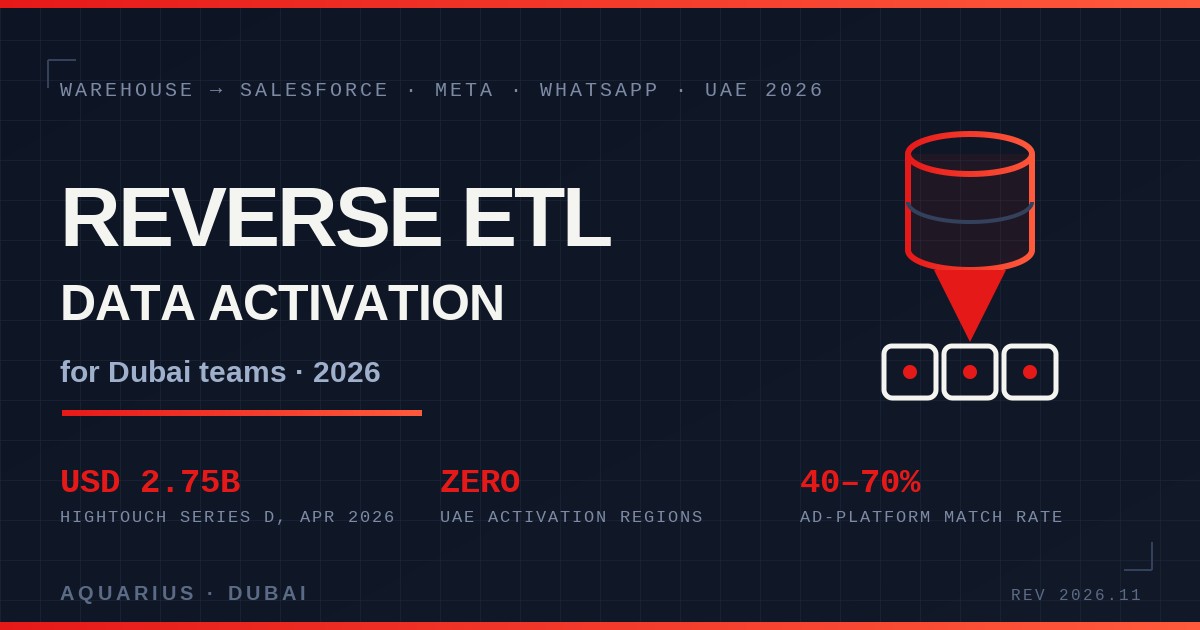
Reverse ETL is the pipeline that runs backwards: instead of pulling data into your warehouse, it pushes modelled data back out of it and into the tools your team already works in — Salesforce, HubSpot, Meta, Google Ads, WhatsApp. For a Dubai business the deciding factor is almost never the feature list. It is that not one major activation vendor runs a UAE region, so every audience sync moves customer data across a border under a PDPL whose Executive Regulations were still unissued in November 2026.
This guide covers what reverse ETL actually does, where your data physically lands when you buy Hightouch or Fivetran Activations from Dubai, the match rates you should realistically expect on Meta and Google, and what an activation layer costs in AED when we build one.
The category got serious in 2026. The region did not.
Three things happened in eighteen months that changed reverse ETL from a plumbing curiosity into infrastructure.
- Hightouch raised USD 150m at a USD 2.75bn post-money valuation on 29 April 2026, co-led by Goldman Sachs and Bain Capital Ventures with strategic participation from The Trade Desk. That is more than double the USD 1.2bn valuation it carried a year earlier. The company says it crossed USD 100m ARR in 2025 and synced 2.17 trillion records in 2026.
- Fivetran bought Census (signed 1 May 2025) and folded it in as Fivetran Activations, then completed an all-stock merger with dbt Labs on 1 June 2026. The ingestion vendor, the transformation vendor and the activation vendor are now one company.
- The reason any of it matters locally: UAE internet penetration sits at 99.0% across roughly 11.5m users, the e-commerce market is tracking USD 12.30bn in 2026 to USD 21.01bn by 2031 (11.29% CAGR) with about 11.04m online shoppers, and WhatsApp reaches 85.8% of UAE social users. The channel mix here is unusually dependent on exactly the destinations reverse ETL feeds.
Against that, dbt Labs' 2026 State of Analytics Engineering survey found 53% of practitioners name poor data quality as their biggest problem and 71% worry that wrong data is reaching stakeholders. Reverse ETL does not fix that. It industrialises it — a bad segment definition now ships straight into a live ad account.
What reverse ETL replaces
Most Dubai marketing teams are already doing reverse ETL. They are doing it with a person and a spreadsheet. Someone runs a query on Monday, exports a CSV of high-value customers, uploads it to Google Ads and Meta Ads Manager, pastes a shorter list into the CRM, and the whole thing is stale by Wednesday.
A reverse ETL tool turns that into a scheduled sync: a SQL model or a visual audience definition in the warehouse, a destination mapping, and a diffing engine that only pushes what changed. The warehouse stays the single definition of "high-value customer" — which is the entire point, and the reason this sits downstream of a warehouse and analytics platform rather than replacing one.
Most Dubai businesses get this wrong by buying the activation layer first. Reverse ETL on an unmodelled warehouse just delivers your mess faster, to more places, with an ad budget attached.
Where your data actually lands
This is the part Dubai buyers skip and then discover during a security review. Both leading vendors publish their processing regions, and neither list includes the UAE.
| Vendor | Nearest processing region to the UAE | Plan needed to choose it |
|---|---|---|
| Hightouch | GCP me-central2 (Dammam, Saudi Arabia). Otherwise AWS ap-south-1 (Mumbai) or eu-west-1 (Ireland) | Region selection is set at workspace creation |
| Fivetran (incl. Activations) | "Middle East" geography, served from GCP Dammam | Business Critical — cloud-region choice is gated to that tier |
| Fivetran Standard / Free | Geography choice only; Google Cloud is your only provider | Included, but no region control |
| Self-hosted (dbt + custom sync jobs) | AWS me-central-1 (UAE) or Azure UAE North, in Dubai | None — you run it |
So the realistic best case on a managed tool is Saudi Arabia, on the vendor's top tier. Everything cheaper processes your customer list in Mumbai, Ireland or Virginia. That is not automatically a PDPL problem — Articles 22 and 23 permit cross-border transfer on specified grounds — but it is a decision you have to be able to defend in writing, and the federal standard contractual clauses that would make it routine do not exist yet. We covered the mechanics of that in the Dubai CDP guide; the short version is that an activation layer is the single largest outbound flow of personal data most companies here will ever build.
Match rates: the number that decides whether this pays
Reverse ETL's commercial case is almost entirely about identity. You push hashed emails and phone numbers; the ad platform matches what it can; everything unmatched is wasted budget.
- Google Customer Match commonly lands in a 40–70% match range, with 40–60% considered healthy for email-only uploads (third-party benchmark aggregations, not a Google-published figure). Since December 2025 the minimum list size for serving across Search, Display and YouTube is 100 active users, down from 1,000 on Search — which finally puts audience sync in reach of mid-size Dubai advertisers.
- Meta's Event Match Quality score typically sits at 3–5 for a pixel-only setup and 6–8+ once the Conversions API is sending hashed first-party PII; Meta's own guidance points at 8.8+ for Purchase events. Hashed email is the single biggest lever. This is where server-side tagging and reverse ETL overlap — see our server-side tracking guide for the collection half.
- Hightouch's own Match Booster went live in Europe on 3 November 2026 (UK, Germany, France, Spain, Italy), claiming up to 90% more matched people than traditional data onboarding and 10%+ more than first-party data alone. It runs on a per-region identity graph. There is no Middle East graph. Gulf audiences fall back to raw first-party matching.
For a UAE business the practical consequence is that phone number is usually your best identifier, not email — a market where WhatsApp reaches 85.8% of social users and 78.7% of 2025 e-commerce orders came from a smartphone is a market where mobile numbers are clean and emails are often disposable. If you are syncing to WhatsApp, the Business API integration is the destination that will out-earn the ad platforms.
What it costs in Dubai
Hightouch publishes a genuinely free Basic Reverse ETL tier — up to two active syncs, unlimited destinations, unlimited seats — and no list price at all for its Composable CDP or Agentic Marketing Platform; everything above the free tier is "get a demo". Third-party trackers put practical paid entry somewhere around USD 450–1,000+ per month. Treat that as indicative, not quoted.
The licence is rarely the expensive part. Building the activation layer is. Note the cost of not buying one: dbt Labs' own figures put the internal build of three basic connectors at around USD 24,000 — roughly AED 88,000 — before anyone maintains them.
| Scope | What you get | Aquarius range (AED) |
|---|---|---|
| First activation layer | Existing warehouse, 2–3 destinations (Meta CAPI, Google Customer Match, CRM), hashed-PII pipeline, consent gating, sync alerting | 18,000 – 45,000 |
| Warehouse-native activation | 6–10 destinations, identity resolution on phone + email, audience library in dbt, WhatsApp and lifecycle triggers, EMQ monitoring | 55,000 – 130,000 |
| In-region self-hosted stack | Sync jobs you own, running in AWS me-central-1 or Azure UAE North — no personal data leaves the UAE | 100,000 – 240,000 |
| Care and run | Sync monitoring, schema-drift fixes, new destinations, quarterly match-rate review | 3,000 – 9,000 / month |
For reference, Dubai freelance developer rates run AED 100–600 per hour and mid-market studio rates AED 250–700 per hour, so an activation layer quoted below about AED 15,000 is someone wiring a CSV export on a cron and calling it a platform.
How Aquarius does it
We build the activation layer in the order that survives an audit. Model first in the warehouse, so every audience has one definition and an owner. Hash PII at the edge before it ever leaves, so the destination receives identifiers and not a customer list. Gate every sync on a consent field, because the PDPL offers no general legitimate-interest basis the way GDPR does — non-essential marketing processing needs consent you can evidence. Then alert on sync failure, because a silently broken audience is worse than no audience: budget keeps spending against a frozen list.
If data residency is a hard requirement — common for Dubai healthcare, government-adjacent and regulated finance work — we skip the managed vendors and run the sync jobs in-region. It costs more up front and removes the transfer question entirely. For everyone else, a managed tool on a documented transfer basis is the cheaper correct answer, and we will tell you which one you are.
Pricing for the whole build sits on our pricing page, and the first conversation is a free scoping call: if your warehouse is not ready for activation yet, we will say so rather than sell you a sync.
FAQ
Is reverse ETL the same as a CDP?
No. A CDP stores and resolves customer profiles in its own system; reverse ETL leaves the profiles in your warehouse and only moves segments out. If you already have a modelled warehouse, reverse ETL is the cheaper path and you skip a second copy of your customer data — which also means one less cross-border flow to document.
Does reverse ETL break UAE PDPL compliance?
Not inherently, but it is the flow most likely to. The PDPL's Executive Regulations were still not issued as of November 2026, so transfer mechanics, DPO thresholds and breach timing all remain unsettled — and there is no fixed federal 72-hour breach deadline, the law says "immediately". Once the Regulations land, organisations get six months to comply. Document your transfer basis now and hash everything you send.
What match rate should a Dubai advertiser expect?
Plan for 40–60% on email-based Google Customer Match uploads and a Meta EMQ of 6–8 once hashed phone and email are flowing through the Conversions API. Phone-first lists generally outperform email here. Anyone promising 90%+ is quoting a European identity-graph product that has no Middle East coverage.
Can we start without replatforming?
Usually yes. If you already have a warehouse and any usable customer table, a first activation layer with two destinations is a three-to-five week build. The common blocker is not tooling but event tracking that was never designed to be joined to a customer record.
Reverse ETL is not a growth hack. It is the difference between a warehouse that produces dashboards nobody opens and one that moves money — and in the UAE, the hard part is deciding where that data is allowed to go.