
Chrome 158 killed XSLT: what breaks on Dubai websites
Chrome 158 shipped on 17 November 2026 without XSLT. We audited UAE sitemaps to find the real exposure: your SEO is fine, but legacy Dubai portals are not. The fix list, AED costs and deadlines.
- PUBLISHED
- 21 NOV 2026
- READ TIME
- 10 MIN
- AUTHOR
- AQUARIUS · DUBAI
- UNIT
- REV 2026.09
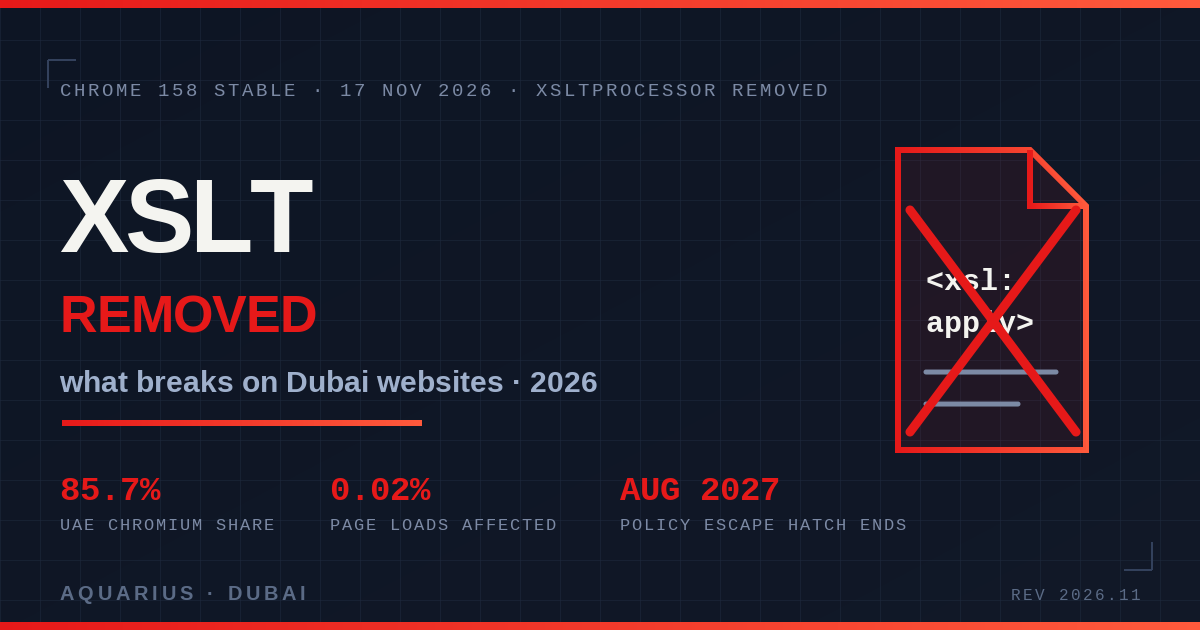
Chrome 158 reached stable on 17 November 2026 with XSLT support removed entirely — both the XSLTProcessor JavaScript class and the <?xml-stylesheet type="text/xsl"?> processing instruction. If your Dubai website serves a styled XML sitemap or RSS feed, nothing happens to your rankings: crawlers never executed XSLT in the first place. The real damage is in legacy enterprise portals — Remote Desktop Web Access, classic ERP screens and in-house XML report viewers — which now render as a raw XML tree for roughly 86% of UAE browser traffic.
The numbers that set the stakes
Three figures explain why this landed quietly and still caught Dubai IT teams off guard.
- 17 November 2026 — Chrome 158 stable date per the Chromium release schedule (early stable 4 November, late stable 18 November).
- 85.7% of UAE browser sessions run on Chromium. StatCounter's October 2026 UAE desktop-and-mobile split puts Chrome at 76.98%, UC Browser 2.67%, Edge 2.7%, Opera 1.97% and Samsung Internet 1.41%. Safari holds 12.05% and still supports XSLT — which is exactly why a broken portal looks "fine on the boss's iPhone".
- 0.02% of page loads used XSLT when Chrome measured it, and fewer than 0.001% used the stylesheet processing instruction. That tiny number is why Google removed it, and why the breakage is concentrated rather than widespread.
The driver was maintenance risk, not fashion. XSLT in Chrome ran on libxslt, an ageing C library with a documented memory-safety record (CVE-2025-7425 and CVE-2022-22834 among them). Its long-time maintainer stepped back in March 2025, the project was publicly described as unmaintained by July 2025, and the same maintainer left libxml2 in September 2025. Firefox filed its own intent to unship in August 2026 with removal across all channels targeted for August 2027. Safari has announced no date.
Myth-bust: this is not an SEO problem
Every Dubai agency inbox got the same panicked question last week: "will Google stop reading our sitemap?" No. We checked rather than guessed.
We pulled the sitemaps of 24 UAE domains — Gulf News, Khaleej Times, The National, WAM, Dubizzle, Bayut, Emirates NBD, Mashreq, Dubai Culture and others — and grepped every response for xml-stylesheet. Among the domains that returned HTTP 200, zero referenced an XSL stylesheet. The large UAE publishers were never exposed.
That is the whole point: <?xml-stylesheet?> is a hint to a browser, not part of the sitemap protocol. Googlebot, Bingbot and every AI crawler parse the XML directly and ignore the instruction. Removing XSLT changes what a human sees when they open /sitemap.xml in a tab, and nothing else. Your <loc> and <lastmod> values are read exactly as before.
One caveat worth noting: type="text/css" stylesheets on XML still work. If you only ever wanted a tidy-looking sitemap for stakeholders, a 20-line CSS file replaces the XSL and survives every browser.
What actually breaks on Dubai systems
The exposure clusters in four places, roughly in order of how much pain each one causes.
1. Remote Desktop Web Access (the big one)
Microsoft published guidance on 17 November 2026 — the same day Chrome 158 shipped — confirming that RD Web Access customises its pages through SiteXsltRenderer.RenderPage calls in Default.aspx, login.aspx, Desktops.aspx and password.aspx. Any organisation running a branded RD Web portal is affected the moment staff update Chrome or Edge. The November 2026 cumulative updates (reported as KB5130994 and KB5131080) move the transform server-side using .NET's XslCompiledTransform, with the stylesheet path set through the RDWebSiteXsltPath app setting (default ~/Pages/SiteLayout.xsl, virtual paths only).
Two constraints matter for Dubai sysadmins who inherited a heavily themed portal: the server-side engine is XSLT 1.0 only — msxsl:script, network-based xsl:import/xsl:include/document() and anything XSLT 2.0 or 3.0 will fail — and RDWebEnableServerSideXslt=false is a diagnostic switch, not a supported long-term workaround. Append ?rdwaformat=xml to a page URL to see the raw XML the transform consumes while you debug.
2. Yoast-style WordPress sitemaps
This is where most Dubai SMEs sit. WordPress's own /wp-sitemap.xml and Yoast's /sitemap_index.xml both ship an XSL stylesheet so the file looks presentable. In Chrome 158 those URLs now show a raw XML tree. Cosmetic only — but it generates support tickets from clients who think their site is broken, and it is the single most common "is this serious?" call we have taken this month.
3. Legacy portals and classic ERP screens
Older on-premise apps common in Dubai trading, logistics and contracting firms render reports by shipping XML plus an XSL file to the browser: classic ERP UIs, statement viewers, customs and shipping document previews, in-house QA dashboards. If any internal tool opens a .xml URL and renders a formatted table, test it today. This is the same class of debt we work through in legacy software modernisation projects.
4. Build-time and feed tooling
Anything that called new XSLTProcessor() in client-side JavaScript — XML config editors, SOAP response formatters, old reporting widgets — now throws. Server-side XSLT is completely unaffected; this removal is browser-only.
Your five options, costed
Dubai developer time is the real input here. Levels.fyi puts the median Dubai software-engineer salary at AED 316,000 per year (about AED 152 per hour), and Guildhall's 2026 UAE salary guide lists front-end developers at AED 24,000 to AED 34,000 per month depending on seniority. The ranges below assume a mid-level rate and include testing.
| Option | What it does | Effort | Typical Dubai cost (AED) | Lifespan |
|---|---|---|---|---|
| Do nothing (sitemap/RSS only) | Accepts a raw XML view for humans; crawlers unaffected | 0 hours | 0 | Permanent |
| Swap XSL for CSS | type="text/css" still works; keeps feeds readable | 1–3 hours | 150–500 | Permanent |
| Move the transform server-side | Server renders HTML; browser gets plain HTML | 1–5 days | 1,200–6,000 | Permanent |
| WASM XSLT polyfill (Saxonica / community) | Restores XSLTProcessor in-page; Saxon adds XSLT 3.0 | 0.5–2 days | 600–2,500 | Permanent, adds payload |
| Rewrite to JSON + JavaScript | Removes XSLT from the stack entirely | 1–4 weeks | 6,000–30,000 | Permanent |
XSLTEnabled enterprise policy | Re-enables XSLT on managed devices | 1–2 hours | 150–300 | Expires with Chrome 176, August 2027 |
The policy row is the trap. XSLTEnabled and the reverse origin trial both expire when Chrome 176 reaches stable in August 2027. Deploying the policy buys a managed Dubai fleet about nine months of breathing room — it is a scheduling tool, not a fix. Treat it the way you would treat a staged cutover in a migration that must not lose traffic: useful to hold the line while the real work happens.
How Aquarius handles an XSLT cutover
Our sequence is deliberately boring, because the cost of this project is almost entirely discovery — the fix itself is small.
- Inventory (half a day). Crawl every public and internal URL for
xml-stylesheetand grep the codebase forXSLTProcessor. Most firms find between zero and three real hits. - Triage. Cosmetic (sitemaps, feeds) versus functional (portals, report viewers). Cosmetic items get CSS or nothing.
- Hold the line. If a functional system is exposed, push
XSLTEnabledto managed devices the same day so staff keep working. - Fix properly. Server-side transform where a server exists; JSON rewrite where the XML was never the point. Both ship well before August 2027.
- Verify on real devices. Chrome and Edge current, plus Safari — because Safari still works and will mask the bug during UAT.
The economics favour acting now rather than in July 2027. A typical Dubai SME audit lands at AED 1,500 to AED 4,000 and usually ends with "you are not affected, here is the evidence". Against that, an RD Web portal that fails for 85.7% of UAE browser traffic takes down remote access for an entire office — and staff cannot work around it, because the browser they are told to use is the one that broke. Scheduled, the fix is a day. Unscheduled, it is an outage.
FAQ
Will Chrome 158 hurt my Google rankings in the UAE?
No. Search crawlers parse sitemap and feed XML directly and have always ignored the <?xml-stylesheet?> instruction. Removing XSLT changes only what a person sees when they open the XML file in a browser tab.
How do I check whether my Dubai website is affected?
Run curl -s https://yourdomain.ae/sitemap.xml | grep xml-stylesheet, repeat for your RSS feed and any internal .xml URL, then grep your front-end source for XSLTProcessor. No matches means no exposure. Also open your RD Web Access or ERP login page in Chrome 158 — visual breakage is immediate and obvious.
Can I just re-enable XSLT?
On managed devices, yes — the XSLTEnabled enterprise policy restores it, and there is a reverse origin trial for individual sites. Both stop working when Chrome 176 ships in August 2027, so treat either as a deadline extension rather than a solution.
Does this affect server-side XSLT or .NET applications?
No. .NET's XslCompiledTransform, Java's Saxon, PHP's XSL extension and every build-time pipeline are untouched. This removal applies only to XSLT executed inside the browser, which is exactly why "move it to the server" is the standard fix.
What about Safari and Firefox users in the UAE?
Safari holds 12.05% of UAE browser share and still supports XSLT with no announced removal date. Firefox has declared its intent to unship with removal across all channels targeted for August 2027. Plan for every browser losing XSLT by late 2027.
Where to go from here
Most Dubai businesses will finish this exercise in an hour and discover they were never exposed. The ones that were exposed almost always find it in a system nobody has touched in years — which is the real lesson, not XSLT. If you want that audit done properly, with the evidence written down, see how we scope web and software engineering work or send us the URL and we will test it.