
Website Migration in Dubai (2026): Replatform Without Losing Google Traffic
60-80% of website migrations lose organic traffic and the average recovery takes 523 days. The 2026 Dubai playbook for replatforming without losing Google rankings, plus real AED costs.
- PUBLISHED
- 01 OCT 2026
- READ TIME
- 11 MIN
- AUTHOR
- AQUARIUS · DUBAI
- UNIT
- REV 2026.09
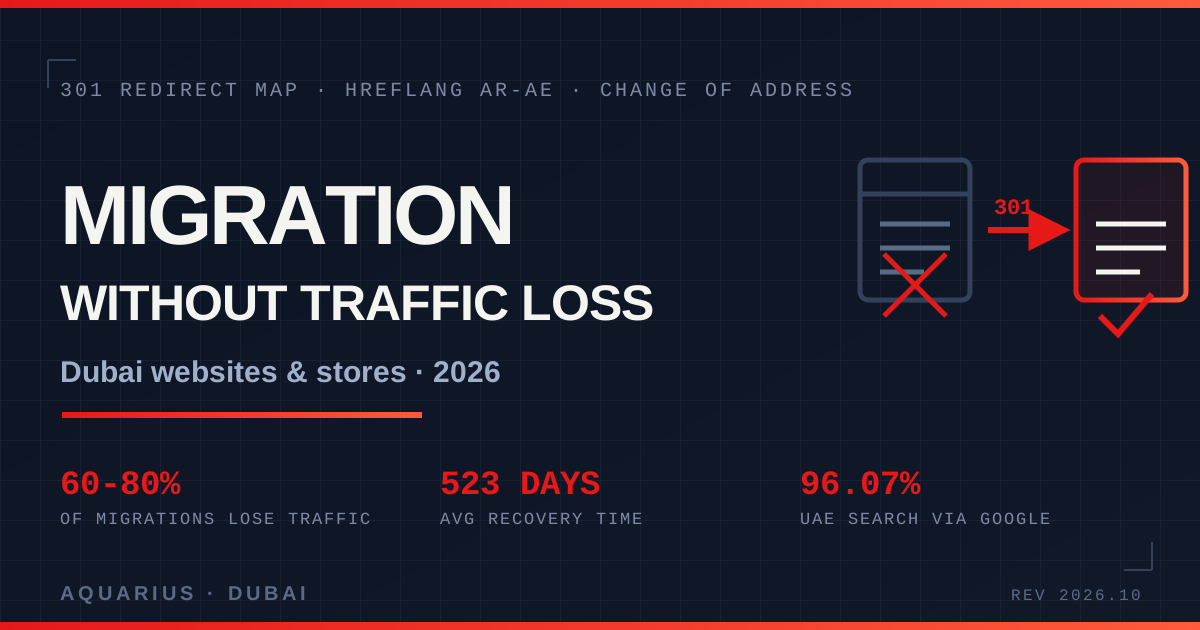
Short answer: between 60% and 80% of website migrations lose measurable organic traffic, only about 10% come out of it with better SEO, and the average site that drops takes roughly 523 days to climb back. In Dubai that bill is steeper than most markets, because 96.07% of UAE search goes through Google and replacing lost organic clicks with Google Ads costs AED 6–18 per click for a typical service business. A migration is not a design project with an SEO step at the end. The redirect map is the project.
Key takeaways
- Expected damage scales with scope: a visual refresh on the same URLs usually dips 10–25% and recovers in 4–8 weeks. A full replatform with new URLs typically drops 30–60% and takes 4–12 months.
- 17% of migrated sites had still not recovered after 1,000 days. This is the one web project that can permanently reduce the size of your business.
- Google’s Change of Address tool in Search Console forwards signals for 180 days. Google’s own guidance is to keep the 301 redirects live for at least one year — most Dubai projects kill the old hosting after 30 days.
- Bilingual sites carry double the risk and double the upside: roughly 54% of UAE Google searches are in Arabic, and Arabic URLs are where hreflang and RTL templates break silently.
- In 2026 you are migrating into a harsher SERP. Zero-click searches hit 68.01% in early 2026 and AI Overviews cut click-through by 58–61% where they appear. There is no spare traffic to gamble with.
Why a Dubai migration is higher-stakes than most markets
Three numbers set the stakes. First, concentration: StatCounter puts Google at 96.07% of UAE search (March 2026) and 98.08% on mobile (August 2026). There is no Bing or Yandex cushion here — if Google loses track of your URLs, you are dark.
Second, the whole market is online. The UAE runs at roughly 99% internet penetration with about 11.3 million internet users, and around 11.04 million people shop online. UAE e-commerce is worth USD 12.30 billion in 2026 and is forecast to reach USD 21.01 billion by 2031 at an 11.29% CAGR. Your organic listings are not a marketing channel in Dubai; they are the shopfront.
Third, the replacement cost of lost traffic is brutal. Google Ads in the UAE runs AED 4–65 per click on Search, with most service businesses paying AED 6–18, healthcare AED 10–35, legal and professional services AED 18–65, and competitive real-estate keywords AED 40–120 and above. The UAE carries the highest average CPC of any country, about 8% above the United States, and Dubai CPCs run 30–50% above Abu Dhabi.
Put those together. A Dubai services site doing 6,000 organic sessions a month that drops 40% after a botched replatform loses 2,400 clicks a month. At AED 12 a click, buying that traffic back costs AED 28,800 a month — about AED 345,000 a year, which is more than the entire rebuild cost for most businesses. That is the number nobody puts in the migration proposal.
What actually breaks: the five failure modes
Migrations rarely fail because of one catastrophic mistake. They fail because five small things are each 90% done.
1. Partial redirect maps
Every indexed URL on the old site needs a one-to-one 301 to its closest equivalent. Not a blanket redirect to the homepage — Google treats mass homepage redirects as soft 404s and the ranking signals evaporate. The common Dubai failure is mapping the 40 pages in the main menu and forgetting the 300 blog posts, old Arabic URLs, PDF brochures and campaign landing pages that hold the backlinks.
2. Redirects switched off too early
Google recommends permanent redirects (301 or 308) kept in place for as long as possible, generally at least one year, so it can recrawl and reassign links from third-party sites. The Change of Address tool emphasises the new site and forwards signals, but its effect runs for 180 days, after which Google no longer treats the old site as related. If you cancel the old hosting at the 30-day mark to save AED 400, you throw away every backlink you ever earned.
3. Arabic and RTL silently dropped
With roughly 54% of UAE Google searches in Arabic, the Arabic tree is half your addressable demand. Migrations routinely ship with hreflang pointing at the wrong locale, Arabic URLs flattened into English slugs, or the RTL stylesheet missing from the new templates. Sites that publish properly matched Arabic and English versions of the same service page see roughly 40–55% more organic traffic within six to eight months — so this is the one area where a migration can genuinely grow traffic rather than just preserve it. See our guide to Arabic website localization and RTL in Dubai.
4. Speed regressions
A new site is often slower than the old one because it ships uncompressed hero images and four analytics tags. Google judges Core Web Vitals at the 75th percentile of real visitors: LCP at or under 2.5s, INP at or under 200ms, CLS at or under 0.1. Only about 43% of mobile origins clear that bar. Benchmark before and after, not just on your office fibre — see Core Web Vitals optimisation for Dubai websites.
5. Compliance and tracking reset to zero
New site, new consent banner, new analytics property, new forms. In practice that means a broken conversion history exactly when you need to prove the migration worked, plus a PDPL exposure: the UAE personal data regime carries administrative fines from AED 50,000 up to AED 5,000,000, with oversight now centralised under the Federal Authority for Artificial Intelligence and Data established on 14 June 2026, and a 72-hour breach-notification clock. Port the consent logic and the data-processing records along with the design. Our UAE PDPL checklist covers the build-side requirements.
Expected traffic loss by migration type
Use this to set expectations before launch, not after. The drop and recovery ranges are industry benchmarks; the AED figures are Aquarius scoping ranges for the SEO-preservation workstream only, excluding design, build and 5% VAT.
| Migration type | Typical organic drop | Recovery window | SEO workstream (AED) |
|---|---|---|---|
| Visual refresh, same URLs | 10–25% | 4–8 weeks | 2,500–6,000 |
| CMS change, URLs preserved | 15–30% | 6–12 weeks | 6,000–15,000 |
| Replatform with new URL structure | 30–60% | 4–12 months | 15,000–40,000 |
| Domain change or rebrand | 30–60% | 6–12 months | 25,000–70,000 |
| Consolidating EN + AR + microsites into one site | 25–50% | 6–12 months | 35,000–90,000 |
For context on the build side: international benchmarks put a simple platform move at roughly AED 2,000–18,000 and a properly SEO-preserved migration with integrations at AED 18,000–147,000, while a custom performance replatform onto a modern stack such as Next.js starts around AED 73,000. Mid-market e-commerce replatforms run far higher — USD 150,000–300,000 over five to ten months — with the platform licence only 20–40% of the total. Our Dubai website redesign cost guide breaks down the design and build side in AED.
The sequence that protects the traffic
Order matters more than effort. This is the sequence we run at Aquarius.
Two to four weeks before launch
Crawl the live site in full and export every indexable URL, including Arabic paths, paginated archives and PDFs. Pull 12 months of Search Console data per URL so you have a ranking and impression baseline to argue from later. Export the backlink profile and flag the top 50 linked pages — those URLs are non-negotiable and must keep a direct 301. Then build the redirect map as a spreadsheet with old URL, new URL, status code and owner. Nothing goes live until that sheet has no blanks.
Launch week
Ship with the redirect map deployed and tested on staging first. Keep the old XML sitemap live alongside the new one for a few weeks so Google discovers the redirects faster. Check robots.txt and meta robots on the new build — a staging noindex shipped to production is still the single most common one-line disaster. Confirm canonical tags, hreflang pairs for every English and Arabic counterpart, structured data, and that titles and meta descriptions carried over rather than reverting to template defaults. If the domain is changing, file the Change of Address request in Search Console the same day.
First 30 days after launch
Watch four reports daily: Search Console Pages (indexing errors and redirect chains), Crawl Stats, Core Web Vitals field data, and organic sessions by landing page against your baseline. A 10–15% temporary dip is normal; a sustained drop beyond 30% is a technical fault, not a patience problem — usually a redirect chain, a missing canonical or a blocked resource. Fix it within days, because the recovery clock is unforgiving: median recovery runs into months, not weeks.
How Aquarius runs migrations
We treat the redirect map as the deliverable the project is judged on, and we quote the SEO workstream as a named line item instead of burying it in the build. That means a full pre-launch crawl and ranking baseline, a one-to-one redirect map signed off before launch, bilingual hreflang verification across the Arabic and English trees, Core Web Vitals benchmarked before and after against the 2.5s / 200ms / 0.1 thresholds, and 30 days of post-launch monitoring included. We also keep the old host alive for a minimum of 12 months on purpose, per Google guidance, rather than switching it off to trim the invoice.
The risk reversal is simple: if organic traffic is not back to baseline within 90 days of launch and the cause sits inside our scope, the remediation work is on us. See pricing for how we scope this, or send us your current URL list and we will tell you honestly whether you need a migration or just a faster theme.
One last 2026 reality check. You are not migrating into the SERP you remember. Zero-click searches reached 68.01% of Google queries in early 2026, the share of searches producing at least one click fell 9.51 percentage points between 2024 and 2026, and where an AI Overview appears click-through drops 58–61%. The clicks that still exist are worth more than ever — which is exactly why losing 40% of them to a redirect spreadsheet nobody finished is the most expensive avoidable mistake in Dubai digital right now.
FAQ
How much traffic will I lose when I migrate my Dubai website?
Plan for 10–25% on a redesign that keeps the same URLs and 30–60% on a replatform with new URLs. Industry data shows 60–80% of migrations lose measurable organic traffic and only about 10% improve SEO. A 10–15% dip in the first weeks is normal; anything sustained beyond 30% means something is technically broken.
How long should I keep 301 redirects after a site move?
Google recommends keeping permanent redirects (301 or 308) in place for as long as possible and generally at least one year, because third-party sites take that long to update their links. Search Console signal forwarding from a Change of Address request lasts 180 days, so the one-year rule is the safer standard. Do not decommission the old hosting early.
Do I need the Google Search Console Change of Address tool?
Only when the domain changes. It tells Google to prioritise crawling the new site, forwards signals from the old one, and prefers the new URLs as canonical for 180 days. If you are changing platform but keeping the same domain you do not use the tool — your 301s and sitemaps do the work.
How long does organic traffic take to recover after a migration?
Most well-executed, same-domain migrations stabilise in 4–8 weeks. Across all migrations the average recovery runs about 523 days, and 17% of sites had still not recovered after 1,000 days. Execution quality, not elapsed time, is the variable you control.
What does an SEO-safe website migration cost in Dubai?
As an SEO-preservation workstream on top of the build, budget roughly AED 2,500–6,000 for a small brochure site, AED 6,000–15,000 for a corporate or bilingual site, AED 15,000–40,000 for e-commerce, and AED 25,000–70,000 for a domain change or rebrand, before 5% VAT. Set against an AED 28,800 monthly cost of buying lost clicks back at UAE CPCs, it is the cheapest insurance in the project.
Should I migrate my Arabic pages at the same time?
Yes — migrating English first and Arabic later doubles the risk window and usually breaks hreflang in the gap. With roughly 54% of UAE searches in Arabic, treat the Arabic tree as a first-class part of the redirect map, not a phase two.