
Cloud Migration Cost in Dubai (2026): AWS vs Azure, and the 23% Data-Residency Premium Nobody Budgets
Running in AWS me-central-1 costs about 23% more per hour than N. Virginia — forever. Real AED migration costs, AWS vs Azure UAE regions, and the residency rules that force the choice.
- PUBLISHED
- 22 SEPT 2026
- READ TIME
- 12 MIN
- AUTHOR
- AQUARIUS · DUBAI
- UNIT
- REV 2026.09
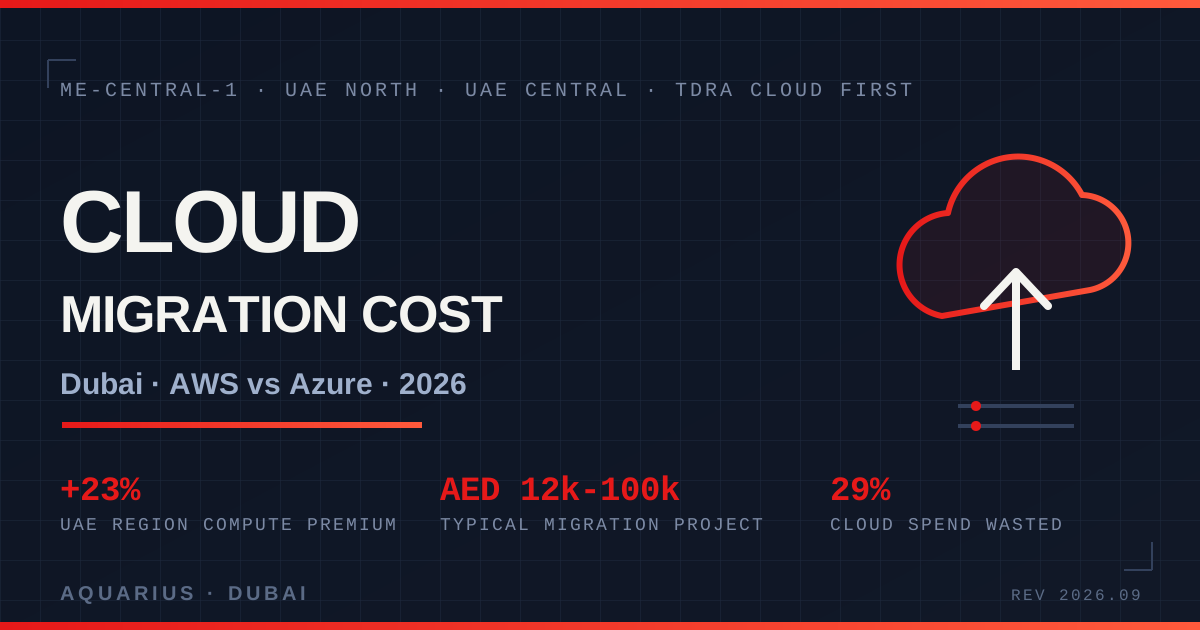
Short answer: A Dubai cloud migration costs roughly AED 3,000 to AED 8,000 to move 50 mailboxes to Microsoft 365, AED 12,000 to AED 25,000 to lift three to five VMs into Azure or AWS, and AED 30,000 to AED 100,000+ for a full on-premise exit of ten or more servers. The number almost nobody budgets is the one that never stops: keeping data inside the UAE costs about 23% more per compute hour than running the same instance in Virginia. That premium is permanent, and for most regulated Dubai businesses it is not optional. Updated September 2026.
Here is the number we pulled ourselves, straight from the AWS Price List API in September 2026: an m5.large in me-central-1 (UAE) lists at $0.118 per hour against $0.096 in us-east-1. A t3.medium is $0.0502 against $0.0416. That is a 21–23% residency premium on raw compute, before storage, before egress, before the 5% VAT on your invoice. Ten mid-size instances running year-round is roughly AED 7,000 a year of pure geography.
This guide covers what the UAE cloud market actually looks like in 2026, when residency is a legal requirement rather than a preference, how AWS and Azure compare inside the country, and honest AED bands for the migration itself. Aquarius is an AI-native web and app development studio in Dubai, so these are the numbers we put in front of clients before they sign anything.
Key takeaways
- The UAE cloud market is at USD 16.43 billion in 2026, up from USD 12.84 billion in 2025, on track for USD 56.26 billion by 2031 at a 27.93% CAGR.
- Residency is cheap to buy and expensive to keep. Both hyperscalers have in-country regions; both charge roughly a fifth more to use them.
- Cloud waste hit 29% of spend in 2026 — up from 27%, the first rise in five years — and organisations overshot cloud budgets by 17%.
- Only 8% of UAE SMEs have reached advanced digital maturity, and 47% name setup cost as the barrier.
- Migration bands: AED 3,000–8,000 for email, AED 5,000–12,000 for file servers, AED 12,000–25,000 for 3–5 VMs, AED 30,000–100,000+ for a real datacentre exit.
Why 2026 is the year Dubai stopped debating the cloud
The infrastructure argument is over. Microsoft opened Azure UAE North in Dubai in 2019 — the first global hyperscaler with a dedicated UAE region — paired with UAE Central in Abu Dhabi. AWS followed with the Middle East (UAE) Region in August 2022, three Availability Zones, backed by a planned $5 billion (roughly AED 20 billion) investment over 15 years.
The capital has only accelerated. Microsoft announced a $15.2 billion UAE investment programme, including a 200 MW datacentre expansion with G42 delivered through Khazna, with capacity expected to come online before the end of 2026. The UAE datacentre market itself was worth around AED 12 billion in 2025 and is growing at roughly 18% a year.
Meanwhile the demand side is still immature. A 2026 SME survey found 81% of UAE businesses use laptops and desktops and 77% run a POS system, but only 8% have reached an advanced level of digital maturity. The barriers are money and people: 47% cite setup costs, 45% a skills gap, 37% subscription costs and 31% integration difficulty. Translation — the platforms are world-class, and most Dubai SMEs are still running a server in a cupboard behind reception.
When UAE data residency is a legal requirement, not a preference
This is the part that decides your architecture before any price comparison does.
The UAE Cloud First Policy, administered by the TDRA, requires government data to sit on UAE-located, registered cloud infrastructure, with a three-tier classification running from government-cloud-only, through community cloud with approved providers, to commercial cloud with additional controls. If you sell to or integrate with a government entity, your provider needs TDRA CSP registration and you inherit the Information Assurance Regulation (IAR) control set.
Sector rules stack on top. CBUAE circulars keep financial data in the UAE. MOHAP rules keep health data in the UAE. And Federal Decree-Law No. 45 of 2021 (PDPL) restricts transferring personal data outside the country without an adequacy finding or an approved safeguard.
The detail most Dubai businesses get wrong: the residency obligation attaches to processing, not just storage. Keeping your database in me-central-1 while calling an AI inference endpoint in Ireland can still be a cross-border transfer. In 2026, with GenAI now the third most widely used public cloud service at 58% adoption, this is no longer a theoretical edge case — it is the single most common compliance gap we find in Dubai architectures.
AWS UAE vs Azure UAE: how to actually choose
Most UAE businesses picking a primary cloud in 2026 land on AWS or Azure, with Google Cloud in the conversation for data and AI work but thinner local enterprise penetration. The honest decision rule is boring:
- Choose Azure if you are already a Microsoft shop — Windows Server, SQL Server, Active Directory, Microsoft 365. Azure Hybrid Benefit lets you carry existing Windows and SQL licences across, which frequently swings a five-year TCO comparison harder than any list price does. Two in-country regions also give you a same-country DR pair.
- Choose AWS if you are building modern Linux and container workloads, want the widest managed-service catalogue, or need the deepest local partner bench. The UAE region has run with three AZs since 2022, so it is mature rather than new.
- Choose both, deliberately, only if you have a named reason. Multi-cloud doubles your operational surface and is a leading contributor to the 29% waste figure below.
The residency premium, in real numbers
These are AWS on-demand Linux list prices pulled from the public Price List API in September 2026, converted at the pegged rate of AED 3.6725 to the dollar, at 730 hours a month. VAT at 5% is charged on top for UAE-billed accounts.
| Instance | me-central-1 (UAE) | us-east-1 (Virginia) | UAE premium |
|---|---|---|---|
| t3.medium, per hour | $0.0502 | $0.0416 | +21% |
| m5.large, per hour | $0.1180 | $0.0960 | +23% |
| m5.large, per month | AED 316 | AED 257 | AED 59 / month |
| 10 × m5.large, per year | AED 37,970 | AED 30,890 | AED 7,080 / year |
Two conclusions fall out of that table. First, the residency premium is real but survivable — AED 7,080 a year on a ten-instance estate is less than one PDPL exposure is worth. Second, anyone quoting you a UAE cloud bill off a US pricing calculator is under-quoting you by about a fifth. Ask which region the estimate assumed.
What a Dubai cloud migration actually costs in AED
Migration service fees are separate from what you then pay AWS or Azure every month. Confusing the two is the most common budgeting error we see. Typical UAE market bands:
| Scope | Typical AED range | Rough timeline |
|---|---|---|
| Email to Microsoft 365, ~50 users | 3,000 – 8,000 | 1 – 2 weeks |
| File server to SharePoint / OneDrive, SME | 5,000 – 12,000 | 2 – 3 weeks |
| On-premise to Azure or AWS, 3–5 VMs | 12,000 – 25,000 | 4 – 6 weeks |
| Full infrastructure exit, 10+ VMs | 30,000 – 100,000+ | 8 – 14 weeks |
| Re-architecture (monolith to containers / serverless) | 90,000 – 400,000+ | 3 – 9 months |
Inside any of those, the shape is the same: assessment 1–2 weeks, pilot workload 2–4 weeks, then cutover waves. If a vendor skips the assessment and quotes a fixed price off a phone call, that quote is a guess and the variance lands on you as change requests.
Two costs that reliably get missed. Egress: moving data out of the cloud is billed per GB, so analytics pipelines that pull data back on-premise nightly can quietly outgrow the compute bill. Parallel running: for the four to eight weeks you run old and new side by side, you pay twice — budget it explicitly rather than discovering it.
One offset worth checking before you pay full price: Khalifa Fund grants reimburse up to 50% of eligible cloud subscription costs for qualifying smaller businesses, and both hyperscalers run migration-assessment and credit programmes through local partners.
The 29% problem: why most Dubai cloud bills are too high
The Flexera 2026 State of the Cloud Report puts wasted IaaS and PaaS spend at 29% — up two points from 27% in 2025, and the first increase in five years, driven largely by AI workloads and sprawling PaaS. On top of that, organisations are exceeding their cloud budgets by 17%.
Apply that to a Dubai SME spending AED 20,000 a month on cloud: roughly AED 5,800 a month, near AED 70,000 a year, buys nothing. That is materially larger than the cost of the migration project that created the estate. The usual suspects are idle non-production environments running nights and weekends, over-provisioned instances sized for a 2019 peak, orphaned volumes and snapshots, no reserved-instance or savings-plan coverage on steady workloads, and duplicated tooling across two clouds.
The cost-of-inaction framing matters here: a migration that lands badly does not just cost the project fee, it installs a recurring 29% leak into your operating budget. Right-sizing and a commitment strategy at cutover — not six months later — is where the money is.
How Aquarius approaches a Dubai cloud migration
We run it in four stages, and we quote each one separately so you can stop after any of them.
- Residency map first. Every data class labelled against PDPL, CBUAE, MOHAP and TDRA Cloud First — including where it is processed, not just stored. This determines the region before it determines the provider.
- Assessment and right-sized target. Real utilisation data, not the spec sheet of the box you bought in 2019. Most on-premise servers migrate at 40–60% of their nominal size.
- Pilot one workload end to end. A non-critical system, fully cut over, measured. The pilot is what makes the rest of the quote honest.
- Cutover with FinOps on day one. Tagging, budgets, alerts and a savings-plan commitment at go-live, so the 29% never gets a chance to accumulate.
If you also need the application layer modernised rather than just relocated, that is the same conversation — see our services and pricing. For the residency side specifically, our UAE PDPL compliance checklist and Dubai hosting and data residency guide go deeper. When you are ready for real numbers on your estate, tell us what you are running and we will map it.
FAQ
How much does cloud migration cost in Dubai in 2026?
Between AED 3,000 and AED 8,000 to move around 50 mailboxes to Microsoft 365, AED 12,000 to AED 25,000 for three to five VMs into Azure or AWS, and AED 30,000 to AED 100,000 or more for a full on-premise exit of ten or more servers. A re-architecture to containers or serverless runs AED 90,000 to AED 400,000+. Those are service fees only — monthly cloud consumption is billed separately, plus 5% VAT.
Is AWS or Azure cheaper for a UAE business?
List prices are close enough that licensing usually decides it. If you already own Windows Server or SQL Server licences, Azure Hybrid Benefit typically makes Azure cheaper on a five-year view. For Linux, containers and managed services, AWS is generally competitive and has the broader catalogue. Both charge a UAE-region premium of roughly 21–23% over US regions, so compare like-for-like regions or the comparison is meaningless.
Does UAE law require my data to stay in the country?
It depends on the data. Government data falls under the TDRA Cloud First Policy and must sit on UAE-located registered infrastructure. CBUAE rules keep financial data in the UAE and MOHAP rules keep health data in the UAE. General personal data is governed by PDPL (Federal Decree-Law No. 45 of 2021), which restricts cross-border transfer without an adequacy finding or approved safeguard. Critically, the obligation covers processing as well as storage, which catches AI and analytics workloads that call out-of-country endpoints.
How long does a cloud migration take in Dubai?
Assessment takes one to two weeks, a pilot workload two to four weeks, and cutover depends on scope — roughly four to six weeks for three to five VMs and eight to fourteen weeks for a ten-plus server estate. Budget for four to eight weeks of parallel running where you pay for both environments.
Why is my UAE cloud bill higher than the calculator said?
Three usual reasons. The estimate was built against a US region, which understates UAE compute by about a fifth. VAT at 5% was not included. And data egress, backups, snapshots and non-production environments were left out — those categories are a large part of why 29% of global cloud spend delivered no value in 2026.