
Where to Host Your Dubai Website in 2026: UAE Data Residency, Speed & PDPL
Where to host your Dubai website in 2026: UAE data residency under PDPL, local vs overseas latency (126ms to under 10ms), and real AED hosting costs — so your site is fast, compliant and search-ready.
- PUBLISHED
- 12 SEPT 2026
- READ TIME
- 08 MIN
- AUTHOR
- AQUARIUS · DUBAI
- UNIT
- REV 2026.09
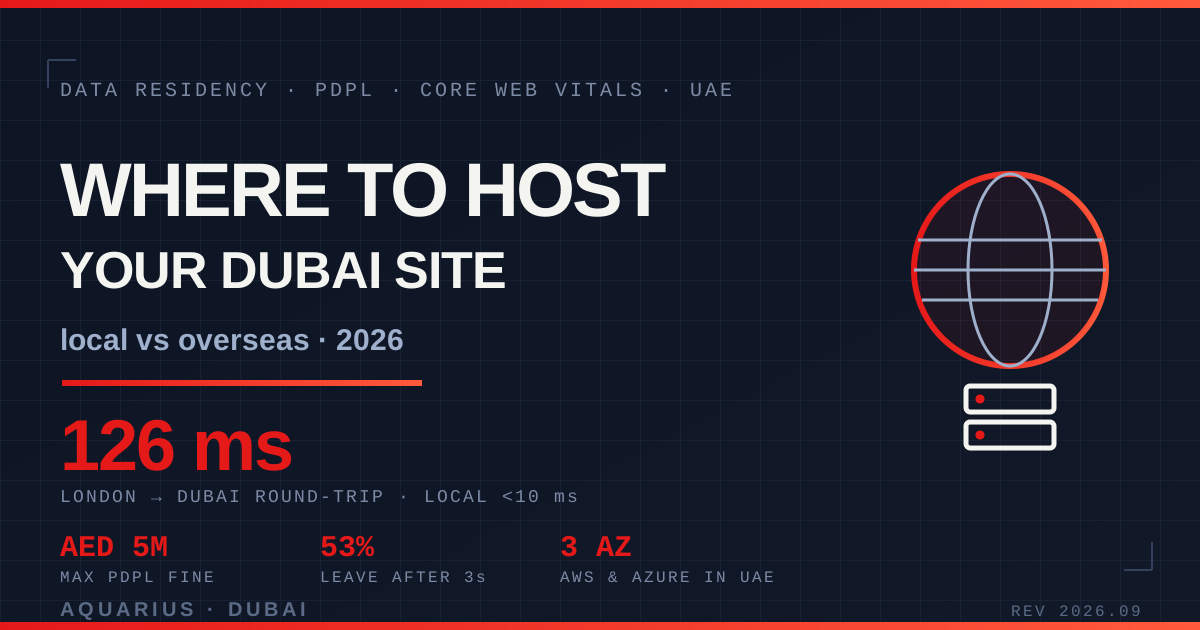
Short answer: for most Dubai businesses in 2026, host inside the UAE — on a local provider or an in-country cloud region (AWS me-central-1 or Azure UAE North) — if a meaningful share of your visitors, or any personal data, sits in the Emirates. Local hosting cuts the round-trip from a UAE user from roughly 126ms (London) or 247ms (New York) to under 10ms, which is the difference between a page that feels instant and one people abandon. It also keeps you clear of the cross-border-transfer rules in the UAE's Personal Data Protection Law (Federal Decree-Law No. 45 of 2021), where fines reach AED 5 million. Host overseas only when your audience is genuinely global and you pair it with a strong CDN.
Key takeaways
- Latency is physics. A UAE user pings a Dubai server in under 10ms, London in ~126ms, Frankfurt ~131ms, and New York ~247ms. No amount of code fixes distance.
- Residency is law. PDPL pushes personal data to stay in-country unless you meet cross-border-transfer conditions; DIFC, ADGM, healthcare and government work often require local hosting outright.
- The cloud is already here. AWS (me-central-1) and Microsoft Azure (UAE North in Dubai, UAE Central in Abu Dhabi) each run three in-country availability zones — you no longer trade compliance for capability.
- Cost is not the blocker. Quality UAE hosting runs AED 120–1,080/yr for shared and AED 500–2,000/yr for high-performance or VPS — a rounding error against lost conversions.
TOFU: why hosting location suddenly matters in the UAE
Hosting used to be an afterthought — cheapest plan, nearest checkbox, done. In 2026 it is a strategic decision, because the ground under it has shifted. The UAE data-centre market is worth about USD 1.74 billion in 2026 and is forecast to hit USD 3.86 billion by 2031 (17.33% CAGR), while the broader UAE cloud-computing market is running at roughly USD 16.43 billion in 2026, heading for USD 56.26 billion by 2031 (27.93% CAGR). That build-out exists for a reason: both regulation and user expectation now reward keeping workloads in-country.
Two forces drive it. First, data residency. The UAE's Personal Data Protection Law — Federal Decree-Law No. 45 of 2021, in force since 2 January 2022 and overseen by the UAE Data Office — steers personal data toward staying inside the UAE unless specific cross-border-transfer safeguards are met. Hosting customer records in Frankfurt or Virginia is not automatically illegal, but it triggers obligations that simply vanish when the data never leaves the country. For DIFC, ADGM, healthcare and government-adjacent work, in-country hosting is frequently mandatory, not optional. Get it wrong and penalties reach AED 5 million — more on the compliance build in our PDPL checklist for websites and apps.
Second, speed. Google's own data is blunt: 53% of mobile visitors abandon a page that takes more than three seconds, and the probability of a bounce rises 123% as load time grows from one to ten seconds. Server distance feeds straight into Core Web Vitals — Largest Contentful Paint and Interaction to Next Paint both depend on server response time. Host far away and you start every page load already behind.
MOFU: local vs overseas — the numbers that decide it
Distance is not negotiable. Here is what a visitor in Dubai actually experiences, by origin server location:
| Server location | Round-trip latency to a Dubai user | Verdict for UAE audiences |
|---|---|---|
| Dubai / UAE (local or in-country cloud) | Under 10ms | Best — near-instant response |
| London, UK | ~126ms | Noticeable lag without a CDN |
| Frankfurt, Germany | ~131ms | Noticeable lag without a CDN |
| Singapore | ~167ms | Slow for UAE-first sites |
| New York, USA | ~247ms | Poor — avoid as origin for UAE traffic |
Translated into page load: when 80%+ of your visitors are UAE-based, moving from an overseas origin to a local host can drop load times from 3–4 seconds to under 0.5 seconds. Overseas visitors typically eat a 1–3 second penalty per page — straight off the edge of the bounce-rate cliff described above. If you are already fighting slow pages, our guide to Core Web Vitals for Dubai sites pairs directly with this decision.
You have three realistic hosting routes in 2026:
| Option | Best for | Trade-off |
|---|---|---|
| Local UAE host (shared / VPS) | SMEs, brochure & lead-gen sites, most Dubai businesses | Fewer advanced managed services than hyperscalers |
| In-country cloud region (AWS me-central-1, Azure UAE North/Central) | Apps handling personal data, DIFC/ADGM/health/gov, scale | New AWS services can lag Bahrain (me-south-1) by 6–18 months |
| Overseas host + global CDN | Genuinely global audiences, static-heavy sites | Cross-border PDPL obligations; origin still far for dynamic calls |
The hyperscaler footprint is real: AWS me-central-1 launched in the UAE in August 2022 with three availability zones, and Microsoft Azure runs UAE North (Dubai) and UAE Central (Abu Dhabi), also with in-country zones and DR pairing. So "we need cloud scale" is no longer a reason to leave the country. A CDN (Cloudflare, CloudFront, Azure Front Door) still helps everyone by caching static assets at the edge — but a CDN in front of a New York origin does not fix a slow, dynamic, database-driven page for a Dubai user. The origin location still matters.
BOFU: what it costs, and how Aquarius sets it up
The cost objection rarely survives the numbers. Quality UAE hosting in 2026 runs about AED 120–1,080 per year for shared hosting, and AED 500–2,000 per year for high-performance local hosting or a Dubai VPS. In-country cloud (AWS/Azure) is usage-based and scales with your app, but even a small production workload sits in the low hundreds of dirhams a month. Set that against the alternative: if slow overseas hosting adds two seconds and pushes even a slice of your traffic over the three-second abandonment line, a single lost enterprise lead can cost more than a decade of the hosting itself. Hosting is the cheapest performance and compliance lever on your entire stack.
How Aquarius handles it: (1) we map where your visitors and your data actually sit before choosing anything; (2) UAE-first sites go on local hosting or an in-country cloud region so latency stays under 10ms and PDPL residency is clean by default; (3) global static assets ride a CDN at the edge; (4) personal data handling, consent and cross-border logic are built to PDPL from day one, not retrofitted; and (5) we bake it into a fixed-scope AED quote alongside the build, so hosting is a decision, not a surprise line item. See our pricing or tell us where your users are and we'll recommend the right setup.
FAQ
Do I legally have to host my website in the UAE?
Not always. PDPL (Federal Decree-Law No. 45 of 2021) allows overseas hosting if you meet its cross-border-transfer conditions, but keeping personal data in-country removes those obligations entirely. DIFC, ADGM, healthcare and government-adjacent work frequently require local residency, so check your sector before choosing.
How much faster is local UAE hosting really?
Materially. A Dubai user reaches a local server in under 10ms versus ~126ms to London or ~247ms to New York. For UAE-majority audiences that can cut page load from 3–4 seconds to under 0.5 seconds.
Can't a CDN fix slow overseas hosting?
Partly. A CDN caches static files (images, CSS, JS) at the edge and helps everyone, but it does not fix dynamic, database-driven requests that still travel to a distant origin. For UAE-first, app-like sites, the origin location still decides real-world speed.
Is AWS or Azure available inside the UAE?
Yes. AWS operates the me-central-1 region (launched August 2022, three availability zones) and Microsoft Azure runs UAE North (Dubai) and UAE Central (Abu Dhabi). Both support in-country data residency; note that some newer AWS services reach the UAE region later than Bahrain.
What does UAE hosting cost in 2026?
Roughly AED 120–1,080/year for shared hosting and AED 500–2,000/year for high-performance local hosting or a VPS. In-country cloud is usage-based. Budget hosting alongside annual maintenance for the true cost of keeping a site live.
Bottom line: in 2026, where you host is a speed and compliance decision, not a checkbox. If your users or your data live in the UAE, host in the UAE — local or in-country cloud — and put a CDN in front for the rest of the world. The latency math (under 10ms vs 126–247ms) and the PDPL residency rules both point the same way. Talk to Aquarius and we'll pick the right hosting for where your audience actually is.