
Completion Accounts vs Locked Box: How Dubai Deals Get Priced in 2026
Locked box or completion accounts? 54% of European deals now fix the price at signing, while 89% of post-closing adjustments actually move money. What works for a Dubai deal in 2026.
- PUBLISHED
- 16 NOV 2026
- READ TIME
- 12 MIN
- AUTHOR
- AQUARIUS · DUBAI
- UNIT
- REV 2026.09
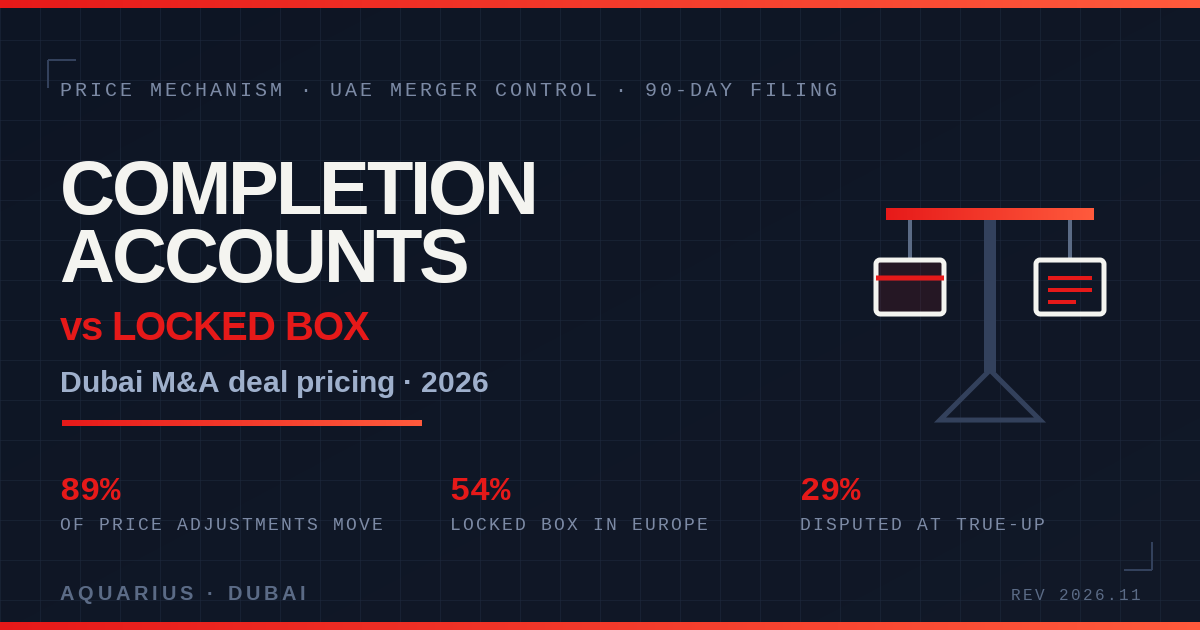
Short answer: completion accounts set the final price after completion, from a closing balance sheet drawn up on the completion date and trued up against a working-capital, cash and debt peg. Locked box fixes the equity price at signing off a recent set of audited accounts, and every dirham the business earns from that balance-sheet date belongs to the buyer — policed by a leakage covenant rather than a post-closing calculation. In Europe, 54% of deals that used no post-completion adjustment used a locked box. In the US, 91% of private-target deals carry a purchase price adjustment, and 89% of those adjustments actually moved money. In Dubai the choice matters more than either benchmark suggests, because UAE merger control can now force a 90-day minimum gap between signing and completion.
Most Dubai buyers treat the price mechanism as a drafting detail the lawyers settle in week six. It is not. It decides who owns a quarter of the target’s trading, who carries the surprise in the receivables ledger, and whether the deal ends with a wire transfer or an expert determination.
Why this is suddenly a UAE question, not an import from London
The volume is real. EY’s MENA M&A Insights counted 572 transactions worth USD 83.5 billion across MENA in the first nine months of 2026, a 21% rise in value year on year. UAE domestic activity alone ran to 93 transactions worth USD 18.4 billion — 81% of all domestic deal value in the region, and cross-border flows added 290 deals worth USD 60.9 billion. These are not handshake transactions any more; they are documented deals with institutional buyers on one side and sophisticated sellers on the other.
Then the local clock. Under the UAE’s turnover-based merger control regime, a transaction must be notified to the Ministry of Economy where the combined annual UAE sales of the parties exceed AED 300 million, or where their combined market share exceeds 40% of the relevant UAE market. The filing must be made at least 90 days before completion. The Ministry then has 90 days to decide, extendable, and silence at the end of the period counts as rejection, not approval. Failure to notify carries a fine of 2% to 10% of the previous year’s sales in the relevant market, or AED 500,000 to AED 5,000,000 where turnover cannot be established. The regime applies to transactions that had not closed by 31 March 2025.
A notifiable Dubai deal has a built-in three-month-plus gap between signing and completion. That is a full quarter of trading, collections, payroll and VAT cycles that your price mechanism has to allocate to somebody. Pick the wrong one and you are arguing about it in month seven.
The two mechanisms, stripped down
Completion accounts
The parties agree an estimated price at signing, pay it at completion, then prepare a closing balance sheet as at the completion date. Actual cash, debt and net working capital are compared against agreed targets — the peg — and the difference is settled as a true-up, usually 60 to 90 days later, often out of a dedicated escrow. Economic risk passes at completion. The seller runs the business until the last minute and is paid for it.
Locked box
The price is fixed at signing by reference to a locked-box balance sheet — a recent, ideally audited set of accounts. Economic risk passes at that earlier date. From then on the seller may not extract value: no dividends, no management fees, no bonuses, no repayment of shareholder loans, except items the agreement expressly permits (permitted leakage). The seller is usually compensated for the delay by an interest or profit ticker on the equity price. There is no post-completion calculation at all, which is the entire point.
Which one, for which deal
| Dimension | Completion accounts | Locked box |
|---|---|---|
| Price certainty at signing | None. Final number lands 60–90 days after completion | Fixed and knowable on the day you sign |
| Who owns the signing-to-closing trading | Seller, until completion | Buyer, from the locked-box date |
| What has to be built | Agreed accounting policies hierarchy, a defensible peg, a closing balance sheet, an expert-determination clause | A reliable recent balance sheet, a leakage definition, a permitted-leakage list, a ticker rate |
| Where the fight happens | The peg, the policies, and whether an accrual belongs in working capital | Whether a payment was leakage, and whether the box was sound to begin with |
| Escrow needed | Usually. Three quarters of US deals with an adjustment hold a separate escrow for it | Rarely for price; leakage is a pound-for-pound indemnity claim |
| Best fit | Carve-outs, hived-down businesses, targets without audited standalone accounts, volatile working capital | Auction processes, private-equity exits, clean standalone subsidiaries with audited numbers, long regulatory gaps |
The pattern in the market tracks that table closely. The CMS European M&A Study 2026, covering 601 transactions, found a purchase price adjustment in 48% of European deals against 92% of US deals — and of the European deals with no adjustment, 54% used a locked box, down six percentage points on the prior year but in line with the 56% average across 2015–2024. Size drives it: locked boxes appeared in 69% of medium and 69% of large deals but only 47% of small ones. So does sector. 75% in banking and finance, 74% in consumer products, 51% in TMT — and 22% in hospitality and leisure, where working capital swings too hard to lock. Dubai’s deal mix — financial services, consumer, technology — sits squarely in locked-box territory.
Where completion accounts are used, the data on how they end is unflattering. The SRS Acquiom 2026 Working Capital Purchase Price Adjustment Study looked at more than 1,500 private-target transactions representing over USD 385 billion of deal value. 91% included a purchase price adjustment. 89% of those produced an actual adjustment to the price. The buyer’s initial calculation claimed money back from the seller in 57% of deals, showed a surplus owed to the seller in 34%, and was neutral in only 9%. Sellers disputed the buyer’s opening number in roughly 29% of deals. The average initial claim was 0.88% of transaction value (median 0.26%), and about 20% of claims exceeded 1% of deal value. Median time to resolve: 0.7 months undisputed, 1.5 months disputed — with a longest observed case of 29.4 months.
The working-capital peg is where Dubai deals actually leak
A peg is normally set as a normalised twelve-month average of net working capital, excluding cash and debt. The arithmetic is easy. The judgement is not, and in the UAE five line items do most of the damage.
- End-of-service gratuity. An accrued, growing, legally mandated obligation that is neither trade payable nor financial debt. If the agreement does not say which bucket it sits in, both sides will later discover it suits them to disagree.
- VAT receivable and payable. Quarterly or monthly filing cycles mean completion-date VAT position swings wildly depending on where in the cycle you close. Set the peg from a monthly series, not a year-end snapshot.
- Post-dated cheques. Still common across Dubai trade and real-estate-linked businesses. A ledger full of cheques dated after completion is not cash, and it is not an ordinary receivable either.
- Seasonality. Ramadan, summer shutdown and the Q4 events season produce genuine 30% swings in receivables for consumer and hospitality targets. A twelve-month average smooths it; a three-month average lets whoever picked the window win.
- Intercompany and related-party balances. In group carve-outs these are often the largest number on the page, and frequently not settled before completion. That is a separation problem dressed up as an accounting one.
Locked box has its own UAE-specific trap: it only works if the box is sound. That means standalone, audited or audit-grade accounts at the locked-box date — which many Dubai SMEs and almost no hived-down divisions have. A locked box built on management accounts is a completion-accounts dispute with extra steps. And since Federal Decree-Law No. 20 of 2025 amended the Commercial Companies Law to introduce statutory drag-along and tag-along rights for LLCs and private joint stock companies, effective 15 October 2025, minority shareholders being dragged into a locked-box deal have a sharper interest in how that box was drawn.
What it costs to get the data side right
Neither mechanism survives bad data. A locked box needs a balance sheet you can defend line by line twelve months later; completion accounts need the same close process running to a deadline, under a counterparty’s review, with every policy choice evidenced. That is a systems problem, and it is the part Aquarius builds.
| Approach | Aquarius range (AED) | What you get |
|---|---|---|
| Spreadsheet close plus adviser memos per deal | AED 0 up front; typically AED 40,000–110,000 of extra advisory and audit time per transaction | The peg gets reconstructed from emails. Leakage is policed by memory. Every deal starts from zero. |
| Deal-readiness data room and peg build | AED 35,000–95,000 one-off | Twelve-month normalised working-capital series, cash and debt bridge, related-party and gratuity schedules, locked-box pack ready for buyer diligence. |
| Locked-box and leakage monitor in your finance stack | AED 60,000–180,000 one-off | Daily leakage watchlist against the permitted-leakage schedule, ticker accrual, signing-to-closing dashboard, completion-date snapshot with an audit trail you can hand over. |
| Completion-accounts automation on an existing ERP | AED 30,000–85,000 one-off | Narrower build: closing balance sheet on a 10-day clock, peg variance report, agreed-policies mapping, true-up calculation with supporting extracts. |
Set that against the exposure. At the SRS average initial claim of 0.88% of transaction value, a AED 70 million Dubai deal carries roughly AED 616,000 of opening true-up claim — and a 29% chance you spend the next quarter arguing about it instead of integrating. Negotiated settlements in that study reduced buyers’ initial claims by an average of USD 687,000, which tells you how much of the opening number was positioning rather than arithmetic. The side with the better data wins that negotiation. Every time.
And the price mechanism is only the first of the accounting consequences. Whatever number you land on then has to be allocated across identifiable assets, which is an IFRS 3 exercise with its own UAE corporate tax consequences — and on the sell side, a business classified for disposal brings IFRS 5 held-for-sale mechanics into the same reporting period.
FAQ
Is locked box or completion accounts better for a Dubai acquisition?
Locked box is usually better where the target has standalone, audit-grade accounts and the deal faces a long gap to completion — which includes any transaction notifiable to the Ministry of Economy, given the 90-day pre-completion filing requirement. Completion accounts remain the right answer for carve-outs, businesses without reliable standalone financials, and targets whose working capital swings seasonally. In Europe, 54% of deals with no post-completion adjustment chose a locked box, rising to 69% of medium and large deals.
What is permitted leakage in a locked box?
It is the closed list of value transfers from the target to the seller that the agreement allows between the locked-box date and completion — typically agreed salaries and ordinary-course management fees, pre-agreed dividends, and specified tax payments. Anything not on the list is leakage, and leakage is normally recoverable from the seller dirham for dirham, without a materiality threshold. The list is negotiated, not standard.
How long does a completion-accounts true-up take?
The SRS Acquiom data puts the median at 0.7 months from delivery of the closing statement where nobody disputes it, and 1.5 months where the seller challenges the buyer’s calculation. Roughly 29% of deals get disputed, and the extreme tail is long — the longest resolution in that dataset ran 29.4 months. Budget finance-team capacity for the quarter after completion, not just the quarter before it.
Does UAE merger control really add 90 days to a deal?
Where the thresholds are met — combined UAE sales above AED 300 million, or combined market share above 40% of the relevant market — the notification must be filed at least 90 days before completion, and the Ministry has its own 90-day review period, extendable, in which silence is treated as rejection. Plan on a quarter at minimum between signing and completion, and price the trading in that window deliberately.
Can we use a locked box without audited accounts?
You can, and buyers will price the risk back to you. Without an audited locked-box balance sheet the buyer is accepting your management numbers as the basis of a fixed price, so expect a lower price, a broader warranty package, or a hybrid structure with a narrow post-completion check on specific line items. Building the audit-grade balance sheet first is almost always cheaper than the discount.
Where Aquarius fits
We are not your deal lawyers or your reporting accountants. We build the finance systems both mechanisms depend on: the normalised working-capital series that makes a peg defensible, the leakage monitor that runs between signing and completion, and the close process that can produce a completion balance sheet in ten days with a trail behind every number. If a deal is on your 2026 calendar, the data work starts now — not in the week the SPA is signed.
See what we build for Dubai finance teams, or tell us about the transaction and we will tell you honestly whether this is a systems problem or an advisory one.