
Purchase Price Allocation and Earn-Outs: IFRS 3 for Dubai Acquisitions in 2026
Goodwill is not price minus net book value. The IFRS 3 allocation that decides your UAE tax bill, the earn-out that is really payroll, and the 12-month clock most Dubai buyers miss.
- PUBLISHED
- 15 NOV 2026
- READ TIME
- 14 MIN
- AUTHOR
- AQUARIUS · DUBAI
- UNIT
- REV 2026.09
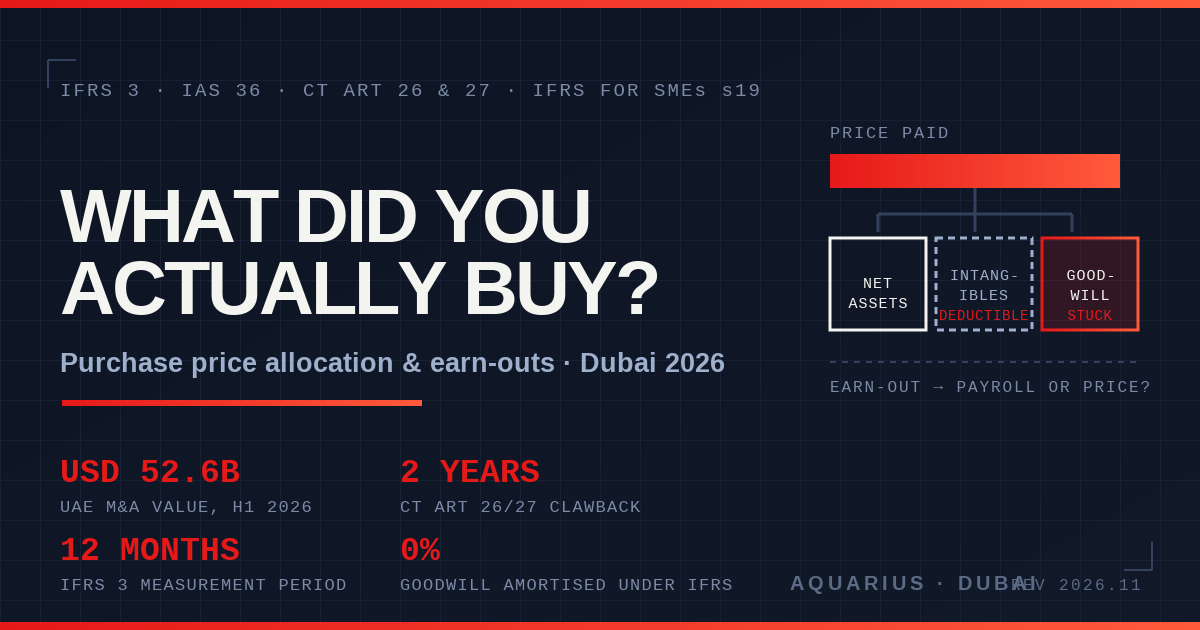
Short answer: under IFRS 3 you do not book goodwill as “price paid minus the seller’s net book value”. You restate everything you bought at acquisition-date fair value — including intangibles the seller never had on its balance sheet, such as customer relationships, brand and software — recognise a deferred tax liability on those uplifts, and only the residual becomes goodwill. That split is not cosmetic in the UAE: identifiable intangibles amortise and shelter 9% corporate tax, goodwill does not amortise under IFRS at all, and you have twelve months from the acquisition date to finish the allocation before the numbers freeze.
Most Dubai SME acquisitions in 2026 are still booked as a single line: cash out, “goodwill” in. It passes the first audit because the amounts look plausible. It fails later — at the impairment test, at the first FTA query about the amortisation deduction, or at the moment a selling founder’s earn-out turns out to have been payroll all along.
The money arrived. The accounting did not keep up.
The UAE is now, by a distance, the deal capital of the Gulf. In the first half of 2026 the country accounted for USD 52.6 billion of the USD 65.1 billion of disclosed GCC M&A value — 80.9% — across 131 of the region’s 192 transactions (68.2%), according to the Grant Thornton UAE and GCC M&A Market Review. Across the wider region EY counted 390 deals worth USD 46.7 billion completed in H1 2026.
The shape of that activity is the part that matters for your ledger. GCC deal volume fell 17.9%, from 234 transactions to 192, while total value rose roughly 12%. Fewer deals, bigger cheques, more structure — the Dubai Aerospace Enterprise acquisition of Macquarie AirFinance at approximately USD 9 billion sets the tone at the top. More structure means deferred consideration, earn-outs, escrows, rollover equity and share-for-share exchanges. Every one of those is an IFRS 3 measurement question with a corporate tax consequence attached.
And this is the first full cycle in which that consequence is real money. UAE corporate tax runs at 9% above AED 375,000 of taxable income, and Small Business Relief — the AED 3 million revenue shelter — is only available for tax periods ending on or before 31 December 2026. An acquisition closed in 2026 by a buyer who relied on that relief produces deductions that are worth nothing this year and 9% next year.
Most Dubai buyers get the direction of the error wrong. They assume a conservative allocation — dump everything into goodwill — is the safe choice. It is the expensive one. Goodwill is the only bucket that never produces a deduction and never stops being tested.
What purchase price allocation actually requires
IFRS 3 applies the acquisition method. At the acquisition date — the date you obtain control, which is not necessarily the date the SPA was signed or the licence was transferred — you measure the identifiable assets acquired and liabilities assumed at fair value (paragraph 18), and goodwill falls out as the residual under paragraph 32: consideration transferred, plus any non-controlling interest, plus the fair value of any previously held stake, less the net identifiable assets.
1. The intangibles the seller never recorded
This is where most of the value in a Dubai services, clinic, agency or SaaS acquisition sits, and where the seller’s own books show nothing. A business that spent eight years building a contracted client base carries AED 0 of customer relationships on its balance sheet, because IAS 38 forbids recognising internally generated intangibles. IFRS 3 reverses that for the buyer: in a business combination you recognise them separately if they are separable or arise from contractual rights. Customer contracts and relationships, trade names, non-compete undertakings, licences and internally developed software routinely qualify.
2. The deferred tax that grosses up your goodwill
Recognise an intangible at fair value with no corresponding tax base and you have created a taxable temporary difference. IAS 12 requires a deferred tax liability on it — at the 9% UAE rate — and because the DTL is part of the net identifiable assets, booking it increases goodwill. Goodwill itself is exempt: IAS 12 specifically prohibits recognising deferred tax on the initial recognition of goodwill. Two different rules in the same journal entry, which is exactly why spreadsheets get it wrong.
3. Goodwill as residual, not as plug
Goodwill is what remains after an honest allocation, not the label for work you skipped. If the residual comes out negative you have a bargain purchase: IFRS 3 requires you to reassess the identification and measurement of everything first, and only then recognise the remaining excess as a gain in profit or loss on the acquisition date. A gain that, being accounting income, walks straight into the corporate tax computation.
4. The non-controlling interest election
Buying 70% of a Dubai company leaves 30% with someone else, and IFRS 3 gives you a choice for each transaction: measure that NCI at fair value, which recognises goodwill attributable to the minority, or at its proportionate share of net identifiable assets, which does not. The same deal produces two different balance sheets and two different impairment outcomes. It is an election, so it has to be documented — and under Article 56 of the Corporate Tax Law, documents evidencing an election and the basis or method used must be retained for seven years.
| Allocation bucket | What a typical Dubai SME deal holds | Corporate tax consequence |
|---|---|---|
| Tangible assets and working capital | Fit-out, equipment, receivables, inventory — restated to fair value | Revised depreciation base; uplift is deductible over the asset life |
| Customer relationships and contracts | Often 20–40% of the price in a services or agency deal | Amortisation over a finite life is deductible — the single biggest shield in the deal |
| Brand or trade name | Material where the name travels with the business, not the founder | Deductible if finite-lived; an indefinite-life brand is tested, not amortised |
| Internally developed software and IP | The whole thesis in a SaaS or platform acquisition | Deductible over its useful life; the seller carried it at near zero |
| Non-compete undertaking | Short life, usually 2–3 years, tied to the selling shareholder | Amortises fast — but watch the connected-person market-value test |
| Deferred tax liability on the uplifts | 9% of the net taxable uplift | No cash effect at close; it increases recognised goodwill |
| Goodwill (residual) | Whatever is left | Not amortised under full IFRS. No annual deduction, and an impairment test every year, forever |
On a mid-market Dubai deal the gap between a lazy allocation and a proper one is straightforward arithmetic. GCC private SMEs typically change hands at 4x to 8x EBITDA — Dubai services businesses nearer 2x to 5x, SaaS and recurring-revenue businesses 4x to 10x, and mid-market technology assets as high as 8x to 16x. Take an AED 24 million acquisition where AED 9 million is genuinely identifiable intangibles with an average seven-year life. That is roughly AED 1.29 million of annual amortisation and about AED 116,000 a year of corporate tax shielded, for seven years, against AED 0 if the same AED 9 million is swept into goodwill.
Earn-outs: the paragraph that turns purchase price into payroll
Earn-outs are now standard in Dubai SME deals, because buyers and sellers rarely agree on a 2026 multiple. The accounting trap is in IFRS 3’s application guidance, and almost nobody models it before signing.
If the earn-out is forfeited when the selling shareholder stops working for the business, it is not consideration. It is remuneration for post-combination services — an expense in your profit or loss over the service period, not part of the price, not part of goodwill. A founder who sells for AED 12 million up front plus AED 6 million over 24 months conditional on staying puts AED 3 million a year straight through your P&L. Buyers who modelled an EBITDA covenant on the headline deal discover the breach in month four.
If it genuinely is consideration, the classification question moves to IAS 32: a contingent payment settled in cash is a financial liability, measured at fair value at acquisition date and remeasured at each reporting date with the change in profit or loss. The target outperforming makes your earn-out liability bigger, which makes your earnings smaller — a loss caused by good news. Settled in a fixed number of your own shares, it may sit in equity and never be remeasured at all. The fixed-for-fixed test that governs convertible notes governs this too.
Then the UAE layer. A selling founder who stays on is almost certainly a connected person for corporate tax purposes, and payments to connected persons are deductible only to the extent they correspond to the market value of the service actually provided. An earn-out recharacterised as remuneration does not automatically become a deduction — it becomes a payment you have to justify against market rates, with the related-party disclosure register picking up the rest.
Deferred consideration has a quieter cost. IFRS 3 measures it at fair value, which means discounting, and the UAE now has observable rates to discount at: the CBUAE base rate has stood at 3.90% since 17 September 2026, and 3-month EIBOR fixed at 4.339930% on 11 November 2026. AED 5 million payable in three years is not AED 5 million of consideration. The unwinding difference is interest expense — and interest expense is where Articles 30 and 31 start asking questions.
First question, asked last: did you buy a business at all?
IFRS 3 only applies to a business combination. If what you acquired is a group of assets — a client list, a licence, a fit-out and a lease — without a substantive process that turns inputs into outputs, it is an asset acquisition. Then there is no goodwill, no bargain purchase gain, no deferred tax on initial recognition, and your transaction costs are capitalised into the assets rather than expensed.
IFRS 3 offers an optional concentration test to settle this quickly: if substantially all of the fair value of the gross assets acquired is concentrated in a single identifiable asset or group of similar assets, it is not a business, and you stop there. For the small Dubai acquisitions that happen constantly — buying out a competitor clinic, absorbing a rival agency’s book, taking over a cloud kitchen — running that test first saves an allocation you never needed. Note the direction of the cost rule, because it is counter-intuitive: in a business combination, acquisition-related costs (advisers, legal, due diligence) are expensed as incurred and never form part of goodwill.
The twelve-month clock nobody starts
IFRS 3 gives you a measurement period to finish the job: if the accounting is incomplete at the reporting date, you report provisional amounts and then adjust them retrospectively as better information about facts and circumstances that existed at the acquisition date emerges. The period ends as soon as you have the information, and in any case twelve months after the acquisition date.
Two things follow, and both are data problems rather than accounting problems. First, retrospective adjustment means your comparatives move — a valuation that lands in month eleven rewrites the prior period, including the depreciation and amortisation already charged. Second, after twelve months the door shuts: a correction found in month fourteen is an IAS 8 prior-period error, with restated comparatives and, if accounting income moved, an amended corporate tax return.
Which brings us to the field that no finance system in Dubai stores: the acquisition date itself, as a controlled, dated, queryable attribute of the acquired entity. Not the SPA date, not the licence amendment date, not the date the first consolidated trial balance appeared. Without it nobody can tell you when the measurement period expires — and the standard offers no extension for a clock you forgot to start.
The UAE tax layer: Articles 26 and 27
Not every UAE acquisition is taxable at close. Two reliefs sit alongside IFRS 3, and both are deferrals rather than exemptions.
Qualifying Group Relief (Article 26) allows assets and liabilities to move between UAE resident taxable persons inside a group with 75% or more common ownership without triggering a gain, by transferring at net book value.
Business Restructuring Relief (Article 27) covers the transfer of a business, or an independent part of a business, in exchange for shares or ownership interests — the mergers and reorganisations layer. The FTA published a dedicated guide on it on 17 April 2024, its sixteenth corporate tax guide. The core conditions: both parties UAE taxable persons, neither exempt nor a Qualifying Free Zone Person, the same financial year and the same accounting standards, transfer at net book value, and a valid commercial or non-fiscal reason reflecting economic reality.
Both reliefs carry a two-year clawback. Dispose of the transferred assets, or move the shares in the transferor or transferee outside the group, within two years of the transfer, and the relief is reversed and the original gain becomes taxable. That is a two-year obligation to remember something that happened once — which, in practice, means a diarised, owned register entry or nothing at all.
Note the quiet condition in Article 27: the same accounting standards. A mainland company reporting under IFRS and an acquired entity reporting under IFRS for SMEs cannot restructure under Article 27 until one of them converts. Nobody discovers this in due diligence because nobody asks the target which framework it uses.
Goodwill after day one: two frameworks, two taxable incomes
Under full IFRS, goodwill is never amortised. It is allocated to cash-generating units and tested for impairment annually under IAS 36, whether or not there is any indicator — a permanent annual exercise that most Dubai SMEs run for the first time a year after the deal and then discover they never defined the CGUs.
Under IFRS for SMEs, goodwill is amortised. The third edition, issued in February 2025 and effective for periods beginning on or after 1 January 2027, requires amortisation over the useful life, defaulting to ten years where the life cannot be reliably estimated.
Now connect that to Article 20 of the Corporate Tax Law, which lets entities with revenue up to AED 50 million prepare accounts under IFRS for SMEs. Two identical Dubai companies, same acquisition, same price: one reports under full IFRS and deducts nothing for goodwill each year; the other reports under IFRS for SMEs and amortises AED 6 million of goodwill over ten years at AED 600,000 a year. Advisers generally treat goodwill as non-amortisable for UAE corporate tax where the accounts do not amortise it, with impairment and SME amortisation following the accounts — so the framework election changes the tax bill on an unchanged transaction. Confirm your own position with your adviser before relying on it; this is precisely the kind of determination Article 56 expects you to be able to evidence.
The disclosure rules are being rewritten right now
The IASB published the exposure draft Business Combinations—Disclosures, Goodwill and Impairment on 14 March 2024, proposing that acquirers disclose performance against the objectives and expected synergies they used to justify the deal, alongside targeted changes to the IAS 36 impairment test. The Board was still deliberating feedback at its 21 April 2026 meeting and is scheduled to decide the project direction in Q4 2026.
Read that as a forward requirement to prove, in public, that an acquisition did what you said it would. Which is impossible retrospectively unless the deal thesis was captured as structured data at acquisition date: expected synergies, by category, with the metric and the horizon. Nobody has that in a spreadsheet eighteen months later.
The nine fields no Dubai finance system stores
- Acquisition date — the date control passed, as a dated field, driving the measurement-period expiry.
- Measurement-period status per allocation line: provisional or final, and the date it was finalised.
- Allocation line items with the valuation method, the valuer, and the useful life assigned to each intangible.
- Deferred tax by allocation line, with the goodwill initial-recognition exemption flagged separately.
- NCI measurement election, per transaction, with the basis documented.
- Earn-out classification: consideration or remuneration, the paragraph relied on, and the forfeiture condition quoted verbatim from the SPA.
- Contingent consideration fair value at each reporting date, with the discount rate and probability weights that produced it.
- Relief election and clawback expiry — Article 26 or 27, the election date, the two-year expiry, and an owner.
- Expected synergies at acquisition, by category and metric, for the disclosure regime now being drafted.
What it costs to build this properly
| Option | 2026 Dubai cost | What you get — and what you still carry |
|---|---|---|
| Spreadsheet plus a year-end valuation scramble | AED 0 up front; typically AED 35,000–90,000 of extra valuation and audit time per deal | The allocation gets decided eleven months after close by whoever is free. Measurement period expires un-diarised. |
| One-off PPA engagement from an advisory firm | AED 45,000–140,000 per transaction | A defensible allocation for that deal. Nothing persists — no clawback register, no synergy tracking, no second-deal reuse. |
| Acquisition register built into your finance stack | AED 60,000–190,000 one-off | The nine fields above, measurement-period alerts, earn-out remeasurement schedules, Article 26/27 clawback diary and a CGU map that feeds the IAS 36 test. You own the logic. |
| Add an earn-out and clawback layer to an existing ERP | AED 30,000–80,000 one-off | Narrower build for groups whose allocation is already clean and who only need the ongoing remeasurement and expiry tracking automated. |
The cost of inaction is not theoretical. A reversed Article 27 relief on an AED 30 million business transfer puts the full deferred gain back into charge at 9%. Record-keeping failures carry their own penalty: Cabinet Decision No. 129 of 2025 sets AED 1,000 per violation, rising to AED 20,000 for a repeated violation within 24 months, effective 14 April 2026, and FTA Decision No. 4 of 2026 requires records to be complete, legible, in order and accessible to the Authority, including access to the system that stores them. An allocation memo living in an adviser’s email thread is not a producible record.
How Aquarius builds it
We model the acquisition as a first-class object in the systems you already run, not as a folder. Each deal carries its acquisition date, its allocation lines with method and useful life, its deferred tax by line, its earn-out classification with the SPA clause attached, and its relief election with the two-year expiry diarised to a named owner. The measurement period runs as a countdown with an alert at month nine, not a surprise at month thirteen. Expected synergies are captured at close as structured metrics, so the disclosure regime the IASB decides on in Q4 2026 is a report rather than a reconstruction. Typical delivery is four to ten weeks; see pricing for how we scope, or the full services list.
FAQ
Is goodwill tax deductible in the UAE?
Not under full IFRS, because full IFRS does not amortise goodwill at all — there is no annual charge to deduct. Impairment losses and, for entities reporting under IFRS for SMEs, goodwill amortisation generally follow the accounting treatment into the corporate tax computation, since Article 20 starts from accounting income. Identifiable intangibles recognised separately in the allocation do amortise, and that amortisation is the deduction most Dubai buyers leave on the table. Confirm your specific position with your tax adviser.
How long do I have to finish a purchase price allocation?
Twelve months from the acquisition date. IFRS 3 lets you report provisional amounts and adjust them retrospectively during that measurement period as information about conditions existing at acquisition date comes in. After twelve months any correction is a prior-period error under IAS 8, with restated comparatives and potentially an amended corporate tax return.
Is an earn-out part of the purchase price or an expense?
It depends on one clause. If the selling shareholder forfeits the earn-out by leaving, IFRS 3 treats it as remuneration for post-combination services — an expense recognised over the service period, outside goodwill. If it survives their departure, it is contingent consideration, measured at fair value at acquisition date and, where it will be settled in cash, remeasured each reporting date through profit or loss.
What is Business Restructuring Relief under Article 27?
It defers corporate tax on the transfer of a business, or an independent part of a business, in exchange for shares or ownership interests, with the transfer taken at net book value. Both parties must be UAE taxable persons that are not exempt and not Qualifying Free Zone Persons, must share the same financial year and the same accounting standards, and the transaction must have a valid commercial or non-fiscal reason. The FTA guide was published on 17 April 2024. The relief is clawed back if the assets or the relevant shares leave the group within two years.
Do I need a formal valuation for a small Dubai acquisition?
You need defensible fair values, which is not always the same as a formal valuation report. For a small acquisition with one obvious intangible, a documented internal allocation with a stated method, discount rate and useful life will usually carry it. Bring in an external valuer where the intangibles are a large share of the price, where there is an NCI fair value election, or where the buyer is audited by a firm that will ask for independent support.
What if the acquisition is not a business?
Then IFRS 3 does not apply. Use the optional concentration test first: if substantially all the fair value of the gross assets acquired sits in one asset or a group of similar assets, it is an asset acquisition. You allocate the cost across the assets acquired, recognise no goodwill, recognise no deferred tax on initial recognition, and capitalise your transaction costs instead of expensing them.
The one thing to do this week
Take every acquisition your group has closed since 1 January 2025 and write down two dates for each: the date control actually passed, and the date twelve months after it. If the second date is in the past and the allocation is still carrying provisional amounts, you no longer have a measurement period — you have an IAS 8 restatement waiting for an auditor to notice. If the second date is still ahead, you have a deadline, and you now know it.
If you want the acquisition register, the earn-out schedules and the Article 26 and 27 clawback diary built into the systems you already run, talk to Aquarius. We scope in a week, and we do not start with a spreadsheet.
This article is general information on accounting and tax systems, not accounting, tax or legal advice. Figures are current as at November 2026; confirm your own position with your auditor, tax adviser and UAE counsel.