
Construction Project Management Software Development in Dubai (2026): Real AED Cost, BIM-Ready Build & the Overrun Most Contractors Pay For
What a custom construction PM platform costs to build in Dubai in 2026 — real AED tiers, BIM/IFC-ready BOQ workflows, Arabic + English site teams, and the overrun and rework ROI most contractors absorb.
- PUBLISHED
- 12 SEPT 2026
- READ TIME
- 12 MIN
- AUTHOR
- AQUARIUS · DUBAI
- UNIT
- REV 2026.09
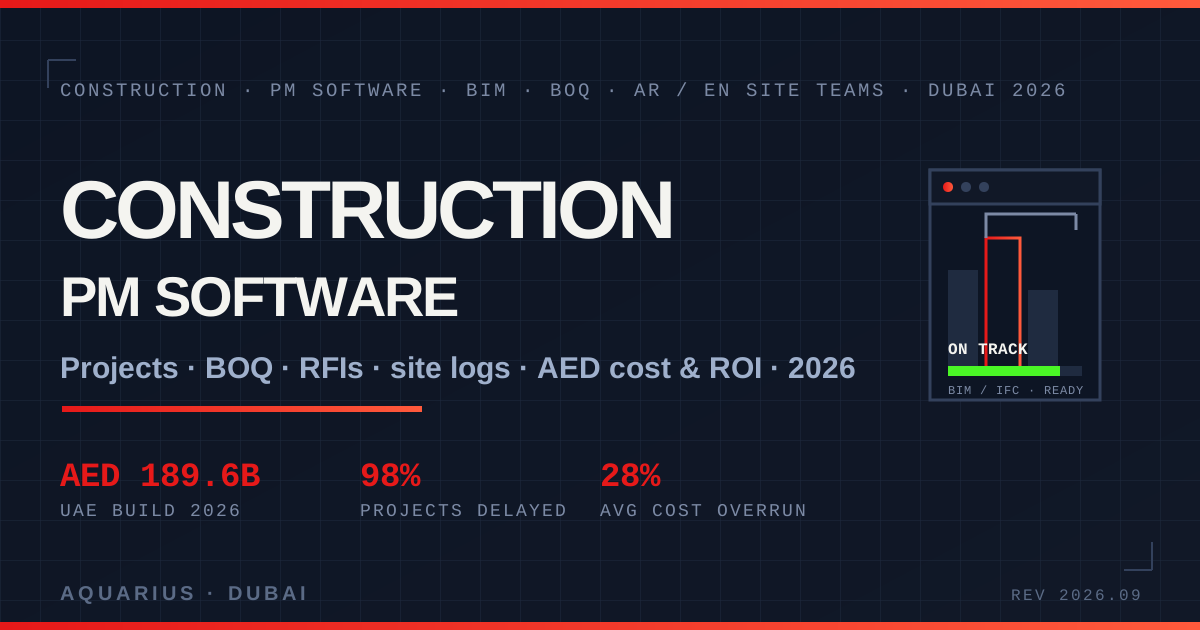
Short answer: A custom construction project management (PM) platform for a Dubai contractor typically costs AED 90,000-160,000 for a core build (projects, tasks, documents, RFIs, daily site logs, mobile), AED 160,000-280,000 for a standard build that adds BOQ and cost tracking, procurement, a subcontractor portal and full Arabic/English, and AED 280,000-450,000+ for an advanced build with BIM/IFC model viewing, automated valuations, dashboards and VAT-compliant invoicing. It pays for itself against two numbers contractors quietly absorb every year: an industry-average 28% cost overrun and the 35% of professional time lost to non-productive admin — on a UAE construction market set to reach AED 189.59 billion in 2026.
Key takeaways
- The UAE construction market is forecast to grow 6.2% to AED 189.59 billion in 2026, with Dubai alone approving AED 99.5 billion (USD 27.1 billion) in spending — most of it infrastructure.
- 98% of construction projects face delays, the average project runs 37% longer than planned, and the Middle East posted an 83% average delay-versus-schedule figure in a 2025 market review.
- Off-the-shelf platforms like Procore run AED ~185-4,400/month for SMEs and AED 184,000-735,000+/year at enterprise scale, often priced on your annual construction volume — and Arabic UI support is limited.
- Custom AED build tiers run from AED 90,000 (core) to AED 450,000+ (BIM-ready), with maintenance at 15-20%/year.
- Dubai Municipality's BIM mandate (announced 10 March 2026) makes BIM/IFC-aware software a competitive edge, not a nice-to-have.
Why Dubai contractors are moving off spreadsheets in 2026
Dubai is not short of work. The UAE construction market is forecast to grow 6.2% to AED 189.59 billion in 2026 after a 7.3% CAGR across 2021-2025, and Dubai's government approved AED 99.5 billion (USD 27.1 billion) in 2026 spending with a heavy tilt toward infrastructure. The pipeline is enormous: the AED 34 billion Dubai Metro Gold Line, the RTA's 2025-2029 roads plan (634 km across 21 projects, AED 3.7 billion), and a steady stream of towers, communities and mixed-use complexes.
The problem is not demand — it is delivery. Globally, 98% of construction projects face delays and the average project stretches 37% longer than originally scheduled. The Middle East fares worse: a 2025 regional market review reported an 83% average delay against schedule. McKinsey's benchmark for average cost overrun is 28%, rising to 45% on mega-projects over USD 100 million. And it is not just the big numbers — commercial rework alone consumes 5-10% of total labour cost, while 35% of construction professionals' time goes to non-productive activities: chasing approvals, rekeying data, and hunting for the latest drawing.
Those losses are not a software problem you can buy away with a licence. They are a coordination problem — RFIs stuck in email, BOQ variations tracked in someone's personal Excel file, site progress reported by WhatsApp photo with no audit trail. That is exactly what a fit-for-purpose PM platform is built to close.
What construction PM software actually costs — off-the-shelf vs custom
There are two routes, and the honest answer for most Dubai contractors is a blend. Off-the-shelf platforms (Procore, Autodesk Construction Cloud, Oracle Primavera, Fieldwire) are mature and battle-tested. But pricing scales aggressively: SME plans land around AED 185-4,400 per month, and enterprise contracts run AED 184,000-735,000+ per year (USD 50,000-200,000+) — frequently priced on your annual construction volume, so the more you build, the more you pay, forever. Arabic UI support is limited, and field adoption on mixed-language crews is a documented pain point on GCC programmes.
A custom build flips the maths: a larger one-time investment, then a maintenance line instead of a per-seat tax that grows with your turnover. Here is the honest 2026 range for a Dubai-built platform (these are agency estimates, not fixed quotes — scope drives everything):
| Build tier | What you get | AED (one-time) | Timeline |
|---|---|---|---|
| Core PM portal | Projects, tasks, document control, RFIs, daily site logs, mobile app | AED 90,000-160,000 | 8-12 weeks |
| Standard platform | + BOQ & cost tracking, procurement, subcontractor portal, Arabic/English, photo site reports | AED 160,000-280,000 | 12-18 weeks |
| Advanced / BIM-ready | + BIM/IFC model viewer, automated valuations, dashboards, VAT-compliant invoicing, integrations | AED 280,000-450,000+ | 16-24 weeks |
| Maintenance & support | Hosting, updates, new features, SLA | 15-20% of build/year | Ongoing |
The break-even is simpler than it looks. If an off-the-shelf enterprise contract costs you AED 400,000/year and keeps rising with your volume, a AED 280,000 custom platform with AED ~50,000/year maintenance pays back inside 18 months — and every project after that runs on software you own, in the languages your crews actually speak.
Building for Dubai: BIM, BOQ and bilingual site teams
A generic PM tool will not survive contact with a Dubai project. Three local realities shape the build.
BIM is now a mandate, not a bonus. On 10 March 2026, Dubai Municipality announced a digital building-management system covering the full lifecycle of every structure, with BIM models required at permit stage — architectural BIMs for buildings over 20 floors and complexes over 20,000 sq m, structural BIMs for buildings over 40 floors, plus all government projects and specialised buildings like hospitals and universities. It is built on open standards (ISO 19650, IFC, BCF). Software that can ingest and reference IFC models — even just view and link RFIs to model elements — is now a genuine competitive edge on any sizeable Dubai job.
BOQ and valuations run the money. In this market, cost control lives in the Bill of Quantities. A platform that tracks BOQ line items against actuals, handles variations, and generates interim payment applications is where the 28% overrun gets caught early — while it is still a line item, not a claim.
Your site speaks two languages. Foremen, engineers and subcontractor crews across a Dubai site work in Arabic and English. A mobile app that logs progress, captures geo-tagged photos and pushes approvals in both languages is the difference between a platform that gets used and one that gets abandoned after week three — the exact adoption gap that sinks off-the-shelf rollouts on mixed-language GCC crews.
How Aquarius builds it — and what it costs to start
We build construction PM platforms the way the projects run: mobile-first for the site, structured for the head office. A typical Aquarius engagement starts with a two-week discovery to lock the 25 core workflows (the same ones in our free checklist), then ships a working core portal in 8-12 weeks so your teams are logging real projects before the full platform is done.
Pricing follows the tiers above: most Dubai contractors start at the AED 160,000-280,000 standard tier — enough for BOQ, cost tracking, a subcontractor portal and bilingual site reporting — then add the BIM/IFC viewer and automated valuations once the core is embedded. Everything is VAT-compliant for UAE invoicing out of the box, and you own the code.
The ROI is concrete. If a platform trims your rework by even 2 percentage points of labour cost on a AED 50 million project, that is AED 1 million recovered — many times the build cost — before you count the schedule days saved when RFIs stop dying in email. On an industry where large projects run 20% behind schedule with overruns reaching 80%, catching problems while they are still small is the whole game.
Book a free scoping call and we will map your workflows to a fixed-scope proposal — no obligation, no jargon.
Frequently asked questions
How long does it take to build construction PM software in Dubai?
A core portal ships in 8-12 weeks; a standard platform with BOQ and a subcontractor portal takes 12-18 weeks; an advanced BIM-ready build runs 16-24 weeks. We ship the core first so teams start using it before the full scope is complete.
Is custom software cheaper than Procore for a UAE contractor?
Over a 3-5 year horizon, usually yes for teams of 50+ users. Off-the-shelf enterprise contracts run AED 184,000-735,000+/year and often scale with your construction volume, whereas a custom platform is a one-time AED 90,000-450,000 build plus 15-20%/year maintenance. You also get Arabic-first UI and workflows built around how your projects actually run.
Can the software work with BIM models for Dubai Municipality submissions?
Yes. With Dubai Municipality's 2026 BIM mandate on open standards (ISO 19650, IFC, BCF), we build IFC-aware platforms that can view models and link RFIs, issues and documents to model elements. Full authoring stays in your BIM tools; the platform becomes the coordination and audit layer around them.
Does it handle VAT and interim payment applications?
Yes — VAT-compliant invoicing and interim payment applications (IPCs) against the BOQ are standard in the advanced tier, so valuations, variations and tax all reconcile in one place.
The bottom line
Dubai's AED 189.59 billion construction market rewards contractors who deliver on time — and punishes the ones absorbing a silent 28% overrun as the cost of doing business. Custom PM software, built BIM-ready and bilingual for how Dubai sites actually work, turns that overrun into a controllable line item for a one-time AED 90,000-450,000 instead of a forever-rising licence tax. If you are already comparing tools, it is worth reading our take on what it costs to build a web app in Dubai, how a BI dashboard surfaces project risk early, and how field service management software solves the same mobile-crew coordination problem in an adjacent trade.