
Content Moderation for UAE Platforms: 2026 Costs, Law and Arabic Accuracy
UAE platforms face AED 300,000 minimum fines for ignored disable orders and mandated AI detection by 2027. Real 2026 AED moderation costs, UAE-region options, and the Arabic dialect gap nobody benchmarks.
- PUBLISHED
- 20 NOV 2026
- READ TIME
- 12 MIN
- AUTHOR
- AQUARIUS · DUBAI
- UNIT
- REV 2026.09
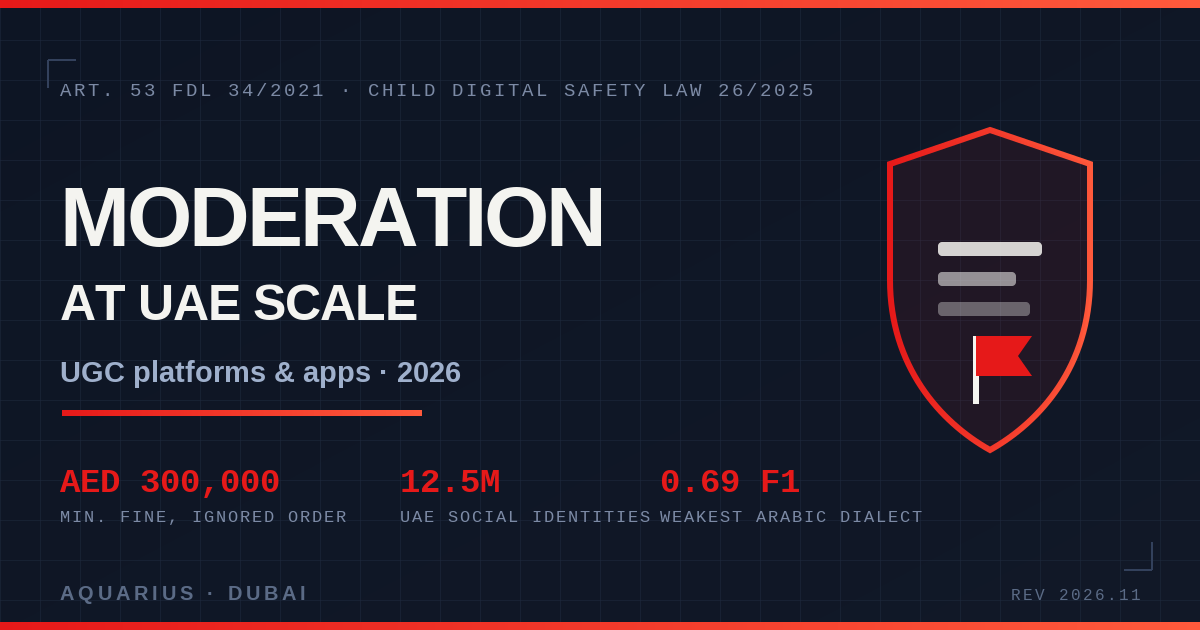
Content moderation is no longer a trust-and-safety nice-to-have for UAE platforms — it is a licensing and criminal-liability question. Under Article 53 of Federal Decree-Law 34/2021, a platform that fails to disable illegal content after an order from the competent authority faces a fine of no less than AED 300,000, and the law sets no fixed removal window — the clock is whatever the authority says it is. The practical answer for 2026: run an automated first pass in a UAE region (Azure AI Content Safety in UAE North at AED 1.38 per 1,000 text records, or Amazon Bedrock Guardrails in me-central-1 at AED 0.55 per 1,000 text units), then escalate a thin slice to human reviewers — because no shipping Arabic safety model is benchmarked on Emirati Arabic at all.
Why UAE moderation stopped being optional
The UAE is one of the most saturated social markets on earth. DataReportal's Digital 2026 report counts 12.5 million social media user identities in the UAE in October 2025 — 110% of the 11.4 million population, after adding 1.8 million identities (+16.7%) in a single year. Internet users reached 11.3 million, a 99.0% penetration rate.
That means any UAE consumer product with a comment box, a review field, a chat thread, a profile photo or a marketplace listing is operating a user-generated-content platform at near-universal reach — whether or not anyone in the business calls it that.
Three instruments now bite:
1. Article 53, Federal Decree-Law 34/2021 (Countering Rumours and Cybercrimes)
Criminal liability for platforms is narrow but sharp: it attaches when a platform fails to disable access to illegal content after a disable order from the competent authority. Chambers' analysis of the amended law puts that penalty at a fine of not less than AED 300,000 and not more than AED 1,000,000 without imprisonment; an open-access comparative study of Emirati and French law reads the Article 53 band as reaching AED 10,000,000 for the gravest cases. The same study flags the operational trap: UAE law does not specify a fixed period for removal, leaving it to the discretion of the competent authority.
2. Federal Decree-Law 26/2025 (Child Digital Safety)
In force 1 January 2026 with a one-year grace period, so fully enforceable from January 2027. It applies extraterritorially to platforms that operate in or target UAE users, and — critically for engineering teams — it requires proactive content detection and removal using AI or machine learning, user-friendly reporting tools for harmful content, privacy-by-default settings on child accounts, and age-verification mechanisms sized to a tiered Cabinet risk classification. Personal data of under-13s may not be collected, processed, published or shared without explicit, documented parental consent and an always-available withdrawal path.
3. Federal Decree-Law 55/2023 (Media Regulation)
Electronic and digital media activity is subject to the Article 17 content standards, and the party responsible for the activity bears responsibility for what is published through it — whether the activity is licensed or not. There is no broad statutory safe harbour for user-generated content in UAE law.
Alongside those, Article 52 of the cybercrime law prices the content itself: spreading false news or rumours carries at least one year of imprisonment and a fine of not less than AED 100,000, rising to at least two years and AED 200,000 where it inflames public opinion against UAE authorities or occurs during a crisis.
What a 2026 moderation stack actually looks like
Most Dubai teams get the architecture wrong in the same way: they buy one API, wire it to a boolean, and block or allow. That produces either a flood of false positives (users leave) or a leaky filter (regulator arrives). The pattern that holds up is a four-tier funnel.
Tier 0 — deterministic rules
Blocklists, regex for phone numbers and WhatsApp handles, rate limits, new-account throttles, hash matching for known-bad media. Near-zero cost, catches the highest volume of low-effort abuse. Amazon Bedrock Guardrails charges AED 0.00 for word-policy filters — denied-word lists are free.
Tier 1 — managed classifiers
A hosted toxicity, sexual-content, violence and hate classifier scores every item on ingest. This is where the UAE data-residency question gets decided, and it is where the vendor landscape is genuinely uneven (see the table below).
Tier 2 — LLM adjudication on the grey band
Items that score in the uncertain middle get a short, structured prompt to a cheap model with your actual community guidelines in context — not a generic "is this bad?" call. In me-central-1, Amazon Nova Lite runs at AED 0.22 per million input tokens and AED 0.88 per million output tokens; Nova Micro is cheaper still at AED 0.13 and AED 0.51. At roughly 500 tokens per adjudication, a million grey-band items costs well under AED 200 in model spend.
Tier 3 — human review and appeals
A queue, an audit log, an appeals path, and a named human who can action a disable order within hours. This tier is not optional under Article 53: automation cannot acknowledge a regulator's order.
What moderation costs in the UAE in 2026
Here is the part no Dubai agency publishes. All USD figures are vendor list prices read from the AWS Price List API and the Azure Retail Prices API in November 2026, converted at the pegged AED 3.6725.
| Layer | Service | 2026 list price | AED equivalent | UAE region? |
|---|---|---|---|---|
| Text / toxicity | Azure AI Content Safety (Standard) | USD 0.375 per 1,000 text records | AED 1.38 per 1,000 | Yes — UAE North |
| Images | Azure AI Content Safety (Standard) | USD 0.75 per 1,000 images | AED 2.75 per 1,000 | Yes — UAE North |
| Text at volume | Azure commitment tier, 1M text records | USD 338 per month | AED 1,241 per month (AED 0.00124 per record) | Yes — UAE North |
| Text + topic policy | Amazon Bedrock Guardrails | USD 0.15 per 1,000 text units | AED 0.55 per 1,000 | Yes — me-central-1 |
| PII redaction | Bedrock Guardrails, sensitive information | USD 0.10 per 1,000 text units | AED 0.37 per 1,000 | Yes — me-central-1 |
| Images | Amazon Rekognition DetectModerationLabels | USD 0.0010 per image (first 1M/month) | AED 3.67 per 1,000 | No UAE region |
| Text toxicity | Amazon Comprehend DetectToxicContent | USD 0.0001 per 100-character unit | AED 3.67 per 1,000 records of 1,000 chars | No Middle East region |
| Video | Rekognition archived content moderation | USD 0.10 per minute | AED 0.37 per minute | No UAE region |
| LLM adjudication | Amazon Nova Lite, me-central-1 | USD 0.06 in / 0.24 out per 1M tokens | AED 0.22 in / AED 0.88 out per 1M | Yes — me-central-1 |
| Human review | Dubai reviewer, AED 3,402 median monthly | ~AED 19.33 per hour | ~AED 129 per 1,000 items at 150/hour | Local hire |
Two findings in that table matter more than the prices.
First: the obvious AWS moderation services are not in the UAE. Amazon Rekognition's price list publishes 19 regions and me-central-1 is not among them — the nearest are il-central-1 and eu-south-2. Amazon Comprehend publishes 14 regions with no Middle East region at all. Amazon Transcribe reaches me-south-1 in Bahrain but not me-central-1. Of this family, only Bedrock is in the UAE region. So a team that reaches for Rekognition's content-moderation API is, by default, shipping user photos out of the country — a PDPL cross-border transfer decision made by an SDK import, not by counsel. Azure AI Content Safety does publish UAE North pricing, including its free tier of 5,000 text records and 5,000 images per month.
Second: the automation arbitrage is roughly 90x. A Dubai reviewer at the Indeed median of AED 3,402 per month (40 salaries reported, updated 28 October 2026; range AED 2,285–5,065) costs about AED 19.33 per working hour. At a brisk 150 items reviewed per hour that is AED 129 per 1,000 items. The same 1,000 text records through Azure's UAE North standard tier cost AED 1.38. Humans are not the expensive part because people are expensive; they are the expensive part because they are the only tier that scales linearly.
The Arabic problem nobody benchmarks
This is the myth-bust. Vendors publish Arabic support; almost none publish Arabic dialect performance, and the research that does exist does not cover the dialect your Dubai users actually type.
ArabicDialectSafety, a 2025 dialect-aware Arabic content-safety benchmark, contains 24,051 examples across six varieties: Modern Standard Arabic, Syrian, Egyptian, Algerian, Palestinian and Moroccan. Gulf and Emirati Arabic are not included. On that benchmark, a fine-tuned MARBERTv2 reaches 0.95 macro-F1 on the binary safe/unsafe task overall — but only 0.85 on Moroccan. Push to granular seven-category harm classification and overall macro-F1 falls to 0.90, with Egyptian at 0.92 and Moroccan at 0.69. Earlier cross-dialect work records accuracy collapsing to 0.64 when a model trained on Egyptian tweets is tested on Gulf tweets.
Frontier LLMs are better behaved but not clean: across seven models tested on 500 dialectal prompts, unsafe response rates ranged from 0.20% (Qwen3.6-plus) to 4.60% (GPT-4o-mini), with the Arabic-specialised FANAR-v2 at 1.00%. And when an LLM was used as the judge, it agreed with human annotators only 77.7% of the time (kappa = 0.44) — which is the empirical argument for keeping Tier 3 humans in the loop rather than a philosophical one.
Practically, for a UAE platform: assume a measurable accuracy penalty on Gulf-dialect and code-switched Arabic-English content, set your escalation threshold lower for Arabic than for English, and sample-audit Arabic decisions weekly. If you are also localising the interface, our guide to Arabic website localisation and RTL design in Dubai covers the front-end half of the same problem.
Where PDPL fits
Moderation generates some of the most sensitive data a platform holds: reported content, reviewer notes, abuse reports naming other users, and in child-safety cases, data about minors. Under Federal Decree-Law 45/2021 (PDPL), that is personal data processing requiring a lawful basis, retention limits and a cross-border transfer assessment — and if your classifier sits in eu-west-1 because that is where the SDK defaulted, you have made a transfer decision without documenting it. Our UAE PDPL compliance checklist for websites and apps walks the documentation.
The clean pattern: classify in a UAE region, store reports and reviewer decisions in a UAE region, keep an immutable audit log with timestamps and the policy version applied, and retain only what you need to answer a regulator.
How Aquarius builds this in Dubai
We treat moderation as a pipeline, not a product purchase. Typical engagements:
- Moderation layer on an existing app — AED 32,000 to AED 55,000, 3 to 5 weeks. Ingest hook, Tier 0 rules, one managed classifier in a UAE region, a reviewer queue with audit log, and an Article 53 disable-order runbook with a named owner.
- Full trust-and-safety stack — AED 90,000 to AED 180,000, 8 to 12 weeks. Multi-signal scoring, Arabic-specific escalation thresholds, LLM adjudication on the grey band, user reporting and appeals flows, age-gating for Child Digital Safety Law tiers, and a regulator reporting pack.
- Run cost — typically AED 400 to AED 2,500 per month under one million items, before human review time.
Risk reversal: fixed-price milestones, the disable-order runbook delivered in writing, and the audit-log schema handed over as yours — no lock-in to our stack. See our pricing for the underlying rate card.
The cost-of-inaction maths is blunt. One Article 53 fine at its AED 300,000 floor would pay for roughly 240 million moderated text records at Azure's UAE North commitment pricing. No UAE platform processes 240 million items before it processes its first disable order.
FAQ
Is content moderation legally required for a UAE app?
There is no single statute that says "you must moderate". But Federal Decree-Law 26/2025 requires proactive AI or machine-learning detection and removal plus user reporting tools for platforms accessible to children, Article 53 of Federal Decree-Law 34/2021 penalises failure to disable illegal content after an order, and Federal Decree-Law 55/2023 makes the operator responsible for what is published. In combination, an unmoderated UAE platform is non-compliant.
How fast must we remove content after a UAE order?
The law does not state a fixed period — removal timing is at the competent authority's discretion. Plan for same-day capability rather than a statutory grace window, and keep a 24/7 contactable owner.
Can we keep moderation data outside the UAE?
Possibly, but it becomes a PDPL cross-border transfer you must justify and document. Because Rekognition and Comprehend have no UAE region, the default AWS moderation path exports content by design. If you want in-region classification, Azure AI Content Safety publishes UAE North pricing and Bedrock Guardrails runs in me-central-1.
Can an LLM replace a moderation service?
For the grey band, yes — and it is cheap in me-central-1. As the sole decision-maker, no: LLM-as-judge agreement with human annotators was measured at 77.7% (kappa = 0.44), and frontier models still produced unsafe responses on up to 4.60% of dialectal Arabic prompts.
What does Emirati Arabic cost us in accuracy?
Nobody has published the number, which is the point. The leading dialect-aware Arabic safety benchmark covers six varieties and excludes Gulf and Emirati Arabic entirely, while documented dialect shifts drop macro-F1 from 0.95 to 0.85 on binary classification and from 0.90 to 0.69 on granular harm categories. Budget for a lower Arabic escalation threshold and your own sampled evaluation set.
If you are launching or scaling a UAE platform with user content — a marketplace, a community app, a review system, a social feature — we will map your moderation funnel, pick the UAE-region services that fit your residency position, and ship the queue your reviewers will actually use. Talk to Aquarius.