
Dubai Customs Duty & Deposit Refund Software (2026): How AED 6.9 Billion in Claims Gets Processed, and Why Yours Misses the Window
Dubai Customs processed 1.36m deposit-refund applications worth AED 6.9bn in H1 2026 and approved AED 6.2bn. Real AED costs for a refund-claim data layer that files before the fine ladder starts.
- PUBLISHED
- 10 NOV 2026
- READ TIME
- 13 MIN
- AUTHOR
- AQUARIUS · DUBAI
- UNIT
- REV 2026.09
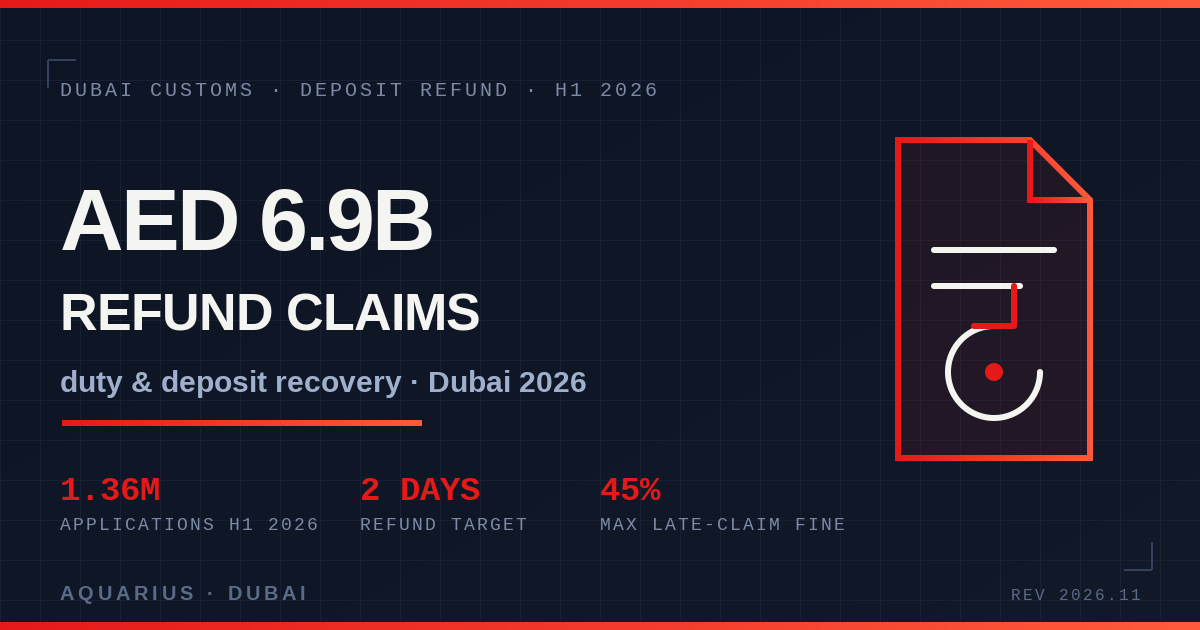
Short answer: Dubai Customs handled 1.36 million deposit-refund applications in the first half of 2026, worth AED 6.9 billion submitted against AED 6.2 billion approved — and it clears 99% of them inside a two-working-day target. The money that goes missing in Dubai is almost never lost at the refund desk; it is lost in the importer’s own records, where nobody knows which declaration still has a deposit sitting against it or which claim window closes this week. A refund-claim data layer — a deposit ledger, a deadline engine and an evidence pack builder wired to your declarations — costs AED 38,000–240,000 in Dubai and is the only reliable way to claim everything you are owed before the fine ladder starts.
The refund desk is fast. Your claim file is the bottleneck.
Three numbers from the Dubai Customs Refund Department’s H1 2026 disclosure (25 October 2026) reset the whole conversation:
- 1,360,000 deposit-refund applications processed in H1 2026, up from 1.31 million a year earlier — a 3.6% rise.
- AED 6.9 billion in refund value submitted (up 13.1% from AED 6.1 billion), of which AED 6.2 billion was approved (up 14.8% from AED 5.4 billion).
- 844,500 applications were approved automatically — 62.1% of all completed applications and 10% more auto-approvals than the prior year — against a service target of two working days met 99% of the time.
Set that against the volume side: Dubai Customs processed 21.15 million customs declarations in H1 2026 with 98% of transactions automated, 89.4% of them air-cargo declarations, and 99.3% of payments cashless. Air Cargo Centre declarations grew about 53% and free-zone department declarations about 62%. In the same period 7,871 new companies registered, 9,365 clients filed a declaration for the first time, and 271 new customs brokers joined.
That is the real story. Six out of ten refunds now clear with no human touching them, which means the differentiator is no longer who you know at the customs house — it is whether your claim arrives complete, inside the window, with the right evidence attached. Nearly ten thousand first-time declarants in six months are learning that the hard way.
The gap between AED 6.9 billion submitted and AED 6.2 billion approved in the same half-year is roughly AED 0.7 billion. Refund value is rising faster than claim volume — the deposits are getting bigger, so each missed claim costs more.
Most Dubai importers get this wrong: there is no single refund deadline
Ask a finance team in Jebel Ali when a re-export deposit claim is due and you will usually get one number, remembered from a broker conversation. That number is almost always stale, because 2026 moved the goalposts twice:
- Customs Notice No. 05/2026, effective 31 March 2026, raised the transit declaration period from 30 to 90 days — for transit declarations only, with extensions needing prior approval, and explicitly as a temporary measure.
- Customs Notice No. 17/2026, issued 23 September 2026, added a further 60 days of duty suspension — taking the period to 180 days from the 120 set in June 2026 — for import-for-re-export, temporary admission and transit declarations whose suspension expires between 27 February and 31 October 2026.
- The Refund Department separately extended the deadline for submitting refund documentation from 30 to 90 days, specifically to cut the number of claims that die on paperwork.
Underneath the notices, the GCC Common Customs Law baseline has not moved: goods must be re-exported within one year of duty payment, the refund claim must be lodged within six months of that re-export, and the consignment must be worth at least USD 5,000 to qualify. Returned goods are exempt if they come back inside a year.
So a single consignment can be running three clocks at once — a suspension clock, a documentation clock and a claim clock — and two of those three were amended by temporary notice this year. A spreadsheet that was correct in February 2026 was wrong by October. That is not a staffing problem. It is a systems problem.
What the fine ladder actually costs you
Claim late and the refund does not simply vanish — it gets shaved. The penalty schedule in the Dubai Customs Services Guide (2025, V09) deducts a rising percentage of the deposit the further past the window you file. Claim inside the first band and there is no fine at all.
| Deposit / case type | Days after declaration | Deduction from deposit |
|---|---|---|
| Re-export deposit — standing guarantee | 241–270 / 271–300 | 15% / 30% |
| Re-export deposit — cash | 241–300 / 301–330 / 331–360 | 15% / 30% / 45% |
| Transit deposit | 61–75 / 76–90 | 25% / 50% |
| Temporary admission deposit | 211–240 / 241–270 | 25% / 50% |
| Customs duty deposit | 61–90 | 10% |
| Deposit against invoice & certificate of origin | 61–90 / 91–120 | 25% / 50% |
| Goods not exported (fixed fine) | 211–240 / 241–270 | AED 1,000 / AED 2,000 |
Two more lines from the same guide decide whether a claim is even worth filing. Submitting a refund claim is a five-working-day service that costs AED 50 per declaration plus an AED 20 Knowledge and Innovation fee. Late declaration documents attract AED 5 per day, capped at 106 days. And the hard gate: “Any claim for refund of duty or deposit shall not be accepted until the client completes the process of Documents submission.”
At roughly AED 70 of fees per declaration, a trader with thousands of small deposits needs batching and threshold logic, not heroics — and a trader with a free-zone exposure needs to remember that goods declared for re-export but never exported can attract a penalty of 10% of CIF value, while a wrong declaration or HS-code error runs AED 500 and a client-requested customs audit AED 3,000.
The five jobs of a refund-claim data layer
Dubai Customs already gives you the rails: declarations through Mirsal, claim submission and guarantee release through the Dubai Trade portal, and payment instruments including CDR, standing guarantee, debit account and virtual stock guarantee. What almost no Dubai trader has is the layer in between. A working build does five things:
1. A deposit ledger keyed to the declaration
Every import-for-re-export declaration carries a security — commonly around 5% of CIF value as cash or bank guarantee — that is released only on confirmed exit. The ledger’s single job is to answer “how much of our money is currently sitting with Customs, against which declaration, and under which instrument?” Most ERPs post the deposit to a prepayment account and lose the declaration reference on the way.
2. A deadline engine that reads notices, not folklore
Per declaration type, compute every live clock — suspension, documentation, claim — and version the rules so a notice like 17/2026 is a dated rule change, not a manual re-keying exercise. Alerts fire a safe margin before the first fine band, not on the day it opens.
3. An evidence pack builder
Proof of export differs by mode: sea, air and land each need their own combination of exit or entry certificate, export declaration, and manifest, bill of lading or air waybill. Assemble the pack automatically per mode, flag the missing document while the shipment is still fresh, and the documentation gate stops being the reason claims die.
4. Fee, fine and threshold maths
Compute net recovery before filing: deposit value, minus the deduction band you are actually in, minus AED 50 plus AED 20 per declaration. Then batch and prioritise by net value, and escalate anything approaching a 45% band.
5. Reconciliation back to the bank
An approved refund can land as a customs credit or a bank transfer. Until it is matched to the original deposit line, finance cannot close the loop — which is how traders end up with aged prepayment balances nobody can explain. The same discipline we describe for freight forwarding and customs clearance software applies here, one layer further down the money trail.
Retention matters too: mainland records must be kept for five years, so the evidence pack is an archive, not a transient attachment.
What this costs to build in Dubai
Real AED ranges for a UAE-based build, assuming your declaration data can be exported from Mirsal or your broker’s system:
| Scope | AED range | Typical timeline |
|---|---|---|
| Deposit ledger + deadline engine, CSV or report ingest, alerting dashboard | 38,000 – 65,000 | 3 – 5 weeks |
| Adds evidence-pack builder by transport mode, document-gap flags, 5-year archive | 70,000 – 120,000 | 6 – 9 weeks |
| Full claim operations platform: broker and portal integrations, net-recovery maths, batching, bank reconciliation, multi-entity free-zone and mainland views | 140,000 – 240,000 | 10 – 16 weeks |
| Rule maintenance retainer (notice tracking, band updates, support) | 4,500 – 9,000 / month | ongoing |
Compare that to the exposure. On a mid-size re-exporter running AED 40 million of annual CIF through import-for-re-export at a 5% security, roughly AED 2 million of working capital is with Customs at any point in the cycle. One slide into the 45% cash-deposit band on a single AED 300,000 deposit is AED 135,000 — more than the mid-tier build. The AED 0.7 billion half-year gap between submitted and approved refund value across Dubai is the market-wide version of the same arithmetic.
How Aquarius builds it
We build the data layer, not a replacement for Mirsal or your broker. Week one is a read-only audit: we pull your declaration history, rebuild the deposit ledger as it should look, and tell you how much is outstanding and which claims are inside which band — before you commit to a build. The deadline rules ship as dated, versioned configuration so a new customs notice is a configuration change we apply under retainer, not a rewrite. Everything runs on your own tenancy with UAE data residency, and the audit trail is designed for the five-year retention rule and for a client-requested customs audit.
Risk reversal: if the week-one audit finds less recoverable value than the first build tier costs, we say so and you stop there. We would rather lose a project than ship a system with nothing to recover. Our pricing page carries the full band breakdown, and if your exposure is ecommerce rather than re-export, start with the AED 1,000 ecommerce duty exemption instead.
FAQ
How long does a Dubai Customs refund actually take in 2026?
The Refund Department targets two working days and hit it on 99% of H1 2026 applications, with 62.1% of completed applications approved automatically. Submitting the claim is a separate five-working-day service. The long pole is always your own document submission — a claim is not accepted until documents are complete.
What is the deadline to claim a re-export deposit refund?
Under the GCC Common Customs Law, goods must be re-exported within one year of duty payment and the claim lodged within six months of re-export, with a USD 5,000 minimum consignment value. On top of that, Dubai’s own suspension periods were extended to 180 days by Notice 17/2026 for declarations expiring between 27 February and 31 October 2026, and refund documentation now has 90 days rather than 30. Check the current notice — both numbers changed during 2026.
What happens if I claim late?
You still get a refund, minus a deduction that rises with delay: 15% at the first band for a cash re-export deposit, up to 45% at 331–360 days, with transit and temporary-admission deposits running their own ladders. Claim before the first band opens and there is no fine.
Do I need software if my broker handles claims?
Brokers file; they do not own your balance sheet. With 271 new brokers joining Dubai Customs in H1 2026 alone, broker quality varies and broker changes are common. The deposit ledger, the deadline clocks and the reconciliation back to your bank account have to live with you — which is also what makes a broker’s performance measurable.
Can the system file claims automatically?
Submission runs through the Dubai Trade portal and your broker’s access, so full lights-out filing depends on your integration rights. What is reliably automatable today is detection, evidence assembly, net-recovery maths, prioritisation and reconciliation — which is where the recovered money actually comes from.
Start with the audit, not the build
If you cannot name, today, how much of your cash is sitting with Dubai Customs and which claim window closes first, that is the number to find before anything else. Tell us your declaration volume and transport mix and we will scope the read-only audit — you will know your recoverable position before you spend a dirham on a build.