
Freight Forwarding & Customs Clearance Software in Dubai (2026): Mirsal 2, the 12-Digit HS Shift and the 30 October Deadline
Dubai air-cargo customs transactions jumped 53% to 18.2 million in H1 2026. Here is what forwarding and clearance software costs in AED, and the compliance clock most Dubai forwarders have not started.
- PUBLISHED
- 14 SEPT 2026
- READ TIME
- 10 MIN
- AUTHOR
- AQUARIUS · DUBAI
- UNIT
- REV 2026.09
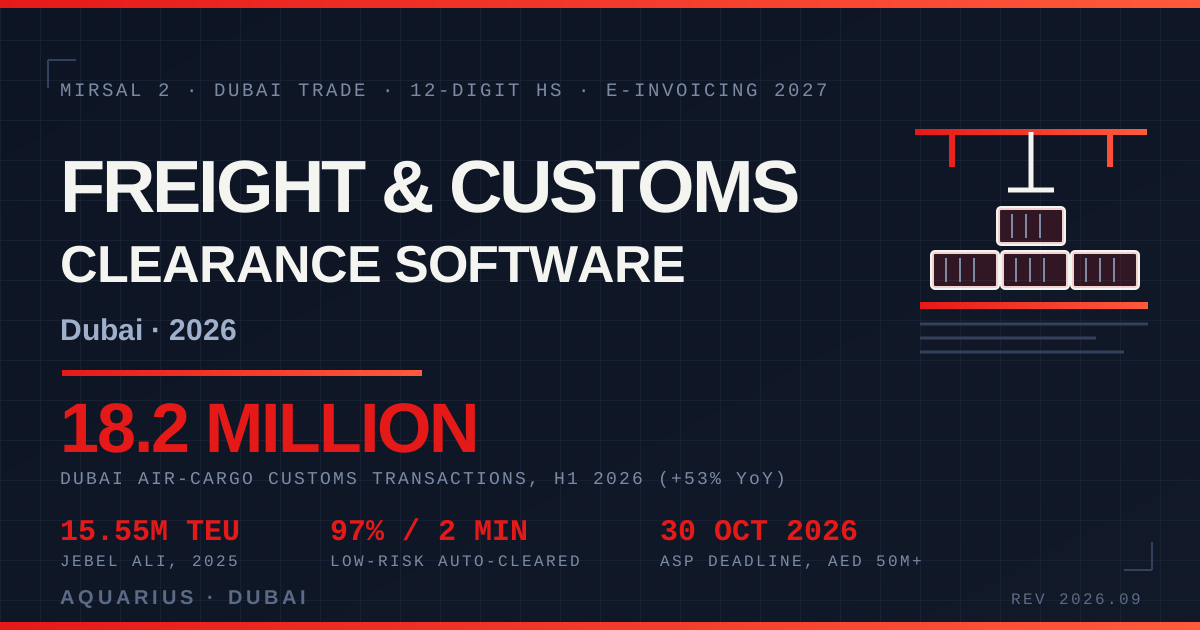
Short answer: A Dubai freight forwarder in 2026 can licence a packaged forwarding TMS for roughly AED 184-1,470 per user per month (plus per-container and per-entry fees), or commission a custom platform for AED 60,000-120,000 at entry scope and AED 150,000-350,000 for a full operations system with Mirsal 2 submission, job files and invoicing. The forcing function this year is not cost, it is compliance: Dubai Customs now expects 12-digit HS codes and early sea-cargo submission, and any forwarder billing AED 50 million or more must appoint an Accredited Service Provider for e-invoicing by 30 October 2026 and go live 1 January 2027. If your job files still live in Excel and Outlook, that deadline is roughly six weeks away.
Key takeaways
- Volume has outrun manual processing. Dubai Customs' Air Cargo Centres handled about 18.2 million transactions in H1 2026, up 53% from roughly 11.9 million in H1 2025. Trade through the Hatta crossing alone hit AED 37.08 billion, up 175% year on year.
- The market is large and still compounding. UAE freight forwarding was worth USD 21.56 billion in 2025 and is forecast at USD 35.08 billion by 2032 (7.20% CAGR). Logistics contributes over 8% of UAE GDP, and Dubai holds about 38.7% of the national logistics market.
- Sea volume is flat — so margin has to come from process. Jebel Ali moved 15.55 million TEU in 2025, just 0.1% above 2024, against 19.4 million TEU of installed capacity. You are not going to grow on throughput alone.
- Customs is already automated; your side often is not. Dubai Customs clears roughly 97% of low-risk consignments automatically within two minutes, and offers a Mirsal 2 B2G channel that lets high-volume partners file declarations straight from their own system.
- Two clocks are running. Since January 2026, most Dubai trade flows require 12-digit HS codes — an outdated 8-digit code triggers automatic flags and penalties — and e-invoicing becomes mandatory for AED 50 million+ businesses on 1 January 2027, with the ASP appointment due 30 October 2026.
TOFU: Dubai's paperwork grew faster than Dubai's cargo
The headline numbers for Dubai trade in 2026 look healthy but lopsided, and the shape of that lopsidedness is exactly the business case for software. Jebel Ali handled 15.55 million TEU in 2025 — a record in absolute terms, but only 0.1% above 2024, inside an installed capacity of 19.4 million TEU across four terminals, 100-plus berths and 25 km of quay. DP World's group throughput, by contrast, rose 5.8% to 93.4 million TEU on record revenue of USD 24.4 billion. Dubai remains the hub; Dubai's box count is not what is growing.
What is growing is transactions. Dubai Customs' Air Cargo Centres Management processed about 18.2 million customs transactions in the first half of 2026, against roughly 11.9 million in the same period of 2025 — a 53% jump, driven largely by ecommerce parcels. Land trade is moving the same way: the Hatta crossing carried AED 37.08 billion of trade in H1 2026, up from AED 13.48 billion, a 175% increase. The UAE freight forwarding market sat at USD 21.56 billion in 2025 and is projected to reach USD 35.08 billion by 2032 at a 7.20% CAGR, inside a logistics sector contributing more than 8% of UAE GDP — of which Dubai is about 38.7%.
Here is what most Dubai forwarders get wrong: they read those numbers as a growth story and hire more coordinators. Read them properly and it is a unit economics story. Boxes are flat, shipments are smaller, and the number of documents per AED of revenue is rising sharply. An air ecommerce consignment generates the same declaration, the same HS classification and the same invoice as a full container — at a fraction of the freight value. Add headcount to that curve and your cost per shipment climbs every quarter. The only lever that bends it is automation of the file, not the freight.
Dubai Customs has already done its half. Roughly 97% of low-risk consignments clear automatically within two minutes, and the authority ran a facilitation package between 1 March and 30 June 2026 that released more than AED 79 million in liquidity, supported AED 33.9 billion of trade across 428 companies, cut financial penalties by 80%, and gave 6,613 companies a 120-day extension on declarations. The regulator is fast. The bottleneck in most Dubai clearance chains in 2026 is a coordinator retyping a commercial invoice into Mirsal 2.
MOFU: what forwarding and clearance software actually has to do in Dubai
Generic international TMS products assume a world of standard trade lanes. Dubai is not that. A system that works here has to handle free-zone-to-mainland transfers, bonded movements, re-exports and a customs authority with its own declaration types and its own submission channel. The functional core breaks into seven blocks:
- Quotation and tariff management — sell rates and buy rates per lane, per carrier, per equipment type, with validity dates. This is where forwarder margin is either protected or quietly given away.
- The job file — one record carrying the shipment from booking to invoice: consignee, HS lines, incoterms, carrier, container numbers, milestones, costs and revenue. If you have no job file, you have no margin visibility per shipment, and you will discover loss-making lanes at year end.
- Document generation — bill of lading, delivery order, packing list, certificate of origin, cargo manifest, delivery advice. Generated from the job file, not retyped from it.
- Customs declaration and Mirsal 2 filing — HS classification, duty and VAT calculation, declaration type selection, and submission. Dubai Customs offers a Mirsal 2 B2G integration for eligible high-volume partners that pushes declarations from your own system into Mirsal 2 rather than through manual entry on the Dubai Trade portal. This is the single highest-value integration available to a Dubai forwarder, and it is under-used.
- Duty, VAT and charge calculation — standard UAE import duty is 5% on CIF value, plus 5% VAT, with Dubai Customs declaration service fees running roughly AED 15-100 depending on declaration type and channel. Free-zone, transit and re-export flows change that arithmetic entirely, which is why hard-coded duty logic breaks within a month.
- Tracking and the customer portal — shipment status, documents and ETAs that your client reads without emailing you. Every portal login is a support call you did not take.
- Invoicing and accounting — job-level P&L, disbursements, and tax invoices built to the structure the FTA will require from 2027.
Two Dubai-specific changes landed in 2026 and both are silent job-file killers. First, most Dubai trade flows now require 12-digit HS codes; submitting a legacy 8-digit code triggers automatic system flags and penalties. If your classification data lives in a spreadsheet built years ago, every line in it is now a liability. Second, since January 2026 early submission also protects you from amendment fines on sea cargo — meaning the forwarder who files before arrival pays less than the one who files after. Both are software problems with software fixes: a validated HS master, and a workflow that files on booking rather than on arrival.
MOFU: buy, build, or build the thin layer
Buy first. That is the honest default for a forwarder running standard lanes, and anyone quoting you a full custom platform before asking about your declaration mix is selling hours. Packaged forwarding TMS products cover booking, job files, documents and accounting well. They break in four specific Dubai situations:
- Free zone and mainland under one licence group. Bonded stock, inter-company transfers between a Jafza entity and a mainland one, and re-export flows need declaration logic and stock segregation that imported products treat as an edge case.
- Mirsal 2 B2G submission. Global vendors support dozens of customs regimes generically. Getting a clean, validated, resubmittable declaration flow into Mirsal 2 — with the right declaration type, 12-digit HS lines and duty treatment — is usually local integration work regardless of which platform you licence.
- Per-shipment pricing that punishes small consignments. CargoWise's widely-cited Value Pack model charges about USD 19.95 (AED 73) per full import container plus inland legs, and USD 9.95 (AED 37) per standalone customs entry. On full containers that is trivial. On a book of 40,000 small air ecommerce entries a year, it is roughly AED 1.5 million — and that is exactly the volume segment growing 53% a year in Dubai.
- Bilingual operations. Arabic and English documents, correspondence and portal screens with genuine RTL handling — usually retrofitted badly by products designed elsewhere. The same discipline we cover in our Arabic RTL design guide.
The pragmatic middle — and what we build most often — is a hybrid: keep a packaged TMS or your accounting system as the ledger, and build the thin custom layer where Dubai is actually different. That is normally the Mirsal 2 submission service, the HS master with 12-digit validation, the free-zone declaration logic, and the customer portal. You are not rebuilding a TMS; you are building the 20% that no global vendor ships for this market. If you also run your own fleet or last-mile, that layer usually connects to the systems in our Dubai fleet and logistics guide, and to warehouse stock as covered in our 2026 WMS cost guide.
BOFU: real 2026 costs in AED, and the payback math
Licence figures below are converted from published vendor ranges at AED 3.67 to the dollar; build figures are our own Dubai delivery ranges.
| Option | Cost (AED) | Timeline | Best for |
|---|---|---|---|
| SMB cloud forwarding TMS (per user) | AED 184-551 / user / month (USD 50-150) | 2-6 weeks | Under 10 users, standard lanes, light integration |
| Mid-market TMS (per user) | AED 367-1,470 / user / month (USD 100-400) | 6-14 weeks | Multi-branch forwarder with carrier and accounting links |
| Enterprise TMS (per user) | AED 1,835-7,340+ / user / month (USD 500-2,000+) | 4-9 months | Large operations with in-house IT and EDI requirements |
| Per-shipment pricing | ~AED 73 per full import container; ~AED 37 per standalone customs entry; AED 1.50-18 per load on load-based tools | n/a | Low-volume books; punishing at high small-parcel volume |
| Enterprise implementation (packaged) | AED 367,000-1,835,000 (USD 100k-500k) for setup, integration and data migration | 4-12 months | Multi-entity rollouts replacing a legacy core |
| Custom — entry scope | AED 60,000-120,000 | 7-11 weeks | Job files, documents, HS master, duty/VAT calculation |
| Custom — full forwarding operations platform | AED 150,000-350,000 | 14-22 weeks | Quotes, job P&L, Mirsal 2 filing, customer portal, invoicing |
| Custom — multi-branch + ERP + e-invoicing | AED 400,000-800,000+ | 6-10 months | Several entities, free zone and mainland, deep accounting |
| Thin custom layer on a packaged TMS | AED 45,000-110,000 | 5-9 weeks | Mirsal 2 submission, 12-digit HS validation, portal |
| Annual maintenance (either route) | 15-20% of build cost per year | ongoing | Regulatory change is not optional here |
Setup costs on the Dubai Customs side are small and often misquoted: new registration runs about AED 100 per business type plus a AED 20 knowledge and innovation fee, with a Mirsal 2-linked digital certificate at roughly AED 100-200 per year. Those are rounding errors. The money is in staff time and penalties.
The payback math. Take a mid-sized Dubai forwarder filing 1,200 declarations a month. If a coordinator spends 18 minutes per file on manual entry, document assembly and portal work, that is 360 hours a month — roughly 2.3 full-time coordinators. Cut it to 6 minutes with a job file that generates documents and files into Mirsal 2 directly and you release about 240 hours a month. At a loaded Dubai coordinator cost of roughly AED 9,000 a month, that is around AED 165,000 a year of released capacity — before counting amendment fines avoided by early sea-cargo submission, and before counting the 12-digit HS penalties you simply stop incurring. Against an AED 150,000-350,000 custom platform or an AED 45,000-110,000 thin layer, payback typically lands inside 9-18 months — and on the thin-layer route, often inside 6.
The cost of inaction has a date on it. Ministerial Decisions 243 and 244 of 2025 set the UAE e-invoicing timetable: a pilot from 1 July 2026, then mandatory e-invoicing for businesses with AED 50 million or more in annual revenue from 1 January 2027 — with an Accredited Service Provider appointed by 30 October 2026. Everyone else appoints by 31 March 2027 and goes live 1 July 2027. For a forwarder, every disbursement, freight charge and clearance fee eventually becomes a structured tax document, and the source data lives in the job file. Our UAE e-invoicing guide has the field-level detail.
How Aquarius builds it: (1) a two-day operations audit before a line of code — we count minutes per declaration type, because half the time the first win is a template, not a platform; (2) a job-file core with per-shipment P&L, so loss-making lanes surface in week one rather than at year end; (3) an HS master with 12-digit validation and duty/VAT rules for mainland, free-zone, transit and re-export flows; (4) Mirsal 2 filing built as a queued, retryable, fully-logged service rather than a screen-scrape — declarations are legal documents and need an audit trail; and (5) invoicing structured for the 2027 e-invoicing schema now, so compliance is a configuration change instead of a rebuild. Fixed-scope quotes in AED, source code and data you own, and a phased rollout that never dark-starts a live clearance desk. See our pricing, or send us your monthly declaration count and lane mix and we will model buy-versus-build on your real numbers.
FAQ
How much does freight forwarding software cost in Dubai in 2026?
Packaged cloud TMS platforms run about AED 184-551 per user per month at SMB tier, AED 367-1,470 at mid-market and AED 1,835-7,340+ at enterprise tier, with enterprise implementations of AED 367,000-1,835,000. Per-shipment models add roughly AED 73 per full import container and AED 37 per standalone customs entry. A custom build is AED 60,000-120,000 at entry scope, AED 150,000-350,000 for a full operations platform, and AED 400,000-800,000+ for multi-branch with ERP and e-invoicing. Budget 15-20% of build cost annually for maintenance.
What is Mirsal 2 and can software file declarations into it automatically?
Mirsal 2 is Dubai Customs' electronic declaration and clearance system, accessed through the Dubai Trade portal, and all import, export and free-zone transit declarations pass through it. Dubai Customs also operates a Mirsal 2 B2G service for eligible high-volume partners, which lets declarations be submitted directly from a company's own system rather than keyed into the portal. That is the integration worth building: it removes the retyping step that consumes most of a clearance coordinator's day.
What changed for Dubai customs declarations in 2026?
Two things matter operationally. Dubai has moved to 12-digit HS codes for most trade flows, and submitting an outdated 8-digit code triggers automatic system flags and penalties — so legacy classification spreadsheets need re-validating. And since January 2026, early submission protects you from amendment fines on sea cargo, which turns "file on arrival" from a habit into a cost.
What duty and VAT apply to imports into Dubai?
The standard rate is 5% customs duty on the CIF value plus 5% VAT, with Dubai Customs declaration service fees of roughly AED 15-100 depending on declaration type and channel. Free-zone, transit and re-export movements follow different treatments, which is exactly why duty logic belongs in configurable rules rather than hard-coded into a form.
Does a freight forwarder need to be ready for UAE e-invoicing?
Yes, and the first deadline is close. Under Ministerial Decisions 243 and 244 of 2025, the pilot ran from 1 July 2026; businesses with AED 50 million+ annual revenue must appoint an Accredited Service Provider by 30 October 2026 and issue structured e-invoices from 1 January 2027. Smaller businesses appoint by 31 March 2027 for a 1 July 2027 start. For forwarders the practical work is upstream: charges, disbursements and tax data must be captured cleanly in the job file, because that is what the invoice is generated from.
Should a small Dubai clearing agent build custom software at all?
Usually not at first. Under roughly 300 declarations a month, a packaged TMS plus a thin custom layer for Mirsal 2 filing and HS validation — around AED 45,000-110,000 — beats a full build on both cost and time to value. Building the whole platform makes sense when you run free-zone and mainland entities together, carry per-client tariff structures, or have declaration volume high enough that per-entry licence fees become a five- or six-figure annual line.
Bottom line: Dubai's boxes are flat at 15.55 million TEU while its customs transactions grew 53% to 18.2 million in a single half-year. That gap is the whole story — more files, smaller shipments, same headcount. Customs already clears 97% of low-risk consignments in two minutes; the delay is on your side of the wire. Talk to Aquarius about a job-file platform sized to your declaration volume, and we will tell you honestly whether a packaged TMS plus a thin Mirsal 2 layer is the better call.