
Database Scaling for Dubai Apps in 2026: Read Replicas, Connection Pooling and When to Shard (Real AED Costs)
A 16 GiB Postgres box in Dubai permits ~1,800 connections that would need 19.5 GB of RAM. Real me-central-1 AED costs for pooling, read replicas and sharding.
- PUBLISHED
- 19 NOV 2026
- READ TIME
- 12 MIN
- AUTHOR
- AQUARIUS · DUBAI
- UNIT
- REV 2026.09
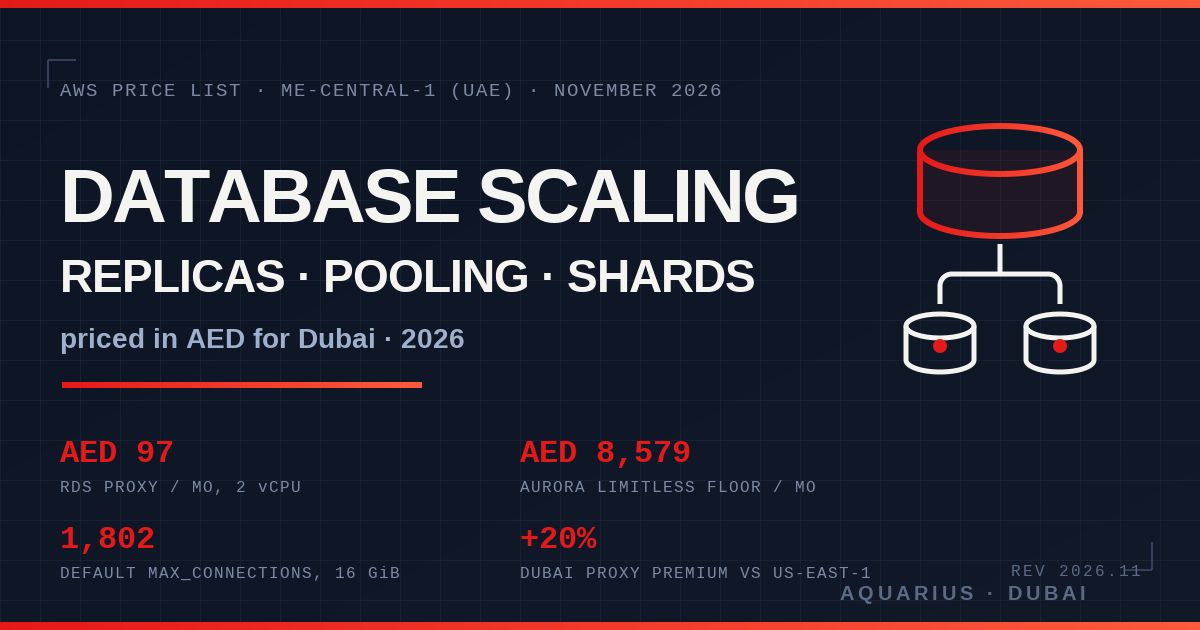
Pool your connections first, add a read replica second, and shard last. On AWS me-central-1 (Dubai), an RDS Proxy in front of a 2-vCPU PostgreSQL instance costs about AED 97 a month — roughly 13% of what the database itself costs — while the managed sharding tier, Aurora PostgreSQL Limitless, starts at a hard floor of AED 8,579 a month before you store a single gigabyte. Most Dubai businesses skip the cheap fix and shop for the expensive one.
Dubai traffic is spiky, and spikes break databases before they break servers
UAE demand does not arrive in a smooth line. In the run-up to Ramadan 2026, Khaleej Times reported UAE e-commerce order volumes up 30% in early February versus January and GMV up 40%, with mid-February order surges hitting 173% and GMV up 195% across the first two weeks. Shopping-app sessions across the UAE, Saudi Arabia and Qatar grew about 20% year on year to 682 million, and a large share of Gulf transactions lands in the post-Iftar window between 10 PM and 2 AM — a few hours that carry a disproportionate slice of the month's revenue.
That matters because SMEs are 94% of all companies in the UAE and about 63% of the non-oil economy, and the typical UAE SME app runs on exactly one database instance. The web tier scales out behind a load balancer without anyone thinking about it. The database does not. When the 10 PM wave hits, the thing that falls over is almost never CPU — it is connections.
The myth-bust: your default connection limit is bigger than your RAM
Most Dubai teams assume the database's connection limit is a safe ceiling set by AWS. It isn't a safety limit — it's arithmetic.
On RDS and Aurora PostgreSQL, the default max_connections is set by the documented formula LEAST({DBInstanceClassMemory/9531392}, 5000). On a 16 GiB instance class that resolves to roughly 1,800 connections (slightly fewer on RDS, which reserves more memory for the OS).
Now price a connection. AWS's own measurements on PostgreSQL put an idle connection at about 1.5 MB when freshly opened, climbing to roughly 10.04 MB after temporary tables and 10.8 MB after running ordinary SELECTs. Multiply it out: 1,800 connections × 10.8 MB is about 19.5 GB of RAM on a machine that has 16 GiB. The default limit is not a budget — it's an overdraft. As the Aurora documentation puts it bluntly, "even an idle connection consumes memory and CPU."
Most Dubai businesses get this wrong: they upsize the instance to fix connection errors. Upsizing raises
max_connectionstoo, so the same crash returns one traffic spike later — at double the AED rate.
Lever one: pool connections (the cheapest fix you are not using)
A pooler sits between your app and the database and multiplexes thousands of client connections onto a few dozen real backend ones. In Dubai you have two sensible options.
Amazon RDS Proxy
Fully managed, Multi-AZ, and billed per vCPU of the database it fronts. It does transaction-level multiplexing only — it reverts to session-like behaviour when a connection gets "pinned" by session state — supports prepared statements through the extended query protocol, integrates natively with IAM and AWS Secrets Manager, and because it bypasses DNS propagation it cuts failover times by up to 66% compared with connecting directly. That failover number is the real reason to pick it: a Multi-AZ failover during a 10 PM Ramadan peak is the difference between a blip and a trending complaint.
Self-hosted PgBouncer
Lighter and more flexible: it supports session, transaction and statement pooling, and protocol-level prepared statements since v1.21 (on by default in v1.24+). But it is single-threaded, so it becomes CPU-bound at high throughput, has no native IAM integration, and failover handling is your own scripting problem. You also own patching, monitoring and the EC2 bill.
What each actually costs in Dubai
Here are the real me-central-1 on-demand rates, converted at AED 3.6725 to the dollar over a 730-hour month:
| Option | me-central-1 rate | AED / month | Notes |
|---|---|---|---|
| RDS Proxy, 2 vCPU database (db.r6g.large) | USD 0.018 / vCPU-hr | AED 96.51 | Billing floor is 2 vCPUs |
| RDS Proxy, 4 vCPU database (db.r6g.xlarge) | USD 0.018 / vCPU-hr | AED 193.02 | Scales linearly with vCPU |
| RDS Proxy, 8 vCPU database (db.r6g.2xlarge) | USD 0.018 / vCPU-hr | AED 386.05 | DIY starts winning here |
| RDS Proxy on Aurora Serverless v2 | USD 0.019 / ACU-hr | AED 407.50 minimum | Billed on 8 ACUs minimum |
| HA PgBouncer pair (2 × t4g.small EC2) | USD 0.0204 / hr each | AED 109.39 | Plus your own ops time |
Read the break-even carefully, because it is not where people expect. At 2 vCPUs the managed proxy is cheaper than a two-instance PgBouncer pair — AED 96.51 against AED 109.39 — and you get IAM, Secrets Manager and the 66% faster failover thrown in. The crossover sits at about 2.3 vCPUs. From a 4-vCPU database upward, raw AED favours self-hosting, and from 8 vCPUs the gap is wide enough to be a real decision rather than a rounding error.
One Dubai-specific trap: on Aurora Serverless v2, RDS Proxy bills a minimum of 8 ACUs regardless of how small your database scales. A cluster idling at the 0.5-ACU floor costs about AED 201 a month — so the proxy in front of it, at AED 407.50, costs twice as much as the database. Pool with PgBouncer on serverless, or accept the floor knowingly.
And yes, Dubai pays a premium
RDS Proxy is USD 0.018 per vCPU-hour in me-central-1 versus USD 0.015 in us-east-1 — a 20% Dubai premium. On Aurora Serverless v2 it is USD 0.019 against USD 0.015, or +26.7%. That is not a reason to host your UAE database in Virginia; residency and latency usually settle that argument. It is a reason to size the pooler deliberately instead of copying a US tutorial's numbers into your budget.
Lever two: add a read replica (and know which engine charges you twice)
Once pooling is in place, the next real constraint is read volume: dashboards, search, catalogue browsing, the analytics query someone runs at 11 PM. A read replica absorbs all of that, and this is where RDS and Aurora quietly diverge on price.
RDS PostgreSQL replicas have their own storage. Each one is a full copy, so 100 GB of GP3 at USD 0.14 per GB-month in me-central-1 is billed again for every replica. Aurora replicas share one storage volume at USD 0.121 per GB-month consumed — you pay for the data once, no matter how many readers you attach.
| Setup (100 GB data, me-central-1) | Compute AED / mo | Storage AED / mo | Total AED / mo |
|---|---|---|---|
| RDS PostgreSQL db.r6g.large, Single-AZ | 742.61 | 51.42 | 794.03 |
| RDS PostgreSQL db.r6g.large, Multi-AZ | 1,485.23 | 102.46 | 1,587.69 |
| RDS Single-AZ + one read replica | 1,485.23 | 102.85 | 1,588.08 |
| Aurora PostgreSQL db.r6g.large writer | 839.13 | 44.43 | 883.56 |
| Aurora writer + one Aurora Replica | 1,678.26 | 44.43 | 1,722.69 |
So a pooled, replicated, highly available PostgreSQL setup for a mid-sized Dubai app lands between roughly AED 1,600 and AED 1,850 a month, all in. That is the number worth memorising, because it is the one that gets compared against sharding — and against the cost of a bad night. If you are still choosing an engine rather than a scaling strategy, our Aurora vs RDS vs DynamoDB cost breakdown for me-central-1 runs the same maths one layer down.
Two caveats we apply on every UAE build. Replica lag is real, so never read a just-written row from a replica — route post-write reads to the writer. And resizing an instance class can take 15 minutes or more; AWS's own guidance is to add a replica and fail over to it instead of resizing in place, which is exactly why we add the replica before Ramadan rather than during it.
Lever three: sharding — and the AED 8,579 floor
Aurora PostgreSQL Limitless Database is AWS's managed sharding tier, and it is genuinely impressive engineering. It is also priced at USD 0.20 per ACU-hour in me-central-1 with a 16-ACU minimum shard group: 16 × 0.20 × 730 = USD 2,336, or AED 8,578.76 per month, before storage, before I/O, before the mandatory monitoring.
That is roughly five times the pooled-and-replicated setup above. And the price is the easy part. Limitless requires I/O-Optimized storage only, runs special 16.X-limitless engine versions, and mandates Enhanced Monitoring, Performance Insights with at least 31-day retention, and CloudWatch Logs export — all billable. Routers and shards are fixed at creation, merging shards is unsupported, you cannot delete an individual shard, and you cannot UPDATE a shard key. Serializable isolation is unavailable.
Then there is the list of things it does not support, which reads like an inventory of everything you already use: RDS Proxy, read replicas, Aurora Global Database, Aurora Auto Scaling, ElastiCache, Blue/Green Deployments, AWS Backup, AWS Secrets Manager, Lambda integration, zero-ETL, cloning, custom endpoints, the RDS Data API, Babelfish, Aurora ML, database activity streams and Kerberos authentication.
Our rule for Dubai clients is simple: you shard when a single writer genuinely cannot absorb your write volume — not when reads are slow and not when connections are exhausted. Those two problems cost AED 97 and AED 840 to solve respectively. Sharding starts at AED 8,579 and takes features away.
The cost of not fixing it
Here is the BOFU number. ITIC's Hourly Cost of Downtime research found that a single hour of downtime now costs over USD 300,000 — about AED 1.1 million — for 91% of mid-size and large enterprises, with 41% reporting USD 1 million to 5 million-plus per hour (AED 3.67 million to AED 18.4 million). Splunk and Cisco's downtime research puts the average at roughly USD 15,000 per minute.
Scale that down to a UAE SME doing a meaningful share of its month in the post-Iftar window and the ratio still holds: an AED 97-a-month pooler is cheaper than twenty minutes of outage, every time.
How Aquarius does it
We treat database scaling as a sequence, not a shopping list. Before any Dubai launch we run the connection maths against your actual instance class, put a pooler in front with pinning audited, add a read replica ahead of the seasonal peak rather than during it, and set CloudWatch alarms on connection count and replica lag — not just CPU. Residency stays in me-central-1 so your data never leaves the UAE, which keeps the PDPL conversation short.
We quote the AWS line as a pass-through at the published me-central-1 rate, so the AED figures in this article are the AED figures on your invoice — no markup hidden in a "hosting" line item. See our pricing for engagement ranges, or the full list of what we build and run in services. If you are weighing managed AWS services against self-hosting more broadly, the same trade-off plays out in our self-hosted LLM vs Bedrock cost comparison.
FAQ
How many connections can my Dubai PostgreSQL database really handle?
Far fewer than max_connections suggests. The documented default is LEAST({DBInstanceClassMemory/9531392}, 5000) — about 1,800 on a 16 GiB class — but at roughly 10.8 MB per warmed-up connection that would need about 19.5 GB of RAM. Size for what your instance can actually hold, then let a pooler absorb the rest. AWS also recommends leaving at least three connections free for its own automation.
Is RDS Proxy or PgBouncer cheaper in the UAE?
At 2 vCPUs, RDS Proxy wins: AED 96.51 a month versus AED 109.39 for a two-instance PgBouncer pair, plus you get IAM, Secrets Manager and up to 66% faster failover. The break-even is about 2.3 vCPUs; from 4 vCPUs upward self-hosted PgBouncer is cheaper in raw AED if you are willing to own the ops.
Do I need Multi-AZ, a read replica, or both?
They solve different problems. Multi-AZ is availability — a standby that takes over on failure. A read replica is capacity — somewhere to send read traffic. If your Dubai app has heavy evening reads and a hard uptime requirement, you need both, and on Aurora that costs less than you'd expect because replicas share one storage volume.
When does sharding actually make sense for a UAE business?
When a single writer cannot absorb your write throughput, and only then. Aurora Limitless starts at AED 8,578.76 a month in me-central-1 and drops support for RDS Proxy, read replicas, Global Database, AWS Backup and Secrets Manager, among others. Below that threshold, pooling and a replica deliver more headroom for a fraction of the cost.
Why is database infrastructure more expensive in Dubai than in the US?
me-central-1 carries a regional premium: RDS Proxy is USD 0.018 per vCPU-hour against USD 0.015 in us-east-1 (+20%), and USD 0.019 versus USD 0.015 per ACU-hour on Serverless v2 (+26.7%). For UAE users, the latency and data-residency gains are usually worth it — just budget with local rates, not US ones.
Start with the AED 97 fix
If your Dubai app has ever thrown a "too many connections" error, you do not have a scaling problem yet — you have a pooling problem, and it costs less than a monthly phone bill to solve. Send us your instance class and peak traffic window and we will tell you which of the three levers you actually need, with the me-central-1 AED figures attached. No obligation, and we will say so plainly if the answer is "you're fine".