
Aurora vs RDS vs DynamoDB in Dubai (2026): Real me-central-1 Database Costs in AED
The same Dubai workload costs AED 480 a month on DynamoDB and AED 1,856 on an Aurora HA cluster. Real me-central-1 price-list maths in AED for 2026.
- PUBLISHED
- 18 NOV 2026
- READ TIME
- 12 MIN
- AUTHOR
- AQUARIUS · DUBAI
- UNIT
- REV 2026.09
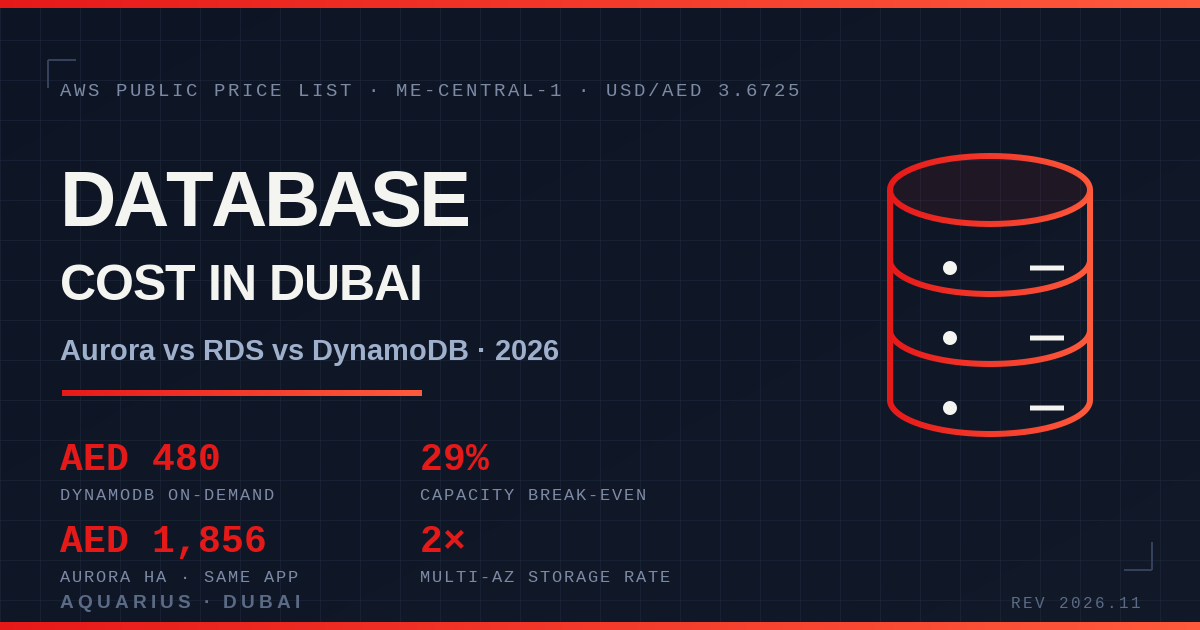
For most Dubai web and app workloads, Amazon RDS for PostgreSQL is the cheapest safe default, Aurora is worth its premium only when you need fast failover and read replicas, and DynamoDB is dramatically cheaper when your access patterns are simple key lookups. On the AWS public price list for me-central-1 (UAE), the exact same 200 GB workload with roughly 20 million writes and 80 million reads a month costs AED 480 a month on DynamoDB on-demand, AED 1,240 on a Multi-AZ RDS PostgreSQL m6g.large, and AED 1,856 on a two-node Aurora PostgreSQL cluster. That is a 3.9x spread for the same application — and most Dubai businesses pick the expensive end by accident.
Why database choice is now a real line item in the UAE
Three numbers explain why this stopped being an engineering detail and became a finance conversation:
- UAE cloud database and DBaaS revenue hit USD 734.6 million in 2025 and is estimated at USD 824.9 million for 2026, growing at a 12.4% CAGR through 2033 (Grand View Research).
- The broader UAE cloud computing market is sized at USD 16.43 billion in 2026, forecast to reach USD 56.26 billion by 2031 at a 27.93% CAGR (Mordor Intelligence).
- The UAE took the largest share of Middle East and Africa cloud infrastructure revenue in 2025 at 34.5% (Emergen Research), helped by the roughly USD 5 billion AWS has earmarked for the UAE region.
Translation: there is now a real local region to run in, local pricing to pay, and a lot of Dubai companies running production databases in me-central-1 for the first time. Every one of them is making an engine choice with a four-figure monthly AED consequence.
All figures below are pulled from the AWS public price list API for me-central-1 and converted at the pegged rate of USD 1 = AED 3.6725, using 730 hours per month. These are on-demand list rates — no Reserved Instances, no Savings Plans, no EDP discount.
The myth that costs Dubai teams the most: "Multi-AZ just doubles the instance"
It does not. Multi-AZ doubles the instance rate and the storage rate.
In me-central-1, RDS GP3 storage is USD 0.14/GB-month Single-AZ, USD 0.279/GB-month Multi-AZ, and USD 0.419/GB-month for a Multi-AZ cluster with readable standbys. On 500 GB that is AED 257 → AED 512 → AED 769 a month for the storage line alone, before you touch compute. Teams that budget for "2x the instance" under-forecast their HA bill by hundreds of dirhams every month.
Real me-central-1 costs for one workload, five ways
Scenario: a typical Dubai SaaS or e-commerce backend. 200 GB of data, ~20 million writes and ~80 million reads per month, high availability on, point-in-time recovery on.
| Option | What you get | USD / month | AED / month |
|---|---|---|---|
| DynamoDB on-demand | Serverless, no instances, PITR on 200 GB | 130.83 | 480 |
| Aurora PostgreSQL Serverless v2 | Averaging 2 ACU across writer + reader | 267.40 | 982 |
| RDS PostgreSQL db.m6g.large | Multi-AZ, 200 GB GP3 | 337.58 | 1,240 |
| RDS PostgreSQL db.r6g.large | Multi-AZ, memory-optimised, 200 GB GP3 | 460.22 | 1,690 |
| Aurora PostgreSQL db.r6g.large x2 | Writer + reader, 200 GB, 100M I/O | 505.38 | 1,856 |
The underlying hourly rates, so you can rebuild this for your own workload:
| Resource (me-central-1) | Rate | AED equivalent |
|---|---|---|
| RDS PostgreSQL db.t4g.medium | USD 0.076/hr Single-AZ · 0.152 Multi-AZ | AED 204 · 408 / month |
| RDS PostgreSQL db.m6g.large | USD 0.193/hr Single-AZ · 0.386 Multi-AZ | AED 517 · 1,035 / month |
| RDS PostgreSQL db.r6g.large | USD 0.277/hr Single-AZ · 0.554 Multi-AZ | AED 743 · 1,485 / month |
| Aurora PostgreSQL db.r6g.large | USD 0.313/hr per instance | AED 839 / month |
| Aurora Serverless v2 | USD 0.15/ACU-hr · 0.20 I/O-Optimized | AED 402 / ACU / month |
| Aurora storage & I/O | USD 0.121/GB-mo · 0.242 per million I/O | AED 0.44/GB · 0.89/M |
| DynamoDB on-demand | USD 0.7755/M writes · 0.1555/M reads | AED 2.85/M · 0.57/M |
| DynamoDB storage & PITR | USD 0.3113/GB-mo · 0.242/GB-mo PITR | AED 1.14/GB · 0.89/GB |
The 29% rule for DynamoDB capacity mode
Here is the single most useful number in this article. In the Middle East (UAE) region, a provisioned write capacity unit costs USD 0.0008085/hour and an on-demand write request costs USD 0.7755 per million. Divide one by the other and you get the break-even: provisioned capacity only beats on-demand above roughly 29% sustained utilisation (28.96% for writes, 28.9% for reads).
So if your table is not busy at least 29% of the time, every hour you spend on provisioned capacity is pure waste. Most Dubai B2B apps — traffic clustered into UAE business hours, dead on Friday and Saturday — sit well below that line. On-demand is the correct default, and auto-scaling provisioned capacity is usually a worse version of it.
The Aurora Serverless v2 break-even is 2.09 ACU
Aurora provisioned db.r6g.large is USD 0.313/hour. Serverless v2 is USD 0.15 per ACU-hour. Divide and you get 2.09 ACU: below that average, Serverless v2 is cheaper than the equivalent provisioned instance; above it, you are paying a premium for elasticity you may not need. Pull your actual ServerlessDatabaseCapacity CloudWatch average before you renew anything.
What it costs to do nothing: Extended Support
AWS charges USD 0.123 per vCPU-hour for RDS PostgreSQL and MySQL Extended Support in years 1 and 2 after a major version goes end of standard support, then USD 0.246 per vCPU-hour in year 3. On a 2-vCPU db.r6g.large that is AED 659 a month, rising to AED 1,319 a month in year three — on top of the instance. Aurora Serverless v2 Extended Support is USD 0.105/ACU-hour, doubling to 0.209 in year three. A deferred version upgrade is not free; it is a line item that can exceed the database itself.
One free 20% saving nobody claims
If you run ElastiCache in front of your database, switching the engine from Redis OSS to Valkey cuts the node rate immediately: cache.m7g.large is USD 0.153/hour on Valkey versus USD 0.1912 on Redis OSS — a flat 20% cut, or about AED 102 a month per node. ElastiCache Serverless is better still: Valkey data storage at USD 0.103/GB-hour against USD 0.154 for Redis, a 33% reduction, with ECPUs at USD 0.0028 per million versus 0.0042. Same API, same client libraries, lower bill.
So which one should a Dubai business actually pick?
Choose RDS PostgreSQL when
You have relational data, joins, reporting queries, an existing ORM, and a team that knows SQL. This covers the large majority of Dubai web platforms, booking systems, ERPs and internal tools. Start at db.t4g.medium Multi-AZ (AED 408/month compute) and move to m6g or r6g when your working set stops fitting in memory, not before.
Choose Aurora when
You need sub-minute failover, two or more read replicas, or storage that grows to tens of terabytes without you resizing volumes. Aurora backup storage is also far cheaper — USD 0.0231/GB-month versus USD 0.1045 on RDS PostgreSQL, a 4.5x difference that matters at long retention. Aurora charges per million I/O requests, so a read-heavy, poorly-indexed application can turn that into the biggest line on the invoice; if your I/O spend exceeds about 25% of your Aurora bill, evaluate I/O-Optimized (storage rises to USD 0.273/GB-month but I/O charges stop).
Choose DynamoDB when
Your access patterns are known and simple: get by ID, query by partition key, append events, store sessions or carts. The AED 480 figure above is not a trick — it is what serverless key-value access genuinely costs in the UAE region at that volume. The catch is architectural, not financial: ad-hoc queries, joins and schema changes are painful, so if your product roadmap still has unknowns in the data model, the discount is a trap.
If you are also deciding how to run the application layer, the same price-list logic applies there — see our breakdown of Kubernetes versus serverless costs in me-central-1.
Two Dubai-specific constraints that override the price list
Data residency. The UAE Personal Data Protection Law (Federal Decree-Law No. 45 of 2021) is in force, but its Executive Regulations remain unpublished as of late 2026, and no adequacy list or standard contractual clauses have been issued under Articles 22 and 23. Transfers currently lean on Article 23(3) express informed consent. In June 2026 the Cabinet created a Federal Authority for Artificial Intelligence and Data, absorbing the Emirates Data Office. Practical read: if you handle UAE personal data, keeping the primary database in me-central-1 removes a question you otherwise have to answer in writing. More detail in our guide to Dubai hosting and data residency.
Availability Zone risk is not theoretical here. The March 2026 strikes on AWS UAE facilities took two of the three me-central-1 Availability Zones offline, and in September 2026 AWS confirmed that resources held exclusively in mec1-az2 with no external backup were unrecoverable. Multi-AZ is the floor, not the ceiling — cross-region backup copies are what actually saved companies. Our Dubai disaster recovery plan covers the RPO/RTO maths.
How Aquarius sizes databases for Dubai clients
We do not start from an engine preference. We pull two weeks of CloudWatch data — CPU, freeable memory, read and write IOPS, connection count and, for Aurora, average ACU — then price every viable option off the current me-central-1 price list in AED. The output is a one-page table like the one above, with your numbers in it.
In practice the recurring findings are boring and lucrative: instances two sizes larger than their working set, provisioned DynamoDB capacity running at 6% utilisation, Redis OSS nodes that should be Valkey, and Multi-AZ storage priced as if it were Single-AZ. Right-sizing against real metrics routinely takes 30–50% off a UAE database bill without touching a line of application code — the same pattern we document in our Dubai FinOps guide.
Risk reversal: the audit is fixed-fee and we hand over the spreadsheet. If the projected annual saving does not exceed the audit fee, you keep the analysis and we tell you to leave the architecture alone. See our pricing, or send us your current AWS bill and we will tell you within two working days which of the five options above fits your workload.
FAQ
Is Aurora always more expensive than RDS in me-central-1?
No, but it usually is at small scale. A single Aurora db.r6g.large at USD 0.313/hour costs more than a Single-AZ RDS db.r6g.large at USD 0.277, and an Aurora cluster needs at least two instances to deliver its failover advantage. Aurora wins on cost at larger scale through cheaper backup storage (USD 0.0231 vs 0.1045 per GB-month) and not having to over-provision volumes.
How much does Multi-AZ actually add in AED?
Roughly double, on both compute and storage. A db.m6g.large PostgreSQL goes from AED 517 to AED 1,035 a month, and 200 GB of GP3 goes from AED 206 to AED 410. Budget about 2x, not 1.5x.
Should I use DynamoDB provisioned or on-demand capacity?
On-demand, unless your table is busy more than about 29% of the time. That threshold comes straight from the UAE region rates: USD 0.0008085 per WCU-hour against USD 0.7755 per million on-demand writes. Below 29% utilisation, provisioned capacity costs more than it saves.
Can I run a Dubai production database outside me-central-1?
Technically yes, and some workloads do for cost or feature reasons. But with PDPL Executive Regulations still pending and no adequacy decisions issued, cross-border transfers of UAE personal data currently rest on express consent under Article 23(3) — a weaker footing than simply keeping the primary in-region. Latency to European regions also adds 100–140 ms per round trip.
What is the cheapest safe production setup in me-central-1?
RDS PostgreSQL db.t4g.medium Multi-AZ with 100 GB GP3 and 7-day automated backups: about USD 155 a month, or AED 570. That is a genuinely production-grade, highly available UAE-resident database. Add a cross-region backup copy before you add a bigger instance.