
Dubai AI Sandbox (2026): How to Test Regulated AI Products Before the 18 December Deadline
Dubai opened an AI Sandbox on 28 October 2026 and applications close 18 December. What it gives you, the MVP bar most applicants miss, how it compares to DIFC and ADGM, and real AED costs.
- PUBLISHED
- 31 OCT 2026
- READ TIME
- 11 MIN
- AUTHOR
- AQUARIUS · DUBAI
- UNIT
- REV 2026.09
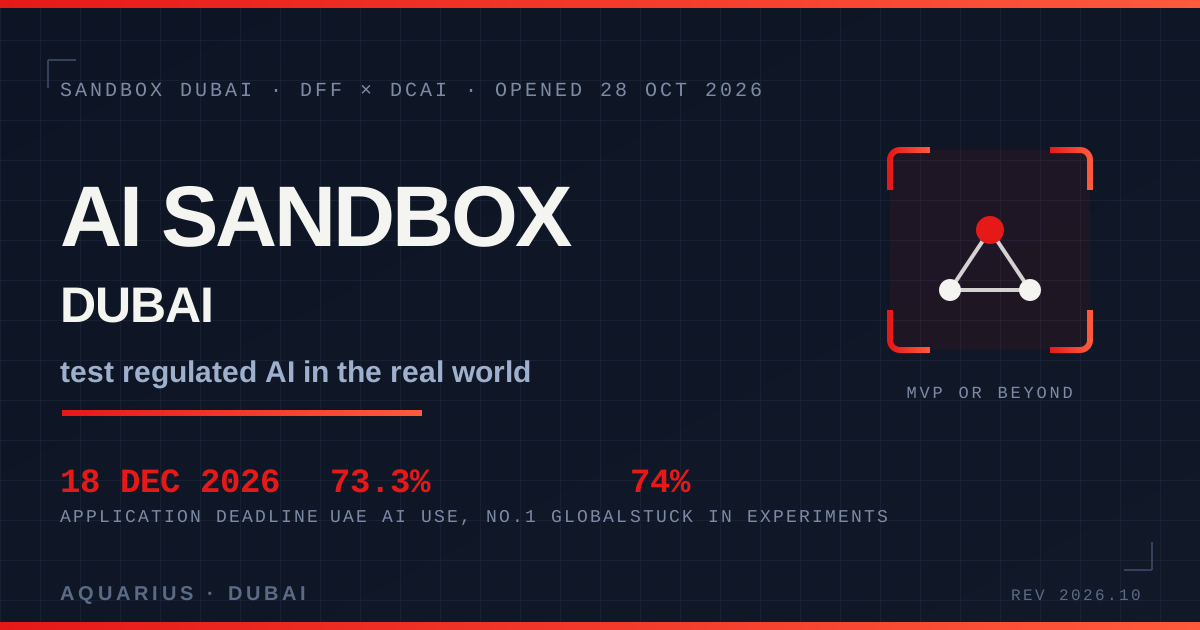
Dubai opened an AI Sandbox on 28 October 2026, and applications close on 18 December 2026. Run by the Dubai Future Foundation through Sandbox Dubai in partnership with the Dubai Centre for Artificial Intelligence (DCAI), it lets companies test AI products in real-world Dubai environments alongside the regulators who would normally block them — including the possibility of regulatory exemptions, subject to each authority’s approval. The catch almost nobody mentions: your product has to already be at minimum viable product stage or beyond. A deck is not an application.
The Dubai numbers that make this deadline matter
The UAE does not have an AI adoption problem. It has an AI deployment problem, and the gap between the two is the entire reason this sandbox exists.
- The UAE ranks first in the world for AI use, with 70.1% of its working-age population using AI in Q1 2026, rising to 73.3% in Q2 2026 — against a global figure of roughly 18%. The UAE and Singapore are the only two economies where more than half of working-age adults use AI.
- And yet the Dubai Future Foundation cited at launch that 74% of companies have not moved their AI initiatives beyond experimentation. Consumers adopted. Companies piloted and stalled.
- The UAE AI market sits at about USD 7.93 billion in 2026, compounding at roughly 44% a year on Precedence Research’s numbers. The National AI Strategy 2031 targets AED 335 billion of additional economic growth.
- The pressure is top-down and dated. The UAE Cabinet directed that 50% of federal government services run through autonomous AI agents by 2028. On 4 May 2026, Dubai Crown Prince Sheikh Hamdan bin Mohammed launched a two-year plan to move Dubai’s entire private sector to agentic AI, with training tracks through the Dubai Chamber of Commerce and Industry and incubators for agentic AI companies.
“The UAE has made significant progress in AI adoption, but the next priority is ensuring that promising technologies can move beyond testing.” — Khalifa Al Qama, Chief of Research, Development and Innovation, Dubai Future Foundation.
Read that as a procurement signal. Dubai government entities — which already have 22 Chief AI Officers appointed across departments under the Dubai Universal Blueprint for AI — are being measured on shipped AI, not pilots. A sandbox place puts your product in front of exactly those buyers.
What the AI Sandbox actually gives you
Sandbox Dubai is not an accelerator and not a grant. It is a regulatory instrument. Selected companies get four things:
- A real-world testing environment in Dubai — live users, live data, a named government counterpart, not a demo tenant.
- Tailored regulatory guidance from the entity that actually owns your constraint, rather than a generic legal opinion.
- Technical, policy and commercial expertise from DFF and DCAI, including help framing your use case so a regulator can say yes to it.
- Possible exemptions from rules that block the pilot — explicitly subject to approval by the relevant authority. This is the valuable part and the part you cannot buy.
Eligible sectors named at launch: education, healthcare, transport and mobility, logistics, tourism, media, government services, and others. Developers of enabling technology — foundation models and hyperscaler platforms — are eligible too, but only where their product faces a genuine regulatory, policy or data-access barrier.
This is the same machinery Dubai has already used elsewhere. The Gig Economy Sandbox pulled in Emirates, Amazon, Careem and GEMS Education to co-write gig-work regulation, and a Construction Technology Sandbox runs with Dubai Municipality. The AI Sandbox is that playbook pointed at AI.
Who qualifies: the MVP bar most applicants miss
Here is where most Dubai AI pitches die. The published criteria are specific:
- Your solution must be at MVP stage or beyond.
- You must demonstrate readiness to commercialise — a path to paying customers, not a research agenda.
- Your use case must have the potential to inform policy and regulatory development. If current rules already permit what you do, you do not need a sandbox and you will not be selected.
- Applications are assessed on innovation, market readiness, the regulatory challenge, and potential impact. Applying guarantees nothing, and the support offered is shaped per use case.
Read criterion three twice. The sandbox is looking for products whose blocker is the rulebook — an AI triage tool that wants to read patient records, a model that needs to act on behalf of a user, an autonomous agent that makes a decision a human is currently required to sign. “We added a chatbot” is not a regulatory challenge. That is the single most common reason a strong-sounding Dubai AI application reads as a non-starter.
Dubai AI Sandbox vs the UAE’s other sandboxes
Founders routinely confuse these four. They solve different problems, at very different costs.
| Programme | Run by | Best for | Duration | Indicative cost |
|---|---|---|---|---|
| AI Sandbox (Sandbox Dubai) | Dubai Future Foundation + DCAI | AI-native products blocked by policy or data access, any sector | Per use case | No published application fee; your cost is the MVP |
| DIFC Innovation Testing Licence | DFSA | Regulated financial services testing live with real clients | 6 – 12 months | Regulatory fees roughly AED 25,000 – 40,000; all-in AED 40,000 – 70,000 |
| ADGM RegLab | FSRA, Abu Dhabi | Fintech needing the longest runway before full licensing | Up to 24 months | USD 1,000 application; about USD 3,400 for two years all-in |
| Construction Tech Sandbox | Dubai Municipality + DFF | Built-environment and proptech pilots | Per use case | Project-based |
Two practical notes. The DIFC licence caps live testing — for payment services, up to 50 clients and AED 5 million in aggregate transaction volume — so it is a finance instrument, not an AI one. And the AI Sandbox has no publicly stated application fee, which means your real spend is engineering: getting to a defensible MVP before 18 December.
The seven artefacts a serious application needs
A regulator is not assessing your model. They are assessing whether you can be trusted with a live Dubai environment. In practice that means you need:
- A working MVP with real users or a credible pilot partner. Deployed, URL-reachable, not a Figma file.
- A written statement of the regulatory blocker — which rule, which authority, what you want relaxed, and for how long.
- An eval set and results. Accuracy, failure modes, refusal behaviour. If you cannot measure your AI, you cannot defend it.
- A model card and data lineage — what the model is, what it was trained or grounded on, where data is stored.
- PDPL posture. The UAE’s Personal Data Protection Law (Federal Decree-Law No. 45 of 2021) still governs you inside a sandbox: lawful basis, consent records, cross-border transfer logic, data-subject request handling, breach procedure.
- Human-in-the-loop and kill-switch design. Which decisions an agent may take alone, which escalate, and how you stop it mid-action. See our guide to AI agent security and prompt injection.
- Arabic and English coverage where the use case touches residents or government services. In Dubai this is not a nice-to-have.
The governance context tightened this year too: the UAE established a Federal Authority for Artificial Intelligence and Data on 14 June 2026, absorbing the AI Office, TDRA’s digital government sector and the Emirates Data Office into one body that sets national AI and data policy — and which is expected to finalise the PDPL implementing regulations. Build as if the rules will get sharper, because they will.
What sandbox-ready costs in AED
Most Dubai companies reading this do not need a sandbox strategy. They need an MVP that is good enough to be let into one. Real ranges for that work:
| Scope | What you get | AED range | Timeline |
|---|---|---|---|
| AI MVP, single workflow | One high-value use case, live, with auth, logging and an eval harness | 45,000 – 95,000 | 4 – 7 weeks |
| Agentic MVP with tool access | Agent that reads and writes to real systems, with approval gates and audit trail | 90,000 – 190,000 | 7 – 12 weeks |
| Evaluation and guardrail layer | Eval set, red-team suite, injection containment, model card | 25,000 – 60,000 | 2 – 4 weeks |
| PDPL and governance pack | Lawful-basis mapping, DSR flow, residency and transfer design, breach runbook | 18,000 – 45,000 | 2 – 3 weeks |
| Application evidence pack | Regulatory-blocker memo, pilot design, metrics, exemption request | 12,000 – 30,000 | 1 – 2 weeks |
The cost of inaction is the sharper number. Dubai has swapped its Create Apps Championship for a Create AI Agents Championship, announced on 7 October 2026, with AED 550,000 per category and AED 1 million for AI Agent of the Year — and 9,754 applications this year alone out of 15,564 all-time from 153 countries, producing 1,700 prototypes and 140+ live apps. The stated goal is to compress the innovation cycle to under six months. If your competitor’s agent ships in that window and yours is still a pilot, the regulatory question becomes academic.
How Aquarius does this
We build the MVP and the evidence around it in the same sprint, because a sandbox application is judged on both. That means an eval harness from week one, not bolted on; approval gates designed before the agent gets tool access; and PDPL decisions documented as they are made rather than reconstructed later. If the sandbox says no, you still own a shipped, measured, compliant AI product — which is the point.
We work in fixed-scope phases with a working deployment at the end of each, so you are never paying into a six-month black box. See pricing for how we band AI work, our services for the stack, and AI agents for Dubai SMEs for the use cases that pay back fastest.
FAQ
When is the Dubai AI Sandbox deadline?
Applications run through the Sandbox Dubai website until 18 December 2026. The AI Sandbox was announced on 28 October 2026, so the window is roughly seven weeks.
Does the Dubai AI Sandbox cost anything to apply to?
No application fee has been published. Compare that with the DIFC Innovation Testing Licence, where regulatory fees alone run about AED 25,000 to 40,000, or ADGM RegLab at USD 1,000 to apply. Your real cost for the AI Sandbox is building the MVP it requires.
Can a startup apply, or is it only for large companies?
Startups, SMEs and established technology companies are all eligible, local or international. The filter is product maturity, not company size: MVP stage or beyond, with readiness to commercialise.
Do PDPL obligations still apply inside the sandbox?
Yes. A sandbox place may bring specific exemptions where an authority approves them, but the UAE Personal Data Protection Law remains your baseline — lawful basis, data-subject rights, transfer rules and breach handling. Our PDPL compliance checklist covers the build-side requirements.
What if we miss the 18 December window?
Sandbox Dubai runs multiple programmes and has opened new ones repeatedly — gig economy, construction technology, now AI. Build the MVP and the evidence pack anyway; both are what a government buyer asks for with or without a sandbox place.
Have an AI product that a rule is blocking? Talk to us — we will tell you honestly whether it is a sandbox case or just an engineering one, and what it takes to be ready before 18 December.