
Dubai Government Now Runs on 93 AI Agents: What It Means for Your Business in 2027
On 18 November 2026 Dubai put 93 AI agents to work across 85 government entities, targeting 34 million tasks a year. Here is what changes for private-sector systems, and what readiness costs in AED.
- PUBLISHED
- 20 NOV 2026
- READ TIME
- 12 MIN
- AUTHOR
- AQUARIUS · DUBAI
- UNIT
- REV 2026.09
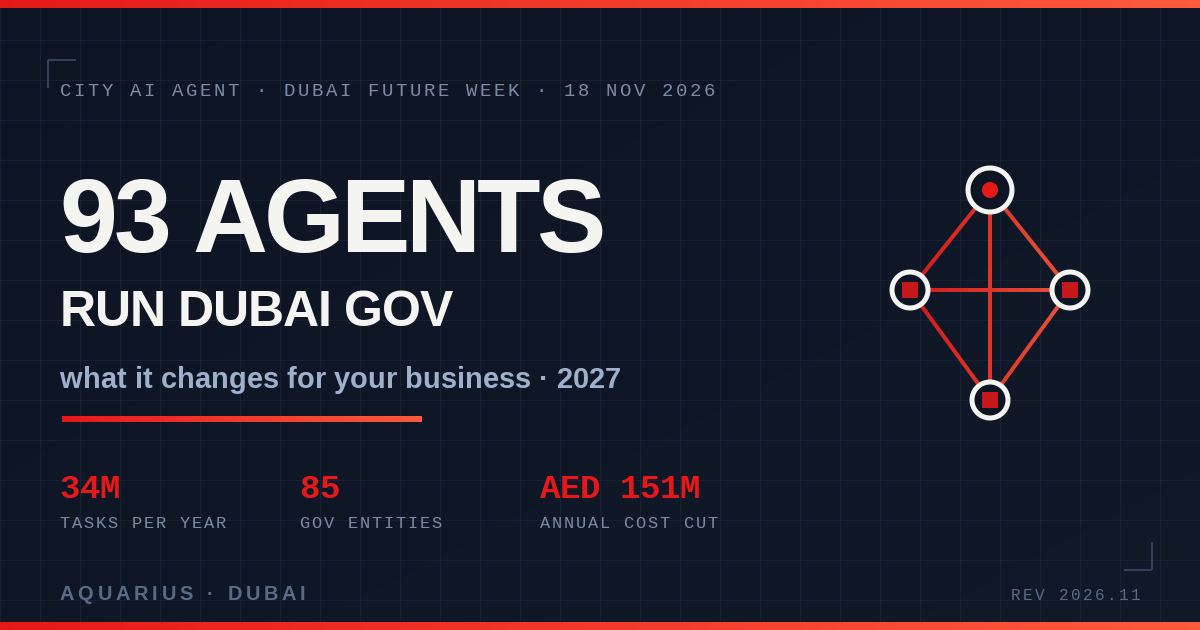
On 18 November 2026 Dubai put 93 specialised AI agents into live government operations across 85 entities, where they are expected to execute more than 34 million tasks a year, save over 812,000 working hours and cut more than AED 151 million in costs. The same day, the Crown Prince approved the City AI Agent initiative, which lets agents understand a request, execute it and coordinate across entities as one experience. For a private-sector company in Dubai, this is not a news story about government. It is a notice that the party on the other side of your invoices, tenders, licences and approvals is becoming software.
The practical question is no longer whether to buy an AI agent. It is whether your systems can be read, verified and transacted with by someone else's agent. Below are the real numbers, the three places this hits a Dubai business first, the one governance rule that decides who is liable, and what readiness costs in AED.
The numbers Dubai just put on the board
Four figures set the stakes, and all four are from 2026 government announcements rather than vendor marketing.
- 93 agents, 85 entities, 34 million tasks a year. The Government Resources AI Agents ecosystem launched at Dubai Future Week 2026 covers human resources, finance and procurement. Projected impact: more than 812,000 working hours saved and more than AED 151 million in cost reduction annually.
- 50% of federal government by April 2028. On 23 April 2026 the UAE Cabinet approved a framework to run agentic AI across half of all federal sectors, services and operations within two years, starting with tax auditing, procurement, customer service and technical support.
- The private sector got a two-year clock too. On 4 May 2026 Dubai launched its Agentic AI Transition Initiative for the private sector: 24 months, training tracks through every Dubai Chamber of Commerce business council, government-backed incubators and dedicated funds. The stated goal is for Dubai to be the world's leading city in adopting these technologies.
- Roughly 70% of government services are considered AI-tolerant. The remaining 30% sit above the risk threshold and stay under human control, per the Ministry of State for AI when it detailed the federal AI Control Tower in October 2026.
Do the arithmetic on Dubai's own announcement and you get the benchmark nobody is quoting: AED 151 million across 812,000 hours is about AED 186 of cost removed per hour of work the agents absorb, or roughly AED 4.44 per task across 34 million tasks. That is the number to hold your own AI business case against. If a proposal cannot tell you the per-task cost it removes, it is not a business case.
"We are witnessing a shift from a government that harnesses AI to one that is designed to operate with AI capabilities." — Hamad Obaid Al Mansoori, Director General, Digital Dubai
Where an agent-run government hits your company first
Most Dubai businesses read these announcements as something happening inside government buildings. It is not. The first three agent cohorts are procurement, finance and HR, which are precisely the three surfaces where government touches a private company.
1. Procurement: your bid becomes a data feed
When a procurement agent screens submissions, the winner is not the prettiest PDF. It is the supplier whose trade licence, VAT registration, insurance validity, past performance and line-item pricing are machine-readable, internally consistent and verifiable without a human phoning you. The UAE opened AED 2.445 billion in government contracts and tenders to SMEs through its National Forum for SMEs procurement programme in 2026. A company whose quotation lives in a hand-formatted spreadsheet with merged cells is competing for that money with a document an agent cannot parse.
2. Finance: e-invoicing is the rail the agents run on
The UAE e-invoicing mandate is the plumbing underneath all of this. The voluntary phase runs from July 2026 and the mandate takes effect 1 October 2027, with Cabinet Decision No. 173 of 2026 setting penalties at AED 5,000 plus AED 5,000 for each further month of non-compliance, capped at AED 50,000 in any 12 consecutive months. Structured invoices exchanged through accredited service providers are what let a finance agent validate, match and pay without a human in the loop. Businesses treating e-invoicing as a 2027 tax chore are missing that it is the single highest-leverage piece of agent-readiness they will do.
3. Identity and HR: verification stops being a PDF exchange
HR and licensing agents verify against government identity rather than scanned attachments. If your onboarding, employee records and customer identity flows still depend on emailed documents, every interaction with an agent-run entity degrades into the slow human exception path. Systems that already speak digital identity and expose a clean API get the fast lane.
The myth to kill first: "we will just buy an agent"
Here is where most Dubai businesses get this wrong. The mandate reads like a shopping instruction, so the reflex is to buy a product with "agentic" on the label. Gartner's assessment is blunt: of the thousands of vendors claiming agentic capability, it estimates only about 130 genuinely offer it, and it predicts more than 40% of agentic AI projects will be cancelled by the end of 2027 on rising costs, unclear business value and inadequate risk controls. Gartner's own forecast for what does land is modest and specific: around 15% of day-to-day work decisions made autonomously by 2028, and 33% of enterprise software embedding agentic AI by then, from under 1% today.
Read those two sets of numbers together. Government is deploying agents against a narrow, well-instrumented domain: known processes, structured data, logged actions, defined risk tiers. Failed private projects almost always skip that groundwork and buy the agent first. The groundwork is the project.
What agent-ready actually means, tier by tier
Agent-readiness is not one purchase, it is four stages, and almost every Dubai SME can skip straight past the hype by doing the first two properly. Indicative AED ranges below are build costs for a UAE SME, excluding licence fees.
| Tier | What it means | Typical build (AED) | Timeline |
|---|---|---|---|
| 1. Machine-readable | Structured e-invoices via an accredited provider, clean product and price data, licence and compliance documents in one verified source | 18,000 – 60,000 | 3 – 6 weeks |
| 2. API-addressable | Your core system exposes authenticated endpoints: stock, pricing, order status, booking slots, document status. Agents stop screen-scraping and start querying | 45,000 – 140,000 | 5 – 10 weeks |
| 3. Agent-facing front door | A website and checkout an external AI agent can actually complete a task on, plus a retrieval assistant on your own documents | 50,000 – 150,000 | 6 – 12 weeks |
| 4. Acting agents | Agents that execute inside your business with tool access, approval gates, full action logs and evaluation harnesses | 100,000 – 350,000 | 10 – 20 weeks |
Tiers 1 and 2 are not AI spending at all. They are data and integration work that pays off whether or not you ever deploy an agent, and they are the reason a tier-4 project either works or gets cancelled. We cover the automation side of this in our breakdown of RPA and intelligent automation costs in Dubai, and the external-agent side in making a Dubai website agent-ready for AI browsers.
The governance rule that decides who pays when an agent is wrong
The UAE's federal AI Control Tower, detailed in October 2026, is the clearest statement of accountability any regional regulator has issued, and it applies to the mindset you should build with. Every federal agent must connect to it and log every action. Risk tiering decides autonomy: low-risk work such as document renewals can be decided by the agent, higher-risk services need stricter oversight, and about 30% of services remain above the threshold entirely. One line is explicit, from the Minister of State for AI: if something harms a citizen, the responsible party is not the agent but the institution that deployed it.
Translate that to your build. An agent with no action log is an unaccountable liability, not an efficiency. Three things belong in scope from day one: a complete audit trail of every action and the inputs behind it, a hard allow-list of what the agent may do without human approval, and an evaluation harness that catches regressions before customers do. That also keeps you aligned with the data rules now consolidated under the UAE's new AI and Data Authority, which we covered in what Dubai businesses must do before the PDPL rules land.
What it costs, and what it has to return
Real AED numbers, consistent with what we quote and what the market charges in Dubai. A scripted FAQ bot runs AED 12,000 to 35,000. A generative assistant on your own documents with retrieval runs AED 50,000 to 150,000. A regulated, multi-system agent with approval gates, logging and evaluations runs AED 100,000 to 350,000. Running costs land around AED 0.80 to AED 3.50 per conversation depending on model and context size, which is the line most budgets forget. Our full AI chatbot and agent cost breakdown has the per-tier detail.
Now the conversion-side number, because this is where a Dubai business should make the decision. Government is removing cost at roughly AED 186 per hour of absorbed work. A Dubai admin or coordinator role at AED 9,000 a month is about AED 52 an hour fully loaded. If an agent absorbs 15 hours a week of quoting, status-chasing and data entry, that is roughly 780 hours a year, or about AED 40,000 of recovered capacity annually, against a tier-2 or tier-3 build you amortise over three years. The cost of inaction is quieter and larger: when procurement, tax and licensing agents can transact instantly with competitors whose data is structured and still need a human to chase yours, you lose the work before anyone reads your proposal.
How Aquarius builds this
We start at tier 1 and refuse to sell tier 4 to a company that has not done it, because that is the 40% cancellation statistic in practice. The sequence is a two-week readiness audit of your data, invoicing and integration surface, then the smallest useful build with logging and evaluations in from the start, then expansion only where the per-task numbers justify it. Fixed scope, fixed price, your code and your data in your accounts, with the action log built so your auditor and your insurer can both read it. See what we build and how we scope and price.
FAQ
Is my Dubai company legally required to adopt agentic AI?
No. The April 2026 federal framework and the two-year transformation target apply to government sectors, services and operations. Dubai's May 2026 Agentic AI Transition Initiative for the private sector is a support and acceleration programme with training, incubators and funds, not a penalty regime. What is legally binding on your side is adjacent: e-invoicing from 1 October 2027, and personal-data obligations.
What is the City AI Agent, in plain terms?
It is Dubai's move from individual AI services to one coordinated agent layer across government, approved on 18 November 2026 at Dubai Future Week. Rather than you finding the right entity and the right form, an agent interprets the need, executes the task and coordinates between entities. Supporting systems announced alongside it include NxtBI for decision-making and Dubai Nexus.
What is the cheapest first step that actually matters?
Get your invoicing structured through an accredited e-invoicing service provider and get your product, price and compliance data into one authoritative source. That is tier 1, typically AED 18,000 to 60,000, it is required for 2027 anyway, and it is what every later agent project depends on.
How do I avoid buying agent-washed software?
Ask three questions. Can it take an action in a live system without a human clicking, and where is that logged? What happens when it is wrong, and who is accountable? Show me the per-task cost and the evaluation results on my data, not a demo. Vendors that rebrand a chatbot or an RPA script as agentic fail all three.
Do we need our own data centre or UAE-hosted models?
For most SME workloads, no. Keeping personal data in-region and documenting where processing happens matters far more than owning infrastructure, and the UAE AWS and Azure regions make in-region deployment routine.
Dubai has told the market what the next two years look like, with 93 agents already in production as proof it is not a slogan. The companies that benefit will not be the ones that bought an agent fastest. They will be the ones whose data, invoices and APIs were ready to be transacted with. Book a readiness audit and we will tell you in one call which tier you are actually at, and the shortest path to the next one.