
UAE AI and Data Authority: What Dubai Businesses Must Do Before the PDPL Rules Land
The UAE merged its AI office, digital government sector and Data Office into one authority on 14 June 2026. No PDPL fine schedule has ever been published. Here is the real 2027 compliance clock.
- PUBLISHED
- 20 NOV 2026
- READ TIME
- 11 MIN
- AUTHOR
- AQUARIUS · DUBAI
- UNIT
- REV 2026.09
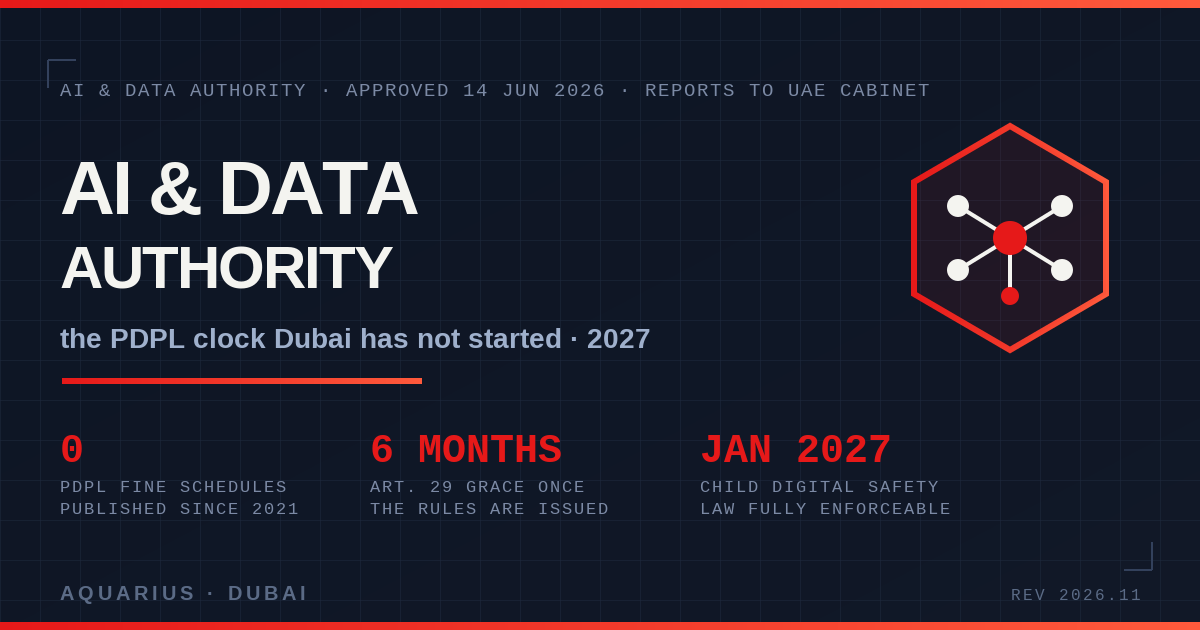
The UAE now has a single regulator for artificial intelligence, data and digital government: the Artificial Intelligence and Data Authority, approved on 14 June 2026 and reporting directly to the Cabinet. It absorbed the body that was legally required to propose the PDPL penalty schedule, which is why that schedule still does not exist five years after the law passed. For a Dubai business, the practical consequence is this: your personal-data exposure today comes from the Cybercrime Law, not the PDPL, and the moment the new authority publishes the PDPL Executive Regulations you get exactly six months to be compliant.
That six-month clock has not started. It can start on any Gazette Tuesday. Below is what the authority actually is, which obligations are enforceable right now in 2026, which dates are already fixed for 2027, and what a readiness programme costs in AED.
The Dubai numbers that set the stakes
Three figures explain why the UAE consolidated AI and data oversight into one body rather than leaving it spread across three.
- Adoption outran governance. Generative AI use among the UAE's working-age population reached 73.3% in Q2 2026, the highest rate measured anywhere. Deployment maturity did not keep pace: only about 31% of UAE businesses that report using AI are running anything beyond basic assistants.
- Dubai is the concentration point. Precedence Research values the UAE artificial intelligence market at USD 7.93 billion in 2026 on a 44.15% compound growth rate, with Dubai accounting for roughly 43% of it. More than 800 AI-specialised companies operate in the emirate, and about 72% of them are SMEs or startups — firms with no in-house general counsel.
- The enforceable number is not the one you have read. Article 13 of Federal Decree-Law No. 34 of 2021 on Countering Rumours and Cybercrimes carries detention and a fine of not less than AED 50,000 and not more than AED 500,000 for using information technology to collect, keep or process the personal data of UAE nationals or residents in violation of applicable legislation. That provision is in force and the UAE Public Prosecution has publicly warned about it. It is the live personal-data penalty in the UAE today.
What the Artificial Intelligence and Data Authority actually is
On 14 June 2026, His Highness Sheikh Mohammed bin Rashid Al Maktoum approved the establishment of the Artificial Intelligence and Data Authority, chaired by Omar Sultan Al Olama, Minister of State for Artificial Intelligence, Digital Economy and Remote Work Applications. In his own words:
“Today we approved the establishment of the Artificial Intelligence and Data Authority, the single national body responsible for data, artificial intelligence and digital government in the UAE.”
Three separate entities were folded into it:
- the Office of Artificial Intelligence, Digital Economy and Remote Work Applications;
- the Digital Government Sector of the Telecommunications and Digital Government Regulatory Authority (TDRA);
- the UAE Data Office — the regulator named in the PDPL itself.
Its published mandate runs to national AI strategy, government data quality and sharing, AI-powered national data platforms, proactive digital services, standards and guidelines for data and AI management, national R&D capability, international coordination and support for government information security. The stated objective is “a government that runs on data and agentic AI.”
Read that list carefully and you will notice what is missing: no new obligation on private companies, no licensing regime, no registration deadline. The authority did not create duties on 14 June 2026. It created a single desk from which the duties that were already drafted will be issued.
The myth-bust: the AED 5 million PDPL fine and the 72-hour breach clock do not exist
This is the part most Dubai businesses get wrong, and plenty of compliance content repeats it. Search “PDPL fines” and you will be told the maximum administrative fine is AED 5 million per violation and that you must notify a breach within 72 hours. Go to the text of Federal Decree-Law No. 45 of 2021 and neither figure is there.
- Article 26 provides that the Council of Ministers, on a proposal from the Director General of the Data Office, shall issue a decision listing the acts that constitute violations and the administrative penalties to be imposed. The law sets no amounts. As of 19 November 2026 that Cabinet decision was not findable on the official UAE legislation portal.
- Article 9 requires you to notify the Bureau of a personal-data breach “within the period” set by the Executive Regulations. The law names no number of hours. The 72-hour figure is imported from the GDPR.
- Article 13 sets out what a data subject is entitled to receive, with no response deadline in days. The commonly quoted 30-day window is, again, a Regulations placeholder.
- The Executive Regulations themselves remain unissued. They were expected roughly six months after the law was published in September 2021. Legal commentary dated June, late August and September 2026 all confirm they still have not appeared in the Official Gazette.
The PDPL has been in force since 2 January 2022 under Article 31, and Article 2 reaches controllers and processors outside the UAE who process the data of people inside it. So the duties are live; the price list is not. Treat any vendor quoting you an AED 5 million PDPL exposure as quoting a draft.
Article 29: the six-month clock you cannot see coming
Here is the clause that should drive your 2027 planning. Article 29 gives in-scope organisations a period of no more than six months from the date the Executive Regulations are issued to regularise their position.
That is a short runway for anything involving engineering work. A consent management platform rebuild, a data map across every SaaS tool touching customer records, a data-subject request workflow with an audit trail, and a breach runbook with named owners is a one-to-three-month programme if you start with budget approved. It is a six-month programme if you start by discovering which 40 tools have your customer list.
And the authority that now holds the pen is a brand-new, Cabinet-level body with a mandate to set standards and a chairman whose portfolio is AI acceleration. The reasonable planning assumption is that the Regulations arrive sooner under one consolidated regulator than they did under three fragmented ones — not later.
The 2027 dates that are already fixed
While the PDPL clock is unstarted, two other UAE clocks are running with published dates. Both hit Dubai digital businesses directly.
| Instrument | Status now (Nov 2026) | Hard date | Who it catches |
|---|---|---|---|
| Child Digital Safety Law (Federal Decree-Law No. 26 of 2025) | In force since 1 January 2026, one-year grace period running | January 2027 — fully enforceable | Any website, app, game, messaging, streaming or e-commerce platform in the UAE or directed at UAE users |
| UAE e-invoicing regime | Pilot and voluntary adoption opened July 2026 | 1 October 2027 — mandatory | Every VAT-registered business issuing B2B and B2G invoices |
| E-invoicing penalties (Cabinet decision, November 2026) | Amended and capped | Applies with the regime | AED 5,000 initial, AED 5,000 per month of continuation, capped at AED 50,000 in any 12 consecutive months |
| PDPL Executive Regulations | Unissued; penalties schedule undrafted in public | Issue date + 6 months (Article 29) | Any controller or processor handling UAE personal data, including from abroad |
The Child Digital Safety Law is the sharper of the two for product teams. TDRA enforces it, supported by a Child Digital Safety Council chaired by the Minister of Family. Platforms get classified by the level of risk they pose to children, and that classification determines the age groups, the age-verification mechanism and the obligations that apply to you. Separately, processing the personal data of a child under 13 requires a parental consent mechanism. If your Dubai app has a sign-up form and no age gate, January 2027 is six weeks away from this article's publication date. Our breakdown of age verification and kids' app compliance in Dubai covers the build detail.
Note the e-invoicing amendment too, because it tells you how UAE regulators are now thinking about penalties: the November 2026 Cabinet decision reduced exposure, scrapped fines for failing to report system failures, and capped the total. Proportionate and capped is the current direction of travel. That is a reason to prepare calmly, not a reason to ignore the deadline.
Do you need a Data Protection Officer? Read Article 10, not a blog
The PDPL does not require every company to appoint a DPO, and there is no employee-count threshold in the law despite what comparison tables suggest. Article 10 ties the requirement to the processing, not the headcount. You need one where processing:
- would cause a high-level risk to the confidentiality and privacy of personal data as a result of adopting new technologies or the volume of data involved;
- involves a systematic and comprehensive assessment of sensitive personal data, including profiling and automated processing;
- or involves processing a large volume of sensitive personal data.
For a Dubai business, that first limb is the one AI triggers. Pipe customer records through a third-party model, start scoring or profiling users automatically, or move a decision from a human to an agent, and you are squarely in “new technologies” territory with a plausible high-risk finding. A clinic, a lender, an HR platform or an insurtech that bolted on an LLM in 2026 should assume the DPO limb applies and document the reasoning either way. Where the data cannot leave the country at all, a private LLM with UAE data residency is the usual answer.
What to build in the next 90 days
Nothing on this list depends on the Executive Regulations being published. Every item is required by the law as it stands, reduces Cybercrime Law Article 13 exposure, and is what the six-month Article 29 window will be spent on if you have not done it.
- Data map first. Every system, SaaS tool, analytics tag, model endpoint and spreadsheet holding personal data, with a named owner, a lawful basis and a retention period. This is the artefact everything else is derived from, and the one nobody has.
- Consent and script gating. A real consent management platform that blocks tags before consent rather than logging after it. Granular, bilingual, with a stored consent record you can produce.
- Data-subject request workflow. A route in, an identity check, a fulfilment runbook, a clock. Build it to answer in days, so that whatever number the Regulations set, you are inside it.
- Breach runbook with a trigger, not a plan. Who declares, who notifies, what the notification contains, where the evidence lives. Article 9's clock is set by Regulations you have not read yet, so make your internal target 24 hours.
- AI-specific controls. An inventory of every model and vendor touching personal data, a documented human-review point for consequential decisions, and a policy that bans personal accounts for work data. Formalising this is what an ISO 42001 AI management system certifies.
- Age assurance if children can reach your product. Classification assumption, age gate, under-13 parental consent path. January 2027.
Our full PDPL compliance checklist for websites and apps is the implementation companion to this list, and the e-invoicing ERP integration guide covers the October 2027 side.
What this costs in Dubai in 2026
These are the AED ranges we quote for UAE SME and mid-market work, excluding 5% VAT. They assume an existing web or app product rather than a greenfield build.
| Work item | What you get | AED |
|---|---|---|
| Consent management platform | Granular bilingual banner, pre-consent script gating, stored consent log | 3,000 – 9,000 |
| Privacy notices | Bilingual policy plus just-in-time notices at every collection point | 2,500 – 7,000 |
| Data-subject request flow | Request form, identity verification, internal fulfilment workflow | 3,000 – 8,000 |
| Security and breach runbook | Encryption at rest and in transit, access controls, notification playbook | 5,000 – 15,000 |
| Full data map and PDPL gap audit | End-to-end review of every tool touching personal data, prioritised remediation list | 8,000 – 20,000 |
| AI governance layer | Model and vendor inventory, DPIA template, human-review checkpoints, usage policy | 12,000 – 30,000 |
| Age assurance build | Risk classification assessment, age gate, under-13 parental consent path | 9,000 – 25,000 |
| Full readiness programme | All of the above, sequenced, with documentation pack | 45,000 – 95,000 |
Set that against the cost of being wrong. A single Cybercrime Law Article 13 finding starts at AED 50,000 and reaches AED 500,000, carries detention exposure, and attaches to a criminal provision rather than an administrative one — so it does not wait for the PDPL Regulations to exist. An AED 8,000 data map that finds the marketing tool quietly exporting your customer list is the cheapest line on this page. See our pricing for how these packages are structured, or the services overview for the build side.
How Aquarius handles this
We are a Dubai development studio, not a law firm, and the split matters: your counsel opines on obligations, we build the systems that satisfy them. In practice that means we start with the data map because every other decision depends on it, we gate scripts in code rather than trusting a banner widget, and we write the AI inventory into your repository so it stays current instead of ageing in a slide deck.
Fixed scope, fixed price, and the documentation pack is yours whether or not you continue with us — there is no retainer lock-in on compliance artefacts. If the Executive Regulations land mid-project, we re-sequence against the actual text at no change fee, because we scoped for the six-month window rather than against a guess at its contents.
FAQ
Does the new AI and Data Authority create obligations for my Dubai company?
Not directly, and not yet. The 14 June 2026 approval consolidated the Office of AI, TDRA's Digital Government Sector and the UAE Data Office into one Cabinet-level body with a mandate over national strategy, standards and government data. It introduced no new private-sector duties, no licence and no registration. What changed is who issues the pending rules: the PDPL's own regulator is now inside the new authority.
What is the actual maximum PDPL fine in the UAE?
There is no published PDPL fine schedule. Article 26 of Federal Decree-Law No. 45 of 2021 delegates the list of violations and administrative penalties to a Cabinet decision, and that decision had not appeared on the official UAE legislation portal as of 19 November 2026. The widely quoted AED 5 million figure is not in the law. The enforceable personal-data penalty today is Article 13 of the Cybercrime Law: AED 50,000 to AED 500,000 plus detention.
When do the PDPL Executive Regulations come into effect?
Unknown. They were expected around March 2022 and remain unissued as of November 2026. What is certain is the consequence: Article 29 gives you no more than six months from their issue date to regularise. Build on that assumption rather than on a predicted date.
Is the 72-hour breach notification rule real in the UAE?
No. Article 9 requires notification to the Bureau within a period to be set by the Executive Regulations, and no number of hours appears in the law. The 72-hour figure comes from the GDPR and has been copied into UAE compliance content. Plan for 24 hours internally so any published window is comfortable.
My app has UAE users but my company is offshore. Am I in scope?
Very likely yes. Article 2 of the PDPL applies to controllers and processors located outside the UAE who process the personal data of data subjects inside the UAE. The Child Digital Safety Law is explicit on the same point: it reaches platforms operating outside the UAE where services are directed at UAE users.
What should I do first if I have no compliance work in place?
The data map. It is cheap, it is the input to every other control, and it is the document that turns an abstract obligation into a finite task list. Everything else — consent, DSAR flow, breach runbook, AI inventory — is scoped from what the map finds.
One regulator now holds the pen on UAE data and AI rules, and the only deadline you control is how ready you are when it writes. If you want the Dubai-specific version of this mapped against your actual stack, talk to us — the first conversation is a gap read, not a pitch.