
Dubai Truck Curfews 2026: What RTA Restrictions Break in Your Dispatch Software
RTA restricted heavy vehicles on key Dubai roads from 1 October 2026. AED 1,000 plus 4 black points per trip. What your dispatch software has to change.
- PUBLISHED
- 04 NOV 2026
- READ TIME
- 12 MIN
- AUTHOR
- AQUARIUS · DUBAI
- UNIT
- REV 2026.09
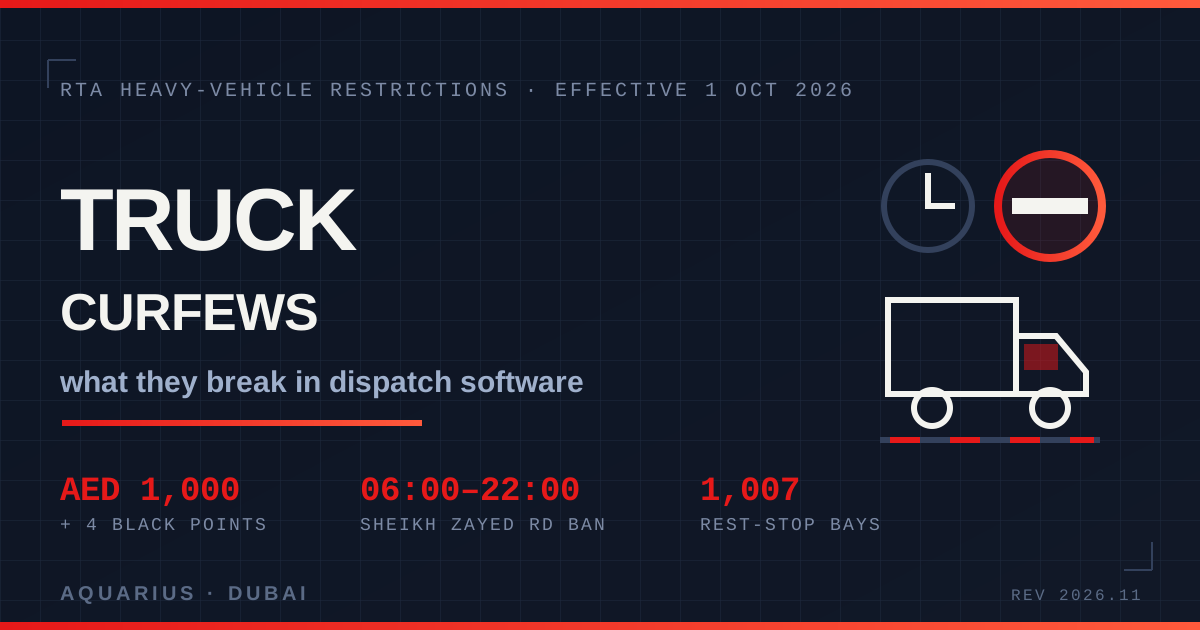
Short answer: since 1 October 2026, RTA and Dubai Police restrict heavy vehicles on a named list of Dubai roads — some banned around the clock, some from 06:00 to 22:00, some only in the three daily peak windows. A truck caught on a restricted road pays AED 1,000 and takes 4 black points. If your dispatch or delivery software still routes on shortest-distance, it is now actively generating fines.
This is not a signage problem. It is a software problem. Every Dubai fleet running a booking app, a delivery platform or an ERP-attached dispatch module needs a road-class layer and a time-of-day rule engine before the next invoice cycle — and most do not have one.
What actually changed on 1 October 2026
RTA announced the restrictions on 26 September 2026 through the Dubai Media Office, framing them as a move to improve traffic flow across Dubai’s road network and enhance road safety. Three numbers set the stakes:
- AED 1,000 plus 4 black points per violation for a heavy vehicle entering a prohibited road or area — a federal traffic violation, not a municipal warning.
- 1,007 truck parking bays now exist across Dubai’s truck rest stops, after RTA added 364 spaces — a roughly 50% expansion. Fourteen of sixteen facilities across six sites are complete, with four more planned.
- More than 150,000 truck visits a month already use those rest stops, which is RTA’s own measure of how much heavy-vehicle traffic the network absorbs.
Context for scale: Dubai’s population reached 4,807,185 on 29 September 2026, up 226,885 since the end of 2025 according to the Dubai Data and Statistics Establishment. Every one of those residents is a delivery address. The road network did not grow 5% this year; the demand on it did.
Meanwhile transport and storage generated AED 50.6 billion of value added in H1 2026 — but that was a 7.4% decline, against a Dubai GDP of AED 473 billion for the same half. The sector is already being squeezed on productivity. Routing penalties land directly on that line.
The three restriction tiers your rule engine has to model
Most teams try to encode this as a single blocklist. That is wrong, and it will either over-block — killing legitimate night runs — or under-block, which means fines. There are three distinct tiers, and each needs its own rule type.
| Tier | Roads | Restricted window | Rule type in software |
|---|---|---|---|
| Round-the-clock ban | Al Qudra Street, Al Meydan Street, Airport Tunnel, all crossings | 24/7 | Static edge exclusion on the graph |
| Daytime ban | Sheikh Zayed Road, Beirut Street, Al Mizhar, Muhaisnah, Oud Al Muteena | 06:00–22:00 | Time-windowed edge cost, infinite inside the window |
| Peak-only ban | Airport Street, Oman Street, Damascus Street | 06:30–08:30, 13:00–15:00, 17:30–20:00 | Three-window rule, evaluated at ETA not dispatch time |
| Exempt corridor | Emirates Road | No restriction | Preferred trunk route; weight it down |
The bug almost every Dubai dispatch build has
Time-windowed restrictions must be evaluated against the estimated arrival time at each road segment, not against the time the job was dispatched. A truck leaving Jebel Ali at 05:40 is legal on Sheikh Zayed Road for twenty minutes and illegal for the rest of the trip. Systems that stamp a single dispatch time and check it once will clear that job and collect the fine.
The fix is not exotic: carry a cumulative travel-time offset through the route solver and re-test each restricted edge at its own arrival estimate. If you are building fleet tooling from scratch, this belongs in the core routing layer from day one — see our breakdown of custom fleet and logistics software in Dubai for where it sits in the module stack.
The Mobility Permit path, and why it needs a workflow
RTA does issue a Mobility Permit for Heavy Vehicles in Banned Times and Roads, handled by the Right-of-Way (ROW) Department, for essential cases. Practically that means your software needs three things most builds lack: a flag on the job marking it permit-required, storage for the permit reference and its validity window, and a hard block on dispatch if that window has lapsed. Treat the permit as a first-class record, the same way you treat a trade licence or an Ejari number — not a WhatsApp screenshot in a driver’s phone.
Stacking with the summer heat-stress window
Dubai fleets that load and unload by hand have a second legal window to respect. Under MoHRE’s Occupational Heat Stress Prevention Policy — Ministerial Resolution No. 44 of 2022, in its 22nd consecutive year in 2026 — outdoor work is prohibited from 12:30 to 15:00 between 15 June and 15 September. Penalties run AED 5,000 per worker, capped at AED 50,000 per establishment, and MoHRE reported 99% compliance in 2025, so enforcement is real.
Overlay that on the peak-hour road bans and a mid-June afternoon in Dubai leaves almost no legal window for a manual-handling job on Airport Street. Any scheduler that cannot represent two independent, overlapping prohibition calendars will quietly book work that cannot legally happen.
What it costs to make a Dubai fleet system curfew-aware
Three honest paths, depending on what you already run. These are the AED bands we quote in Dubai for 2026.
| Scope | What you get | AED (2026) | Timeline |
|---|---|---|---|
| Rule-layer retrofit | Road-class and time-window rules bolted onto your existing dispatch, plus a permit field and violation alerts | 18,000–45,000 | 2–4 weeks |
| Compliant routing module | Arrival-time-aware route solver, Emirates Road weighting, permit workflow, driver-app warnings | 55,000–140,000 | 6–10 weeks |
| Full dispatch platform | Jobs, drivers, vehicles, e-POD, Salik-aware costing, restriction engine, admin dashboard, reporting | 150,000–400,000 | 3–6 months |
Run the arithmetic on the cheapest band. A 20-truck Dubai fleet averaging one restricted-road violation per truck per month pays AED 20,000 in fines a year — before counting the 4 black points per violation accumulating against drivers you then cannot deploy. The rule-layer retrofit pays for itself inside the first year on fines alone, and that ignores the real cost: a vehicle impounded or a driver suspended in the middle of a contracted delivery window.
How Aquarius builds it
We encode the restriction set as data, not as code — a versioned table of road segments, tiers and windows that an operations manager can update when RTA publishes the next revision, with no redeploy. The route solver reads that table; the driver app surfaces a plain-language warning before the turn, not after; and every blocked dispatch logs why it was blocked, so you have an audit trail when a client disputes a delay.
We build in Dubai, for Dubai conditions — the same approach behind our movers and packers app builds. Fixed scope, fixed price, source code yours at handover. See our pricing for the current bands, or send us your dispatch flow and we will mark the exact points where the new restrictions break it, at no charge.
FAQ
When did Dubai’s new truck restrictions take effect?
1 October 2026. RTA announced them on 26 September 2026, jointly enforced with Dubai Police.
What is the fine for a truck on a restricted Dubai road?
AED 1,000 plus 4 black points per violation, under the federal heavy-vehicle prohibited-road violation.
Is Sheikh Zayed Road fully banned for trucks?
No — it falls in the 06:00 to 22:00 tier, so heavy vehicles may use it outside that window. Al Qudra Street, Al Meydan Street, the Airport Tunnel and all crossings are the round-the-clock bans.
Can I get a permit to run a truck during banned hours?
Yes, for essential cases. RTA’s Right-of-Way Department issues a Mobility Permit for Heavy Vehicles in Banned Times and Roads. Build the permit reference and its expiry into the dispatch record rather than tracking it manually.
Which Dubai road is still open to trucks?
Emirates Road is exempt and is the intended heavy-vehicle trunk corridor. Weight it as the preferred route in your solver rather than treating it as a detour.
Does a small fleet really need custom software for this?
Under roughly five vehicles, a printed rule sheet and a disciplined dispatcher can hold. Past that, the restriction set has too many conditional windows for a human to apply consistently under pressure — which is exactly when the AED 1,000 fines start.
Most Dubai fleets will discover this through a fine, not a memo. The ones that do not are the ones treating road restrictions as a data layer in their software today. If that is a conversation worth having, talk to us.