
Logistics & Fleet Software Development in Dubai (2026): Tracking, Route Optimization & Last-Mile
How Dubai fleets build custom logistics software in 2026 — live GPS tracking, route optimization, driver apps, e-POD and COD reconciliation — plus realistic AED build ranges and a build-vs-buy call.
- PUBLISHED
- 08 SEPT 2026
- READ TIME
- 09 MIN
- AUTHOR
- AQUARIUS · DUBAI
- UNIT
- REV 2026.09
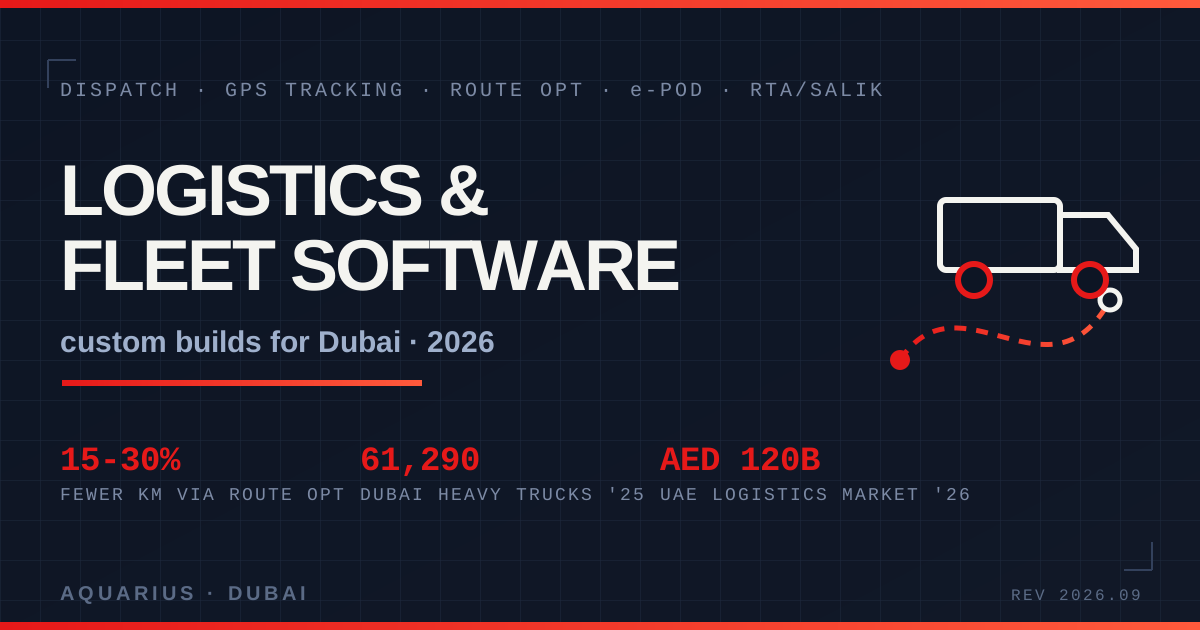
Short answer: A custom logistics platform for a Dubai fleet in 2026 stands on six modules — dispatch, live GPS tracking, route optimization, a driver mobile app, electronic proof-of-delivery (e-POD), and COD reconciliation — ideally wired to your ecommerce or ERP. Route optimization alone typically cuts kilometres driven by 15-30% and fuel spend by 10-15%, with payback in 3-6 months. Expect a realistic build range of AED 80,000 to AED 400,000+ depending on scope, and choose build over an off-the-shelf TMS only when your routing rules, integrations, or margins justify it. This guide breaks down every decision with real 2026 numbers.
Why Dubai logistics software is a 2026 priority (the numbers)
The market context explains why fleets are moving off spreadsheets and WhatsApp dispatch this year:
- ~AED 120 billion (US$32.8B) — the size of the UAE logistics market in 2026, on track for US$57.3 billion by 2035 at a 6.4% CAGR, per IMARC. Dubai alone holds 38.7% of that activity, anchored by its ports, airports and free-zone ecosystem.
- 61,290 heavy commercial vehicles were registered in Dubai as of September 2025 — trucks from 3.5 to 65 tonnes — every one of which is a candidate for telematics.
- 6.2 million postal parcels cleared Dubai Customs in the first half of 2026 alone, while air-cargo transactions jumped 53% to 18.2 million. Last-mile volume is compounding, and manual dispatch does not scale into it.
Most Dubai fleet owners think their problem is "not enough trucks." It's almost never that. It's empty return legs, drivers idling in Salik peak windows, deliveries that can't be proven, and COD cash that never fully reconciles. Software fixes those before a single extra vehicle does.
The six modules every Dubai fleet platform needs
Whether you buy or build, this is the anatomy of a working system. Skip one and the others leak value.
1. Dispatch & order management
The command centre: ingest orders (from your store, ERP, or a CSV), assign them to drivers or auto-assign by zone and capacity, and track status from picked to delivered. This is where the RTA reality bites — Dubai's variable Salik tolls run AED 6 in peak hours (06:00-10:00, 16:00-20:00) and AED 4 off-peak, with a toll-free window from 01:00 to 06:00. A dispatch engine that batches heavy runs into off-peak and toll-free windows quietly trims both toll and fuel bills.
2. Live GPS tracking & telematics
Real-time vehicle location, speed, and geofence alerts — the backbone of accountability and customer ETAs. The UAE fleet-management software market is projected to grow from US$245 million in 2025 to US$513 million by 2031, and AI/video telematics penetration is modelled to reach 83% by 2032. In other words, tracking is table stakes; the differentiation is what you do with the data. Related reading: garage and workshop management software.
3. Route optimization
The single highest-ROI module. Instead of drivers guessing sequence, the engine solves for the shortest feasible route across all stops given time windows, vehicle capacity, and traffic. The measured payoff is consistent across the industry:
| Metric | Typical improvement | Source context |
|---|---|---|
| Kilometres driven | 15-30% reduction | Last-mile optimization studies, 2025 |
| Fuel consumption | 10-15% reduction | CSCMP 35th State of Logistics, 2025 |
| On-time delivery | 85% → 95%+ | Post-deployment benchmarks |
| Payback period | 3-6 months | Carrier deployments |
4. Driver mobile app
The field interface: turn-by-turn navigation, the day's stop list, one-tap status updates, and capture for e-POD. In Dubai this must be bilingual (English/Arabic) and usable on a low-end Android phone in bright sun — your drivers are not on the latest iPhone.
5. Electronic proof-of-delivery (e-POD)
Photo, signature, timestamp, and GPS pin at the doorstep — the difference between "we delivered it" and "here's proof we delivered it at 14:32 to this location." e-POD kills disputes, speeds up B2B invoicing, and is increasingly demanded by enterprise clients before they sign.
6. COD reconciliation
With 25-30% of UAE ecommerce orders still cash-on-delivery, the driver is collecting cash all day. Without a reconciliation module that matches collected cash to courier remittances and flags shortfalls per driver per day, COD becomes a slow, untraceable cash leak. This is the module fleets most often forget and most often regret forgetting.
Integrations that decide the price (and the value)
A fleet platform is only as good as what it plugs into. The integrations that matter for Dubai operators:
- Ecommerce / OMS — auto-pull orders from Shopify, WooCommerce or a custom store so dispatch is not a copy-paste job. If you run a store, see our Dubai ecommerce build guide.
- ERP / accounting — push delivered orders and COD collections into your books, VAT-ready. The UAE's e-invoicing mandate (mandatory from January 2027) makes clean data flow non-negotiable.
- Payment & wallet — let customers switch COD to card at the door via a payment link, shrinking cash handling.
- Telematics hardware — OBD/GPS devices feed the tracking layer; the software must be device-agnostic so you're not locked to one supplier.
What it actually costs in Dubai (AED)
Ranges we see in the 2026 Dubai market for a genuinely custom build. The spread is driven by module count, integration depth, and fleet size:
| Build tier | What you get | Typical cost (AED) |
|---|---|---|
| Starter platform | Dispatch + GPS tracking + basic driver app, single integration | 80,000 - 150,000 |
| Growth platform | Add route optimization, e-POD, COD reconciliation, ecommerce sync | 150,000 - 280,000 |
| Enterprise platform | Multi-depot, ERP + telematics integration, analytics, SLA, scale | 280,000 - 400,000+ |
Budget a further 15-20% of build cost per year for maintenance, hosting, and updates — the same rule that governs website maintenance in Dubai. See our transparent AED pricing for fixed-scope options.
Build vs buy: when a custom platform beats an off-the-shelf TMS
Off-the-shelf transport management systems (TMS) exist and are often the right call. Be honest about which camp you're in:
| Choose off-the-shelf TMS if… | Choose custom build if… |
|---|---|
| Standard delivery flow, small fleet, need it live in weeks | Your routing rules or SLAs are unusual and a differentiator |
| Per-seat/per-vehicle subscription fits your budget | Subscription cost at your fleet size exceeds a build over 2-3 years |
| You can adapt your process to the tool | You need deep ERP/ecommerce integration the TMS won't do |
| Data residency and lock-in aren't concerns | You want to own the code, data, and roadmap outright |
The cost of inaction is the quiet one: at 15-30% wasted kilometres, a mid-size Dubai fleet burns six figures in avoidable fuel, tolls, and overtime every year — money that funds the platform many times over. That's the real ROI case, not the software licence.
How Aquarius builds logistics software for Dubai
We build fleet platforms with the revenue-critical parts wired in from day one: a dispatch engine that respects Salik windows, live tracking that's hardware-agnostic, route optimization that measurably cuts kilometres, a bilingual driver app that runs on cheap Android hardware, e-POD your enterprise clients will accept, and COD reconciliation that closes to the fils daily — all integrated with your store or ERP and built VAT/e-invoicing-ready. We scope it in AED and hand over the full source code. See how we build, or book a free fleet software review. Related reading: freight forwarding and customs clearance software.
Frequently asked questions
How much does custom logistics software cost in Dubai?
A starter platform (dispatch, GPS tracking, basic driver app) runs AED 80,000-150,000; a growth platform adding route optimization, e-POD and COD reconciliation runs AED 150,000-280,000; and a multi-depot enterprise build with ERP and telematics integration is AED 280,000-400,000+. Budget 15-20% of the build cost per year for maintenance and hosting.
Is a custom build better than an off-the-shelf TMS?
Not always. If you have a standard flow and a small fleet, an off-the-shelf TMS is faster and cheaper to start. A custom build wins when your routing rules are a competitive differentiator, you need deep ERP/ecommerce integration, subscription costs at your fleet size exceed a build over 2-3 years, or you want to own the code and data outright.
What does route optimization actually save?
Across last-mile deployments, route optimization cuts kilometres driven by 15-30% and fuel consumption by 10-15% (CSCMP 2025), lifts on-time delivery from around 85% to 95%+, and typically pays for itself in 3-6 months. For a mid-size Dubai fleet that's usually six figures of AED a year in avoided fuel, tolls, and overtime.
Why does COD reconciliation matter so much in the UAE?
Because 25-30% of UAE ecommerce orders are still cash-on-delivery, drivers collect cash all day. Without a module matching collected cash to courier remittances per driver per day, shortfalls go untraced and COD becomes a slow cash leak. It's the module fleets most often skip and most often regret.
Can the platform account for Dubai's Salik tolls?
Yes. A good dispatch and routing engine factors in Dubai's variable Salik tolls — AED 6 in peak hours, AED 4 off-peak, and toll-free from 01:00 to 06:00 — batching heavy or flexible runs into cheaper windows to trim both toll and fuel costs alongside the kilometre savings from route optimization.