
Are E-Signatures Legally Valid in the UAE? (2026): The Law, the Exceptions and How to Build E-Signing In
Yes — under Federal Decree-Law No. 46 of 2021, with three tiers and a short list of documents that still need wet ink. The rules, the AED 750,000 forgery fine, and what it costs to build.
- PUBLISHED
- 13 SEPT 2026
- READ TIME
- 09 MIN
- AUTHOR
- AQUARIUS · DUBAI
- UNIT
- REV 2026.09
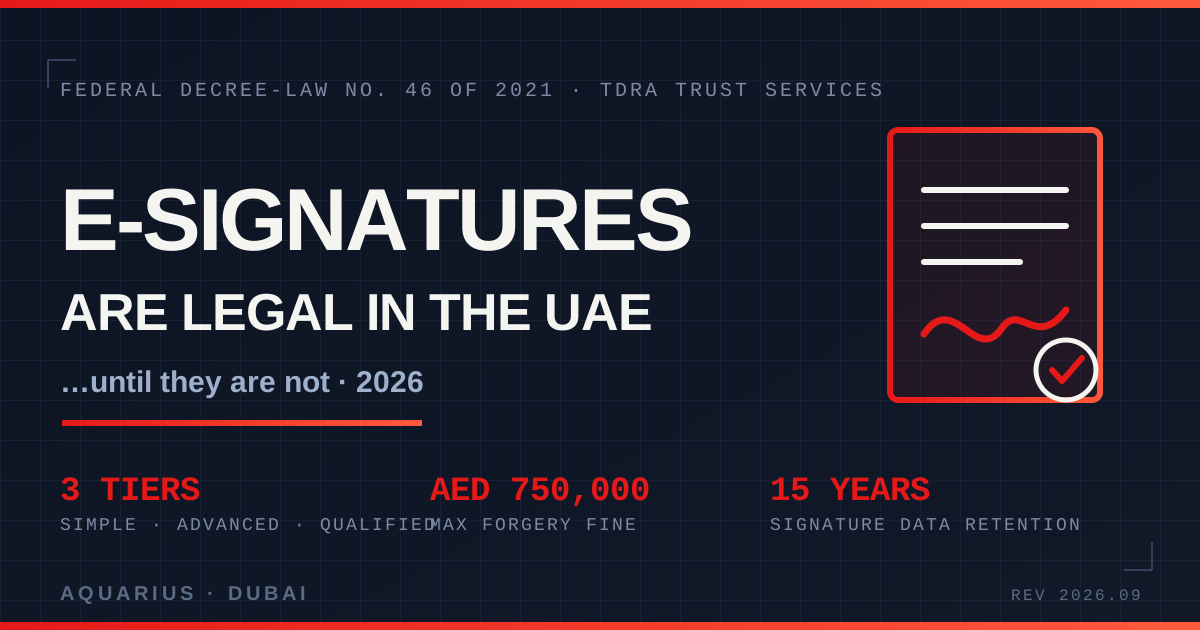
Short answer: Yes. Under Federal Decree-Law No. 46 of 2021 on Electronic Transactions and Trust Services, an electronic contract does not lose validity, evidential weight or enforceability merely because it is electronic, and e-signatures are admissible in UAE courts. But the law recognises three different tiers of signature — simple, advanced and qualified — and only the top tier carries the weight of a wet-ink signature for high-value or regulated documents. A short list of instruments, including powers of attorney and wills, still cannot be signed electronically at all. Forging an electronic signature or certificate carries imprisonment and a fine of AED 100,000 to AED 300,000, rising to AED 150,000 to AED 750,000 where a government authority is involved.
Key takeaways
- The enabling law is federal and settled. Federal Decree-Law No. 46 of 2021, published 20 September 2021, replaced the 2006 e-commerce law. Cabinet Resolution No. 28 of 2023, published 14 April 2023, supplies the executive regulations — so unlike UAE PDPL, this framework is not waiting on anything.
- Tier matters more than the tool. A typed name, a drawn squiggle and a TDRA-certified qualified signature are all "e-signatures" under the law, but they are not equally defensible when the counterparty denies signing.
- UAE Pass is the shortcut to the top tier. It is used by over 10 million people, reaches 5,000+ public and private services, and has carried 600 million-plus logins. Its signing service issues a qualified electronic signature.
- Some documents are still paper. The creation, performance or enforcement of a power of attorney, and the creation and execution of wills, codicils and testamentary trusts, are carved out of the federal regime.
- Signature data must be retained for at least 15 years. That is an architecture decision, not a policy PDF — it dictates where you store the audit trail on day one.
TOFU: the UAE already runs on signatures nobody printed
Dubai finished this argument years before most businesses noticed. The Dubai Paperless Strategy, launched in 2018, was declared complete in December 2021, making Dubai the world's first paperless government. The published results: paper consumption cut by more than 336 million sheets, more than AED 1.3 billion and over 14 million man hours saved, across 45 government entities delivering 1,800-plus digital services and more than 10,500 key transactions. No Dubai Government employee or customer needs to print anything unless they personally want to.
The identity layer caught up just as fast. UAE Pass now serves more than 10 million users — TDRA has reported over 11 million registrations — spanning over 5,000 public and private sector services, with 600 million-plus logins recorded and over 2.6 billion digital transactions carried out across integrated institutions. Adoption of digital signing itself has compounded: UAE digital signature usage has been reported up 216% since 2023.
So here is the uncomfortable gap. Your customer can authenticate with a government-grade digital identity on their phone in four seconds, then reach your onboarding form and be told to print, sign, scan and email a PDF back. Every Dubai business that still does this is paying a conversion tax on a problem the country solved.
MOFU: the three tiers, and which one your document actually needs
This is where most Dubai businesses get it wrong. They ask "are e-signatures legal here?", hear "yes", and then paste a typed-name field into a AED 2 million supply agreement. The federal law recognises a hierarchy, and the tier you choose is a risk decision about what happens when someone disputes the signature two years later.
| Tier | What it is | Typical evidence trail | Use it for |
|---|---|---|---|
| Simple electronic signature | Any electronic procedure showing acceptance — a typed name, a checkbox, a scanned handwritten signature, a click-to-agree. | IP address, timestamp, email trail. Weakest under challenge. | Low-risk, low-value, high-volume: terms of service, internal approvals, delivery confirmations. |
| Advanced electronic signature | Signature linked to the signatory using authentication factors such as verified email, OTP or PIN, with tamper-evidence on the document. | Authentication log, document hash, sealed audit certificate. | Commercial contracts, vendor agreements, employment offers, NDAs, quotations. |
| Qualified electronic signature | Certificate-based, created on an approved qualified signature creation device, with an authentication certificate issued by a qualified trust service provider on the TDRA Trusted List. | Cryptographic certificate identifying issuer and signatory, validity data, long-term validation. | Regulated filings, corporate resolutions, MOAs, banking and government submissions, anything high value or contested. |
For a qualified signature the law is specific about the plumbing: reliable encryption preserving data integrity, creation on an approved device, an authentication certificate identifying both issuer and signatory along with its validity details, issuance by a qualified trust service provider, conformity assessment by approved bodies, and retention of the signature data for a minimum of 15 years. The TDRA regulates this, licenses providers and publishes the UAE Trusted List of trust service providers, their services and licence status, alongside the list of approved qualified signature and seal creation devices. If your vendor is not traceable to that list, you do not have a qualified signature — you have a nicely designed advanced one.
Evidence: what a UAE court will actually accept
Electronic documents, signatures, seals and transactions are admissible as evidence in legal proceedings regardless of being electronic, and official electronic documents printed as hard copies are treated as conclusive evidence. The practical consequence for your build: the signed PDF is not the evidence. The audit trail is — who authenticated, by what method, from where, at what timestamp, against which document hash. Store it immutably and separately from the document, and keep it for the full retention window.
The exceptions: documents that still need wet ink
Do not let a product manager promise "everything gets signed in-app." The federal regime carves out the creation, performance or enforcement of a power of attorney, and the creation and execution of wills, codicils and testamentary trusts. Anything requiring notarisation before a notary public should be treated as wet-ink by default, and free-zone rules diverge: ADGM's Electronic Transactions Regulations 2021 additionally exclude, among others, dispositions of immovable property and leases of more than ten years, declarations of trust, and affidavits used as court evidence, while DIFC runs its own Electronic Transactions Law No. 2 of 2017 — and the DIFC Wills Service Centre has moved to permit e-signed DIFC wills. Three jurisdictions, three rulebooks, one product. Your signing flow needs a document-type switch, not a single global toggle.
The penalty clause your legal team will ask about
Forging, or participating in forging, an electronic document, signature, seal, authentication certificate or qualified trust service is punishable by imprisonment and/or a fine of AED 100,000 to AED 300,000. Where the forgery relates to a public or governmental authority, it becomes temporary imprisonment and a fine of AED 150,000 to AED 750,000. That is the number that should drive your identity verification design — a signing flow with weak identity proofing is not just a commercial risk, it is an invitation to a criminal dispute you will be dragged into as the platform operator.
MOFU: buy a platform, or build signing into your product?
Most Dubai businesses face this fork once their volume passes a few hundred documents a year. The honest answer depends on whether signing is an internal admin task or part of your customer experience.
Off-the-shelf platforms are the right call for internal contract flows. Published 2026 pricing puts DocuSign Standard around USD 30 per user per month with a 100-envelope cap, while Adobe Acrobat Standard for Teams sits near USD 14.99 and Acrobat Pro for Teams near USD 23.99 per user per month, with team plans capped around 150 transactions per user per year. Converted, a ten-seat DocuSign Standard deployment lands near AED 13,200 per year before overage — predictable, and it buys you nothing in brand or workflow control.
Embedded signing via API is the right call when the signature is part of your product: a tenancy renewal inside a property portal, a treatment consent form inside a clinic app, a merchant agreement inside a marketplace onboarding flow. Embedded e-signature API pricing in 2026 spans an enormous range — from roughly USD 0.50 per document at the budget end to around USD 25 per envelope at the enterprise end — so per-document economics, not sticker price, decide the winner at volume.
| Approach | What you get | Typical Aquarius build range (AED) |
|---|---|---|
| Embedded advanced signing in an existing app | OTP or verified-email signer identity, tamper-evident document hash, audit trail, signed-copy delivery, admin dashboard. | 12,000 – 30,000 |
| UAE Pass-integrated qualified signing | UAE Pass authentication plus qualified signature, Emirates ID-verified signer, certificate validation, 15-year audit retention. | 35,000 – 90,000 |
| Full contract lifecycle module | Templates, dynamic fields, multi-party sequential signing, approvals, reminders, versioning, CRM/ERP sync, bilingual EN/AR documents. | 90,000 – 250,000 |
One Dubai-specific requirement people forget until QA: bilingual documents. If your Arabic contract renders right-to-left in the browser but left-to-right in the generated PDF, you have shipped a document that looks unserious to half your market. Get the PDF rendering pipeline right early — the same discipline we apply across every build.
BOFU: what this is worth, and how we implement it
The commercial case does not rest on printer toner. It rests on the days a signature spends in transit. Dubai Government removed 336 million sheets and 14 million man hours from its own operations by closing exactly this loop; a mid-sized UAE firm moving contracts off paper can reasonably expect to save on the order of AED 50,000 a year in printing and courier costs alone, before counting the deals that close faster because nobody waited for a scanner. Against an AED 35,000 – 90,000 qualified-signing build, the payback conversation is short.
How we approach it at Aquarius:
- Document inventory first. We map every document type you sign, assign each a required tier, and flag the wet-ink exceptions before a line of code is written. This is the step that prevents an expensive rebuild.
- Identity proportional to risk. Simple click-accept for terms; OTP-verified advanced signatures for commercial contracts; UAE Pass for anything regulated or high value — which also gives you an Emirates ID-verified signer identity for free. We cover the integration mechanics in our UAE Pass integration guide.
- Audit trail as a first-class record. Immutable, separately stored, retained for the statutory 15 years, exportable as a signature certificate on demand.
- PDPL-aligned by construction. Signing captures Emirates ID data, contact details and often location — all personal data. Consent, retention limits and data subject rights belong in the same sprint, per our UAE PDPL compliance checklist.
- Vendor traceability. Where a qualified signature is required, we select providers traceable to the TDRA Trusted List and document that choice in your compliance file.
Most Dubai businesses get this wrong in one specific way: they treat e-signing as a procurement decision when it is an evidence-architecture decision. The tool is the easy part. Proving, two years and one dispute later, exactly who signed what and how they were identified — that is the part you build once and cannot retrofit.
FAQ
Is a typed name or a scanned signature legally valid in the UAE?
It qualifies as an electronic signature and is admissible, but it sits in the weakest tier. For a low-value, low-risk document that is usually acceptable. For a contract someone might realistically dispute, it puts the burden of proving identity squarely on you, with a thin evidence trail to do it with.
Do I need a qualified electronic signature for ordinary commercial contracts?
Usually not. An advanced electronic signature with verified signer identity and a tamper-evident audit trail is the practical standard for commercial agreements. Reserve qualified signatures for regulated filings, corporate instruments, government submissions and high-value transactions.
Can I sign a power of attorney electronically in the UAE?
No. The creation, performance and enforcement of a power of attorney is excluded from the federal electronic transactions regime, as are wills, codicils and testamentary trusts. Documents requiring notarisation before a notary public should be treated as wet-ink by default.
Does UAE Pass count as a qualified electronic signature?
Yes. UAE Pass signing operates as a qualified electronic signature under Federal Decree-Law No. 46 of 2021, which is why authorised signatories can execute contracts and regulatory filings through it without a courier or a notary visit.
How long do I have to keep e-signature records?
Signature data must be securely retained for a minimum of 15 years to prevent unauthorised use. Design your storage, backup and export strategy around that horizon rather than your usual application retention policy.
Are DIFC and ADGM rules the same as onshore UAE?
No. DIFC applies its Electronic Transactions Law No. 2 of 2017 and ADGM applies its Electronic Transactions Regulations 2021, each with its own exclusion list. If you serve counterparties across all three jurisdictions, your signing flow needs jurisdiction-aware rules rather than one global setting.
Ready to take signatures off paper?
We build signing into Dubai products — UAE Pass authentication, tiered signature logic, bilingual documents and audit trails engineered to survive a dispute. Tell us which documents you sign most and we will tell you which tier each one needs and what it costs. Talk to Aquarius, or see our transparent AED pricing.
This article is general information about UAE digital infrastructure requirements, not legal advice. Confirm document-specific requirements with qualified UAE counsel before relying on an electronic signature for a material transaction.