
UAE PASS Integration for Apps & Websites in Dubai (2026): OAuth Login, SOP Levels, Digital Signature & Real Build Cost
How to add UAE PASS login and digital signature to a Dubai app or website in 2026 — the OAuth flow, SOP1/2/3 verification levels, the service-provider onboarding steps, and real AED build cost.
- PUBLISHED
- 12 SEPT 2026
- READ TIME
- 12 MIN
- AUTHOR
- AQUARIUS · DUBAI
- UNIT
- REV 2026.09
Short answer: Adding UAE PASS to a Dubai app or website means registering as a UAE PASS service provider, implementing the OAuth 2.0 authorization-code flow with a backend token exchange, and choosing the right SOP verification level (SOP1 basic, SOP2 Emirates ID verified, SOP3 biometric). A clean login-only integration is typically an AED 18,000–45,000 add-on; login plus digital signature or data-sharing runs AED 60,000–150,000+. Budget 3–8 weeks including UAE PASS onboarding and production approval.
Key takeaways
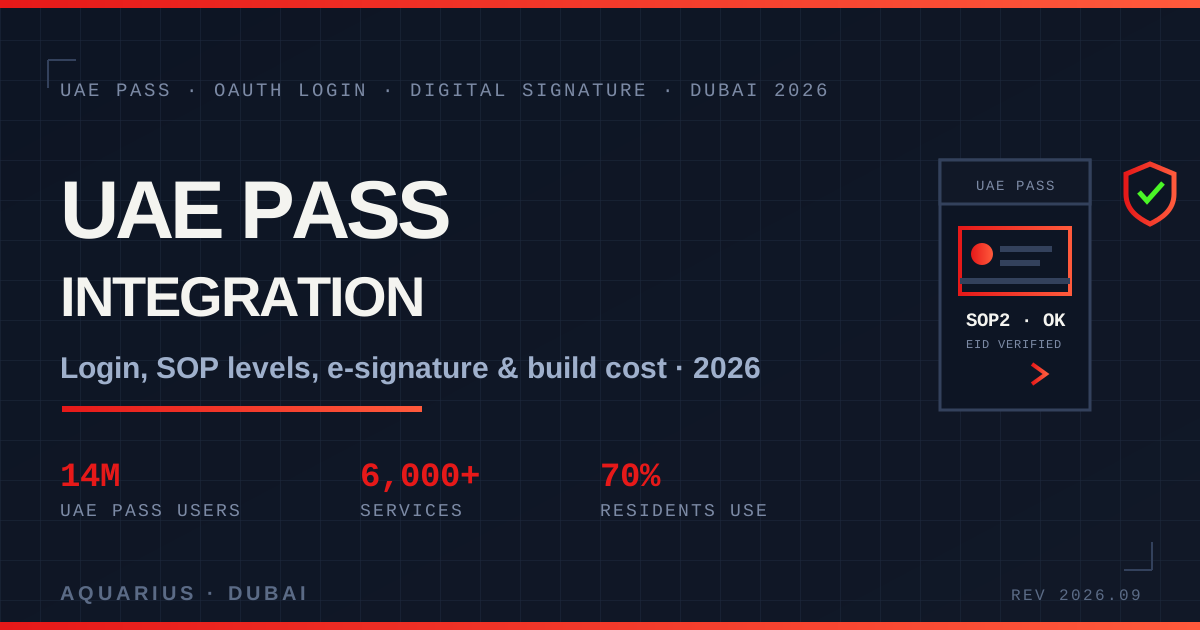
- UAE PASS passed 14 million users in 2026 and is accepted by 6,000+ services — roughly 70% of UAE residents use it for government transactions.
- You must be a UAE-licensed entity (valid trade licence) and register as a service provider — Government or Private — before you get sandbox credentials.
- The client-secret token exchange must happen server-side. Doing it in client-side JavaScript is the single most common security-review failure.
- Ask for the lowest SOP level your use case needs. Over-requesting SOP is the top cause of production-approval delays.
Why UAE PASS is now table stakes in Dubai (the awareness case)
UAE PASS is the country's single national digital identity — one login, one signature, one verified profile across government and private platforms. In 2026 it crossed 14 million users and now unlocks more than 6,000 services, having processed over 2.6 billion digital transactions. About 70% of UAE residents use it for government dealings, and the World Economic Forum named it a global benchmark for digital identity.
For a Dubai business, that changes the maths on your sign-up screen. When a resident already has a verified UAE PASS identity in their pocket, asking them to key in a name, upload an Emirates ID photo and wait for manual review is friction you no longer need. UAE PASS login collapses onboarding to a couple of taps and returns a verified Emirates ID number, name and nationality — which is why fintech, property, insurance, healthcare and government-adjacent apps now treat it as a default, not a nice-to-have.
How UAE PASS integration actually works (the consideration layer)
Under the hood UAE PASS is standard OpenID Connect / OAuth 2.0 — the authorization-code flow. The six moving parts:
- Redirect to authorize — your app sends the user to the UAE PASS authorization endpoint with your client ID, scope, requested SOP level, redirect URI and a
statevalue. - User authenticates in the UAE PASS app or web flow (password, OTP or biometric). Your app never sees the credentials.
- Authorization code returns to your registered redirect URI, with the
stateechoed back. - Token exchange — your backend calls the token endpoint with your client secret. This must never run in browser JavaScript.
- ID token validation — verify the signature against UAE PASS's published keys, plus issuer, audience and expiry.
- Profile retrieval — your backend calls the user-info endpoint for identity attributes (name, Emirates ID number, nationality and more, depending on scope).
Mobile apps usually use the UAE PASS SDK so the flow launches the native UAE PASS app directly; web apps use the browser redirect. Either way, PKCE is recommended, and you encrypt sensitive fields (the Emirates ID number especially) at rest.
SOP levels — pick the lowest one that fits
UAE PASS grades assurance in three tiers. The level you request shapes both your approval path and your user's friction, so choose deliberately.
| SOP level | What it proves | Typical use cases |
|---|---|---|
| SOP1 | Basic identity, no Emirates ID verification | Portal access, information services, non-regulated apps |
| SOP2 | Emirates ID verified identity | Most production apps: banking/fintech onboarding, insurance, property platforms |
| SOP3 | SOP2 + biometric confirmation | High-value transactions, legal authorizations, document signing |
Beyond login, UAE PASS also offers digital signature, e-Seal, hash signing and data-sharing authorization — each a separate feature you declare during onboarding. If you need legally signed PDFs or contracts inside your product, that's the digital-signature module, and it lifts both scope and cost. Pair it with a solid PDPL data-handling setup so the verified data you receive is stored lawfully.
Onboarding, timelines and build cost (the decision layer)
You can't just download an SDK and ship. UAE PASS onboarding runs in phases, and you must be a licensed UAE entity to start:
- Initiation — submit a request via the Developer Portal, declare Government or Private, and (for private entities) provide a valid UAE trade licence. You fill feature questionnaires (authentication, digital signature, e-Seal, hash signing, data sharing), plus workflow diagrams and UI mockups of the user journey.
- Development — you receive staging credentials, build against the sandbox, and sign the Service Provider Agreement (SPA) or MOU.
- Production — a four-stage review: SOP-level justification, security review (token handling, encryption, validation), production domain verification, and a user-journey/branding check against UAE PASS guidelines.
The friction points are predictable: mismatched redirect URIs (scheme, ports and trailing slashes must match exactly), requesting a higher SOP than the use case warrants, and skipping ID-token signature validation. Get those right up front and approval is smooth.
What it costs to build in Dubai (AED)
UAE PASS itself has no per-login fee for standard authentication — the cost is engineering and onboarding. Realistic 2026 ranges for the integration work:
| Scope | Indicative build cost (AED) | Timeline |
|---|---|---|
| Login only (SOP1/SOP2), single platform | 18,000 – 45,000 | 2–4 weeks |
| Login + verified profile + data sharing | 45,000 – 90,000 | 4–6 weeks |
| Login + digital signature / e-Seal (SOP3) | 90,000 – 150,000+ | 6–10 weeks |
| Web + mobile SDK + backend, full stack | 120,000 – 250,000+ | 8–14 weeks |
Timelines include UAE PASS's own onboarding and production approval, which you don't control — one reason we start the service-provider request on day one, in parallel with the build. See our development services and fixed AED pricing for how this slots into a wider app or platform.
How Aquarius does it
We treat UAE PASS as a self-contained module: backend token exchange behind your API, ID-token validation done properly, Emirates ID stored encrypted, the lowest viable SOP requested, and every redirect URI pre-registered per environment. We kick off the service-provider onboarding on day one so the paperwork runs while we build against the sandbox — then hand over full code, no lock-in. It's the same discipline we apply to a full e-wallet or neobank build.
The cost of not doing it: with 14 million residents already carrying a verified identity, a Dubai product that still forces manual sign-up is bleeding conversions at the exact moment a competitor offers one-tap UAE PASS login. Onboarding friction is where high-intent users quietly drop off.
FAQ
Do I need a UAE trade licence to use UAE PASS?
Yes. Private entities must provide a valid UAE trade licence to register as a service provider. There's no self-serve public API for un-licensed developers.
Can I do the whole flow in the browser?
No. The token exchange uses your client secret and must run server-side. A client-side exchange will fail the security review and exposes your secret.
Which SOP level should I request?
The lowest that satisfies your use case. SOP1 for basic access, SOP2 for verified onboarding (most apps), SOP3 only when you need biometric assurance or document signing. Over-requesting is the top cause of approval delays.
Can UAE PASS sign documents, not just log users in?
Yes — it offers digital signature, e-Seal and hash signing as separate features you declare during onboarding. These need SOP3 and add to scope and cost.
How long does the whole thing take?
A login-only integration is often live in 2–4 weeks of engineering, but total calendar time depends on UAE PASS onboarding and the four-stage production review — plan for 3–8 weeks end to end and start onboarding immediately.
Bottom line
UAE PASS is no longer optional infrastructure in Dubai — 14 million users, 6,000+ services and 70% resident adoption make one-tap verified login a conversion advantage. The engineering is standard OAuth done carefully; the real work is choosing the right SOP, passing the security review, and running onboarding in parallel with the build. Want it scoped in AED for your app? Talk to Aquarius.