
Owners Association and Service Charge Software in Dubai (2026): Mollak Is the Product, Not a Plugin
RERA audits over AED 4 billion of service charges through Mollak, and no invoice is legal until RERA approves the budget. What OA software must do in 2026, and what it costs in AED.
- PUBLISHED
- 23 SEPT 2026
- READ TIME
- 11 MIN
- AUTHOR
- AQUARIUS · DUBAI
- UNIT
- REV 2026.09
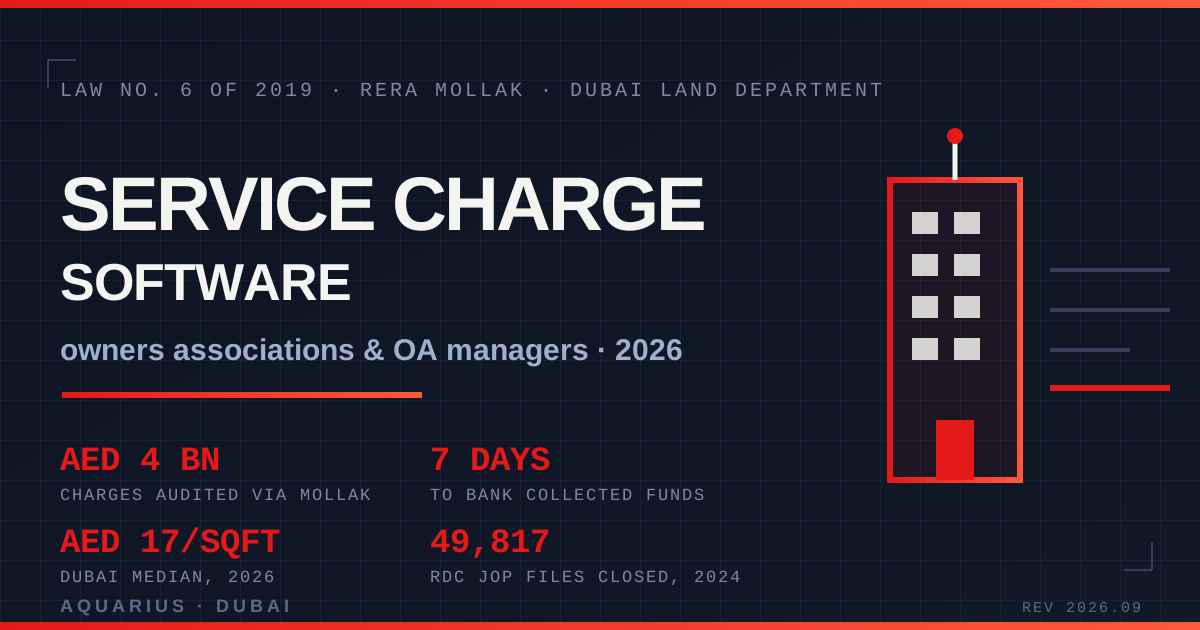
Short answer: In Dubai, owners association software is not a billing app with a Dubai flag on it. Under Law No. 6 of 2019, a management entity cannot charge a single dirham of service charge until RERA has approved the budget, and that approval only happens after a RERA-recognised audit firm has signed it off. Every invoice, receipt, owner record and legal notice has to reconcile with Mollak, the Dubai Land Department platform through which RERA expected to audit more than AED 4 billion of service charges. If your platform cannot sync with Mollak and cannot prove where the money sits, it is not OA software. It is a spreadsheet with a login page.
That distinction is expensive. Most community management tools sold into Dubai were built for markets where the association sets its own budget, invoices whoever it likes, and banks the cash wherever it wants. None of those three things are true here, and the gap usually surfaces in the worst possible place: an audit season where the numbers in your system do not match the numbers RERA holds.
The numbers that set the stakes
Dubai recorded more than AED 286 billion in real estate sales across more than 86,000 transactions in the first half of 2026, its second-strongest half-year on record. Residential alone accounted for 79,281 sales worth AED 221.4 billion. Every one of those units in a jointly owned development lands, eventually, in someone's service charge ledger.
The scale of that ledger is what people miss. When Mollak went live in 2019 RERA had already onboarded 1,212 real estate projects, 88 management companies, around 200,000 units and 468 service charge bank accounts, with seven banks acting as account trustees and eight registered financial auditors. Dubai Land Department expected the service charges flowing through the system to exceed AED 4 billion. Seven years of handovers later, that base has only grown.
And the enforcement side is not theoretical. Dubai's Rental Disputes Center closed 49,817 execution files related to jointly owned properties in 2024. In October 2025 it went further, establishing that a buyer named in the preliminary register is liable for service fees from the date of project completion, even where handover has not formally happened because the buyer defaulted. It also launched a self-execution service so management companies can file service fee claims directly.
Most Dubai OA managers get this backwards. They buy software to send invoices faster. The constraint is not sending invoices. The constraint is that an invoice has no legal standing until RERA approves the budget behind it.
What Law No. 6 of 2019 actually requires of your system
Strip away the marketing and the compliance surface is a short list of hard rules. Any platform you build or buy has to enforce them, not merely record them.
| Requirement | Source | What the software must do |
|---|---|---|
| No charging without RERA approval | Article 27(a) | Block invoice generation against any budget not in an approved state |
| Budget must pass a RERA-recognised audit firm first | Article 27(b) | Audit workflow, versioned budgets, locked prior-year actuals |
| Dedicated service charge account at a RERA-recognised bank | Article 30(a) | Per-project account mapping, reconciliation against bank statements |
| Reserve fund held separately, no withdrawal without RERA approval | Article 30(e)(8) | Segregated reserve ledger with an approval gate on every drawdown |
| Collected charges banked within 7 working days | Mollak operating rules | Receipt date tracking and an aging alert before the deadline |
| Owner share by unit area ratio | Article 25 | Area-weighted apportionment recalculated on every title change |
| 30-day notice before enforcement at the RDC | Article 32(b) | Dated legal notice generation with an auditable service trail |
| Court may order sale of the unit by public auction | Article 32(c) | Arrears escalation states tied to notice evidence |
Read that table as a data model, not a checklist. Every row is a state machine your system has to own: budget states, approval states, notice states, reserve fund states. Software that treats these as free-text fields on an invoice will pass a demo and fail an audit.
Mollak integration: the part vendors quietly skip
Management companies can key everything into the Mollak portal by hand. At a few hundred units that is merely painful. Past a couple of thousand units across several towers, manual entry is where reconciliation breaks and where audit findings come from. That is why Dubai Land Department exposes Mollak through its API gateway, and why serious OA platforms sync rather than retype.
The integration surface is broadly these endpoints:
- Budget Sync - push the annual service charge budget and pull its approval state.
- Invoice Sync - keep issued service charge invoices identical to the official record.
- Receipt Sync - two-way exchange of payment receipts so collections reconcile.
- Owner Sync - update ownership after every sale, transfer or restructuring.
- Community Tenants - pull tenant records for access, work orders and notices.
- Additional Invoice - exceptional billing such as emergency repairs and special levies.
- Legal Notice - formal arrears recovery documentation with a compliance trail.
- Virtual Account - bank-side integration so incoming payments auto-match to units.
Three prerequisites catch teams out, and all three are commercial rather than technical. The company needs the correct DET trade licence activity for jointly owned property management. The company and the individuals practising the activity must be registered with RERA, with personal registration cards. And a software vendor cannot obtain production Mollak access on its own - access is granted through association with a RERA-licensed JOP management company. Where the invoicing module is in scope, FTA accreditation of the accounting software matters too. Validate all of this before a line of integration code is written; discovering it in week six is how a schedule slips a quarter.
What it costs in AED
Context first, because the buying decision is really about portfolio size. The UAE property management software market was worth about USD 68.2 million in 2023 and is forecast to reach roughly USD 112.3 million by 2030 at around 7.5% annual growth - a real but small market, which is why so few off-the-shelf products bother with deep Mollak work. Meanwhile the 2026 Dubai service charge picture runs from about AED 3 to over AED 70 per square foot, with a median near AED 17; JVC and Dubai Sports City sit around AED 11-15, Downtown and Palm Jumeirah commonly AED 25-35.
Against that, here is what the software side actually costs in Dubai in 2026.
| Option | Typical AED | Best for |
|---|---|---|
| Off-the-shelf OAM SaaS, per unit per year | 25 - 90 | Under ~2,000 units, standard towers |
| Focused Mollak integration onto an existing finance stack | from 80,000 | You already run ERP or accounting you like |
| Custom OA platform, core build (billing, owners, arrears, reserve fund) | 150,000 - 320,000 | Multi-building managers, 2,000+ units |
| Owner portal and mobile app on top | 70,000 - 160,000 | Self-service payments, statements, requests |
| Work orders, CAFM and contractor SLAs module | 60,000 - 140,000 | Managers running maintenance in-house |
| Annual run: hosting, support, regulatory changes | 15-20% of build | Everyone. Budget it from day one |
The honest comparison is not licence versus build. It is licence plus the finance headcount a weak system forces you to keep, versus build plus its run cost. Vendors in this space report collection improvements in the region of a third once billing and reminders are automated end to end - treat that as a vendor figure rather than gospel, but it points at the right lever. On a 2,000-unit portfolio at AED 17 per square foot across roughly 1,000 square foot units, a single percentage point of collection is worth around AED 340,000 a year. That is the number that funds the project, not the licence saving.
The VAT trap sitting inside your invoice template
Managing jointly owned real property is a taxable supply of services subject to 5% VAT, and the registration threshold is AED 375,000 of taxable turnover. The Federal Tax Authority's clarification for real estate management entities moved the obligation in a way many systems never caught up with: the management entity registers and accounts for VAT on service charges, rather than the owners association itself, and recovers input tax on the goods and services it buys to run the property under Article 54(1)(a) of the VAT Decree-Law.
In software terms that is not a checkbox. It is a TRN on the correct legal entity, tax-correct invoice layouts, input tax coded against the right property, and a clean trail from supplier invoice to recoverable claim. Getting this wrong is not an accounting inconvenience - it is a restatement across every unit you billed. If you are also planning for the UAE's phased e-invoicing rollout, build the invoice engine once, properly: see our note on VAT-compliant invoicing and UAE e-invoicing.
Where OA software projects go wrong in Dubai
- Building the owner portal first. It demos well and it is the wrong order. If billing accuracy is not settled, the portal just publishes wrong numbers to thousands of owners at once.
- Modelling one community. Dubai managers grow by winning buildings. A schema that assumes a single project has to be rewritten at building number three.
- Treating the reserve fund as another ledger line. It is legally segregated and drawdowns need RERA approval. Model it as a controlled account with its own approval workflow.
- Hardcoding Mollak endpoints. Wrap them in a service layer. Government integrations change, and you do not want a redeploy of your billing core every time they do.
- No evidence trail on notices. The 30-day notice is the gate to enforcement at the RDC. If the system cannot prove what was served and when, the arrears case starts on the back foot.
- Ignoring Arabic. Notices, statements and portals serving Dubai owners need proper Arabic and right-to-left handling, not a translation plugin bolted on at the end.
How Aquarius builds this
We start with the parts that are legally load-bearing: the budget and approval state machine, area-weighted apportionment that survives title changes, the segregated reserve fund with an approval gate, receipt reconciliation against the trustee bank account inside the seven working day window, and a notice engine with a tamper-evident trail. Mollak sync sits behind an abstraction layer so endpoint changes are a config problem, not a rebuild. Owner portal, payments and mobile come after the ledger is provably right, because that order is the difference between a launch and a recall.
Consider the cost of not doing it. Arrears in Dubai do not just sit there - they block the clearance an owner needs to sell or lease, they end up as execution files at the Rental Disputes Center, and in the meantime the building still has to pay for chillers, lifts, insurance and the facade reserve. Against nearly 50,000 jointly owned property execution files closed in a single year, a system that gets notices out correctly and on time is not administrative overhead. It is the collection engine.
See our pricing, browse what we build, or send us your portfolio size and building count and we will come back within two working days with a scoped Mollak-ready build plan and a fixed AED range.
FAQ: owners association software and Mollak in Dubai
Is Mollak registration mandatory for jointly owned property in Dubai?
Yes. Jointly owned developments in Dubai - apartment towers, townhouse communities and mixed-use projects with shared common areas - are administered through Mollak, and under Article 27(a) of Law No. 6 of 2019 a management entity cannot charge owners without RERA approval obtained through it.
Can our software connect to Mollak directly?
Through the Dubai Land Department API gateway, yes - but production access is granted in association with a RERA-licensed jointly owned property management company. A software vendor cannot obtain it independently, so confirm the licensing chain before scoping the integration.
How much does owners association software cost in Dubai?
Off-the-shelf OAM platforms typically run AED 25-90 per unit per year. A focused Mollak integration onto an existing finance stack starts around AED 80,000. A custom multi-building platform is usually AED 150,000-320,000 for the core, plus 15-20% a year to run.
Who charges VAT on service charges - the association or the manager?
Managing jointly owned property is a taxable supply at 5%, and the FTA's clarification places the registration and accounting obligation on the real estate management entity rather than the owners association. The entity also recovers input tax on qualifying costs under Article 54(1)(a).
What happens when an owner does not pay?
The management entity serves a notice, and under Article 32(b) enforcement at the Rental Disputes Center follows a 30-day period. Arrears block the clearance needed to sell or lease the unit, and Article 32(c) allows a court to order sale of the unit by public auction. The Rental Disputes Center closed 49,817 jointly owned property execution files in 2024.
Do we still need a separate CAFM system?
Not necessarily. Financial compliance and maintenance are different problems, but they share assets, buildings and contractors. Many Dubai managers run one platform with a work order module rather than two systems that disagree about which chiller belongs to which tower - see our breakdown of facility management and CAFM software in Dubai.
Related reading: real estate CRM software in Dubai, RERA and Trakheesi rules for property websites, and short-term rental and holiday homes software.