
Email Deliverability in Dubai (2026): Why Your Invoices Land in Spam and What SPF, DKIM and DMARC Cost
Only 1.11% of UAE domains publish a DMARC record, and since November 2025 Gmail rejects non-compliant bulk mail outright. Why Dubai business email lands in spam in 2026 and what fixing it costs in AED.
- PUBLISHED
- 08 OCT 2026
- READ TIME
- 12 MIN
- AUTHOR
- AQUARIUS · DUBAI
- UNIT
- REV 2026.09
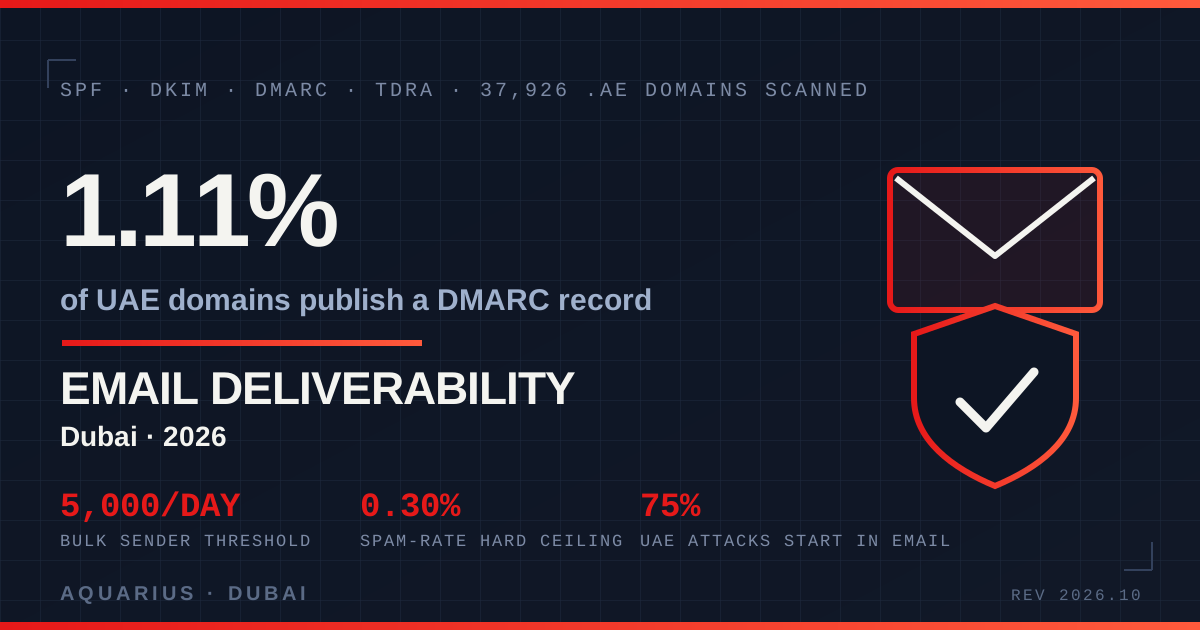
Short answer: Dubai business email lands in spam because the domain is missing authentication, not because the copy is bad. Gmail, Yahoo and Outlook now require SPF and DKIM passing, a DMARC record aligned to one of them, RFC 8058 one-click unsubscribe, and a spam-complaint rate under 0.30% from any domain sending 5,000 or more messages a day to personal inboxes — and since November 2025 Gmail enforces that with 5xx rejections at the SMTP level, not a spam folder. Fixing it in Dubai costs roughly AED 3,500–9,000 for an audit and AED 9,000–28,000 to roll SPF, DKIM and DMARC to full enforcement across every system that sends on your behalf. The uncomfortable part: only 1.11% of UAE domains have a DMARC record at all.
Key takeaways
- The UAE is a near-blank map. A scan of 37,926 .ae domains found just 1.11% — 420 domains — publishing a DMARC record. India sits at 46%, Germany at 4.55%.
- Enforcement is already live. Gmail moved to temporary and permanent SMTP rejections in November 2025. Microsoft started junking, then rejecting, non-compliant high-volume mail to Outlook.com, Hotmail.com and Live.com on 5 May 2025.
- Email is the attack surface, not just a channel. The UAE Cyber Security Council says more than 75% of cyberattacks in the UAE start with a phishing email or fraudulent message, against a backdrop of 3.4 billion phishing messages sent globally every day.
- Deliverability is a DNS job, not a mailing-list job. It breaks invoices, OTPs, quotations and Ejari paperwork long before it breaks the newsletter — and your email platform cannot fix your DNS for you.
- There is a UAE layer on top. TDRA's Unsolicited Electronic Communications policy covers marketing email with a UAE link, and the PDPL requires documented prior opt-in consent for direct marketing.
Dubai runs on email, and almost nobody here has secured the domain
Start with the three numbers that set the stakes, because each one is independently verifiable and together they describe a gap nobody budgeted for.
- 1.11% DMARC adoption. EasyDMARC's analysis of 37,926 .ae domains found only 420 with a DMARC record. Of that small group, 40.24% sit at p=none — monitoring only, no protection — 29.29% at p=quarantine and 30.48% at p=reject. Do the arithmetic and roughly one UAE domain in 300 is actually enforcing an anti-spoofing policy.
- 75% of UAE cyberattacks begin in the inbox. The UAE Cyber Security Council, in a statement to Emirates News Agency in April 2026, put more than 75% of cyberattacks in the country as starting with a phishing email or fraudulent message. Security vendor Illumio attributes over 90% of digital breaches in the UAE to AI-assisted phishing, with phishing incidents up 32% in Q1 2026.
- Preparedness is thin. A QBE study found 21% of UAE organisations hit by an AI-linked cyber incident in the past twelve months, while 31% carry no cyber insurance and 27% have no incident response plan.
Here is what most Dubai businesses get wrong. They treat deliverability as a marketing problem and hand it to whoever owns the newsletter. It is a DNS and infrastructure problem that lives on your domain, and it fails in the order that hurts most: the newsletter is the last thing to break. What breaks first is the quiet, high-value mail — the VAT invoice from your accounting system, the OTP from your app, the quotation from your CRM, the tenancy document from your property platform. Those come from third-party systems sending as your domain, which is exactly the pattern SPF, DKIM and DMARC are designed to police. Get the records wrong and you do not get a bounce report; you get a finance team wondering why a client "never received" an invoice, and a WhatsApp follow-up culture that papers over it.
The other half of the myth is that this is somebody else's threshold. The 5,000-a-day bulk rule reads like it only applies to retailers with huge lists. In practice a mid-size Dubai company with an ERP, a CRM, a help desk, a booking engine and a marketing tool is already sending from five different services under one domain, and the providers count the domain, not the tool. A single unauthenticated service is enough to fail alignment for all of them.
What Gmail, Yahoo and Outlook actually require in 2026
The rules are now published, specific and machine-checked. There is no negotiation and no allowlist to apply for. This is the live state of play.
| Requirement | All senders | Bulk senders (5,000+/day) |
|---|---|---|
| SPF or DKIM | At least one, passing | Both configured and passing |
| DMARC record | Recommended | Mandatory, minimum p=none, aligned to SPF or DKIM |
| Valid reverse DNS (PTR) and MX | Required | Required |
| TLS-encrypted transmission | Required | Required |
| Spam-complaint rate | Keep under 0.10% | Under 0.10% target, 0.30% is the rejection ceiling |
| One-click unsubscribe (RFC 8058) | Good practice | Mandatory on marketing mail, plus a visible link in the body |
| Honouring an unsubscribe | Promptly | Within two days |
| From and display name | Accurate, not misleading | Accurate, no Gmail header impersonation |
The enforcement timeline matters more than the checklist, because it explains why a setup that worked in 2024 fails now:
- October 2023 — Google and Yahoo announce the requirements.
- February 2024 — rules take effect with soft enforcement.
- April 2024 — Google begins rejecting some non-compliant traffic.
- June 2024 — one-click unsubscribe becomes mandatory on marketing mail.
- 5 May 2025 — Microsoft enforces SPF, DKIM and DMARC for senders above 5,000 messages a day to Outlook.com, Hotmail.com and Live.com. Non-compliant mail is routed to Junk, then not delivered at all.
- October 2025 — Google retires legacy Postmaster Tools and launches v2 with a binary compliance status. You are either compliant or you are not; there is no partial credit to argue about.
- November 2025 — Gmail shifts to hard enforcement. Mail that fails authentication or sustains a 0.30%+ spam rate receives 5xx permanent rejections at the SMTP level.
Two details save Dubai teams a lot of wasted debugging. First, the bulk threshold counts messages from your domain to personal gmail.com and googlemail.com addresses in a rolling 24 hours — Google Workspace inbound and intra-domain mail is excluded, which is why your internal test to a colleague always looks fine. Second, Yahoo publishes no numeric threshold at all; it refers to "significant volume", which in practice means assume you are in scope.
The UAE layer everyone skips
Passing Gmail's checks is necessary and not sufficient. Two local instruments also apply to marketing email sent from or into the UAE:
- TDRA's Unsolicited Electronic Communications regulatory policy. It applies to marketing electronic communications with a UAE link, and that scope includes email, not only SMS. It requires prior consent — which cannot be inferred from an existing customer relationship — accurate and specific identification of the sender, and a clear, free, working unsubscribe mechanism. The SMS-specific rules are stricter still: the AD- sender-ID prefix has been mandatory since 3 November 2020, and promotional text messages may not be sent between 9:00 pm and 7:00 am. If you run both channels, our breakdown of SMS, OTP and WhatsApp messaging costs under TDRA rules covers the sender-ID side.
- The UAE Personal Data Protection Law (Federal Decree-Law No. 45 of 2021, in force since 2 January 2022). Direct marketing needs prior opt-in consent that is clear, specific and documented well enough to prove, and the data subject keeps the right to object to processing for direct marketing, including profiling tied to it. A spreadsheet of addresses scraped from a trade show is not a consented list. Our PDPL compliance checklist for websites and apps sets out the build-side controls.
Practically, this means the consent record is part of the deliverability system. Timestamp, source, IP and the exact wording the subscriber agreed to all need to be stored against the address — both because TDRA and the PDPL expect you to prove it, and because the fastest way to breach Gmail's 0.30% ceiling is to mail a list you cannot defend.
Where the mail actually goes
Global benchmarks put inbox placement at 87.2%, with 6.1% in spam and 6.6% missing entirely — and Gmail specifically is the harshest common destination, with reported inbox placement around 53.7%. Against an average open rate of 21.33%, every point of placement you lose is a point of revenue you never see in the report, because an email filtered to spam still counts as "delivered" by most server-side metrics. That is why a 98%+ delivery rate in your platform dashboard is not evidence of anything: delivery means a receiving server accepted the message, not that a human can find it.
What fixing it costs in Dubai, in AED
Deliverability work is cheap relative to almost anything else on a Dubai technology budget, which is what makes the 1.11% adoption figure so strange. These are realistic 2026 ranges for the work, not licence fees.
| Workstream | What it covers | Cost (AED) | Timeline |
|---|---|---|---|
| Deliverability audit | Sending-source inventory, SPF/DKIM/DMARC and PTR review, blocklist and Postmaster v2 check, written remediation plan | 3,500–9,000 | 3–5 working days |
| SPF, DKIM and DMARC rollout | All sources authenticated, SPF flattened under the 10-lookup limit, DKIM keys issued per service, staged ramp from p=none to p=reject with report monitoring | 9,000–28,000 | 4–10 weeks |
| Transactional mail split | Dedicated sending subdomain, app and ERP integration, templates, bounce and complaint webhooks so invoices stop sharing reputation with campaigns | 12,000–40,000 | 2–5 weeks |
| Consent and unsubscribe layer | RFC 8058 one-click unsubscribe, preference centre, PDPL-grade consent capture with timestamp and source, suppression list | 8,000–25,000 | 2–4 weeks |
| Domain warm-up and list hygiene | Validation pass, re-engagement or sunset of dormant addresses, graduated volume ramp on a new domain or IP | 6,000–18,000 | 4–8 weeks |
| BIMI and brand indicators | Logo in the inbox once p=quarantine or p=reject is live; requires a registered trademark and a Verified Mark Certificate | 5,000–14,000 plus certificate | 2–6 weeks |
| Monitoring retainer | DMARC aggregate and forensic reports, Postmaster v2 compliance status, blocklist watch, monthly report | 1,200–4,500 / month | Ongoing |
Now the cost of doing nothing, in numbers you can check. Take a Dubai SME that sends 20,000 transactional messages a month — invoices, statements, booking confirmations, password resets. At the 87.2% benchmark placement, about 2,560 of those messages a month land in spam or vanish. If even a tenth of them are invoices, that is roughly 250 collection cycles a month that start with a phone call instead of a payment, and days added to your receivables for a problem whose fix costs a one-off AED 9,000–28,000. Set that against email's measured return of USD 36–42 for every USD 1 spent and the ranking is not close: authentication is the highest-leverage line item in a Dubai marketing stack, and it is the one almost nobody buys.
The security side of the ledger is heavier again. Because more than 75% of UAE cyberattacks begin with a phishing message and your unprotected domain can be spoofed by anyone, the thing you are really buying at p=reject is the inability of a fraudster to invoice your clients as you. For what that failure costs once it has happened, see our breakdown of what hacked-site recovery costs in Dubai.
How Aquarius does it. We start with discovery rather than DNS, because the record is never the hard part — finding every system that sends as you is. ERP, CRM, help desk, booking engine, the marketing tool, the forgotten PHP script on an old server: all of it gets inventoried and authenticated before any policy tightens. Then DMARC goes live at p=none with reporting switched on, we read two to four weeks of real aggregate data, fix what the reports expose, and only then ramp to quarantine and reject. Transactional mail moves to its own subdomain so an aggressive campaign can never take your invoices down with it. Consent capture is built to PDPL evidentiary standard, not to a checkbox. Published ranges sit on our pricing page, and if the campaign side is also in scope, read what email marketing costs in Dubai first — authentication and campaign work are materially cheaper commissioned together than sequentially.
If you want the fastest possible read on where you stand: send one message from each of your systems to a personal Gmail address, open it, and check the raw headers for spf=pass, dkim=pass and dmarc=pass. Anything other than three passes is a live production issue, not a future project. Tell us what you found and we will size the fix in a day.
FAQ
Why do my emails go to spam in Dubai even though the content is fine?
In the large majority of cases it is authentication, not content. If SPF or DKIM fails, if your DMARC record is missing, or if the From domain does not align with either, Gmail and Outlook now filter or reject the message regardless of what it says. The second most common cause is reputation: a spam-complaint rate at or above 0.30% triggers rejections, and that usually traces back to a list you cannot prove consent for.
Do the Gmail bulk sender rules apply to a small Dubai business?
The 5,000-a-day bulk tier applies to a domain sending that volume to personal gmail.com or googlemail.com addresses in 24 hours. Below that, you still need SPF or DKIM, valid reverse DNS, TLS, an accurate sender name and a spam rate under 0.10%. The practical trap is that the threshold counts your whole domain, so an ERP, a CRM, a help desk and a marketing tool all add together.
What does SPF, DKIM and DMARC setup cost in Dubai?
An audit runs AED 3,500–9,000 over three to five working days. A full rollout across every sending source, taken safely from p=none to p=reject with report monitoring, runs AED 9,000–28,000 over four to ten weeks. Ongoing monitoring of DMARC reports and Postmaster Tools compliance status is AED 1,200–4,500 a month.
Is DMARC legally required in the UAE?
No UAE law names DMARC. What the law requires is different: TDRA's Unsolicited Electronic Communications policy demands prior consent, accurate sender identification and a working unsubscribe for marketing email with a UAE link, and the PDPL requires documented opt-in consent for direct marketing and honours a right to object. DMARC is required by the mailbox providers — Gmail, Yahoo and Outlook — which is a harder constraint in practice, because they enforce it the same day.
How long does it take to go from no DMARC to p=reject?
Four to ten weeks for most Dubai companies. The limiting factor is not the DNS change, it is the two to four weeks of aggregate reporting at p=none you need in order to discover the legitimate senders nobody remembered. Jumping straight to p=reject is the single most common way teams take their own invoices offline.
Should transactional and marketing email use the same domain?
No. Send marketing from a subdomain and transactional mail from a separate one, both authenticated and both aligned to the parent domain's DMARC policy. That way a campaign that collects complaints cannot drag your invoices, OTPs and booking confirmations into the spam folder with it — which is exactly what happens when everything shares one reputation.