
Is Employee Monitoring Legal in Dubai? The 2026 PDPL, Cybercrime and DIFC Rules
Yes, but not on the basis most employers think. The UAE PDPL has no GDPR-style legitimate-interest ground, and covert monitoring is criminal. The articles, the AED fines and real build costs.
- PUBLISHED
- 27 OCT 2026
- READ TIME
- 13 MIN
- AUTHOR
- AQUARIUS · DUBAI
- UNIT
- REV 2026.09
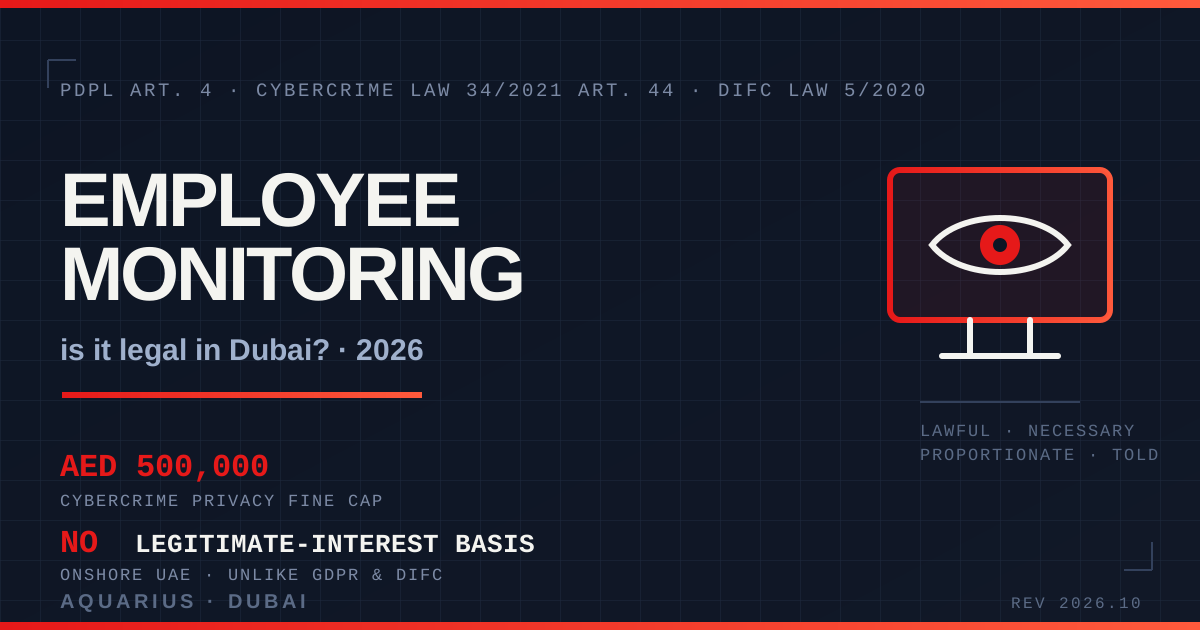
Employee monitoring is legal in Dubai, but the legal basis most employers think they are using does not exist onshore. The UAE PDPL has no general “legitimate interests” ground equivalent to GDPR Article 6(1)(f) — Article 4 is a closed list, so an onshore employer needs consent or a specific statutory exception, not a vendor’s European template. And the penalty that can actually land on you in 2026 is not a PDPL penalty at all: it is imprisonment of at least six months plus a fine of AED 150,000 to AED 500,000 under Article 44 of the Cybercrime Law for using electronic means to violate a person’s privacy.
That gap between what monitoring vendors sell and what UAE law actually permits is the single most expensive misunderstanding in Dubai HR tech right now. This guide covers the real numbers, the exact articles, the onshore versus DIFC versus ADGM split, what each monitoring technique costs in AED, and how to build a system that survives a complaint instead of creating one.
The numbers that make this a 2026 problem
Three figures explain why this question suddenly matters in the UAE.
- The tooling got cheap and ubiquitous. The global employee monitoring software market was valued at USD 3.89bn in 2025 and is projected to reach USD 4.59bn in 2026, growing at a 15.9% compound rate through 2030, according to The Business Research Company. Among organisations with remote or hybrid workforces, 94% now deploy monitoring tools — up from 60% in 2020.
- The UAE did not go back to the office. Average work-from-home levels in the UAE sit at 62%, and 82% of UAE companies say they are not requiring a return to office. Employee preference splits 44% office-first, 39% hybrid, 16% fully remote. The supervision problem is permanent, so the tooling decision is permanent too.
- The downside is not theoretical. IBM’s Cost of a Data Breach 2026 puts the average Middle East breach at USD 8m (roughly AED 29.4m). Malicious insiders caused 11% of regional breaches but were the costliest vector of all, averaging about USD 8.8m per incident. Meanwhile 26% of malicious breaches in the region were AI-enabled.
So Dubai employers have a genuine insider-risk case to answer and a genuine supervision gap to close. What they do not have is a free hand.
The myth: “we have a legitimate interest in monitoring”
Almost every monitoring product sold into the Gulf ships with a GDPR-shaped compliance pack. It tells you to document a legitimate-interests assessment, balance it against employee rights, and proceed. That advice is correct in Europe. It is correct inside the DIFC. It is wrong onshore.
Federal Decree-Law No. 45 of 2021 (the PDPL) starts from a prohibition: Article 4 bars processing personal data without the data subject’s consent, then lists the cases excluded from that prohibition. Those exclusions cover performance of a contract with the data subject, compliance with other UAE laws, obligations under employment and social-security law, legal claims, public interest, public health and occupational medicine, archiving and scientific research, protecting the data subject’s own interests, and data the data subject has already made public.
The Article 4 list is closed. There is no open-ended “legitimate interests” basis in the onshore UAE PDPL. If your monitoring does not fit consent or one of the listed exceptions, it has no lawful basis — no matter how carefully you balanced it on paper.
Article 5 then sets the processing controls that apply regardless of basis: processing must be fair, transparent and lawful, for a specific and clear purpose; data must be limited to what is necessary; it must be accurate, securely stored, and not retained after the purpose ends unless the data subject is anonymised. Those four words — lawful, necessary, proportionate, disclosed — are the whole test.
The practical consequence: a Dubai mainland employer cannot justify always-on keystroke logging by asserting a business interest. It has to point to an exception, keep the collection narrow, and tell people in advance. Generic contract language such as “the company reserves the right to monitor” does not meet the transparency standard on its own.
What the PDPL actually requires, article by article
If you are building or buying monitoring, these are the provisions that shape the specification:
- Article 4 — consent by default, with a closed list of exceptions (see above).
- Article 5 — purpose limitation, data minimisation, accuracy, security, retention limits.
- Article 13 — the employee’s right to information about processing, including automated decisions and who the data is shared with. Yes, that includes their own productivity score.
- Article 17 — the right to object to and stop processing, including profiling.
- Article 18 — the right to object to decisions based on automated processing and demand human review. If a monitoring dashboard feeds performance management, you need a human in the loop and a record of it.
- Article 21 — a data protection impact assessment is required before processing that uses new high-risk technologies or large volumes of sensitive data. Screen capture, behavioural scoring and biometric attendance all land here.
- Article 10 — a Data Protection Officer becomes mandatory for high-risk processing involving new technology, systematic assessment of sensitive data, or large volumes of it.
- Article 9 — breach notification, on a timetable the Executive Regulations are supposed to set.
- Articles 22 and 23 — cross-border transfer rules. Relevant because most monitoring SaaS stores screenshots in the US or EU.
- Article 26 — violations and administrative penalties are to be set by a Cabinet decision, on the proposal of the Data Office’s Director General.
That last one is the twist. The PDPL has been in force since 2 January 2022. Article 28 required the Executive Regulations within six months of the decree-law’s promulgation on 20 September 2021. As of October 2026 neither the Executive Regulations nor the Article 26 penalties decision has been published. No article of the PDPL itself states a figure, so the widely circulated “AED 5m PDPL fine” is a forecast, not a statute. The law entered a transition period from 1 January 2026 with full compliance expected by 1 January 2027, and the UAE Data Office has moved into an active guidance and oversight phase — but the fine schedule is still pending.
Do not read that as a free pass. It means the enforceable exposure sits somewhere else.
The law with teeth today: the Cybercrime Law
Federal Decree-Law No. 34 of 2021 on Countering Rumours and Cybercrimes is already fully operative, criminal, and brutal about covert surveillance.
- Violating privacy by electronic means — Article 44: imprisonment of at least six months and a fine of AED 150,000 to AED 500,000.
- Intercepting communications or data without authorisation: imprisonment and/or a fine of AED 150,000 to AED 500,000. If the intercepted content is then disclosed or leaked, at least one year’s imprisonment and a fine up to AED 1,000,000.
- Acquiring, copying, modifying, disseminating or deleting personal electronic data without permission: imprisonment of at least six months and/or a fine of AED 20,000 to AED 100,000.
Read those alongside a product that silently captures screenshots, reads private messages on a BYOD phone, or records a webcam without telling anyone. The company is not facing a pending administrative fine schedule; the individual who configured it is facing a criminal file. This is the actual reason covert monitoring is the one line never to cross in the UAE — and it applies onshore and in the free zones alike.
The employment-law side is comparatively simple. Federal Decree-Law No. 33 of 2021 and its executive regulation, Cabinet Resolution No. 1 of 2022, recognise remote work as a formal work model — work performed wholly or partly outside the workplace with an electronic rather than physical connection — and allow the employer to stipulate specific working hours for it. That is the hook that makes time and attendance monitoring defensible: you are verifying agreed hours, not inspecting a person. The same law requires worker files to be retained for at least two years after end of service, which is your retention floor, not your retention target.
Onshore, DIFC and ADGM are three different regimes
A Dubai group with a mainland trading company and a DIFC entity is running two data protection laws at once. The differences matter precisely where monitoring lives.
| Issue | Onshore UAE (PDPL) | DIFC (Law No. 5 of 2020) | ADGM (Regulations 2021) |
|---|---|---|---|
| Legitimate-interest basis | None — Article 4 closed list | Yes; processing necessary and proportionate to prevent fraud or ensure network and information security is deemed a legitimate interest | Yes, GDPR-aligned |
| Fine schedule published | No — Article 26 Cabinet decision still pending as of October 2026 | Yes — roughly USD 25,000 to USD 100,000 per infringement | Yes — Commissioner’s fine must not exceed USD 28m |
| Live enforcement activity | Guidance and oversight phase | 173 Decision Notices and 273 Administrative Fine Decision Notices issued in 2025 | Fines Rules in force since 2021 |
| DPIA failure | Article 21 duty, penalty pending | Maximum fine raised from USD 20,000 to USD 50,000 in 2025 | Commissioner discretion |
| Employee private action | Via Data Office complaint | Private Right of Action added by DIFC Laws Amendment Law No. 1 of 2025, effective 15 July 2025 | Regulator-led |
Two things fall out of that table. First, the DIFC is where monitoring is easiest to justify and most expensive to get wrong — it has the legitimate-interest route, a published fine schedule, hundreds of live decisions a year, and since July 2025 an employee can sue directly. Second, the free-zone compliance pack you bought does not transfer to your mainland headcount. Most Dubai groups need one monitoring policy with two legal-basis annexes.
What you can actually monitor, and what it takes
The operating rule in both regimes is the least-intrusive-means test: pick the quietest technique that achieves a stated, written business aim.
| Technique | Onshore defensibility | What you must have in place |
|---|---|---|
| Login, shift and attendance logs on company systems | Strong | Written notice; hours stipulated under the remote-work model; retention cap |
| Work-account email and web-domain metadata (not content) | Strong | Specific-purpose notice; security or fraud framing; no personal-account reach |
| Aggregated application-usage analytics, team level | Strong | Notice; no individual ranking without human review under Article 18 |
| Periodic screenshots of a company device | Medium | DPIA under Article 21; blur or exclude personal apps; employee can see their own capture log |
| GPS or vehicle telematics during shift | Medium | Shift-bounded collection only; hard off-switch outside hours |
| Continuous screen recording or keystroke logging | Weak | Rarely survives proportionality; reserve for a defined investigation with legal sign-off |
| Monitoring on a personal BYOD device | Weak | Containerised work profile only; never the whole device |
| Always-on webcam or audio of a remote worker | None | Treat as off the table |
| Covert monitoring with no notice | Criminal exposure | Cybercrime Law Article 44 territory — do not build it |
One more data point for the balance sheet: 54% of employees say they would consider quitting if their employer increased surveillance. In a Dubai market where replacing a mid-level developer or accountant costs a multiple of monthly salary in recruitment fees, visa processing and ramp-up time, an over-specified monitoring rollout is a retention expense disguised as a security control. The cheapest compliant design is almost always the cheapest design, full stop.
Buy or build: the real AED numbers
Off-the-shelf monitoring is inexpensive per seat. Converted at AED 3.6725 to the dollar, published 2026 list pricing looks like this:
| Tool and plan | USD per user/month | AED per user/month | Note |
|---|---|---|---|
| Time Doctor Basic | 6.67 | ~25 | Time tracking, basic activity |
| Hubstaff Starter / Pro | 7 / 10 | ~26 / ~37 | Pro adds screenshots and apps |
| ActivTrak Essentials / Professional | 10 / 19 | ~37 / ~70 | Annual billing; free tier available |
| Time Doctor Premium | 16.70 | ~61 | Video screen capture |
| Teramind Starter / UAM / DLP | 15 / 30 / 35 | ~55 / ~110 / ~129 | Minimum 5 seats; DLP tier is insider-risk grade |
At 60 staff on a mid tier, that is roughly AED 2,200 to AED 6,600 per month — around AED 26,000 to AED 79,000 a year. The licence is never the problem. Three things are: the screenshots land on servers outside the UAE, triggering PDPL Articles 22 and 23; the default configuration collects far more than your stated purpose, breaching Article 5; and the vendor’s legitimate-interests template has no onshore legal effect. You buy the tool and inherit the exposure.
Building instead is not about replicating Teramind. It is about collecting the narrow signal you can actually justify, keeping it in-country, and making it auditable. Typical Dubai build ranges:
| Scope | What it delivers | AED |
|---|---|---|
| Policy, notice and DPIA pack | Article 4 basis mapping, monitoring notice, DPIA, retention schedule, onshore and DIFC annexes | 12,000–25,000 |
| Compliant audit-log layer in an existing app | Who-saw-what logging, purpose tags, retention enforcement, employee self-service export | 45,000–95,000 |
| Custom workforce-analytics dashboard | Aggregated activity and attendance, no screen capture, Article 18 human-review workflow, UAE hosting | 90,000–180,000 |
| Insider-risk and DLP integration | Endpoint signal into SIEM, investigation-mode controls with legal sign-off gates, full chain of custody | 180,000–450,000 |
Set that against the regional insider number: an average USD 8.8m for a malicious-insider breach in the Middle East, against an AED 90,000 to AED 180,000 build for a system that detects the pattern and holds up as evidence. The cost of inaction is not a fine you have not been given a schedule for yet — it is the incident you cannot prove, because the only logs you had were collected unlawfully and are therefore unusable.
How Aquarius builds this
We start from the basis, not the feature list. The first deliverable is a one-page map of every signal you want, the Article 4 exception or consent that supports it, and the signals we are deliberately not collecting. Anything that fails the proportionality test gets cut before a line of code is written — which is usually where the budget savings come from.
From there: UAE-resident hosting so Articles 22 and 23 never bite, purpose tags on every stored field so retention enforces itself, an employee-facing view of their own data so Article 13 requests answer themselves, and a human-review gate on anything that touches performance management. If you are running mainland and DIFC entities, you get one system with two basis annexes rather than two systems.
Related reading: our UAE PDPL compliance checklist for websites and apps, the WPS-compliant HR and payroll build guide for the attendance and gratuity side, and visitor management and access control if biometrics are in scope. Build ranges for all of it are on our pricing page.
FAQ
Do I need employee consent to monitor a company-owned laptop in Dubai?
Onshore, you need either consent or a specific Article 4 exception — company ownership of the device is not itself a legal basis. In practice most defensible programmes run on a narrow employment or contract-performance exception plus clear advance notice, because employee consent is fragile: it is given under a power imbalance and can be withdrawn. In the DIFC you can rely on legitimate interest where the monitoring is necessary and proportionate to prevent fraud or secure the network.
Is covert monitoring ever allowed in the UAE?
Treat it as never. Using electronic means to violate a person’s privacy carries imprisonment of at least six months plus AED 150,000 to AED 500,000 under Article 44 of Federal Decree-Law No. 34 of 2021, and unauthorised interception carries the same fine band with up to AED 1,000,000 if the content is disclosed. If an investigation genuinely requires covert steps, that is a decision for external counsel and possibly the authorities, not for an IT administrator with an admin console.
Can monitoring data be used as evidence in a dismissal?
Only if it was collected lawfully. Evidence gathered without a valid basis, without notice, or beyond the stated purpose invites the employee to turn your exhibit into their counterclaim — and in the DIFC, since 15 July 2025, into a direct private action. Lawfully collected, well-documented logs are among the strongest evidence you can bring; unlawfully collected ones are worse than having nothing.
Does the PDPL apply to my DIFC or ADGM company?
No. The financial free zones have their own regimes — DIFC Law No. 5 of 2020, as amended in 2022 and again in 2025, and the ADGM Data Protection Regulations 2021. If your group spans a mainland entity and a free-zone entity, you are running both frameworks and your monitoring policy needs to say which basis applies to which population.
What is the maximum fine for unlawful employee monitoring in the UAE?
There is no published PDPL figure: Article 26 leaves violations and administrative penalties to a Cabinet decision that, as of October 2026, has not been issued. The enforceable caps today are criminal — AED 500,000 under the Cybercrime Law for a privacy violation, up to AED 1,000,000 where intercepted content is leaked — plus roughly USD 100,000 per infringement in the DIFC and a ceiling of USD 28m in ADGM.
Do I need a DPO just to run monitoring?
Possibly. Article 10 makes a DPO mandatory where processing is high-risk because of new technology, involves systematic assessment of sensitive data, or handles large volumes of it. Behavioural scoring and screen capture across a sizeable workforce will usually trip at least one of those. An Article 21 DPIA is the cheaper first step and will tell you whether the DPO duty follows.
The one-line version
Lawful, necessary, proportionate, and told in advance. Onshore that means naming an Article 4 exception rather than asserting a legitimate interest; in the DIFC it means documenting the proportionality you are already allowed to rely on; and everywhere in the UAE it means never going covert, because that exposure is criminal and already live.
If you are choosing between a per-seat tool that collects too much and a build that collects only what you can defend, send us the signal list and we will tell you which items survive the basis test before you spend anything.