
Enterprise SSO for Dubai B2B SaaS (2026): SAML, SCIM and the Deals You Lose
UAE enterprise buyers will not sign without SAML SSO and SCIM provisioning. Real 2026 build-vs-buy costs in AED, DESC ISR v3 identity controls, and why UAE Pass does not count.
- PUBLISHED
- 02 NOV 2026
- READ TIME
- 12 MIN
- AUTHOR
- AQUARIUS · DUBAI
- UNIT
- REV 2026.09
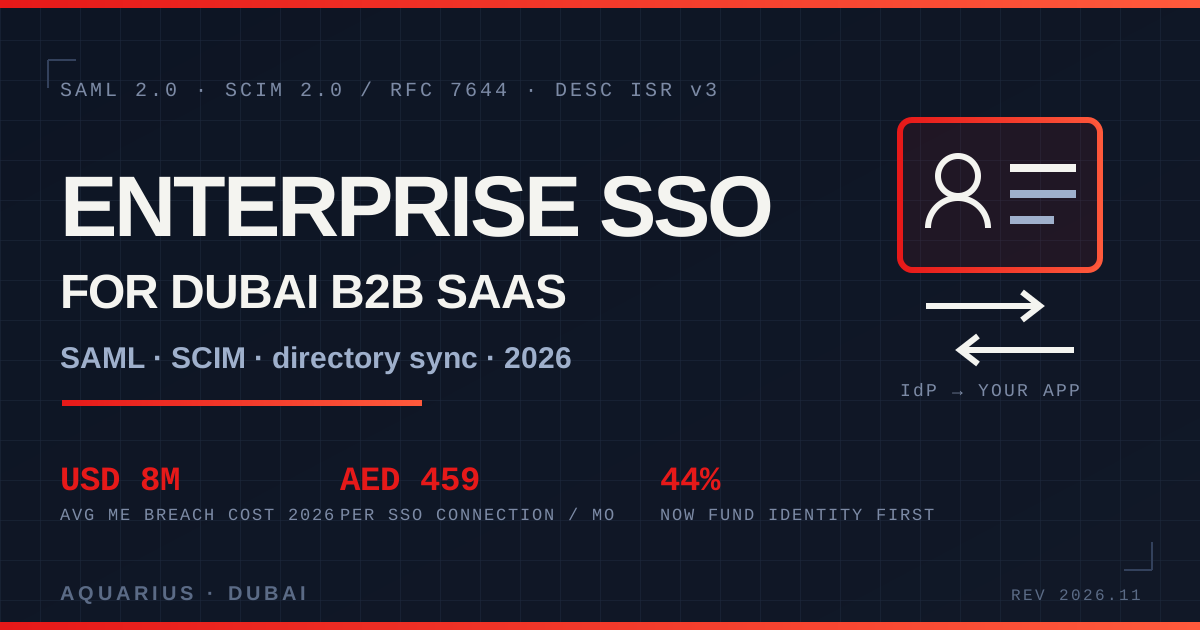
Short answer: If you sell B2B software in the UAE, enterprise single sign-on is not a feature — it is an entry ticket. Dubai banks, government-linked entities, hospital groups and large family conglomerates will not hand your app a set of standalone passwords, so a deal stalls the moment their IT security team asks for SAML 2.0 and SCIM provisioning and you say “it’s on the roadmap.” Budget AED 55,000–AED 185,000 to build it properly, or AED 239–AED 459 per customer connection per month to buy it, and expect two to six weeks either way.
Most Dubai SaaS teams discover this in the worst possible way: late in a procurement cycle, in a security questionnaire, with a signed term sheet going cold.
Why UAE enterprise buyers now lead with identity
Identity stopped being an IT detail and became a board-level line item. Three numbers explain the shift in this region:
- USD 8 million (about AED 29.4 million) — the average cost of a data breach across the Middle East in IBM’s 2026 Cost of a Data Breach research, still the second-highest region in the world and multiples of the global average.
- 44% of breached organisations said identity and access management was the control they prioritised investing in afterwards — with IBM naming excessive privileges and poor role management among the factors that amplify breach cost.
- 57% now run lifecycle controls for machine identities and 43% extend zero-trust rules to non-human identities — which is why questionnaires increasingly ask about your service accounts and API tokens, not just your login page.
Meanwhile the money is moving. Gartner put MENA software spending at USD 20.4 billion in 2026, up 13.9%, and regional information security spending at roughly USD 4 billion, up 10.1%. Translation: UAE enterprises are buying more software and hiring more people whose job is to say no to software that cannot prove its access controls.
The local proof point is UAE Pass. The national digital identity now covers more than 12.5 million users across 15,000+ services from 350+ entities. Federated identity is already normal here — your buyer’s staff log in to government services with one identity, then wonder why your dashboard wants a separate password.
Most Dubai SaaS founders get this backwards: they treat SSO as a feature request from one big client. It is actually a filter that decides which clients ever reach your pricing page.
SAML, OIDC, SCIM: what the procurement team is actually asking for
Three different things get bundled under “enterprise SSO.” Knowing which one is being requested saves you a sprint.
SAML 2.0 — the one you will be asked for by name
A 2005-era XML standard, and still the lingua franca of corporate IT. Your app becomes a Service Provider; the customer’s Microsoft Entra ID, Okta or Ping instance is the Identity Provider. You exchange metadata, validate a signed assertion, and map attributes to a user record. Enterprise IT teams ask for SAML because their existing playbooks, audit evidence and IdP app catalogues are built around it.
OIDC — the modern equivalent, often preferred by newer IdPs
OpenID Connect sits on OAuth 2.0 and speaks JSON and JWTs instead of XML. It is cleaner to implement and better suited to mobile and single-page clients. Build both if you can: SAML wins RFPs, OIDC wins engineering sanity.
SCIM 2.0 — the one that actually gets you renewed
SSO authenticates the user who shows up. SCIM decides who exists. The System for Cross-domain Identity Management (RFC 7643 for the schema, RFC 7644 for the protocol, both published in September 2015) lets the customer’s HR or directory system create, update and — critically — deprovision accounts in your app automatically. When a Dubai employer offboards someone on a Thursday afternoon, SCIM is what removes their access from your product by Thursday afternoon, instead of whenever your client remembers to email support.
The standard is being actively extended, which matters if you are specifying work now:
| Standard | What it does | Status |
|---|---|---|
| SAML 2.0 | Browser-based federated authentication (XML assertions) | OASIS standard since 2005; still the default enterprise ask |
| OpenID Connect | Identity layer on OAuth 2.0 (JWT-based) | Mature; preferred for mobile and single-page apps |
| SCIM 2.0 — RFC 7643 / 7644 | User and group provisioning schema and REST protocol | Published September 2015; the baseline enterprise requirement |
| RFC 9865 | Cursor-based pagination for SCIM | Published October 2025; fixes large-directory sync |
| RFC 9967 | SCIM Security Event Tokens | Published May 2026; near-real-time identity event signalling |
If a prospect’s security team mentions event-driven deprovisioning or continuous access evaluation, RFC 9967 is the vocabulary they are reaching for. Supporting the 2015 core well still clears the overwhelming majority of UAE deals.
The UAE-specific bar: DESC ISR v3
Here is the requirement Dubai-focused teams miss. Dubai Electronic Security Center’s Information Security Regulation v3 has been in effect since August 2026, covering 13 security domains, and it reaches beyond government itself to the cloud providers and key suppliers serving Dubai government and semi-government entities.
Its identity controls are explicit about user registration and de-registration, privilege management, credential management and periodic access reviews. Separately, the regulation expects audit logs to be retained for at least one year. You cannot satisfy periodic access reviews with a CSV you export by hand, and you cannot satisfy log retention with 30 days of application logs. SCIM plus an exportable audit trail is how you answer both — and how your client answers their own auditor.
One clarification worth banking: UAE Pass is not enterprise SSO. It is outstanding national consumer identity for citizen-and-resident-facing journeys, and we have written a full UAE Pass integration guide. But it authenticates individuals, not an employer’s staff directory. A Dubai bank will not use UAE Pass to govern which of its 400 employees can see your admin panel. Different problem, different standard.
Build it or buy it? Real 2026 numbers
Two honest paths. Buying is faster and predictable; building is cheaper at scale and keeps your login flow yours. Published list prices, converted at the pegged rate of AED 3.6725 to the dollar:
| Option | List price | In AED | Best for |
|---|---|---|---|
| WorkOS SSO or Directory Sync | USD 125 per connection/month (tiering to USD 65 at 51–100 connections) | ~AED 459, down to ~AED 239 | Fastest route to “yes” on an active enterprise deal |
| WorkOS audit log streaming | USD 125/month + USD 99 per million events | ~AED 459 + ~AED 364 | Meeting log retention asks without building a pipeline |
| Microsoft Entra ID P1 / P2 | USD 7 / USD 10 per user/month | ~AED 26 / ~AED 37 | Your own workforce identity, not your customers’ |
| Okta Workforce (Starter to Essentials) | USD 6 to USD 17 per user/month, USD 1,500 annual minimum | ~AED 22 to ~AED 62, ~AED 5,509 floor | Internal IT consolidation |
| Auth0 Enterprise | From USD 3,000/month | ~AED 11,018/month | Large consumer plus B2B estates |
| Build in-house (Aquarius) | AED 55,000–AED 185,000 one-off | — | Multi-tenant SaaS with a real roadmap and five or more enterprise clients |
Read the pricing models carefully. Per-connection vendors charge you for every enterprise customer you onboard — sensible at three clients, a tax on growth at thirty. Per-user vendors like Entra and Okta mostly price workforce identity, which is a different line item from letting your customers bring their own IdP. Teams routinely quote the wrong one in a board deck.
What a proper build actually includes
When we scope enterprise identity for a Dubai SaaS product, the deliverable is not “a SAML button.” It is:
- Per-tenant IdP configuration — each customer brings their own metadata, certificate and attribute mapping, self-serve where possible. This is a tenancy design question before it is an auth question; see our notes on multi-tenant SaaS architecture.
- SP-initiated and IdP-initiated flows — enterprise users launch apps from their IdP dashboard, and they will report it as a bug if that fails.
- SCIM 2.0 endpoints with correct filtering, pagination and soft-delete semantics, plus just-in-time provisioning as a fallback.
- Role mapping and RBAC — IdP groups mapped to your permission model, because “everyone becomes an admin” fails a security review instantly.
- Immutable audit logs with at least a year of retention and an export the customer’s auditor can read.
- Session and token policy — idle timeout, forced re-auth for sensitive actions, revocation on deprovision.
- UAE data residency where the contract requires it, under PDPL cross-border rules.
Typical timeline: SAML plus basic provisioning in two to three weeks; full SCIM, RBAC and audit tooling in four to six weeks. Pair it with passkeys for your self-serve tier and you cover both ends of the market with one identity layer. If certification is also on the table, our ISO 27001 vs SOC 2 cost breakdown sets realistic expectations.
The cost of not having it
One lost UAE enterprise contract at AED 150,000 a year pays for the entire build. The asymmetry is brutal: identity work is a fixed, one-time cost, while every quarter without it is a recurring list of deals that quietly went to a competitor whose security questionnaire came back clean. And with Middle East breach costs averaging USD 8 million, no CISO in Dubai is being asked to take a chance on your login screen to save procurement a month.
FAQ
Do I need SAML if my customers already use Microsoft 365?
Yes — that is precisely the case for it. Microsoft 365 means Entra ID, and Entra is an IdP your customer’s IT team expects to connect to your app. Entra supports both SAML 2.0 and OIDC; most UAE enterprise IT teams will hand you SAML metadata first.
Can I launch with SSO and add SCIM later?
Usually, yes. SAML SSO alone clears most initial security reviews; SCIM becomes the blocker at larger headcounts, in regulated sectors, and at renewal when the client has to prove deprovisioning works. Just design your user model for it now — retrofitting external IDs and soft-deletes into a live tenant schema is the expensive version.
Is UAE Pass enough for enterprise clients?
No. UAE Pass is national digital identity for individuals — excellent for citizen and resident onboarding, KYC and government-facing journeys. It does not let an employer manage which of its staff hold which roles inside your product. Enterprise B2B needs SAML or OIDC against the customer’s own directory.
What does DESC ISR v3 require from a SaaS vendor?
If you serve Dubai government or semi-government entities, or sit in their supply chain, you inherit expectations from the regulation’s 13 domains — including documented user registration and de-registration, privilege management, credential management, periodic access reviews, and audit logs retained for at least a year. SCIM-driven provisioning and exportable logs are the practical way to evidence those controls.
How much does enterprise SSO cost in Dubai?
Buying starts around AED 239–AED 459 per customer connection per month with a managed provider. Building in-house runs roughly AED 55,000–AED 185,000 one-off, depending on whether you need SAML only or the full SCIM, RBAC and audit stack. Beyond about ten enterprise tenants, building usually wins on total cost.
Ship the identity layer before the deal needs it
Aquarius builds enterprise identity into Dubai SaaS products the way buyers here audit it: per-tenant SAML and OIDC, real SCIM 2.0 endpoints, group-to-role mapping, year-retained audit logs and PDPL-aware residency — delivered in weeks, with fixed-scope pricing and the security questionnaire answers written for you.
See our transparent AED pricing, or tell us which deal is stuck and we will tell you exactly what it takes to unblock it.