
Multi-Tenant SaaS Architecture in Dubai (2026): Pool, Bridge or Silo, and What UAE Law Decides For You
UAE health and banking law force tenant placement decisions most SaaS teams make by accident. Pool vs bridge vs silo, real AED costs, and the March 2026 AWS UAE lesson.
- PUBLISHED
- 23 OCT 2026
- READ TIME
- 13 MIN
- AUTHOR
- AQUARIUS · DUBAI
- UNIT
- REV 2026.09
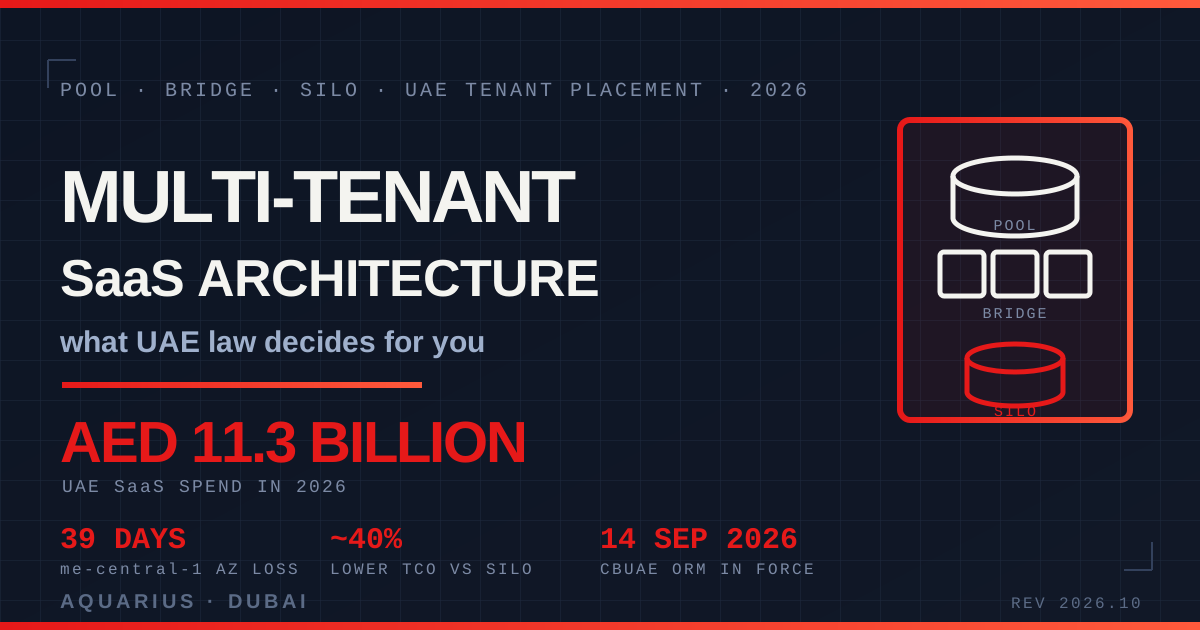
Most Dubai SaaS teams pick their multi-tenant architecture on cost, then discover UAE law already picked it for them. Health data from services delivered in the UAE may not be stored or processed outside the country, and the Central Bank requires licensed financial institutions to hold all consumer and transaction data inside the UAE. The moment a clinic or a lender signs your contract, a shared pooled database in Frankfurt stops being an optimisation and becomes a compliance defect. The architecture that survives in this market is a bridge: pool the many, silo the regulated few, and make tenant placement a configuration value instead of a rewrite.
The market you are building into
Multi-tenancy is an unglamorous decision with an outsized bill attached, and the UAE is now a large enough software market that getting it wrong is expensive.
- The UAE cloud services market is valued at USD 6.15 billion in 2026, forecast to reach USD 9.34 billion by 2032 at a 7.21% CAGR (MarkNtel Advisors). SaaS is the dominant service segment at roughly 50% of 2026 revenue — about USD 3.08 billion, or AED 11.3 billion.
- Across the wider region, the Middle East and Africa SaaS market generated USD 22.3 billion in 2025 and is projected to grow at a 12.4% CAGR through 2033 (Grand View Research).
- UAE startup funding rose 53% year on year to USD 895 million in H1 2026, which was 66% of all MENA venture capital. The regional total was USD 1.7 billion across 242 rounds, with capital down 18% and deal count down 28% year on year (Wamda).
- The software segment of the UAE ICT market is forecast to compound at roughly 15% a year, ahead of the hardware and services segments.
Read the funding figures together: less capital, spread across fewer deals, going disproportionately to the UAE. Investors here are funding fewer, more serious products, and architecture that cannot onboard a regulated enterprise tenant is a visible ceiling in diligence. We see it directly in technical due diligence engagements.
Most Dubai SaaS products get this wrong in the same way: they build one pooled database, win a healthcare or fintech logo, and then rebuild the data layer under contract deadline.
The three models, plainly
There are only three real answers to “where does tenant data live”, and every vendor framework is a variation on them.
Pool — shared schema, tenant_id column
All tenants share the same tables, separated by a tenant identifier on every row. Cheapest unit economics by a wide margin, one schema migration for everyone, and the easiest to operate. Isolation is enforced entirely in software, which means a single missing filter is a cross-tenant breach.
Bridge — schema or database per tenant inside shared infrastructure
Each tenant gets its own schema (or its own database) on shared compute. Isolation moves from your application code down into the database engine, backup and restore become per-tenant operations, and you can place one tenant’s schema in a different region without touching the rest. Migrations get harder: you now run them N times.
Silo — dedicated stack per tenant
Separate database, often separate compute, sometimes a separate account or subscription. Strongest isolation, simplest compliance story, linear cost. Operationally it is a fleet-management problem, not an application problem — without infrastructure-as-code and automated provisioning, every new tenant is a manual deployment.
In practice bridge is where most mature SaaS lands: the bulk of the customer base pooled, with regulated tenants and large enterprise accounts siloed on the same codebase. Industry guidance for 2026 puts the saving from pooling at roughly 40% lower total cost of ownership than a fully siloed estate at the same scale. The discipline that makes a bridge work is boring and absolute: tenant placement must be a row in a configuration table, never a branch in your code.
What UAE regulation actually dictates about tenant placement
Here is the part that surprises founders who have read only the PDPL. The UAE PDPL does not cover the two sectors with the strictest storage rules.
Federal Decree-Law No. 45 of 2021 has been in force since 2 January 2022. It does not require personal data to be stored in the UAE; it restricts transfers abroad, via an adequacy route (Article 22) or contractual and consent-based routes (Article 23). As of October 2026 the Executive Regulations have still not been issued, no adequacy list has been published, and no UAE standard contractual clauses exist — so practically everyone is operating on Article 23 contracts and documented assessments. The UAE Data Office never became fully operational, and its functions were transferred in June 2026 to the new Federal Authority for Artificial Intelligence and Data. Our PDPL compliance checklist covers the application-level duties.
But the PDPL explicitly excludes government data, health data, and banking and credit data from its scope. Those sit under harder, sector-specific rules:
- Health — Federal Law No. 2 of 2019, Article 13. Health data relating to health services provided in the UAE may not be stored, processed, generated or transferred outside the country, except under exceptions set by ministerial decision. Ministerial Resolution No. 51 of 2021 lists about ten narrow exceptions — treatment abroad, overseas lab samples, approved research, insurance claims, telemedicine — most conditional on written consent and encryption. Abu Dhabi’s ADHICS standard adds approval before patient data enters a cloud environment. If you serve clinics, see our hospital information system guide.
- Banking — CBUAE Consumer Protection Standards, Article 6.1.6.3. Licensed financial institutions must hold and store all consumer and transaction data within the UAE, with a secure backup in a separate location for the retention period. There is no risk-assessment escape hatch. The Outsourcing Regulation keeps the master system of record in the UAE, and the payment regulations do the same for personal and payment data. The Operational Risk Management Regulation takes effect on 14 September 2026 and extends the master-system-of-record requirement to outsourced functions — which includes your SaaS. Context for fintech builds is in our DIFC and ADGM regulation guide.
- IoT and critical infrastructure — TDRA IoT Regulatory Policy. Secret, sensitive and confidential data is stored primarily in the UAE; government data in those classes always stays in the UAE; open data may go anywhere. The Cyber Security Council’s National Cloud Security Policy, updated September 2025, is mandatory for government entities and critical infrastructure and requires a known data location in an acceptable legal jurisdiction.
- Free zones run their own regimes. DIFC Law No. 5 of 2020, as amended by DIFC Law No. 1 of 2025 effective 15 July 2025, now reaches non-DIFC-incorporated entities processing data in the territory, adds a private right of action, and raised fines — USD 50,000 for failing to carry out a required DPIA. ADGM’s Data Protection Regulations 2021 carry a maximum fine of USD 28 million.
Translate that into engineering terms and the rule is simple: a UAE SaaS needs the ability to pin an individual tenant to in-country storage, prove it, and back it up in-country too. Not the whole platform. One tenant. That capability is the difference between a bridge and a pool, and it is almost impossible to retrofit cheaply after launch.
Model comparison with real AED numbers
Per-tenant infrastructure ranges below reflect 2026 industry benchmarks, converted at USD 1 = AED 3.67. Build figures are our own Dubai delivery ranges.
| Model | Isolation | Infra per tenant / month | Build cost (AED) | Best fit in the UAE |
|---|---|---|---|---|
| Pool (shared schema) | Logical, in application code | AED 185–1,470 | 90,000–180,000 | SME and prosumer products, high tenant count, no regulated verticals |
| Bridge (schema per tenant) | Database-level | AED 550–4,400 | 160,000–320,000 | Mixed book: pooled SMEs plus clinics, brokers, government suppliers |
| Silo (dedicated stack) | Infrastructure-level | AED 1,835–18,350 | 280,000–600,000 | CBUAE-licensed tenants, hospital groups, sovereign and defence-adjacent |
| Retrofit single-tenant to multi-tenant | Varies | — | 120,000–350,000 | Products that sold a custom instance per client and now need a platform |
Two UAE-specific cost facts belong in that calculation. AWS me-central-1 averages USD 0.6808 per hour on a common EC2 basket — 5.1% above the global average — while us-east-1 averages USD 0.5601, or 13.5% below it, so in-country hosting carries roughly a fifth more compute cost before you add anything. Azure UAE North ranks 42nd of 58 regions, about 57.6% above the cheapest region. Data residency in the UAE is affordable; it is not free, and the premium lands hardest on siloed tenants where you pay it per customer rather than once. More on provider choice in our Dubai hosting and data residency guide.
The March 2026 lesson Dubai architects should not forget
Residency and resilience are two different axes, and the UAE got an unusually blunt demonstration of the second one this year.
On 1 March 2026, availability zone mec1-az2 in the AWS Middle East (UAE) region was struck during the regional conflict, causing fire and structural damage; a second zone, mec1-az3, degraded through shared infrastructure dependencies. AWS reported 38 services disrupted in the UAE region and later confirmed it could not restore access to resources and data hosted exclusively in mec1-az2. The disruption ran for more than 39 days, and AWS waived usage charges in the region for March.
The architectural reading is not “avoid the UAE region”. It is that a single-region, single-zone pooled database is a one-event company-ending risk, and it gets worse the more tenants share it. A bridge model limits the blast radius per tenant and lets you place your highest-value accounts across both Azure UAE North and UAE Central, or across me-central-1 zones with cross-zone replicas, without moving everyone. Pair the decision with a tested restore path — see our disaster recovery and backup plan guide. A backup you have never restored is a belief, not a control.
Where tenant isolation actually breaks
Almost nobody loses tenant data to a clever exploit. They lose it to an unfiltered query.
- Broken access control is the number one entry in the OWASP Top 10 for 2025, and Broken Object Level Authorization has held first place in the OWASP API Security Top 10 since that list launched. Multi-tenancy is the condition that turns a routine authorisation bug into a platform-wide disclosure.
- Published SaaS penetration-testing data for 2025 records 755 vulnerabilities across 119 assessments, with access control and business logic the highest-impact categories.
- Cross-tenant data exposure from misconfigured APIs rose 17% in SaaS environments.
- Research on LLM-integrated SaaS found 12 of 18 discovered vulnerabilities were amplified by multi-tenancy, with cross-tenant exfiltration and knowledge-base poisoning the worst. If you are bolting a copilot onto a pooled database, read our notes on AI agent security and prompt injection first.
Five places the tenant filter goes missing, in the order we find them during audits: a raw SQL report query written outside the ORM; a background job or scheduled export that runs without a tenant context; a cache key that omits the tenant identifier; a file-storage path keyed only on a record ID; and a search index where documents from all tenants share one collection.
The controls that actually hold are structural, not procedural. Enforce the boundary in the database with row-level security so a forgotten WHERE clause fails closed rather than open. Resolve tenant context once, in middleware, from the authenticated session — never from a request parameter a client can change. Use per-tenant encryption keys in a managed KMS so a siloed tenant can be cryptographically shredded on exit, which is also how you satisfy a deletion request without a full restore; the mechanics are in our secrets and key management guide. And make cross-tenant access attempts a test suite, not a code review habit.
How Aquarius builds this
We default every UAE SaaS build to the bridge model, because the bridge is the only one of the three you do not have to abandon later. Concretely: one codebase and one deployment pipeline; tenant placement stored as data, with pooled, schema-isolated and fully siloed as three values of the same field; row-level security switched on from the first migration; per-tenant keys in a managed KMS; and an automated provisioning path so adding a siloed tenant is a pipeline run rather than a project. The pooled majority carries the economics, the regulated minority carries the premium, and your compliance answer is a query against a placement table rather than a document somebody wrote in 2024.
The commercial case is straightforward. Pooling delivers around 40% lower total cost of ownership than a fully siloed estate, which pays for the extra build. The cost of not having the option is harder to put in a spreadsheet and easier to feel: UAE healthcare and CBUAE-licensed tenants are among the highest-contract-value customers in this market, and a pooled-only architecture disqualifies you from both before the first demo. Our pricing page shows how the build phases, and MVP development covers the staged route for pre-revenue products.
Frequently asked questions
Does the UAE PDPL require me to store SaaS data in the UAE?
No. The PDPL does not mandate in-country storage; it restricts cross-border transfer under Articles 22 and 23. Because no adequacy list or UAE standard contractual clauses have been published as of October 2026, most organisations rely on processing agreements, explicit consent and a documented transfer assessment. The hard localisation rules come from sector law, not the PDPL.
Can I serve a Dubai clinic from a pooled database hosted in Europe?
No. Article 13 of Federal Law No. 2 of 2019 prohibits storing, processing, generating or transferring UAE health-service data outside the country, with only the narrow exceptions in Ministerial Resolution No. 51 of 2021. A healthcare tenant needs its data in the UAE, which in a pooled architecture means the entire pool must be in the UAE — one reason the bridge model is cheaper in practice.
What is the cheapest way to support one regulated tenant?
Schema-per-tenant on in-country infrastructure, with the rest of the book pooled wherever your economics favour. That typically runs AED 550–4,400 a month in infrastructure for the isolated tenant against AED 185–1,470 pooled, and avoids the AED 1,835–18,350 range a dedicated stack implies. Build the switch once and the next regulated tenant costs you a configuration row.
How much does it cost to convert a single-tenant product into a multi-tenant one?
In our experience AED 120,000–350,000, driven almost entirely by how much of the existing data access runs through an ORM you can intercept. Products with hand-written SQL scattered across reporting and background jobs sit at the top of the range, because every one of those queries is a tenant filter you have to find and prove.
Is one UAE region enough for resilience?
The March 2026 loss of two of three availability zones in AWS me-central-1 — with data held exclusively in one zone unrecoverable and disruption running past 39 days — suggests not, for anything you would call critical. Azure has operated UAE North and UAE Central since 2019, which gives a second in-country region for workloads that must stay onshore. At minimum, replicate across zones, keep an in-country backup copy as CBUAE requires for financial data, and rehearse the restore.
Where to start
Before you choose a model, write down your tenant types and the law each one sits under. Most Dubai SaaS products have three or four categories and discover that exactly one of them forces the architecture. That single page is worth more than any framework comparison, because it converts an open-ended engineering debate into a short list of placements you must support.
If you want that mapped properly against your roadmap, talk to Aquarius. We are a Dubai studio, we build multi-tenant platforms for this market specifically, and we will tell you plainly if a pooled database is all you need.