
Stable and Riding School Management Software in Dubai (2026): Livery, Lessons and Horse Records in One System
UAE equestrian clubs spend around AED 367M a year and AED 2.1bn on racehorse training. What stable and riding-school software costs in Dubai, and where the money leaks.
- PUBLISHED
- 18 NOV 2026
- READ TIME
- 11 MIN
- AUTHOR
- AQUARIUS · DUBAI
- UNIT
- REV 2026.09
Short answer: A Dubai stable, livery yard or riding school should budget AED 30,000–55,000 for a single-yard booking and billing system, AED 60,000–120,000 for a full platform that handles livery invoicing, lesson packages, horse health records and competition entries, and AED 120,000–220,000 for a multi-site or racing operation with vet, farrier and feed workflows. The build is rarely the expensive part. For a 60-horse yard billing AED 3,200 per horse per month, a 3% invoicing leak is AED 69,000 a year — more than the software.
This is the 2026 guide to stable and riding-school management software in Dubai: what the market actually looks like, which modules earn their keep, what it costs in AED, and the compliance deadlines that landed this year. Updated November 2026.
Dubai's horse economy is bigger than the software serving it
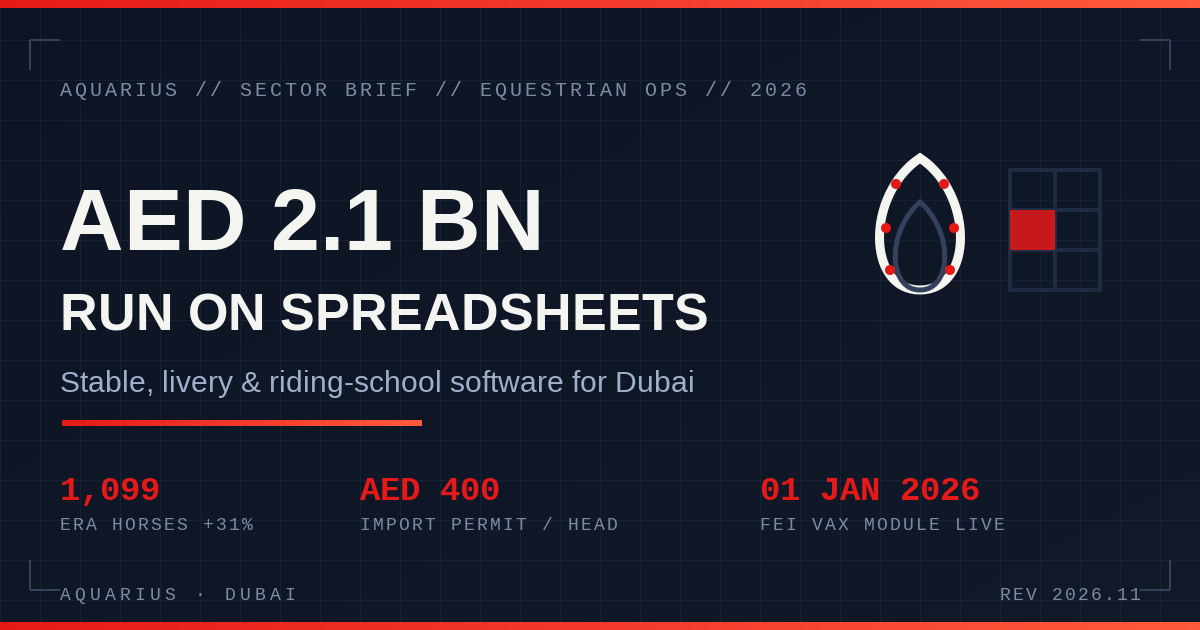
The numbers are not a hobby sector. According to industry analysis published via Meydan Free Zone, UAE equestrian clubs spend roughly AED 367 million a year on operations, and around AED 2.1 billion a year goes into racehorse training alone. High-performance horse feed is a market of more than AED 128 million.
The registration data points the same way. The Emirates Racing Authority's 2025–26 season recorded 1,099 horses registered, up 31% on the previous season's 836, with two-year-old registrations up 68% and active owners and syndicate members up 12.8% to 967, alongside 167 licensed trainers and 117 jockeys. The World Arabian Horse Organization has logged 19,045 horses in the UAE Arabian stud book and 5,999 registered owners as of end-2024. The Dubai World Cup runs its 30th edition at Meydan on 28 March 2026 with a USD 30.5 million card — about AED 112 million — including a USD 12 million feature.
Zoom out and Dubai's sports sector contributes more than AED 9 billion annually, about 2.35% of GDP, supporting at least 105,000 jobs, per the Dubai Sports Council study. Equestrian is a visible, high-ticket slice of that. And most of it is administered on WhatsApp groups, a whiteboard in the tack room, and one shared Excel file that only the yard manager understands.
Most Dubai yards get this wrong: they buy a booking app
The instinct is to copy the fitness world and buy a class-booking app. That solves the smallest problem. A riding school's lesson diary is maybe 30% of its revenue admin. The other 70% sits in places a booking app never touches:
- Livery billing — monthly board plus variable extras: extra feed, shoeing, rugs, clipping, worming, box rest, physio, transport to shows.
- Horse records — passport numbers, vaccination dates, farrier cycles, dental, vet visits, insurance, ownership and syndicate shares.
- Staff and rota — grooms per yard block, feed rounds, turnout schedules, who rode what.
- Competition and entries — entry fees collected, stabling at venue, transport split across owners.
- Imports and movement — permits, quarantine, health certificates, temporary-import expiry dates.
A yard that fixes the diary and leaves billing in Excel has automated the cheap half. Same structural mistake we see in sports venues generally — see our breakdown of padel booking app development in Dubai, where the money was in off-peak utilisation, not more courts.
What the system has to do, priced against Dubai market rates
Dubai livery and lesson pricing is public enough to model. Basic boarding runs AED 1,500–2,500 per month; premium full livery sits at AED 3,000–8,000, with established centres such as Emirates Equestrian Centre publishing around AED 3,200 per horse and AED 2,700 per pony (up to 14.2hh). Group lessons are typically AED 100–150 per 45 minutes, private lessons AED 300–600, and ten-lesson packages land near AED 1,000. Desert and endurance rides run AED 200–600 per session.
| Revenue line | Dubai rate (AED) | Where the money leaks | What the software must do |
|---|---|---|---|
| Basic livery / DIY | 1,500–2,500 / month | Extras never billed | Auto-attach feed, shoeing, rug and vet charges to the horse, not the person |
| Full / premium livery | 3,000–8,000 / month | Pro-rata on arrivals and departures | Day-accurate pro-rating, deposit held, auto-renew invoices with VAT and TRN |
| Group lesson | 100–150 / 45 min | Empty slots, instructor idle | Waitlist auto-fill, horse-suitability matching, instructor load view |
| Private lesson | 300–600 / 45 min | No-shows and late cancels | Card on file, deposit rules, cancellation window enforced by the system not the receptionist |
| 10-lesson package | ~1,000 | Credits honoured after expiry | Credit ledger with expiry, visible to parent and front desk |
| Desert / endurance ride | 200–600 / session | Capacity guessed over the phone | Horse-level availability, rider weight and ability limits, guide allocation |
Run the arithmetic on the two biggest leaks. A yard with 60 horses at AED 3,200 bills AED 192,000 a month; a 3% miss on extras and pro-rating is AED 5,760 a month, AED 69,120 a year. A school running 40 private lessons a week at AED 400 bills AED 16,000 a week; a 12% no-show rate with no deposit rule costs roughly AED 99,800 a year. Those two lines alone outrun the entire build cost in year one.
The horse is the record, not the customer
This is the design decision that separates equestrian software from gym software. Charges, health events, ownership shares and competition history all belong to the horse; invoices belong to one or more humans attached to it. Get that wrong and every syndicate horse, every part-loan and every school pony on a sponsorship breaks your billing. The same entity-modelling discipline shows up in veterinary and pet-care app development in Dubai — the animal, not the account, is the primary record.
Two 2026 compliance dates you cannot skip
First, the FEI HorseApp vaccination module became mandatory on 1 January 2026 for entry to FEI competitions. Equine influenza vaccination details must be registered digitally, entered by the veterinarian on the day of vaccination, with the existing record uploaded first. Through 30 June 2026 the system checks and emails non-compliant athletes without issuing fines — after that the grace period is gone. Any Dubai yard with competing clients needs vaccination dates stored as structured data with alerts, not as a photo of a passport page in a WhatsApp thread.
Second, horse movement. Under MOCCAE's import service for horses (permanent or temporary), the permit costs AED 400 per head with a AED 500 per head release fee, takes about 3 working days, and a temporary import permit is valid for 10 days. You need a laboratory examination from the exporting country, a copy of the horse passport, the vaccination document, owner ID, and — for Arabians — a no-objection certificate from the Emirates Arabian Horse Society; release additionally requires an attested veterinary health certificate and a UAE lab test, with inspection and quarantine at approved facilities including the Nad Al Sheba Center for Equine Species. Imports are only permitted from the approved-countries list. A system that tracks permit numbers, the 10-day expiry and document expiry per horse turns that from a panic into a dashboard.
Third, and quietly the one that bites: riding schools are full of children. Minors' names, photos, medical notes and parent contact details are personal data under the UAE Personal Data Protection Law, and consent, retention and photo use all need handling. Our UAE PDPL compliance checklist for websites and apps covers the basics before you publish a single gallery photo of a nine-year-old on a pony.
What it costs to build in Dubai, and what we would build first
Off-the-shelf international stable software exists and is cheap per month, but it is built for a 20-horse yard in Europe: no VAT or TRN-compliant invoicing, no Arabic, no MOCCAE permit fields, no local payment gateway, no FEI module awareness. Most Dubai operators end up running it alongside a spreadsheet, which is the problem they paid to solve.
| Scope | Build cost (AED) | Timeline | Included |
|---|---|---|---|
| Single yard — diary plus billing | 30,000–55,000 | 4–6 weeks | Lesson diary, livery invoicing with VAT and TRN, card on file, deposits, basic horse profiles |
| Full platform | 60,000–120,000 | 8–12 weeks | Above plus horse health and farrier cycles, packages and credit ledger, staff rota, owner portal, competition entries, Arabic |
| Multi-site or racing yard | 120,000–220,000 | 12–20 weeks | Above plus multi-location stock and feed, vet and farrier scheduling, syndicate share billing, MOCCAE permit and quarantine tracking, reporting across sites |
Our view, and what we would actually ship: start with the billing engine and the horse record, not the pretty booking page. Phase one is day-accurate livery invoicing with extras attached at the point of work, a card-on-file deposit rule, and a horse profile carrying passport, vaccination and farrier dates with expiry alerts. That is the part that pays for itself inside a season. The public booking page, the mobile app and the owner portal are phase two, funded by phase one. Full ranges are on our pricing page.
Risk reversal, plainly: we scope a fixed-price phase one against your own numbers — your horse count, your livery rate, your no-show rate — and if the modelled recovery does not clear the build cost in twelve months, we will tell you to keep the spreadsheet. With AED 2.1 billion a year flowing through UAE racehorse training and registrations up 31% in a single season, the yards that professionalise their admin in 2026 will be the ones absorbing that growth instead of drowning in it.
FAQ
How much does stable management software cost in Dubai?
A custom single-yard system runs AED 30,000–55,000, a full livery and riding-school platform AED 60,000–120,000, and a multi-site or racing operation AED 120,000–220,000. Off-the-shelf SaaS is cheaper monthly but typically lacks VAT and TRN-compliant invoicing, Arabic, local payment gateways and MOCCAE permit fields.
What does it cost to import a horse into the UAE in 2026?
MOCCAE's import permit for horses is AED 400 per head with an AED 500 per head release fee, processed in about 3 working days. A temporary import permit is valid for 10 days. You need an exporting-country lab examination, the horse passport, vaccination documents, owner ID, and an Emirates Arabian Horse Society NOC for Arabians, with inspection and quarantine at approved facilities.
Is the FEI HorseApp vaccination module actually mandatory now?
Yes. Digital registration of equine influenza vaccination details became mandatory for FEI competition entry on 1 January 2026. Until 30 June 2026 the FEI checks records and emails non-compliant athletes without fines; after that, enforcement is live. Vaccination data should sit in your system as structured dates with alerts, not as passport photos.
Can one system handle both a riding school and a livery yard?
Yes, and it should — most Dubai centres run both. The requirement is that the data model treats the horse as the primary record with humans attached to it, so a school pony taking eight lessons a week and a privately owned horse on full livery share the same health, farrier and availability logic while billing completely differently.
How long does a build take?
Four to six weeks for a single-yard diary and billing system, eight to twelve weeks for a full platform, and twelve to twenty weeks for a multi-site or racing operation. Phasing it so billing ships first usually means the system is earning before the second phase starts.
Running a yard, a riding school or a racing operation in Dubai? Send us your horse count, livery rate and current admin stack and we will model the recovery before you spend anything.