
Padel Booking App Development in Dubai (2026): Fill the Off-Peak, Not More Courts
Dubai has 400+ padel courts. Peak slots run 85-95% full while weekday daytime sits under 60%. What a booking platform costs in AED, and the payback maths.
- PUBLISHED
- 15 SEPT 2026
- READ TIME
- 10 MIN
- AUTHOR
- AQUARIUS · DUBAI
- UNIT
- REV 2026.09
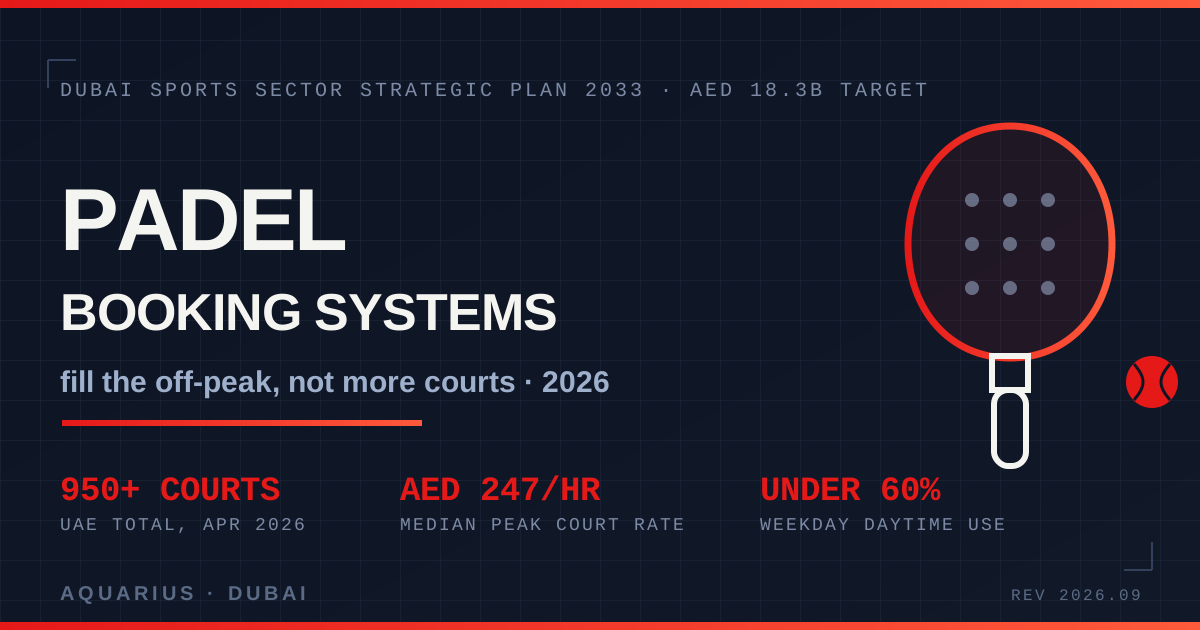
Short answer: A Dubai padel or racket-sports venue should budget AED 35,000–75,000 for a single-site booking system (live court grid, online payment, off-peak pricing rules, WhatsApp confirmations), AED 80,000–180,000 for a full branded platform with native iOS and Android apps, memberships, open matches and no-show deposits, and AED 200,000–500,000+ for a multi-venue or franchise system with a dynamic pricing engine, league management and gate/lighting automation (before 5% VAT). The reason to build is not the software bill. It is that a Dubai court costs AED 80,000–250,000 to construct, and most operators buy another one while 40% of the hours they already own sit empty.
This is the 2026 guide for padel club owners, multi-sport facility operators, academies and hotel leisure managers in Dubai who are deciding between renting a marketplace slot and owning the booking channel. Updated September 2026.
Key takeaways
- Dubai is the densest padel market in the region: the UAE passed 950 courts across 320+ venues by April 2026, with 400+ courts in Dubai alone from Al Quoz to JVC, Business Bay and Dubai Hills.
- The demand is real but lopsided. Peak evening slots (17:00–22:00) run at 85–95% occupancy, while weekday daytime frequently drops below 60% unless it is actively managed.
- The median UAE peak rate is AED 247 per hour against AED 190 off-peak (Padelnomics, March 2026) — a spread most Dubai venues never systematically exploit.
- Recovering three empty off-peak hours a day at AED 190 is worth roughly AED 205,000 a year. That is a whole extra court, built in software instead of steel and glass.
Dubai padel in numbers (and why 2026 gets harder)
Start with the macro picture, because it explains both the opportunity and the incoming squeeze.
In November 2025 Dubai launched the Dubai Sports Sector Strategic Plan 2033, targeting an increase in the sector's contribution to Dubai's GDP from AED 10.17 billion to AED 18.3 billion a year, and growing the number of residents actively involved in sport from 1.6 million to 2.6 million. Sport in this city is no longer a hobby category. It is an economic programme with 19 programmes and 75 initiatives behind it.
Padel is the sharpest edge of that curve. UAE search interest for the sport rose roughly 3,000% over five years, with a further 60.3% jump during 2025, and participation is still compounding at an estimated 40–50% a year. The UAE padel market was valued at USD 205.4 million in 2025 (about AED 754 million) and is projected to reach USD 437.6 million by 2034 at an 8.67% CAGR. Property developers noticed: by mid-2025 roughly 199 Dubai residential listings advertised padel courts as an amenity, and new communities are being handed over with 8–13 courts built to FIP tournament standard.
Here is the part that rarely makes the press release. Every one of those amenity courts is free supply competing with your paid supply. The Global Padel Report 2026 flagged overcapacity as the sport's defining challenge worldwide, with courts growing faster than playing hours. Dubai will feel that before most markets, because it built fastest.
So the operator question for 2026 is no longer "how do I add courts?" It is "how do I sell the hours I already have?"
The myth most Dubai operators are still paying for
The belief is that padel demand is infinite, so the growth lever is concrete. It is not. Look at how a healthy club's calendar actually splits.
| Time band | Typical occupancy | Dubai rate (AED/hour) | What the software has to do |
|---|---|---|---|
| Weekday 17:00–22:00 | 85–95% | 240–320 (premium venues 380+) | Stop no-shows, upsell, enforce deposits |
| Weekend prime | 85–95% | 210–320 | Waitlist and auto-fill cancellations |
| Weekday 09:00–16:00 | Often under 60% | 120–220 | Dynamic pricing, open matches, corporate blocks |
| Early morning / late night | Highly variable | 60–190 | Credits, memberships, automated push campaigns |
Across 72 Dubai clubs with published rates, prices span roughly AED 60 off-peak to AED 600–720 at absolute peak, clustering around an AED 190 median. Well-run clubs in mature markets land at 55–75% overall utilisation. Read that carefully: even a good club sells only about two of every three hours it owns.
Run the arithmetic on a four-court Dubai venue open 06:00 to midnight. That is 72 court-hours a day of inventory. At 60% utilisation you leave 28 court-hours a day unsold. Recover just three of them at the AED 190 off-peak median and you add AED 570 a day, AED 17,100 a month, about AED 205,000 a year. A new court costs AED 80,000–250,000 to build and takes 3–6 weeks (8–12 weeks for a 4–8 court facility). You just built one and a half courts' worth of revenue with no excavation, no glass, no DEWA connection and no extra land rent.
That is the whole business case for owning your booking layer. Everything below is how it gets built.
What a Dubai padel booking platform actually needs
Most off-the-shelf systems were designed for European tennis clubs on a membership model. Dubai operates differently: transient population, walk-in doubles culture, corporate bookings, a summer migration indoors, and four nationalities on one court. These are the modules that earn their cost here.
1. Dynamic off-peak pricing that runs itself
The AED 247 peak versus AED 190 off-peak spread is not a pricing table, it is a yield-management problem. Rules-based pricing (time band, day, lead time, occupancy threshold, school holidays) is a two-to-three week build and is usually the highest-ROI feature in the system. Set a floor, let it discount into empty air, and never discount a slot that was going to sell anyway.
2. Open matches and player levels
Padel is doubles. A player with three friends books a court; a player alone books nothing. Open matches, where one player posts a slot and the system matches three more at a similar level and splits payment four ways, convert solo demand into full courts. They disproportionately fill daytime hours. If you build one community feature, build this one.
3. Memberships, credit wallets and corporate packages
Prepaid credit pulls cash forward and raises visit frequency. Corporate packages (10–50 hour blocks sold to a Business Bay or DIFC company for weekday daytime use) are the cleanest fix for the under-60% band, and they need a B2B portal issuing a TRN-compliant tax invoice, not a consumer checkout.
4. No-show and cancellation control
A no-show looks like a sold slot in your calendar and produces zero revenue while blocking a real booking. Card-on-file with a deposit, a cancellation window enforced by the system rather than by staff (typically 12–24 hours), and an automatic waitlist that pushes freed slots to interested players within seconds. On a venue selling roughly 43 court-hours a day, halving a conservative 5% no-show rate is worth around AED 7,000 a month at a blended AED 220 rate.
5. Coaching, academies, leagues and tournaments
Coach calendars, package deductions, junior academy terms, Americano and Mexicano formats, league tables and ladder rankings. In Dubai this is often 25–40% of a mature venue's revenue, and it is the part generic booking tools handle worst.
6. UAE payments, Arabic, and the hardware layer
Apple Pay and Google Pay are table stakes for a phone-first booking flow. Add a UAE acquirer (Telr, Network International, Tap or Checkout.com) and, for packages above AED 1,000, a buy-now-pay-later option such as Tabby or Tamara. Build Arabic and English from day one, because retrofitting right-to-left layout later costs more than doing it up front. Then connect the physical layer: QR or PIN gate access, automatic court-light switching at booking start, and camera and replay systems players will pay extra for.
Marketplace, SaaS or your own app?
Three models, three very different long-run positions.
| Factor | Marketplace app | White-label SaaS | Custom platform |
|---|---|---|---|
| Upfront cost | Near zero | Low setup | AED 35K–500K+ |
| Ongoing cost | Subscription plus commission on each online booking | Monthly per court or per venue | Hosting plus maintenance |
| New-player discovery | Strong, its main value | None | You build it (SEO, ads, referrals) |
| Customer data | Shared with the platform and its network | Usually yours, in their schema | Entirely yours |
| Pricing and rules control | Within their model | Limited | Total |
| Multi-sport, F&B, retail | Rarely | Sometimes | Yes |
The honest answer for most Dubai venues is both, sequenced. Keep a marketplace as a discovery channel for players who do not know you exist. Own the channel for the players who already do: regulars, members, academy parents and corporate accounts. Paying per-booking commission on a repeat customer you acquired yourself is the most expensive habit in the leisure business. Dubai restaurants worked this out with aggregators and hotels worked it out with OTAs; padel is about three years behind both.
Watch the lock-in detail. If your player database, booking history and payment tokens live inside someone else's platform, your switching cost grows every month. Get a full data-export clause into the contract before you need it.
What it costs to build in Dubai (2026 AED)
| Tier | Scope | Cost (AED, ex-VAT) | Timeline |
|---|---|---|---|
| Single venue | Responsive booking web app, live court grid, online payment, off-peak price rules, WhatsApp and SMS confirmations, admin dashboard | 35,000–75,000 | 5–7 weeks |
| Full branded platform | Everything above plus native iOS and Android apps, memberships and credit wallet, open matches with player levels, coaching and academy scheduling, no-show deposits, Arabic and English | 80,000–180,000 | 10–16 weeks |
| Multi-venue / franchise | Multi-site inventory, dynamic pricing engine, leagues and tournaments, corporate B2B portal, gate and lighting automation, BI dashboards, POS and F&B integration | 200,000–500,000+ | 4–7 months |
| Annual running cost | Hosting, payment gateway fees, push and SMS, support and iteration | 15,000–60,000 per year | Ongoing |
Two notes on these numbers. They exclude 5% UAE VAT and the per-transaction discount rate your acquirer charges, which our breakdown of payment gateway integration costs in Dubai covers in detail. And the middle tier is where most venues with three or more courts should land; below that, rent a SaaS until volume justifies the build. Our published pricing follows the same tiers.
The decision, in one calculation
Take your own venue. Multiply courts by daily opening hours to get your inventory. Multiply by your real occupancy, not your peak-hour feeling but the monthly average from your booking system. The gap is your product.
For a four-court Dubai club at 60% utilisation, closing that gap by ten percentage points is roughly 7 extra court-hours a day. At a blended AED 200 that is AED 42,000 a month, or over AED 500,000 a year, against a mid-tier platform costing AED 80,000–180,000 once. Even if the system delivers only a third of that, it pays back inside a season. Meanwhile the cost of doing nothing rises every quarter: courts keep opening, the overcapacity the Global Padel Report warned about arrives, and the venues that survive a correction are the ones that own their players rather than rent them.
How Aquarius builds these
We build booking and operations platforms for Dubai service businesses, using the same architecture behind salon and spa booking systems and gym and fitness apps, tuned for court inventory instead of chairs or classes. A typical engagement: two weeks of discovery on your actual occupancy data, a working booking core live in six weeks so you start selling off-peak immediately, then apps, memberships and matchmaking in phases. Full source-code handover, your cloud accounts, your player database, no lock-in. See what we build.
FAQ
How much does a padel booking app cost in Dubai?
AED 35,000–75,000 for a single-venue booking system, AED 80,000–180,000 for a full branded platform with native apps, memberships and matchmaking, and AED 200,000–500,000+ for a multi-venue or franchise build. Add AED 15,000–60,000 a year for hosting, gateway fees and support. All figures are before 5% VAT.
Should we leave Playtomic and other marketplaces?
Usually not entirely. Marketplaces are genuinely good at putting new players in front of you, and in the UAE they carry real booking volume. The winning setup keeps them for discovery while moving regulars, members, academy families and corporate accounts onto your own app, where you pay no per-booking commission and keep the customer relationship.
How do we stop no-shows at a Dubai padel club?
Card on file with a deposit or full prepayment, a clear 12–24 hour cancellation window enforced by the system rather than by staff, and an automatic waitlist that instantly offers freed slots to players who wanted that time. On a busy four-court venue this alone is typically worth several thousand dirhams a month.
Do we need an Arabic version?
Yes, and build it from the start. Dubai's playing population is multilingual and a large share of corporate and family bookings comes through Arabic-first users. Adding right-to-left layout after launch means reworking navigation, calendars, forms and notification templates, which reliably costs more than including it in the original build.
How long before a new booking system pays for itself?
A basic booking core can be live in five to seven weeks, so you sell off-peak inventory in the same quarter you commission it. A four-court venue recovering three empty off-peak hours a day at the AED 190 median earns about AED 17,100 a month, which means a mid-tier build typically pays back within one season.
The short version
Dubai does not have a padel demand problem. It has an off-peak problem, a no-show problem and a commission problem, and all three are software problems that cost less to fix than a single new court. The operators who work that out in 2026 will still be full when the courts outnumber the players.
Running a padel club, a multi-sport facility or an academy in Dubai? Tell us your court count and current occupancy and we will map the unsold hours to a number before you spend anything.