
ESG and Carbon Reporting Software in Dubai (2026): The MRV Deadline Already Passed
The UAE GHG reporting deadline passed on 30 May 2026 and it covers every licensed entity, free zones included. Fines reach AED 2,000,000. What the software actually has to do.
- PUBLISHED
- 18 SEPT 2026
- READ TIME
- 10 MIN
- AUTHOR
- AQUARIUS · DUBAI
- UNIT
- REV 2026.09
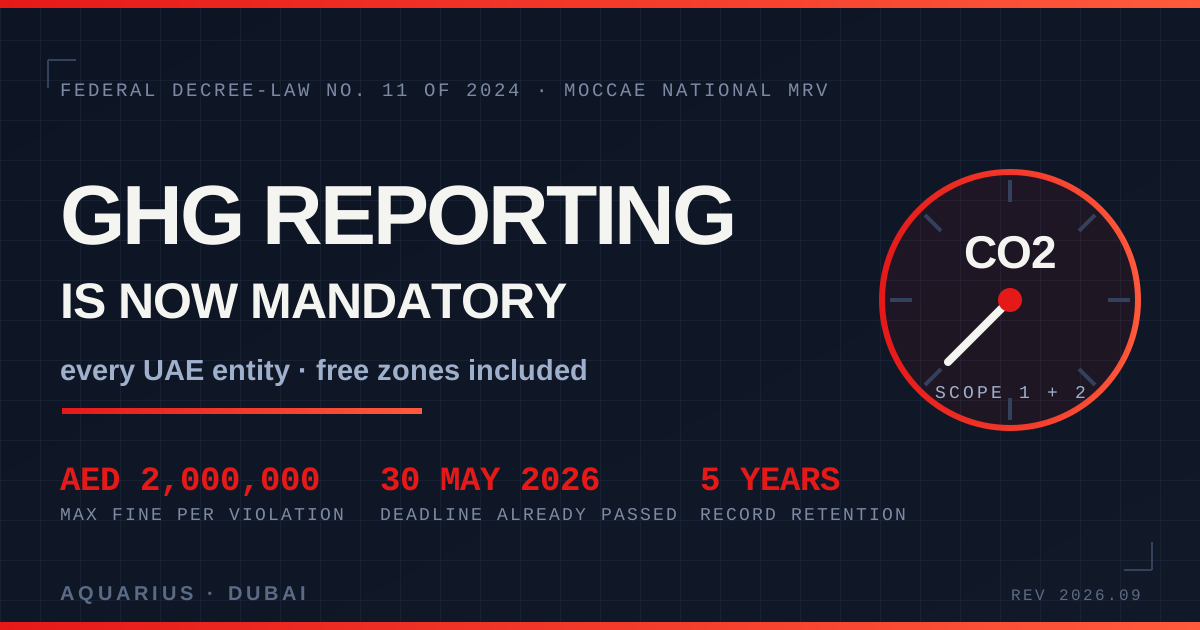
Short answer: Under Federal Decree-Law No. 11 of 2024, every public and private entity in the UAE — including free zone companies, with no exemption for size, turnover or sector — must measure its greenhouse gas emissions, keep a five-year audit trail and report through MOCCAE’s National MRV Transparency System. The compliance deadline was 30 May 2026. It has passed. Fines run from AED 50,000 to AED 2,000,000 per violation, doubling for a repeat within two years. The build that matters is not a PDF sustainability report — it is the data pipeline that produces a defensible number every month.
Key takeaways
- There is no size threshold. The law applies to all entities whose activities generate emissions, free zones included. A 12-person trading company in JAFZA is in scope on the same legal basis as a refinery.
- The deadline is behind you, not ahead of you. Full compliance was due 30 May 2026. Quiet enforcement is still exposure: penalties reach AED 2,000,000, and AED 4,000,000 for a repeat violation inside two years.
- Verification only kicks in above 0.5 Mt CO2e. Entities at or above 0.5 million tonnes of combined Scope 1 and 2 per year must also register with the National Carbon Credit Registry, build an ISO 14064-aligned inventory and get third-party verification from a MOCCAE-approved verifier. Everyone else reports without an auditor — which is exactly why the internal data has to be clean.
- Most Dubai businesses get this wrong: they treat it as a reporting problem and buy a template. It is a plumbing problem. Your emissions live in DEWA bills, district cooling invoices, fuel cards, refrigerant service logs and landlord statements — nine separate data sources in a hotel, more in a logistics firm.
- Software is the cheap part. SME carbon platforms start around US$99 per month (roughly AED 4,400 a year); enterprise suites run US$75,000 to US$250,000+ annually. The expensive part is the six weeks someone spends re-keying meter readings because nothing is integrated.
Why this landed on every Dubai licence holder at once
Federal Decree-Law No. 11 of 2024 on the Reduction of Climate Change Effects was issued on 28 August 2024, came into force on 30 May 2025, and required full compliance by 30 May 2026. It makes the UAE the first country in the MENA region to put corporate climate accountability into binding federal legislation rather than voluntary guidance.
The scope is the part that catches people. The law carves out no exemption based on company size, turnover or sector, and it explicitly reaches entities licensed in free zones. If your activity generates greenhouse gases — and running an office on grid electricity does — you are a “source” under the law.
The policy backdrop is not subtle either. Dubai’s Carbon Abatement Strategy targets a 30% emissions reduction by 2030, with the emirate’s updated citywide plan pushing toward 50% against a 2018 baseline. Dubai already cut emissions 33% in 2020 and 21% in 2021 against its own abatement targets, and the Dubai Clean Energy Strategy aims for 100% clean energy production capacity by 2050, with roughly 27% by 2030. A city hitting those numbers needs the denominator measured at company level. That is what the MRV system is.
Hospitality has lived with this since long before the federal law. Dubai’s Department of Economy and Tourism has required hotels to submit nine carbon emission sources monthly — electricity, water, district cooling, LPG, landfill waste, recycled waste, petrol, diesel and refrigerants — through the Dubai Sustainable Tourism Carbon Calculator since January 2017. The 19 Sustainability Requirements that underpin the Dubai Sustainable Tourism Stamp have since been widened to 27 mandatory measures, and DET recognised a record 237 hotels in the 2026 stamp cycle. Hotels already know what monthly environmental reporting costs in admin hours. Everyone else is about to find out.
What the law actually asks you to produce
Strip away the consultancy language and there are five deliverables.
| Obligation | What it means in practice | Who it applies to |
|---|---|---|
| Register on the National MRV platform | Create an entity account at the MOCCAE MRV portal with trade licence details, nominate data providers and validators, get approval through your emirate-level focal point. | All in-scope entities |
| Measure Scope 1 and Scope 2 | Direct emissions (fuel, company vehicles, refrigerants) and purchased energy (electricity, district cooling), converted to tCO2e. | All in-scope entities |
| Submit via the IEQT | The Integrated Emissions Quantification Tool, launched by MOCCAE in October 2025, applies IPCC-aligned emission factors and categorises output by scope. It is the mandatory submission channel. | All in-scope entities |
| Keep records for five years | Fuel logs, utility bills, activity data, calculation workings and the reduction measures you claimed — retrievable, not buried in a shared drive. | All in-scope entities |
| Third-party verification | ISO 14064-aligned inventory, registration with the National Carbon Credit Registry and independent assurance by a MOCCAE-approved verifier. | Entities at or above 0.5 Mt CO2e per year (Cabinet Resolution 67 of 2024) |
Two further layers sit on top depending on what you are. Listed public joint stock companies on UAE-regulated exchanges must publish an ESG report under the Securities and Commodities Authority rules within 90 days of financial year end, typically aligned to GRI for disclosure and TCFD or IFRS S2 for climate risk. And Abu Dhabi-licensed entities report through the Environment Agency – Abu Dhabi portal on a 31 March annual cycle. If you operate across emirates, you have two calendars, not one.
Where the build actually gets hard
Nobody fails this because they cannot add numbers. They fail because the numbers are in twelve places and none of them agree.
A mid-sized Dubai group typically has: DEWA accounts per premises, an Empower or Emicool district cooling invoice arriving as a PDF, a fuel card statement from ENOC or ADNOC, refrigerant top-up records sitting with the AMC contractor, waste collection dockets from the municipality contractor, a landlord service charge that bundles chilled water into a single line, and a fleet whose mileage exists only in WhatsApp messages between drivers and a supervisor. The regulatory task is one number. The engineering task is normalising seven input formats, in two languages, across multiple premises, every month, with an audit trail.
That is why the useful system has five parts, and only one of them is a report:
- Ingestion. Utility PDF parsing (Arabic and English), CSV import, an API where a provider offers one, and a mobile capture form for meter photos so a facilities technician can log a reading in fifteen seconds without opening a laptop.
- A normalised activity ledger. Every data point stored with source, premises, period, unit, the emission factor version applied and who entered it. This is the five-year retention requirement expressed as a database schema.
- A calculation engine with versioned factors. Emission factors change. If you recalculate 2025 with 2027 factors, your year-on-year trend is fiction and your audit trail breaks. Factors must be pinned to the period.
- Validation and approval workflow. The MRV registration itself separates the people who provide data from the people who validate it. Build that separation into the software or you will be recreating it in email.
- Export. IEQT-shaped output for MOCCAE, DST Carbon Calculator format if you run hotels, GRI or IFRS S2 tables if you are listed, and a board pack that is readable by someone who does not know what a scope is.
Get those five right and the annual submission becomes a button. Get them wrong and you rebuild the spreadsheet every year, which is the state most companies are in right now.
Buy, subscribe or build: the AED decision
The market is real and growing fast. The UAE ESG software market is valued at around US$210 million, roughly 29% of the Middle East and Africa total, growing at about 11.3% CAGR. The wider MEA ESG reporting software segment is forecast to move from US$0.4 billion in 2025 to US$1.0 billion by 2033 at roughly 14.2% CAGR. Middle East carbon accounting software specifically sits near US$18 million — small, because most companies here are still on spreadsheets.
| Route | Typical cost | Fits when |
|---|---|---|
| Off-the-shelf SME carbon platform | From about US$99/month — roughly AED 4,400 per year | One or two premises, no unusual data sources, you can live with manual entry and generic exports. |
| Enterprise ESG suite | US$75,000 – 250,000+ per year | Listed entity, multi-country footprint, assurance-grade controls and an internal sustainability team to run it. |
| Integration layer over an existing tool | AED 35,000 – 75,000 one-off | You already bought a platform but nobody is feeding it. Automate ingestion from DEWA, district cooling, fuel cards and ERP. |
| Custom multi-site ESG and carbon platform | AED 90,000 – 220,000 | Several premises or legal entities, mixed emirate reporting calendars, hotel or facilities workflows, Arabic interface, role-separated approvals. |
| Group platform with ERP and BMS integration | AED 250,000+ | Real-time meter and building-management data, consolidated group reporting, IFRS S2 climate-risk disclosure alongside operational KPIs. |
For context on the assurance side, ISO certification work in the UAE commonly runs AED 3,000 to AED 25,000 depending on scope, covering documentation, training and audit — and that is before a MOCCAE-approved GHG verifier, which only the largest emitters need. If you are under the 0.5 Mt threshold, spend the money on data quality rather than on assurance you are not obliged to buy.
Whichever route you pick, price it against the downside. A single AED 2,000,000 violation is roughly nine times the top of our custom build range, and a repeat inside two years doubles it. For related build economics, see our custom software development cost guide and BI dashboard development breakdown.
How Aquarius approaches it
We build the ledger before the dashboard. First sprint maps every emission source to a document and an owner — which DEWA account, which cooling provider, who holds the refrigerant log. Second sprint is ingestion and the versioned factor engine. Only then does anyone design a chart. Arabic and English from the wireframes rather than retrofitted, role separation between data provider and validator to mirror the MRV structure, and exports shaped for MOCCAE’s IEQT and the DST Carbon Calculator where hospitality is involved.
If you already own an ESG platform, the faster fix is usually the integration layer rather than a replacement. If you own nothing and have multiple premises, a purpose-built system pays back in the admin hours it removes long before it pays back in avoided penalties. See our development services and pricing for how the engagements are structured.
Frequently asked questions
Does the UAE Climate Change Law apply to small companies and free zone entities?
Yes. Federal Decree-Law No. 11 of 2024 contains no exemption based on company size, turnover or sector, and it expressly covers entities licensed in free zones. Any public or private entity whose activities generate greenhouse gases is in scope and must measure, report and plan reductions.
What is the penalty for not reporting emissions in the UAE?
Fines range from AED 50,000 to AED 2,000,000 depending on the severity of the violation, and a repeat violation within two years attracts double the fine — up to AED 4,000,000.
The 30 May 2026 deadline has passed. What should we do now?
Register on the National MRV Transparency System, assemble Scope 1 and Scope 2 activity data for the reporting year, prepare the inventory in the IEQT and submit. Late is materially better than absent, and the retention obligation means you need the underlying records organised regardless of when the report goes in.
Do we need third-party verification?
Only if combined Scope 1 and 2 emissions reach 0.5 million tonnes of CO2 equivalent per year. Those entities must also register with the National Carbon Credit Registry, align the inventory to ISO 14064 and use a MOCCAE-approved verifier. Below that threshold, you self-report — but the five-year record requirement still applies.
Is Scope 3 required?
Scope 1 and Scope 2 are the mandatory reporting basis. Scope 3 — supply chain and value chain emissions — is where disclosure frameworks and large customers are heading, so build the data model to hold it even if you do not report it yet. Retrofitting Scope 3 into a Scope 1 and 2 schema is a rewrite.
Can we just use a spreadsheet?
For a single office, briefly. The failure mode is the audit trail: five years of retained records, a defensible emission factor per period, and a clear separation between who supplied a number and who approved it. Spreadsheets lose all three the moment the person who built them changes role.
How long does an ESG reporting platform take to build?
An integration layer over an existing tool runs about 4 to 6 weeks. A custom multi-site platform typically takes 10 to 16 weeks, with the first third spent on data-source discovery rather than code — because the mapping exercise is the project.
Measure it once, properly
The UAE moved climate reporting from a marketing exercise to a legal one, and it did so without a small-business exemption. The companies that will find 2027 easy are the ones that stop producing an annual number by hand and start capturing it continuously — because the same pipeline that satisfies MOCCAE also tells you which premises is wasting the most energy, which is the only part of this with a payback.