EU AI Act and UAE Businesses (2026): Who Is Actually in Scope, What Got Delayed, and Real Compliance Costs
The Digital Omnibus pushed high-risk AI to December 2027 — but AI content labelling bites on 2 December 2026 and fines reach EUR 35m or 7% of worldwide turnover. What UAE firms must do.
- PUBLISHED
- 02 NOV 2026
- READ TIME
- 12 MIN
- AUTHOR
- AQUARIUS · DUBAI
- UNIT
- REV 2026.09
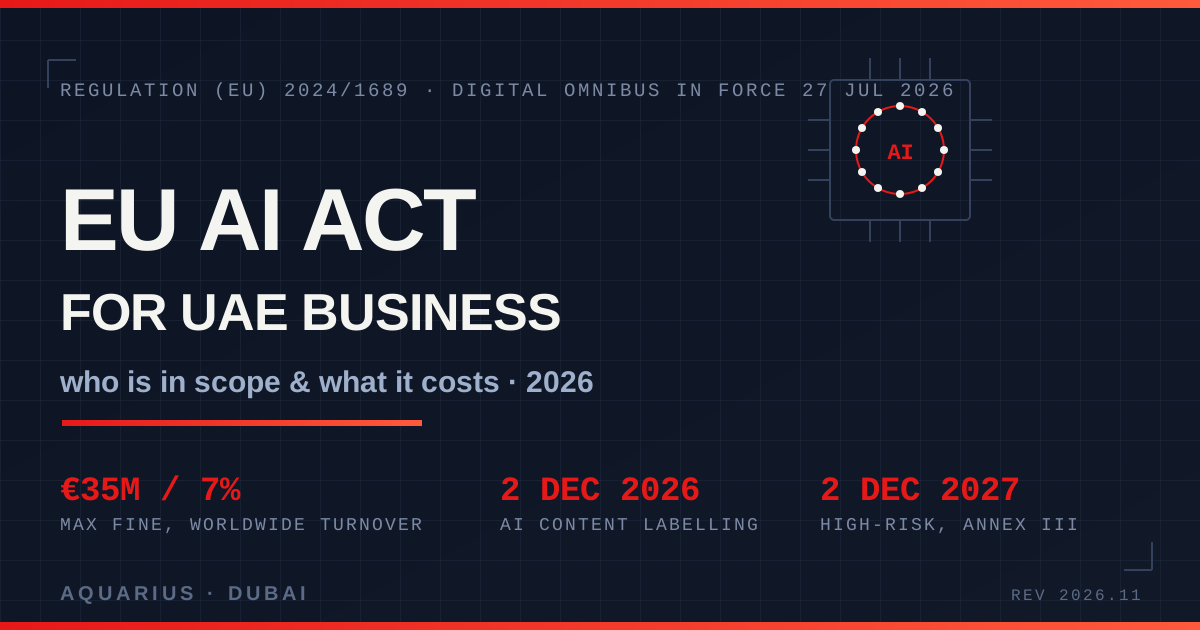
Short answer: yes, the EU AI Act can bind a Dubai company with no EU office, no EU staff and no EU marketing — Article 2 catches you the moment an AI system you build is placed on the EU market, or the output of your AI is used in the Union. The Digital Omnibus on AI, in force since 27 July 2026, pushed the big high-risk deadline out to 2 December 2027. It did not push the transparency rules: AI-generated content labelling and chatbot disclosure bite on 2 December 2026.
Most Dubai businesses read “delayed to 2027” and filed the whole thing under next year’s problem. That is the expensive mistake. The deadline that lands first is the cheapest one to fix and the easiest one to get caught on, because it is visible on your own website.
Why a UAE business should care at all
Three numbers set the stakes.
- 72% of UAE businesses now use AI, up from 53% a year earlier — from the Unlocking the UAE’s AI Potential 2026 report by Strand Partners with AWS and the UAE Artificial Intelligence Office. Only 31% of those adopters have moved to advanced AI.
- The EU is the UAE’s second-largest non-oil trading partner, worth close to USD 68 billion (roughly AED 250 billion) and 8.3% of total non-oil trade. UAE–EU CEPA talks are still grinding through round seven, so none of this gets replaced by a trade deal any time soon.
- Fines reach EUR 35 million or 7% of total worldwide annual turnover, whichever is higher, for prohibited practices under Article 99. At about AED 4.26 to the euro that is roughly AED 149 million. The operator and transparency tier is EUR 15 million or 3% — about AED 64 million.
Worldwide turnover means the whole group, not the EU slice. A Dubai trading company with AED 300 million revenue and one non-compliant AI feature does not get fined on its European revenue.
Are you in scope? Three triggers
Article 2 is modelled on GDPR’s extraterritorial reach. You are in scope if any one of these is true:
- You place an AI system on the EU market — you sell, licence or ship software with an AI component to EU customers, regardless of where you are established.
- You are a deployer established in the EU — relevant if your Dubai group has a European subsidiary or branch.
- The output of your AI system is used in the Union. This is the one that surprises people. A Dubai recruitment firm screening CVs for a client’s Berlin office, a UAE SaaS vendor whose scoring model returns decisions consumed by an Italian reseller, a Dubai agency generating ad copy published to EU audiences — output used in the EU, in scope.
If you are a non-EU provider of a high-risk system, Article 22 also requires you to appoint an authorised representative established in the Union before placing it on the market. There is no grace period for non-EU companies; the timeline runs for a Dubai provider exactly as it does for a Dublin one.
What the Digital Omnibus actually changed
The Digital Omnibus on AI was adopted by the European Parliament on 16 June 2026, approved by Council on 29 June 2026, signed 8 July 2026 and entered into force 27 July 2026. It is a real reprieve on the heaviest obligations and no reprieve at all on the visible ones.
| Obligation | Applies from | Who it hits |
|---|---|---|
| Prohibited practices (Art. 5) + AI literacy (Art. 4) | 2 February 2025 — live now | Everyone in scope |
| General-purpose AI model obligations | 2 August 2025; enforcement powers and fines from 2 August 2026 | GPAI model providers |
| Transparency: chatbot disclosure, synthetic content marking, deepfake labelling (Art. 50) | 2 August 2026 — live now | Any provider or deployer of generative AI, any risk class |
| Art. 111(4) grace for generative systems already on the market | 2 December 2026 | Existing chatbots, image and text generators |
| New prohibitions: non-consensual intimate imagery, CSAM (Art. 5(1a)–(1b)) | 2 December 2026 | Generative model and app providers |
| Stand-alone high-risk systems (Annex III: biometrics, employment, credit scoring, education, critical infrastructure) | 2 December 2027 (was 2 Aug 2026) | Providers and deployers of high-risk AI |
| High-risk AI embedded in regulated products (Annex I: medical devices, machinery, vehicles) | 2 August 2028 (was 2 Aug 2027) | Product manufacturers |
Read the table again and notice the shape of it. The obligations that need lawyers, notified bodies and a quality management system moved. The obligations that need a line of copy next to your chat widget did not.
The deadline that is 30 days away
Article 50 has been in force since 2 August 2026 and applies to all generative AI, regardless of risk classification. A support chatbot on a Dubai e-commerce site is caught just as squarely as a credit-scoring engine. Four duties matter:
- Chatbot disclosure. A person interacting with your AI must be told, at first contact, visibly or audibly — not buried in terms of service.
- Machine-readable marking. Providers must mark AI-generated or manipulated output so a machine can detect it.
- Emotion recognition and biometric categorisation. Deployers must inform the people subjected to it.
- Deepfake and AI-text labelling. Deployers must clearly label deepfakes, and AI-generated text published on matters of public interest without human editorial review. Artistic, satirical and clearly fictional work gets a lighter, non-intrusive disclosure.
Systems already on the market when the rules landed got a transition under Article 111(4): comply by 2 December 2026. That is roughly a month from now. And the responsibility does not transfer to your vendor — if you put a third-party chatbot in front of EU customers, or publish its output, you are the one who must make the disclosure reach the user.
What compliance actually costs
Published estimates vary by an order of magnitude, which tells you most of what you need to know: the cost depends entirely on whether you are a provider of a high-risk system or a deployer of ordinary generative AI.
| Scenario | Reported cost | Indicative AED |
|---|---|---|
| Article 50 transparency retrofit (disclosure, marking, labelling policy) | Days of engineering, not a certification project | AED 12,000 – 45,000 |
| European Commission estimate for an average high-risk system costing ~EUR 170,000 | EUR 6,000 – 7,000 compliance, plus EUR 3,000 – 7,500 verification | AED 38,000 – 62,000 |
| High-risk deployer programme (oversight, logging, human-in-the-loop, records) | EUR 20,000 – 50,000 initial, EUR 5,000 – 15,000/yr | AED 85,000 – 213,000 |
| Third-party conformity assessment, per system | EUR 10,000 – 40,000 | AED 43,000 – 170,000 |
| Building a full AI quality management system from zero | EUR 193,000 – 330,000, plus ~EUR 71,400/yr maintenance | AED 822,000 – 1.4 million |
A Commission-commissioned study put total regulatory cost as high as 17% of a high-risk system’s development cost. Article 99(6) softens the top end for SMEs and small mid-caps: for them the fine is the lower of the percentage or the fixed amount, not the higher.
Most Dubai businesses get this exactly backwards. They budget for a compliance project they probably do not need, and skip the AED 20,000 of labelling work that is already legally due.
How this stacks with UAE rules
The UAE still has no single binding federal AI statute comparable to the EU AI Act. What exists is layered, and two layers hardened in 2026:
- Federal Authority for Artificial Intelligence and Data — announced 14 June 2026, consolidating AI oversight, digital government and data regulation under one body reporting to Cabinet. Its mandate includes proposing legislation and setting national AI and data standards. It has not yet issued binding AI rules; treat its first year as the signal to watch.
- DIFC Regulation 10 — the first AI-specific regulation in the MEASA region, enacted 1 September 2023 under the DIFC Data Protection Law, in full enforcement since 1 January 2026. Entities doing high-risk processing through autonomous or semi-autonomous systems must meet audit and certification conditions or appoint an Autonomous Systems Officer for independent oversight. Following the July 2025 amendments, reported administrative fines sit in the USD 25,000 – 50,000 band per contravention.
- UAE PDPL — your AI system almost certainly processes personal data, which brings lawful basis, data-subject rights and cross-border transfer rules into play. See our UAE PDPL compliance checklist for websites and apps.
- UAE Charter for the Development and Use of AI (10 June 2024) — twelve principles on safety, transparency and human oversight. Policy, not law. No regulator can enforce it.
- ISO/IEC 42001 — the AI management system standard, and the pragmatic bridge. The UAE Ministry of Interior became the country’s first federal entity certified to it. Most of what an Annex III provider needs for the EU is what 42001 asks for anyway: see our guide to ISO 42001 certification in Dubai.
The practical read: build once to 42001 plus Article 50, and you satisfy DIFC Regulation 10 oversight duties, PDPL accountability and the EU’s transparency tier with one body of evidence. Running them as three separate projects is how an AED 60,000 job becomes an AED 300,000 one.
How Aquarius approaches it
We are a Dubai web and software studio, not a law firm, and the work we do here is the engineering half — which is most of it.
- Scope triage (AED 6,000 – 12,000). We inventory every AI feature in your stack — including the ones a vendor bolted on — and classify each as out of scope, Article 50 transparency only, or candidate high-risk. Most UAE businesses end up entirely in the second bucket. Knowing that is worth the fee on its own.
- Article 50 implementation (AED 12,000 – 45,000). First-contact chatbot disclosure in Arabic and English, machine-readable provenance markers on generated media, deepfake and AI-text labelling rules wired into your CMS publishing flow, and a disclosure register you can hand an auditor.
- High-risk readiness (AED 85,000 – 320,000). Logging and traceability, human-oversight controls, data governance records, post-market monitoring hooks, technical documentation. Scoped against the 2 December 2027 date so you are not paying 2026 prices for a 2027 obligation.
- AI security review. Transparency does not help if the model can be talked out of its guardrails — see AI agent security and prompt injection in Dubai.
Risk reversal: if our triage finds you are genuinely out of scope, we say so and we stop. We would rather write that report than sell you a compliance programme you do not need.
One last number for the decision. In that same UAE AI Potential report, 85% of AI adopters said AI accelerated their innovation timelines — but only 4% of UAE technology leaders could point to measurable customer value. The firms that will capture the other 96% are the ones whose AI can be sold into a regulated market without a lawyer stopping the deal.
FAQ
Does the EU AI Act apply to a Dubai company with no EU customers?
It can. Article 2 catches non-EU providers and deployers where the output of the AI system is used in the Union. No EU office, no EU contract and no EU marketing still leaves you in scope if your model’s output ends up being used in the EU — through a client, a reseller or a published channel.
Was everything delayed to 2027?
No. The Digital Omnibus moved Annex III high-risk systems to 2 December 2027 and Annex I embedded high-risk to 2 August 2028. Prohibited practices and AI literacy have applied since 2 February 2025, GPAI obligations since 2 August 2025 with enforcement powers from 2 August 2026, and Article 50 transparency since 2 August 2026 — with a grace period to 2 December 2026 only for generative systems already on the market.
Is a customer-support chatbot high-risk?
Almost never. A support chatbot is not in Annex III, so the heavy conformity machinery does not apply. It is caught by Article 50: it must tell users it is an AI at first contact. That is a copy-and-code change, not a certification project.
What counts as a high-risk AI system?
Annex III covers stand-alone systems in biometrics, employment and worker management, creditworthiness and credit scoring, education, essential services and critical infrastructure. Annex I covers AI embedded in products already regulated for safety — medical devices, machinery, vehicles. CV screening and loan scoring are the two that catch Dubai businesses most often.
Do I need an EU representative?
If you are a non-EU provider of a high-risk AI system, yes — Article 22 requires an authorised representative established in the Union, appointed before the system goes on the market. Deployers and providers of non-high-risk systems do not.
The cheapest version of this is the one you do this month
Nothing about the 2 December 2026 labelling deadline needs a notified body, an auditor or a budget cycle. It needs someone to walk your stack, find every AI surface an EU user can touch, and ship the disclosures. Do that now and the 2027 question becomes a planning exercise instead of a fire.
See our transparent AED pricing, or send us your stack and we will tell you in one pass which of your AI features the EU AI Act actually touches — and which ones it does not.