
EU Batteries Regulation 2027: What UAE Exporters Must Build Now
Most Dubai exporters think the EU battery rules start in February 2027. Labelling has applied since August 2026, and the costliest track, supply-chain due diligence, lands 18 August 2027.
- PUBLISHED
- 03 NOV 2026
- READ TIME
- 12 MIN
- AUTHOR
- AQUARIUS · DUBAI
- UNIT
- REV 2026.09
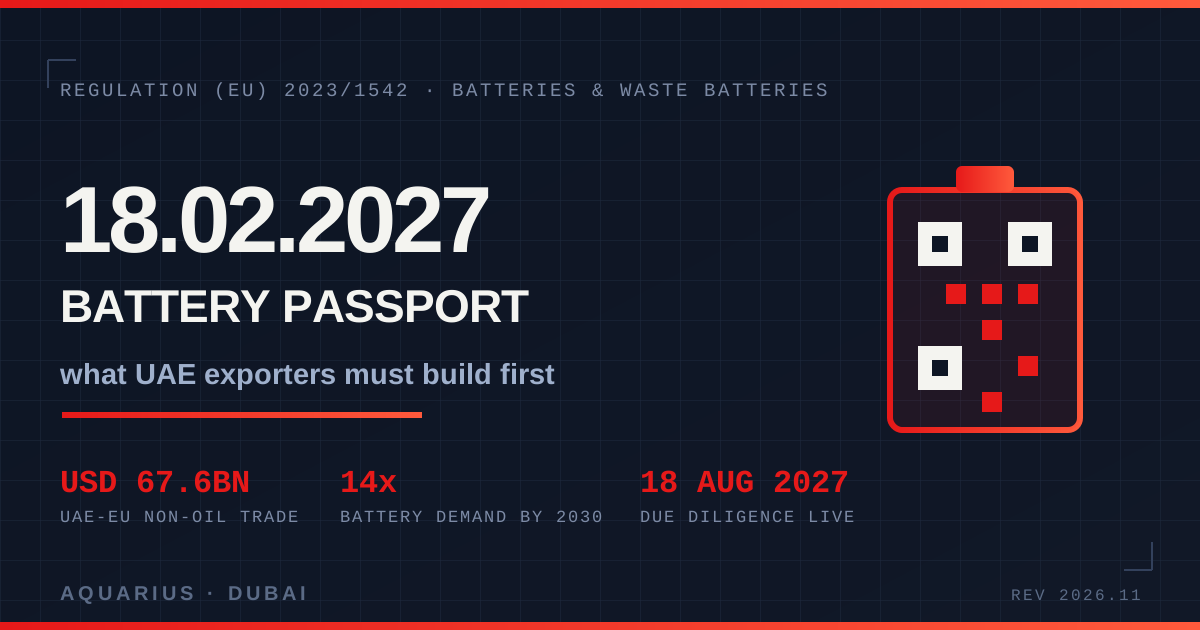
Short answer: if you sell anything containing a battery into the European Union — an e-scooter, a power tool, a storage cabinet, a laptop, a toy, a medical monitor — Regulation (EU) 2023/1542 already applies to you, from a Dubai office, with no EU entity. The headline date is 18 February 2027, when every EV, light-means-of-transport and industrial battery above 2 kWh needs a battery passport behind a QR code. But four of the six obligation tracks are live now, and the one that got postponed — supply-chain due diligence — is the one that costs the most to build. Start with the data, not the QR code.
Three numbers that make this a Dubai problem, not a Brussels problem
The European Commission's own framing is that global demand for batteries is set to increase fourteen times by 2030, and that the EU could account for 17% of that demand. That is why this regulation exists, and why it is being enforced at the border rather than through voluntary schemes.
Second: the EU is the UAE's second-largest trading partner, with non-oil trade of about USD 67.6 billion, up 3.6% year on year — 8.3% of total UAE non-oil trade. EU–UAE CEPA negotiations have now run seven rounds, and the UAE's foreign trade minister has publicly blamed the slow pace on the EU bringing non-trade matters into the talks. Translation: no preferential shortcut is arriving in time to soften 2027.
Third, and this is the one most Dubai boards have not connected: machinery, equipment and electrical equipment made up roughly 66% of all trade through the Dubai Integrated Economic Zones in the first half of 2026 — a record AED 246 billion, up 17%, with re-exports alone up 22% to about AED 108.8 billion. The single biggest commodity block moving through Dubai's free zones is exactly the block that carries cells inside it. And if you re-export, you are a producer in the eyes of EU law the moment that unit is made available on the Union market under your name.
Most Dubai exporters get this wrong in one specific way: they assume "battery rules" mean loose cells and power banks. The regulation covers five categories — portable, light means of transport (LMT), electric vehicle, industrial and starting-lighting-ignition (SLI) — and a battery built inside an appliance is still a battery. The lamp, the vacuum, the e-bike and the cordless drill are all in scope.
The 18 February 2027 date is not your first deadline
Regulation (EU) 2023/1542 entered into force on 17 August 2023 and has applied since 18 February 2024. Everything since then has been staged. Here is the real sequence, and what has actually happened to each track.
| Obligation track | Applies from | Status |
|---|---|---|
| Core regime: economic-operator duties, conformity, EU authorised representative, producer registration and EPR | 18 February 2024 | Live |
| Recycling efficiency and material recovery targets | 31 December 2025 onward | Live |
| General labelling and information requirements | 18 August 2026 | Live |
| Carbon footprint declaration, EV batteries | Was 18 February 2025 | Stalled — methodology act not adopted |
| Battery passport plus QR code (EV, LMT, industrial above 2 kWh) | 18 February 2027 | Unmoved |
| Removability and replaceability of portable batteries | 18 February 2027 | Exemption list widened July 2026 |
| Supply-chain due diligence | 18 August 2027 | Postponed from 2025 |
Read that table as a sequencing instruction, not a calendar. Two of those rows — registration and labelling — can stop a shipment today. The 2027 rows are the ones that need twelve months of data plumbing before they can be satisfied at all.
The obligations already biting
1. An EU authorised representative and producer registration
A manufacturer established outside the Union can only place batteries on the EU market through an authorised representative established in the Union, who holds the technical documentation and is reachable by market surveillance authorities. Separately, extended producer responsibility is national: the entity that first makes the battery available in a member state must be registered as a producer in that member state and arrange collection, treatment and recycling. Selling into six countries means six registrations, six reporting obligations and six sets of fees. There is no single EU registration.
2. Labelling since 18 August 2026, QR from 18 February 2027
General labelling requirements — capacity, chemistry, hazardous substance information, the separate-collection symbol — have applied since 18 August 2026. The QR code that resolves to the passport follows on 18 February 2027. If your artwork pipeline still produces a single global label, you already have a gap on shelves in Europe.
3. End-of-life targets your buyers will push onto you
These are legal duties on producers and recyclers, not on you directly — but they drive the data your EU customers demand from you, because they cannot report what you never declared.
| Target | By end 2025 | 2027 | 2030–2031 |
|---|---|---|---|
| Recycling efficiency, lead-acid | 75% | — | 80% by 2030 |
| Recycling efficiency, lithium-based | 65% | — | 70% by 2030 |
| Recycling efficiency, nickel-cadmium | 80% | — | — |
| Lithium recovery from waste batteries | — | 50% | 80% by 2031 |
| Cobalt, copper, lead and nickel recovery | — | 90% | 95% by 2031 |
| Portable battery collection rate | — | 63% | 73% by 2030 |
Minimum recycled content then lands on 18 August 2031 — 16% cobalt, 85% lead, 6% lithium, 6% nickel — rising in 2036 to 26% cobalt, 85% lead, 12% lithium and 15% nickel. That looks distant. It is not: the recycled-content declaration has to be traceable per batch, which means the supplier data model has to exist years earlier.
4. Removability — and the exemption most people missed
From 18 February 2027, portable batteries in products must be readily removable and replaceable by the end user. On 14 July 2026 the European Commission adopted a delegated act widening the exemption list to cover wearable devices such as smartwatches and fitness trackers, electric toys, and equipment covered by the ATEX directive for explosive atmospheres; medical devices and wet appliances were already exempt. If you build a wearable for the EU market, that act is the difference between a redesign and a document. Check the list before you re-tool.
Due diligence: the expensive track that got two more years
This is where the real build sits. Regulation (EU) 2025/1561, adopted in July 2025 as part of the Omnibus IV simplification package, moved the application of the battery due diligence regime from 18 August 2025 to 18 August 2027, and pushed the Commission's due diligence guidelines back to 26 July 2026. The stated reason is instructive: around half of member states had not yet appointed the notifying authorities for the third-party verification bodies that have to audit these policies. The regime slipped because the EU's own enforcement machinery was not ready — not because the obligation is softening.
What it requires: a due diligence policy covering cobalt, natural graphite, lithium and nickel across your supply chain, with risk identification, mitigation, a grievance mechanism and third-party verification. Reporting moved from annual to once every three years. A separate proposal under the same Omnibus package would exempt small mid-caps below EUR 150 million consolidated net turnover from the policy obligation — but as of late 2026 that is still a proposal in trilogue, not law. Planning around an exemption that has not been adopted is the single most expensive assumption a Dubai exporter can make this year.
If you are already assembling supplier evidence for the EU corporate sustainability due diligence regime, this is the same supplier graph with different fields. Build it once.
Carbon footprint: a clock that has not started
The regulation required the Commission to define the carbon footprint declaration methodology and performance classes for EV batteries, with the declaration originally applying from 18 February 2025. That delegated act has still not been adopted, so the EV declaration date now floats to twelve months after the act eventually enters into force, with industrial batteries above 2 kWh behind it. Do not read that as relief. The measurement — a verified product carbon footprint per battery model, per production site — takes longer to stand up than any declaration deadline will allow once the act lands. The same figure feeds your digital product passport and your UAE climate-law emissions reporting. Measure once, publish three times.
What the digital side costs in AED
Testing, conformity assessment and legal advice are separate spends. What we price is the data layer: the system that captures per-unit and per-batch facts, resolves a QR code to a passport with the regulation's three access tiers — public, notified bodies and authorities, and holders of legitimate interest — and produces declarations on demand. Three honest routes, with what we see Dubai exporters actually pay.
| Route | Indicative AED | Where it breaks |
|---|---|---|
| Spreadsheets plus a static QR to a PDF | AED 0 – 15,000 | No per-unit identity, no access tiers, no audit trail. Fails the first market-surveillance request. |
| Subscription passport platform, onboarded properly | AED 30,000 – 85,000 setup, then AED 1,800 – 9,000 per month | Fine for one product family. Per-SKU pricing and vendor lock-in hurt above a few thousand SKUs. |
| Owned build on your own domain and identifiers | AED 65,000 – 180,000 for one battery category; AED 240,000 – 450,000 multi-category with supplier portal and verification workflow | Needs an internal data owner. Wrong choice if your SKU count is small and static. |
Now the cost of inaction, in the only currency that matters here. A battery without a compliant authorised representative, registration or label cannot lawfully be placed on the EU market, and penalties under Article 93 are set by each member state rather than capped at an EU figure — so your exposure is whichever country your importer sits in, multiplied by every country you ship to. Set against AED 108.8 billion of half-year re-exports flowing through Dubai's economic zones, one European buyer deciding your paperwork is too risky to carry is a bigger number than anything on that table.
How Aquarius builds it
We start from the bill of materials, not the website. One pass to classify every product into its battery category and confirm which of the six tracks it touches. Then a data model with two identity levels — model and individual unit — because the passport is per battery, not per product line. Then a supplier portal, because cobalt, graphite, lithium and nickel evidence will never arrive by email at the volume August 2027 requires. Then the public resolver: a stable URL per unit, three access tiers behind one QR, and versioned records, so a 2027 declaration is still retrievable in 2032 when that battery reaches a recycler.
The deliberate choice we push on every client: own the identifier and the resolver, even if you rent the platform. A QR code printed on a hundred thousand units is a ten-year commitment. If it resolves through a vendor's domain, your compliance evidence has that vendor's renewal date attached to it. See what we build for how this fits alongside the rest of your stack.
Frequently asked questions
Does the EU Batteries Regulation apply to a UAE company with no EU entity?
Yes. The obligations attach to placing batteries on the Union market. A Dubai manufacturer or free-zone re-exporter cannot place batteries on that market without an authorised representative established in the Union holding the technical documentation, plus producer registration in each member state of sale.
Do I need a battery passport for a laptop or a cordless drill?
Not on 18 February 2027. The passport obligation covers EV batteries, LMT batteries and industrial batteries above 2 kWh. Portable batteries in consumer electronics face labelling, removability, EPR and end-of-life duties instead — which is why classifying your portfolio by battery category is the first task, not the last.
Our due diligence deadline moved to 2027. Can we pause?
No, and the reason is the verification layer. Policies need third-party verification by bodies that member states were still appointing in 2025. When capacity is scarce, the queue forms early. Supplier evidence for cobalt, natural graphite, lithium and nickel also takes multiple cycles to collect, so a programme started in 2027 arrives late by construction.
Is the EUR 150 million small mid-cap exemption something we can rely on?
Not yet. It sits in the Omnibus IV simplification proposal, which the Council and Parliament were still negotiating through 2026. Until it is published in the Official Journal, it is not a defence.
Can our EU importer handle all of this for us?
They can hold the authorised-representative role and the EPR registrations. They cannot generate your carbon footprint, your recycled-content declaration or your due diligence evidence — those come from your factory and your suppliers. In practice importers are now writing data-supply clauses into purchase contracts, which turns a compliance question into a commercial one.
Next step
The sequencing is the whole game: classify, then register and label, then build the data layer, then declare. If you export anything with a cell in it to Europe, the useful move this quarter is a one-page map of your products against the six tracks — that alone tells you whether you are facing a document exercise or a 2027 engineering programme. Send us your product list and we will come back with that map and a fixed-scope estimate. See our pricing or talk to us.