
GPSR for UAE Exporters in 2026: The EU Product Safety Deadline That Passed 23 Months Ago
EU Safety Gate hit a record 4,671 alerts in 2025 and cosmetics were 36% of them. What GPSR demands of UAE exporters: an EU Responsible Person, Article 19 listing data, and the real AED fines.
- PUBLISHED
- 29 OCT 2026
- READ TIME
- 12 MIN
- AUTHOR
- AQUARIUS · DUBAI
- UNIT
- REV 2026.09
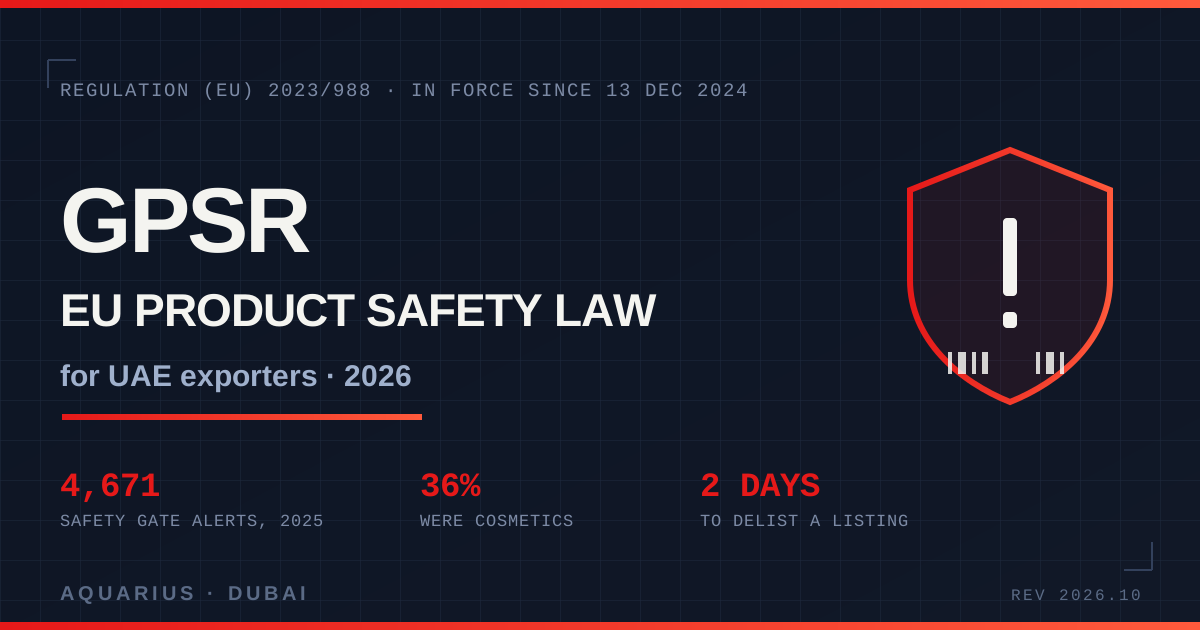
The EU General Product Safety Regulation — Regulation (EU) 2023/988, or GPSR — has applied since 13 December 2024. If you ship any consumer product from the UAE into the EU, you need a named EU Responsible Person, Article 19 traceability data printed on the product and repeated on every online listing, and a technical file you can produce on demand. Miss any of it and customs holds the shipment, or a marketplace deletes the listing within two working days. The grace period did not get extended; it expired almost two years ago.
The enforcement wave is already measurable
This is not a regulation waiting to be enforced. The European Commission’s Safety Gate 2025 report, published in March 2026, logged 4,671 alerts — a record, up 13% on 2024 and running at roughly 90 dangerous products a week. Those alerts triggered 5,794 follow-up actions by national authorities, a 35% jump in enforcement activity year on year. The pace has not slowed in 2026: 3,090 alerts had already been published by October.
Now look at what gets flagged. Cosmetics were 36% of all 2025 alerts, followed by toys at 16% and electrical appliances at 11%. More than half of all alerts — 53% — were for chemical risk, ahead of injuries (14%) and choking hazards (9%).
That top category is a direct collision with one of the UAE’s signature export lines. The Emirates exported roughly USD 682 million of perfumes in 2025, about USD 2.1 billion counting perfumes and cosmetics together, and now sits inside the world’s top ten exporters of finished fragrance. The EU accounts for 8.3% of UAE non-oil trade — roughly USD 67.6 billion — against a non-oil trade total of AED 1.937 trillion in H1 2026 (up 13.1%), with national non-oil exports at AED 452.8 billion, up 23.9%. The fastest-growing part of the UAE export book is pointed straight at the most-policed product category in Europe.
Most Dubai exporters get this wrong: the “4% of turnover” fine does not exist
Search for GPSR penalties and you will be told that fines reach 4% of annual turnover, and that accidents must be reported within two working days. Both numbers are wrong, and both come from the same place: the 2021 draft, COM(2021) 346. Neither survived into the adopted regulation. The word “turnover” was removed from the penalties article entirely.
Article 44 of the adopted GPSR leaves penalties to each member state, requiring only that they be “effective, proportionate and dissuasive”. There is no EU-wide percentage. The two-working-day clock is real, but it belongs to Article 22 — it is how fast a marketplace must act on an authority’s takedown order, not how fast you report an accident.
Why this matters commercially: people who quote the fake 4% figure tend to treat GPSR as a far-off legal risk to be insured against. The actual risk is faster and duller. An Article 19 field missing from a product page gets the listing suppressed, and in 27 different national regimes the real fines have now landed.
What GPSR actually requires from a UAE manufacturer
GPSR covers every consumer product placed on the EU market unless something more specific already covers it. The carve-outs are narrow: medicines, food, feed, live plants and animals, and antiques. Everything else — abayas, oud, dates in gift packaging, phone accessories, furniture, toys, small appliances — is in scope.
1. An EU Responsible Person (Article 16)
No product may be sold in the EU unless an economic operator established in the Union is responsible for it. A UAE company with no EU entity cannot be its own Responsible Person. The RP holds the declaration of conformity and technical documentation, verifies that labelling and instructions are in place, cooperates with authorities, and — under Article 16 — must carry out regular checks with documented evidence. A mailbox address is not compliance.
2. Traceability on the product (Article 19)
The product or its packaging must carry the manufacturer’s name, registered trade name or trademark, a postal and an electronic address, plus a type, batch, serial or model number. If the manufacturer is outside the EU, the Responsible Person’s details go on too. This is the field most often missing from UAE-origin goods, because GCC and Gulf conformity labelling never asked for an EU electronic contact address.
3. The online listing rules (Article 19(b)) — the one that kills revenue
Before a consumer buys, the offer itself must display the manufacturer’s name and addresses, the Responsible Person’s name and addresses, product identification including a picture, and any warning or safety information — in a language consumers in that specific country easily understand. Not a PDF, not “available on request”. On the page. In the local language. For every country you list in.
4. A technical file and a real risk analysis (Article 9)
Manufacturers must perform an internal risk analysis covering all risks, at any severity, and hold technical documentation per model. It must be kept current for ten years after the product is placed on the market. Article 9(4) adds procedures for keeping series production conformant. Article 9(11) and 9(12) require a public complaints channel and an internal register of complaints, recalls and corrective actions.
5. Accidents and recalls (Articles 20, 35, 37)
An accident caused by your product must be notified through the Commission’s Safety Business Gateway “without undue delay”. In a recall, Article 35 requires you to notify affected consumers directly where you can identify them, and publish a recall notice where you cannot. Article 37 then prescribes what the notice must say and what remedies are offered — including two contact methods and a remedy at no significant cost to the consumer.
6. What marketplaces must do to you (Article 22)
Online marketplaces must register a single contact point in the Safety Gate Portal, and act on an authority’s removal order within two working days. By the end of 2025, more than 1,200 marketplaces had registered. That is 1,200 platforms with a standing legal duty to delete your listing quickly, and no commercial incentive to argue on your behalf.
What it costs — and what non-compliance costs
An EU Responsible Person service typically runs EUR 150 to 500 per year (AED 621 to 2,070). Pricing scales by SKU count, category and risk class rather than your revenue: entry plans start around EUR 150/year for unlimited SKUs at the low-risk end, while category-specific plans for electronics, toys and cosmetics run from roughly EUR 199/year for a single product type to about EUR 1,790/year (AED 7,410) for sixteen. Full-service enterprise arrangements with testing coordination reach four figures a month. Against that, here is what the member states have actually legislated.
| Jurisdiction / cost line | EUR | AED (at 4.14) | Note |
|---|---|---|---|
| EU Responsible Person, annual service | 150 – 500 | 621 – 2,070 | Typical, low-risk categories |
| RP for 16 product types, annual | 1,790 | 7,410 | Category-priced plans |
| Germany — most GPSR offences, § 28 ProdSG | up to 10,000 | up to 41,400 | 32 new offences, in force 19 Feb 2026 |
| Germany — no corrective measures (Art 9(8)(a)) | up to 100,000 | up to 414,000 | Highest tier in the German schedule |
| Ireland — summary conviction | up to 5,000 | up to 20,700 | Class A fine, or 6 months |
| Ireland — conviction on indictment | up to 500,000 | up to 2,070,000 | Or up to 2 years |
| Netherlands — fixed penalty per violation | 525 or 1,050 | 2,174 or 4,347 | Rate set by company size |
| Netherlands — turnover-based cap | up to 1,100,000 | up to 4,553,000 | Applied to larger operators |
Germany is the one to watch, because it moved most recently: an amending act to the ProdSG was passed on 3 February 2026 and entered into force on 19 February 2026, adding 32 GPSR offences to the national penalty schedule. The pattern across member states is the same — a small annual compliance cost against a per-violation fine two to three orders of magnitude larger, multiplied by the number of SKUs you list.
Amazon already decided this for you
Whatever your view of the legal risk, the marketplaces removed the choice. Amazon surfaces GPSR data in a “Compliance Information” section on the product detail page in every EU store, and requires manufacturer details, Responsible Person details and safety or warning notices per ASIN. Missing data draws aggressive suppression and deactivation, and repeat failures put selling privileges at risk. Toy listings have been enforced since early 2025, and since Q2 2026 new ASIN creation requires the compliance data upfront — you cannot list first and fix it later.
Which reframes the whole problem. GPSR is not a legal filing you do once. It is a set of product-data fields that must be present, per SKU, per language, per channel, and must stay accurate for ten years. That is a content and systems problem, which is the half most UAE exporters have not built.
How Aquarius builds the digital half
We are a web and software studio in Dubai, not a compliance consultancy — your Responsible Person, product testing and legal interpretation come from a specialist provider. What we build is the machinery that makes the data correct and keeps it correct:
- Product-safety data model — the Article 19 fields as first-class per-SKU attributes in your PIM or CMS, validated so an incomplete product cannot publish.
- Multilingual safety blocks — warnings and instructions rendered from structured fields into each market’s language, not pasted per page, so adding a country is a data task.
- Marketplace feed mapping — your fields mapped to Amazon, eBay and Allegro compliance attributes, so a corrected value propagates instead of being retyped in Seller Central.
- Technical documentation repository — risk analyses and test reports versioned per model with ten-year retention and a clean export for authorities.
- Complaints register and public channel — the Article 9(11) and 9(12) obligations as a working form plus an internal log, not an inbox.
- Accident and recall workflow — a Safety Business Gateway submission path, and an Article 35 recall notice generator keyed to your order database so affected buyers can actually be identified.
| Scope | AED | Typical timeline |
|---|---|---|
| Product-safety data layer and per-SKU field validation | 35,000 – 85,000 | 3 – 5 weeks |
| Multilingual safety block rendering pipeline | 25,000 – 65,000 | 2 – 4 weeks |
| Marketplace compliance feed mapping | 20,000 – 55,000 | 2 – 4 weeks |
| Technical documentation and risk-analysis repository | 30,000 – 75,000 | 3 – 6 weeks |
| Complaints register, contact channel, accident workflow | 18,000 – 45,000 | 2 – 3 weeks |
| Recall notice generator with order-data matching | 22,000 – 60,000 | 2 – 4 weeks |
| Full compliance layer, end to end | 120,000 – 280,000 | 8 – 14 weeks |
| Ongoing monitoring and data care | 3,000 – 9,000 / month | — |
Ranges exclude 5% UAE VAT where we invoice through a local entity. See pricing for how we scope, or services for the full build list. The arithmetic is not subtle: the low band of a full compliance layer costs less than one Dutch turnover-capped penalty, and far less than losing an Amazon EU account in a quarter when UAE non-oil exports grew 23.9%.
If you are already dealing with EU packaging rules under PPWR or preparing for the Digital Product Passport, build one product-data spine rather than three. The fields overlap heavily, and so does the ten-year retention duty.
Frequently asked questions
Does GPSR apply to a UAE company with no EU office?
Yes, the moment your product is placed on the EU market — including by a customer ordering from your website. With no EU establishment you must appoint an EU Responsible Person under Article 16; without one, the product may not legally be sold.
Can my EU distributor act as my Responsible Person?
An importer or fulfilment service provider established in the EU can take the role, and often does. Confirm it in writing, name them in your Article 19 markings, and check they will actually run the documented Article 16 checks — the duty is theirs once they accept it, but the commercial exposure stays yours.
What is the real penalty if I ignore GPSR?
There is no single EU figure. Penalties are national: up to EUR 10,000 (AED 41,400) for most German offences and EUR 100,000 (AED 414,000) for failing to take corrective measures, up to EUR 500,000 (AED 2.07m) on indictment in Ireland, and a turnover-based Dutch cap of EUR 1.1m (AED 4.55m). The faster consequence is customs refusal and marketplace delisting.
Do I need the safety information translated into all EU languages?
Only for the countries you sell into. Article 19(b) requires warnings and safety information in a language that consumers in that specific member state easily understand, so the list grows with your market list, not with the size of the EU.
Is a GCC conformity or ESMA mark enough?
No. Gulf conformity schemes do not satisfy GPSR’s traceability, Responsible Person, documentation or online-offer duties. They can feed your technical file as supporting evidence, but they are not a substitute for it.
The short version
GPSR has been in force since 13 December 2024, Safety Gate alerts hit a record 4,671 in 2025 with cosmetics at 36% of them, and the fine you have probably read about — 4% of turnover — is from a draft that was never adopted. The real cost of getting this wrong is a suppressed listing, a stopped container, and a national fine between AED 41,400 and AED 4.55 million depending on where you got caught. The real cost of getting it right is an EU Responsible Person for a few thousand dirhams a year, plus a product-data layer that makes every listing correct automatically.
If your catalogue ships to Europe and your Article 19 fields live in a spreadsheet, that is the gap. Talk to Aquarius and we will audit your product data against GPSR, SKU by SKU, before a marketplace does it for you.